Thank you for visiting SNEWPapers!
Sign up free
The Virginia Gazette
Richmond, Williamsburg, Richmond County, Virginia
What is this article about?
In a letter to the public dated April 15, 1769, from Williamsburg, Lewis Hansford defends himself against accusations by Joseph Calvert, a sergeant, claiming Calvert's pursuit and arrest were driven by malice and oppression rather than legal duty. He details refused bail and tenders, a mayor's supersedeas, and an ongoing lawsuit in the General Court.
Clipping
OCR Quality
Full Text
WILLIAMSBURG, April 15, 1769.
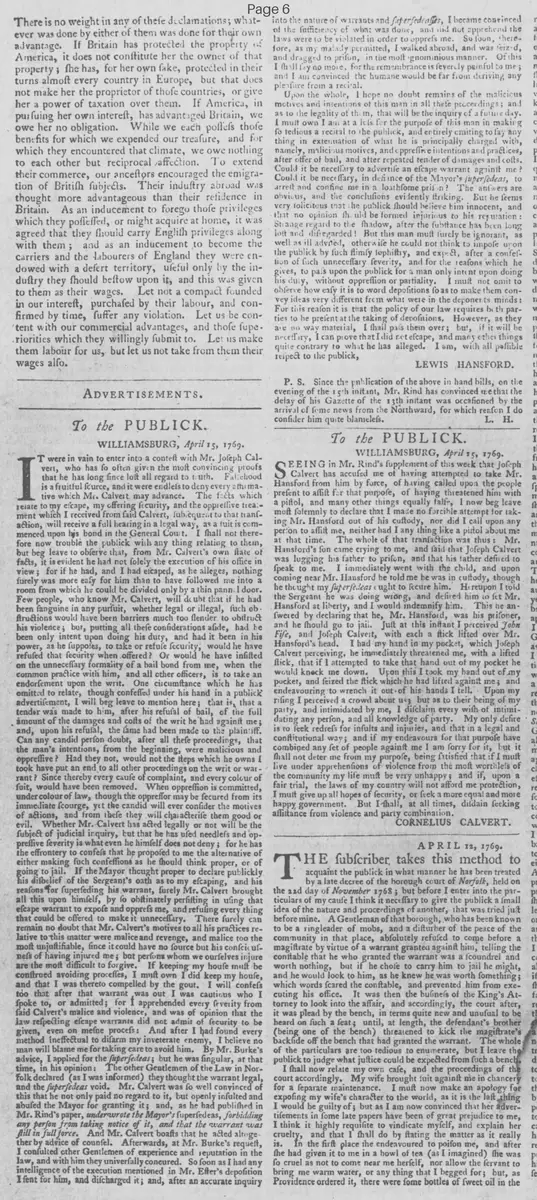
It were in vain to enter into a contest with Mr. Joseph Calvert, who has so often given the most convincing proofs that he has long since lost all regard to truth. Falsehood is a fruitful source, and it were endless to deny every assertion which Mr. Calvert may advance. The facts which relate to my escape, my offering security, and the oppressive treatment which I received from said Calvert, subsequent to that transaction, will receive a full hearing in a legal way, as a suit is commenced upon his bond in the General Court. I shall not therefore now trouble the publick with any thing relating to them, but beg leave to observe that, from Mr. Calvert's own state of facts, it is evident he had not solely the execution of his office in view; for if he had, and I had escaped, as he alleges, nothing surely was more easy for him than to have followed me into a room from which he could be divided only by a thin panel door. Few people, who know Mr. Calvert, will doubt that if he had been sanguine in any pursuit, whether legal or illegal, such obstructions would have been barriers much too slender to obstruct his violence; but, putting all these considerations aside, had he been only intent upon doing his duty, and had it been in his power, as he supposes, to take or refuse security, would he have refused that security when offered? Or would he have insisted on the unnecessary formality of a bail bond from me, when the common practice with him, and all other officers, is to take an endorsement upon the writ. One circumstance which he has omitted to relate, though confessed under his hand in a publick advertisement, I will beg leave to mention here; that is, that a tender was made to him, after his refusal of bail, of the full amount of the damages and costs of the writ he had against me; and, upon his refusal, the same had been made to the plaintiff. Can any candid person doubt, after all these proceedings, that the man's intentions, from the beginning, were malicious and oppressive? Had they not, would not the steps which he owns I took have put an end to all other proceedings on the writ or warrant? Since thereby every cause of complaint, and every colour of suit, would have been removed. When oppression is committed, under colour of law, though the oppressor may be secured from its immediate course, yet the candid will ever consider the motives of actions, and from these they will characterize them good or evil. Whether Mr. Calvert has acted legally or not will be the subject of judicial inquiry, but that he has used needless and oppressive severity is what even he himself does not deny; for he has the effrontery to confess that he proposed to me the alternative of either making such confessions as he should think proper, or of going to jail. If the Mayor thought proper to declare publickly his disbelief of the Sergeant's oath as to my escaping, and his reasons for superseding his warrant, surely Mr. Calvert brought all this upon himself, by so obstinately persisting in using that escape warrant to expose and oppress me, and refusing every thing that could be offered to make it unnecessary. There surely can remain no doubt that Mr. Calvert's motives to all his practices relative to this matter were malice and revenge, and malice too the most unjustifiable, since it could have no source but his consciousness of having injured me; but persons whom we ourselves injure are the most difficult to forgive. If keeping my house must be construed avoiding process, I must own I did keep my house, and that I was thereto compelled by the gout. I will confess too that after that warrant was out I was cautious who I spoke to, or admitted; for I apprehended every severity from said Calvert's malice and violence, and was of opinion that the law respecting escape warrants did not admit of security to be given, even on mere process: And after I had found every method ineffectual to disarm my inveterate enemy, I believe no man will blame me for taking care to avoid him. By Mr. Burke's advice, I applied for the supersedeas; but he was singular, at that time, in his opinion: The other Gentlemen of the Law in Norfolk declared (as I was informed) they thought the warrant legal, and the supersedeas void. Mr. Calvert was so well convinced of this that he not only paid no regard to it, but openly insulted and abused the Mayor for granting it; and, as he had published in Mr. Rind's paper, underwrote the Mayor's supersedeas, forbidding any person from taking notice of it, and that the warrant was still in full force. And Mr. Calvert boasts that he acted altogether by advice of counsel. Afterwards, at Mr. Burke's request, I consulted other Gentlemen of experience and reputation in the Law, and with him they universally concurred. So soon as I had any intelligence of the execution mentioned in Mr. Easter's deposition I sent for him, and discharged it; and, after an accurate inquiry into the nature of warrants and supersedeases, I became convinced of the sufficiency of what was done, and did not apprehend the laws were to be violated in order to oppress me. So soon, therefore, as my malady permitted, I walked abroad, and was seized, and dragged to prison, in the most ignominious manner. Of this I shall say no more. for the remembrance is severely painful to me; and I am convinced the humane would be far from deriving any pleasure from a recital. Upon the whole, I hope no doubt remains of the malicious motives and intentions of this man in all these proceedings; and as to the legality of them, that will be the inquiry of a future day. I must own I am at a loss for the purpose of this man in making so tedious a recital to the publick, and entirely omitting to say any thing in extenuation of what he is principally charged with, namely, malicious motives, and oppressive intentions and practices, after offer of bail, and after repeated tender of damages and costs. Could it be necessary to advertise an escape warrant against me? Could it be necessary, in defiance of the Mayor's supersedeas, to arrest and confine me in a loathsome prison? The answers are obvious, and the conclusions evidently striking. But he seems very solicitous that the publick should believe him innocent, and that no opinion should be formed injurious to his reputation: Strange regard to the shadow, after the substance has been long lost and disregarded! But this man must surely be ignorant, as well as ill advised, otherwise he could not think to impose upon the publick by such flimsy sophistry, and excuse, after a confession of such unnecessary severity, and for the reasons which he gives, to pass upon the publick for a man only intent upon doing his duty, without oppression or partiality. I must not omit to observe how easy it is to word depositions so as to make them convey ideas very different from what were in the deponent's minds: For this reason it is that the policy of our law requires both parties to be present at the taking of depositions. However, as they are no way material, I shall pass them over; but, if it will be necessary, I can prove that I did not escape, and many other things quite contrary to what he has alleged. I am, with all possible respect to the publick,
LEWIS HANSFORD.
P. S. Since the publication of the above in hand bills, on the evening of the 15th instant, Mr. Rind has convinced me that the delay of his Gazette of the 13th instant was occasioned by the arrival of some news from the Northward, for which reason I do consider him quite blameless.
L. H.
What sub-type of article is it?
What themes does it cover?
What keywords are associated?
What entities or persons were involved?
Letter to Editor Details
Author
Lewis Hansford
Recipient
To The Publick
Main Argument
joseph calvert's actions in pursuing and arresting hansford were motivated by malice and oppression rather than legal duty, as evidenced by refusals of bail and tenders, defiance of a supersedeas, and insistence on unnecessary severity; the truth will be determined in court.
Notable Details