Thank you for visiting SNEWPapers!
Sign up free
Virginia Argus
Richmond, Virginia
What is this article about?
Historical account of early Virginia settlement where, to prevent colonists' return to England, Sir Edwin Sandys advised sending young women in 1620 and 1621, exchanged by planters for tobacco at prices of 120-150 pounds per wife, despite King James's limits on tobacco production.
Clipping
OCR Quality
Full Text
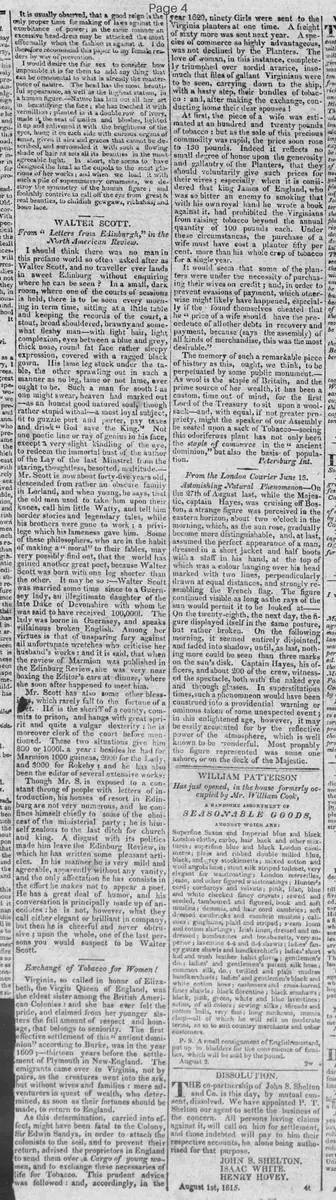
Virginia, so called in honor of Elizabeth, the Virgin Queen of England, was the eldest sister among the British American Colonies: and she has ever felt the pride, and claimed from her younger sisters the full amount of respect and homage, that belongs to seniority. The first effective settlement of this "ancient dominion" according to Burke, was in the year 1609;--thirteen years before the settlement of Plymouth in New-England. The emigrants came over to Virginia, not by pairs, as the creatures went into the ark, but without wives and families: mere adventurers in quest of wealth, who determined, as soon as their fortunes should be made, to return to England.
As this determination, carried into effect, might have been fatal to the Colony, Sir Edwin Sandys, in order to attach the colonists to the soil, and to prevent their return, advised the proprietors in England to send them over a Cargo of young women, and to exchange these necessaries of life for Tobacco. This prudent advice was followed: and, accordingly, in the year 1620, ninety Girls were sent to the Virginia planters at one time. A freight of sixty more was sent next year. A species of commerce so highly advantageous, was not declined by the Planters. The love of woman, in this instance, completely triumphed over sordid avarice, insomuch that files of gallant Virginians were to be seen, carrying down to the ship, with a hasty step, their bundles of tobacco: and, after making the exchange, conducting home their dear spouses!
At first, the price of a wife was estimated at an hundred and twenty pounds of tobacco; but as the sale of this precious commodity was rapid, the price soon rose to 150 pounds. Indeed it reflects no small degree of honor upon the generosity and gallantry of the Planters, that they should voluntarily give such prices for their wives; especially when it is considered that king James of England, who was so bitter an enemy to smoking that with his own royal hand he wrote a book against it, had prohibited the Virginians from raising tobacco beyond the annual quantity of 100 pounds each. Under these circumstances, the purchase of a wife must have cost a planter fifty per cent. more than his whole crop of tobacco for a single year.
It would seem that some of the planters were under the necessity of purchasing their wives on credit; and, in order to prevent evasions of payment, which otherwise might likely have happened, especially if they found themselves cheated, that the price of a wife should have the precedence of all other debts in recovery and payment, because (says the assembly) of all kinds of merchandise, this was the most desirable.
The memory of such a remarkable piece of history as this, ought, we think, to be perpetuated by some public monument.--As wool is the staple of Britain, and the prime source of her wealth, it has been a custom, time out of mind, for the first Lord of the Treasury to sit upon a wool-sack--and, with equal, if not greater propriety, might the speaker of our Assembly be seated upon a sack of Tobacco--seeing this odoriferous plant has not only been the staple of commerce in the "ancient dominion," but also the basis of population.
Petersburg Int.
What sub-type of article is it?
What keywords are associated?
What entities or persons were involved?
Where did it happen?
Domestic News Details
Primary Location
Virginia
Event Date
1609, 1620, 1621
Key Persons
Outcome
planters exchanged 120-150 pounds of tobacco per wife; some purchases on credit with wife price prioritized over other debts; contributed to colony population growth.
Event Details
Early Virginia settlers, arriving without families in 1609, planned to return to England after gaining wealth. To retain them, Sir Edwin Sandys advised sending young women from England to be exchanged for tobacco: 90 girls in 1620 and 60 in 1621. Planters eagerly traded tobacco for wives despite King James's limit of 100 pounds per year.