Thank you for visiting SNEWPapers!
Sign up free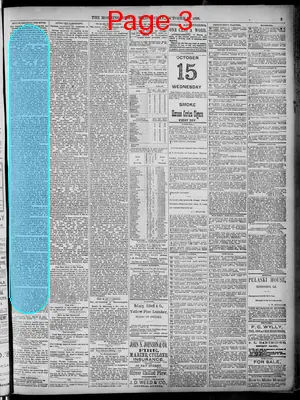
The Morning News
Savannah, Chatham County, Georgia
What is this article about?
A new section in the U.S. river and harbor bill prohibits dumping waste into navigable waters to prevent impeding navigation, with penalties up to $5,000 fine or one year imprisonment. It allocates $965,000 to Georgia and affects Savannah's wharves and industries. Lieut. O. M. Carter discusses its benefits for the Savannah River.
Clipping

OCR Quality
Full Text
Government documents do not, as a rule, contain that light, frothy and effervescent literature that is usually found between the sanguinary covers of the latest 50-cent novel. At the same time, they are full of large-sized blocks of information that is of interest and general moment to a large number of people.
A MORNING News reporter, wending his devious and intricate way through the sloughs, rivers, dams and bayous of the river and harbor bill yesterday, and incidentally learning the weird and curious nomenclature that governs the rivers of this country, came across a section that can not but prove of interest to wharf-owners, lighterage and tow-boat companies, and manufacturing companies of all kinds that border the Savannah and other rivers.
The bill itself gives $965,000 to the state of Georgia, exclusive of the money to be expended in preliminary examinations and surveys.
The aggregate for this state is away above the average.
The section referred to above is as follows:
That it shall not be lawful to cast, throw, empty, unload, or cause or suffer to be cast, thrown, emptied or unloaded, either from out any ship, vessel, lighter, boat or other craft, or from the shore, pier, wharf, furnace, manufacturing establishments or mills of any kind whatever, any ballast, slabs, edgings, sawdust, slag, cinders, ashes, slate, stone, gravel, earth, rubbish, wreck, filth, refuse or other waste of any kind into any port, road, roadstead, harbor, haven, navigable river or navigable waters of the United States which shall tend to obstruct or impede navigation, or to deposit or place or cause, suffer, or procure to be deposited or placed, any ballast, stone, slate, gravel, earth, rubbish, wreck, filth, slabs, edgings, sawdust, or other place or situation on the bank of any navigable waters where the same will be liable to be washed into such navigable waters, either by ordinary or high tides or by storms or floods, or otherwise, whereby navigation shall or may be impeded or obstructed.
Lieut. O. M. Carter, corps of engineers, was seen and was asked what effect the enforcement of the law would have and whether the state of affairs this section is designed to suppress exists here to any great extent. The lieutenant was, as has been the case every time a Morning News reporter has called during the last few weeks, surrounded by a mass of charts and tracings bearing upon the different works in his district, and upon which active work will soon be begun. After reading the section in question he was asked what led up to its enactment and whether he expected the enforcement of it would have a beneficial effect upon the river. He replied:
"For some years past the navigable waters of this country have suffered from the unauthorized deposition therein of ballast, sawdust, slabs; in fact, all sorts of material have been thrown into streams and other bodies of water as a convenient way of getting rid of it. This nuisance became so great and the conditions it created so dangerous to safe navigation of once easily navigable rivers that effective measures were found necessary to be taken to save many bodies of water from deteriorating. The enforcement of this section cannot fail to have other than a beneficial effect upon the Savannah and all other rivers in this district. You will notice also that the penalty for a violation of the section that you brought to my attention is contained in section 10 of the same act, and is severe enough to deter any person from doing any of those things prohibited by section 6."
The penalty for a violation of the section quoted above is a fine not exceeding $5,000, or imprisonment not exceeding one year, or both, at the discretion of the court. Previous to this there was no general law making it a crime punishable by a penalty for any person to use the river as a dumping ground, but now things have changed, and those eccentric captains who unload sand ballast, under cover of night, in the river, where it is liable to find its way into the navigable channel, are liable to find themselves arraigned in the United States court some fine morning.
The city of Savannah is liable to be indicted if it does not repair its bulkheads, to keep sand from being washed into the river after heavy rain storms. Sand has, in the past, been washed into the river, and it is likely to happen again.
So mindful were the early settlers of this state of their harbors that they passed acts prescribing penalties for throwing ballast, etc., into the navigable streams of the colony of Georgia, but in many cases of local legislation these acts were rendered almost wholly inoperative from the fact that the offenders were never brought to trial, men seldom caring to report their neighbors for violating the provisions of such acts.
I have seen it stated that the gas house discharge pipe empties into the Savannah river and that the shoaling at Garden Bank is partly, if not wholly, due to that cause, and should there be a continuance of this discharge into the river will it be a violation of the section that has been discussed and will it render the company liable to a fine of $5,000?"
"Any unauthorized deposition of material within the navigable waters of the United States is proscribed," replied Lieut. Carter.
Section 12 of this same bill is of interest to all those contemplating building new wharves or extending old ones. The harbor lines, as established by a board of engineers' officers composed of Col. Wm. P. Craighill, Capt. Wm. H. Bixby and Lieut. O. M. Carter, corps of engineers, must be conformed to. No structure will be allowed to project further than those lines and the city authorities have no jurisdiction in the matter. A tracing showing the lines is in possession of the city now, and it is not likely that any person contemplating building and desirous of adhering to the lines will have any difficulty in finding out what they are. The section is given in full.
Where it is made manifest to the Secretary of War that the establishment of harbor lines is essential to the preservation and protection of harbors, he may, and is hereby authorized, to cause such lines to be established, beyond which no piers, wharves, bulkheads or other works shall be extended or deposits made, except under such regulations as may be prescribed from time to time by him; and any person who shall wilfully violate the provisions of this section, or any rule or regulation made by the Secretary of War in pursuance of this section, shall upon conviction thereof be deemed guilty of a misdemeanor, and be punished by a fine not exceeding $5,000, or by imprisonment not exceeding one year, at the discretion of the court for each offense.
What sub-type of article is it?
What themes does it cover?
What keywords are associated?
What entities or persons were involved?
Where did it happen?
Story Details
Key Persons
Location
Savannah, Georgia; Savannah River
Story Details
Congress passes a river and harbor bill prohibiting dumping of waste into navigable waters to prevent obstruction of navigation, with severe penalties. The law addresses past issues like unauthorized ballast and sawdust disposal, benefiting the Savannah River. Additional section establishes harbor lines for wharf construction.