Thank you for visiting SNEWPapers!
Sign up free
Literary
November 23, 1840
Vermont Watchman And State Journal
Montpelier, Washington County, Vermont
What is this article about?
Washington Irving retells a Seminole tradition where the Great Spirit creates black, red, and white men, assigning them tools, weapons, and books respectively. The Seminoles decline U.S. Governor Duval's offer of schools, arguing literacy enables whites to deceive and seize Indian lands, as happened with Creeks and Cherokees.
Clipping
OCR Quality
98%
Excellent
Full Text
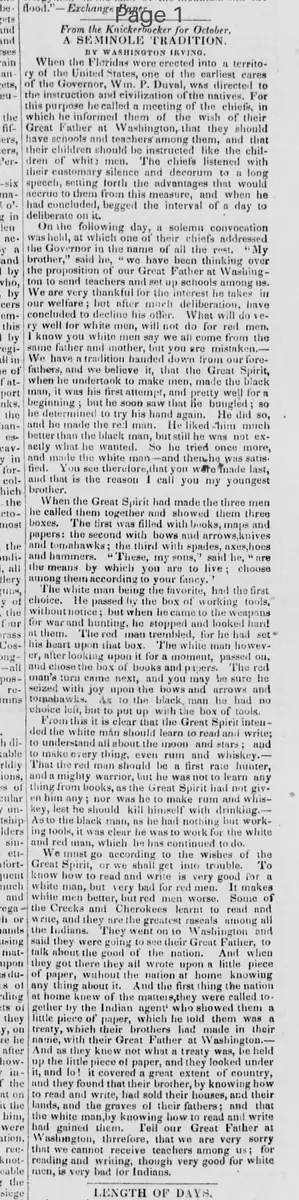
From the Knickerbocker for October.
A SEMINOLE TRADITION.
BY WASHINGTON IRVING.
When the Floridas were erected into a territory of the United States, one of the earliest cares of the Governor, Wm. P. Duval, was directed to the instruction and civilization of the natives. For this purpose he called a meeting of the chiefs, in which he informed them of the wish of their Great Father at Washington, that they should have schools and teachers among them, and that their children should be instructed like the children of white men. The chiefs listened with their customary silence and decorum to a long speech, setting forth the advantages that would accrue to them from this measure, and when he had concluded, begged the interval of a day to deliberate on it.
On the following day, a solemn convocation was held, at which one of their chiefs addressed the Governor in the name of all the rest. "My brother," said he, "we have been thinking over the proposition of our Great Father at Washington to send teachers and set up schools among us. We are very thankful for the interest he takes in our welfare; but after much deliberation, have concluded to decline his offer. What will do very well for white men, will not do for red men. I know you white men say we all come from the same father and mother, but you are mistaken.—We have a tradition handed down from our forefathers, and we believe it, that the Great Spirit, when he undertook to make men, made the black man, it was his first attempt, and pretty well for a beginning; but he soon saw that he bungled; so he determined to try his hand again. He did so, and he made the red man. He liked him very much better than the black man, but still he was not exactly what he wanted. So he tried once more, and made the white man—and then he was satisfied. You see therefore, that you were made last, and that is the reason I call you my youngest brother.
When the Great Spirit had made the three men he called them together and showed them three boxes. The first was filled with books, maps and papers: the second with bows and arrows, knives and tomahawks; the third with spades, axes, hoes and hammers. "These, my sons," said he, "are the means by which you are to live; choose among them according to your fancy.
The white man being the favorite, had the first choice. He passed by the box of working tools, without notice; but when he came to the weapons for war and hunting, he stopped and looked hard at them. The red man trembled, for he had set his heart upon that box. 'The white man however, after looking upon it for a moment, passed on, and chose the box of books and papers.' 'The red man's turn came next, and you may be sure he seized with joy upon the bows and arrows and tomahawks. As to the black man he had no choice left, but to put up with the box of tools.
From this it is clear that the Great Spirit intended the white man should learn to read and write; to understand all about the moon and stars; and to make every thing, even rum and whiskey.—That the red man should be a first rate hunter, and a mighty warrior, but he was not to learn any thing from books, as the Great Spirit had not given him any; nor was he to make rum and whiskey, lest he should kill himself with drinking.—As to the black man, as he had nothing but working tools, it was clear he was to work for the white and red man, which he has continued to do.
We must go according to the wishes of the Great Spirit, or we shall get into trouble. To know how to read and write is very good for a white man, but very bad for red men. It makes white men better, but red men worse. Some of the Creeks and Cherokees learnt to read and write, and they are the greatest rascals among all the Indians. They went on to Washington and said they were going to see their Great Father, to talk about the good of the nation. And when they got there they all wrote upon a little piece of paper, without the nation at home knowing any thing about it. And the first thing the nation at home knew of the matters, they were called together by the Indian agent' who showed them a little piece of paper, which he told them was a treaty, which their brothers had made in their name, with their Great Father at Washington.—And as they knew not what a treaty was, he held up the little piece of paper, and they looked under it, and lo! it covered a great extent of country, and they found that their brother, by knowing how to read and write, had sold their houses, and their lands, and the graves of their fathers; and that the white man, by knowing how to read and write had gained them. Tell our Great Father at Washington, therefore, that we are very sorry that we cannot receive teachers among us; for reading and writing, though very good for white men, is very bad for Indians."
A SEMINOLE TRADITION.
BY WASHINGTON IRVING.
When the Floridas were erected into a territory of the United States, one of the earliest cares of the Governor, Wm. P. Duval, was directed to the instruction and civilization of the natives. For this purpose he called a meeting of the chiefs, in which he informed them of the wish of their Great Father at Washington, that they should have schools and teachers among them, and that their children should be instructed like the children of white men. The chiefs listened with their customary silence and decorum to a long speech, setting forth the advantages that would accrue to them from this measure, and when he had concluded, begged the interval of a day to deliberate on it.
On the following day, a solemn convocation was held, at which one of their chiefs addressed the Governor in the name of all the rest. "My brother," said he, "we have been thinking over the proposition of our Great Father at Washington to send teachers and set up schools among us. We are very thankful for the interest he takes in our welfare; but after much deliberation, have concluded to decline his offer. What will do very well for white men, will not do for red men. I know you white men say we all come from the same father and mother, but you are mistaken.—We have a tradition handed down from our forefathers, and we believe it, that the Great Spirit, when he undertook to make men, made the black man, it was his first attempt, and pretty well for a beginning; but he soon saw that he bungled; so he determined to try his hand again. He did so, and he made the red man. He liked him very much better than the black man, but still he was not exactly what he wanted. So he tried once more, and made the white man—and then he was satisfied. You see therefore, that you were made last, and that is the reason I call you my youngest brother.
When the Great Spirit had made the three men he called them together and showed them three boxes. The first was filled with books, maps and papers: the second with bows and arrows, knives and tomahawks; the third with spades, axes, hoes and hammers. "These, my sons," said he, "are the means by which you are to live; choose among them according to your fancy.
The white man being the favorite, had the first choice. He passed by the box of working tools, without notice; but when he came to the weapons for war and hunting, he stopped and looked hard at them. The red man trembled, for he had set his heart upon that box. 'The white man however, after looking upon it for a moment, passed on, and chose the box of books and papers.' 'The red man's turn came next, and you may be sure he seized with joy upon the bows and arrows and tomahawks. As to the black man he had no choice left, but to put up with the box of tools.
From this it is clear that the Great Spirit intended the white man should learn to read and write; to understand all about the moon and stars; and to make every thing, even rum and whiskey.—That the red man should be a first rate hunter, and a mighty warrior, but he was not to learn any thing from books, as the Great Spirit had not given him any; nor was he to make rum and whiskey, lest he should kill himself with drinking.—As to the black man, as he had nothing but working tools, it was clear he was to work for the white and red man, which he has continued to do.
We must go according to the wishes of the Great Spirit, or we shall get into trouble. To know how to read and write is very good for a white man, but very bad for red men. It makes white men better, but red men worse. Some of the Creeks and Cherokees learnt to read and write, and they are the greatest rascals among all the Indians. They went on to Washington and said they were going to see their Great Father, to talk about the good of the nation. And when they got there they all wrote upon a little piece of paper, without the nation at home knowing any thing about it. And the first thing the nation at home knew of the matters, they were called together by the Indian agent' who showed them a little piece of paper, which he told them was a treaty, which their brothers had made in their name, with their Great Father at Washington.—And as they knew not what a treaty was, he held up the little piece of paper, and they looked under it, and lo! it covered a great extent of country, and they found that their brother, by knowing how to read and write, had sold their houses, and their lands, and the graves of their fathers; and that the white man, by knowing how to read and write had gained them. Tell our Great Father at Washington, therefore, that we are very sorry that we cannot receive teachers among us; for reading and writing, though very good for white men, is very bad for Indians."
What sub-type of article is it?
Prose Fiction
Fable
Satire
What themes does it cover?
Political
Moral Virtue
Social Manners
What keywords are associated?
Seminole Tradition
Washington Irving
Great Spirit
Racial Origins
Native Education
Indian Treaties
Land Loss
What entities or persons were involved?
By Washington Irving
Literary Details
Title
A Seminole Tradition
Author
By Washington Irving
Subject
Seminole Chiefs' Response To Governor Duval's Proposal For Schools
Key Lines
"What Will Do Very Well For White Men, Will Not Do For Red Men."
"The Great Spirit, When He Undertook To Make Men, Made The Black Man, It Was His First Attempt, And Pretty Well For A Beginning; But He Soon Saw That He Bungled; So He Determined To Try His Hand Again."
"The White Man Being The Favorite, Had The First Choice... And Chose The Box Of Books And Papers."
"To Know How To Read And Write Is Very Good For A White Man, But Very Bad For Red Men. It Makes White Men Better, But Red Men Worse."
"Reading And Writing, Though Very Good For White Men, Is Very Bad For Indians."