Thank you for visiting SNEWPapers!
Sign up free
Literary
November 14, 1789
The Kentucky Gazette
Lexington, Fayette County, Kentucky
What is this article about?
Essays from 'The Tablet' (Nos. XXXIII and XXXIV) discuss the dangers of excessive prohibitions or indulgences in child education, arguing that overly strict or lax approaches lead to rebellion and moral confusion, advocating balance to foster virtue and parental affection.
Clipping
OCR Quality
92%
Excellent
Full Text
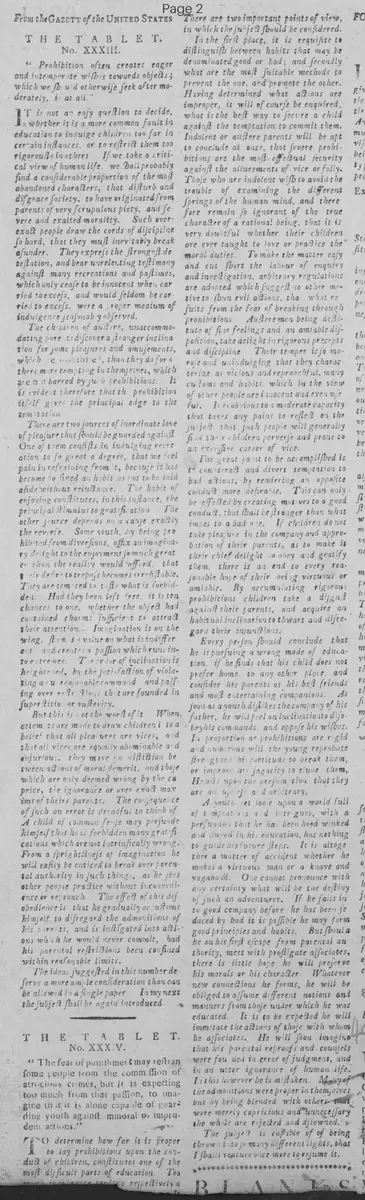
From the Gazette of the United States
THE TABLET.
No. XXXIII.
"Prohibition often creates eager and intemperate wishes towards objects; which we had otherwise seek after moderately, if at all."
It is not an easy question to decide, whether it is a more common fault in education to indulge children too far in certain indulgences, or to restrict them too rigorously in others. If we take a critical view of human life we shall probably find a considerable proportion of the most abandoned characters, that disturb and disgrace society, to have originated from parents of very scrupulous piety, and severe and exalted morality. Such over-exact people draw the cords of discipline so hard, that they must inevitably break asunder. They express the strongest detestation, and bear unrelenting testimony against many recreations and pastimes, which only cease to be innocent when carried to excess, and would seldom be carried to excess, were a proper medium of indulgence reasonably observed.
The children of austere, unaccommodating parents, discover a stronger inclination for some pleasures and amusements, which are forbidden, than they do for others more tempting in themselves, which are not barred by such prohibitions. It is evident therefore that the prohibition itself gives the principal edge to the temptation.
There are two sources of inordinate love of pleasure that should be guarded against. One of them consists in indulging recreation to so great a degree, that we feel pain in refraining from it, because it has become so fixed a habit as not to be laid aside without reluctance. The habit of enjoying constitutes, in this instance, the principal stimulus to gratification. The other source depends on a cause exactly the reverse. Some youth, by being prohibited from diversions, affix an imaginary delight to the enjoyment so much greater than the reality would afford, that their desire to trespass becomes irresistible. They are tempted to do what is forbidden. Had they been left free, it is ten chances to one, whether the object had contained charms sufficient to attract their attention. Imagination is on the wing, in search of what is indifferent and creates a passion which runs into extremes. Terror of inclination is heightened, by the satisfaction of violating a parental command and passing over vetoes that are founded in superstition or austerity.
But this is not the worst of it. When attempts are made to draw children to a belief that all pleasures are vices, and that all vices are equally abominable and injurious, they lose all distinction between acts of moral demerit, and those which are only deemed wrong by the caprice, the ignorance or over-exalted maxims of their parents. The consequence of such an error is dreadful to think of. A child of common sense may persuade himself that he is forbidden many gratifications which are not intrinsically wrong. From a sprightliness of imagination he will easily be enticed to break over parental authority in such things, as he sees other people practice without inconvenience or reproach. The effect of this disobedience is that he gradually accustoms himself to disregard the admonitions of his parents, and is initiated into alliances which he would never commit, had his parental restrictions been confined within reasonable limits.
The ideas suggested in this number deserve a more ample consideration than can be allowed in a single paper. In my next the subject shall be again introduced.
THE TABLET.
No. XXXIV.
"The fear of punishment may restrain some people from the commission of atrocious crimes, but it is expecting too much from that passion, to imagine that it is alone capable of guarding youth against immoral or impudent actions."
To determine how far it is proper to lay prohibitions upon the conduct of children, constitutes one of the most difficult parts of education. Too indulgence seduces relatively a
There are two important points of view, in which the subject should be considered. In the first place, it is requisite to distinguish between habits that may be denominated good or bad; and secondly what are the most suitable methods to prevent the one, and promote the other.
Having determined what actions are improper, it will of course be enquired, what is the best way to secure a child against the temptation to commit them. Indolent or austere parents will be apt to conclude at once, that severe prohibitions are the most effectual security against the allurements of vice or folly. Those who are indolent wish to avoid the trouble of examining the different springs of the human mind, and therefore remain so ignorant of the true character of a rational being, that it is very doubtful whether their children are ever taught to love or practice the moral duties. To make the matter easy and cut short the labour of enquiry and investigation, arbitrary regulations are adopted which suggest no other motive to shun evil actions, than what results from the fear of breaking through prohibitions. Austere men being destitute of fine feelings and an amiable disposition, take delight in rigorous precepts and discipline. Their temper is so morose and unindulging that they characterize as vicious and reproachful, many customs and habits which in the view of other people are innocent and even useful. It is reasonable to a moderate capacity that takes any pains to reflect on the subject that such people will generally find their children perverse and prone to an excessive career of vice.
The great point to be accomplished is to counteract and divert temptation to bad actions, by rendering an opposite conduct more desirable. This can only be effected by creating motives to a good conduct, that shall be stronger than what impel to a bad one. If children do not take pleasure in the company and approbation of their parents, as to make it their chief delight to obey and gratify them, there is an end to every reasonable hope of their being virtuous or amiable. By accumulating rigorous prohibitions children take a disgust against their parents, and acquire an habitual inclination to thwart and disregard their injunctions.
Every person should conclude that he is pursuing a wrong mode of education, if he finds that his child does not prefer home to any other place, and consider his parents as his best friends and most entertaining companions. As soon as a youth dislikes the company of his father, he will feel an inclination to disobey his commands, and oppose his wishes. In proportion as prohibitions are rigid and numerous will the young reprobate try his fortitude to break them, or improve his sagacity to elude them. He acts upon the presumption that they are all less and arbitrary.
A youth let loose upon a world full of temptations and intrigues, with a persuasion that he has been hoodwinked and duped in his education, has nothing to guide his future steps. It is altogether a matter of accident whether he makes a virtuous man or a knave and vagabond. One cannot pronounce with any certainty what will be the destiny of such an adventurer. If he falls into good company before he has been seduced by bad it is possible he may form good principles and habits. But should he on his first escape from parental authority, meet with profligate associates, there is little hope he will preserve his morals or his character. Whatever new connections he forms, he will be obliged to assume different notions and manners from those under which he was educated. It is to be expected he will imitate the actions of those with whom he associates. He will soon imagine that his parental reproofs and counsels were founded in error of judgment, and in an utter ignorance of human life.
In this however he is mistaken. Many of the admonitions were proper in themselves but by being blended with others that were merely capricious and unnecessary the whole are rejected and disowned.
The subject is capable of being thrown into so many different lights, that I shall venture once more to resume it.
THE TABLET.
No. XXXIII.
"Prohibition often creates eager and intemperate wishes towards objects; which we had otherwise seek after moderately, if at all."
It is not an easy question to decide, whether it is a more common fault in education to indulge children too far in certain indulgences, or to restrict them too rigorously in others. If we take a critical view of human life we shall probably find a considerable proportion of the most abandoned characters, that disturb and disgrace society, to have originated from parents of very scrupulous piety, and severe and exalted morality. Such over-exact people draw the cords of discipline so hard, that they must inevitably break asunder. They express the strongest detestation, and bear unrelenting testimony against many recreations and pastimes, which only cease to be innocent when carried to excess, and would seldom be carried to excess, were a proper medium of indulgence reasonably observed.
The children of austere, unaccommodating parents, discover a stronger inclination for some pleasures and amusements, which are forbidden, than they do for others more tempting in themselves, which are not barred by such prohibitions. It is evident therefore that the prohibition itself gives the principal edge to the temptation.
There are two sources of inordinate love of pleasure that should be guarded against. One of them consists in indulging recreation to so great a degree, that we feel pain in refraining from it, because it has become so fixed a habit as not to be laid aside without reluctance. The habit of enjoying constitutes, in this instance, the principal stimulus to gratification. The other source depends on a cause exactly the reverse. Some youth, by being prohibited from diversions, affix an imaginary delight to the enjoyment so much greater than the reality would afford, that their desire to trespass becomes irresistible. They are tempted to do what is forbidden. Had they been left free, it is ten chances to one, whether the object had contained charms sufficient to attract their attention. Imagination is on the wing, in search of what is indifferent and creates a passion which runs into extremes. Terror of inclination is heightened, by the satisfaction of violating a parental command and passing over vetoes that are founded in superstition or austerity.
But this is not the worst of it. When attempts are made to draw children to a belief that all pleasures are vices, and that all vices are equally abominable and injurious, they lose all distinction between acts of moral demerit, and those which are only deemed wrong by the caprice, the ignorance or over-exalted maxims of their parents. The consequence of such an error is dreadful to think of. A child of common sense may persuade himself that he is forbidden many gratifications which are not intrinsically wrong. From a sprightliness of imagination he will easily be enticed to break over parental authority in such things, as he sees other people practice without inconvenience or reproach. The effect of this disobedience is that he gradually accustoms himself to disregard the admonitions of his parents, and is initiated into alliances which he would never commit, had his parental restrictions been confined within reasonable limits.
The ideas suggested in this number deserve a more ample consideration than can be allowed in a single paper. In my next the subject shall be again introduced.
THE TABLET.
No. XXXIV.
"The fear of punishment may restrain some people from the commission of atrocious crimes, but it is expecting too much from that passion, to imagine that it is alone capable of guarding youth against immoral or impudent actions."
To determine how far it is proper to lay prohibitions upon the conduct of children, constitutes one of the most difficult parts of education. Too indulgence seduces relatively a
There are two important points of view, in which the subject should be considered. In the first place, it is requisite to distinguish between habits that may be denominated good or bad; and secondly what are the most suitable methods to prevent the one, and promote the other.
Having determined what actions are improper, it will of course be enquired, what is the best way to secure a child against the temptation to commit them. Indolent or austere parents will be apt to conclude at once, that severe prohibitions are the most effectual security against the allurements of vice or folly. Those who are indolent wish to avoid the trouble of examining the different springs of the human mind, and therefore remain so ignorant of the true character of a rational being, that it is very doubtful whether their children are ever taught to love or practice the moral duties. To make the matter easy and cut short the labour of enquiry and investigation, arbitrary regulations are adopted which suggest no other motive to shun evil actions, than what results from the fear of breaking through prohibitions. Austere men being destitute of fine feelings and an amiable disposition, take delight in rigorous precepts and discipline. Their temper is so morose and unindulging that they characterize as vicious and reproachful, many customs and habits which in the view of other people are innocent and even useful. It is reasonable to a moderate capacity that takes any pains to reflect on the subject that such people will generally find their children perverse and prone to an excessive career of vice.
The great point to be accomplished is to counteract and divert temptation to bad actions, by rendering an opposite conduct more desirable. This can only be effected by creating motives to a good conduct, that shall be stronger than what impel to a bad one. If children do not take pleasure in the company and approbation of their parents, as to make it their chief delight to obey and gratify them, there is an end to every reasonable hope of their being virtuous or amiable. By accumulating rigorous prohibitions children take a disgust against their parents, and acquire an habitual inclination to thwart and disregard their injunctions.
Every person should conclude that he is pursuing a wrong mode of education, if he finds that his child does not prefer home to any other place, and consider his parents as his best friends and most entertaining companions. As soon as a youth dislikes the company of his father, he will feel an inclination to disobey his commands, and oppose his wishes. In proportion as prohibitions are rigid and numerous will the young reprobate try his fortitude to break them, or improve his sagacity to elude them. He acts upon the presumption that they are all less and arbitrary.
A youth let loose upon a world full of temptations and intrigues, with a persuasion that he has been hoodwinked and duped in his education, has nothing to guide his future steps. It is altogether a matter of accident whether he makes a virtuous man or a knave and vagabond. One cannot pronounce with any certainty what will be the destiny of such an adventurer. If he falls into good company before he has been seduced by bad it is possible he may form good principles and habits. But should he on his first escape from parental authority, meet with profligate associates, there is little hope he will preserve his morals or his character. Whatever new connections he forms, he will be obliged to assume different notions and manners from those under which he was educated. It is to be expected he will imitate the actions of those with whom he associates. He will soon imagine that his parental reproofs and counsels were founded in error of judgment, and in an utter ignorance of human life.
In this however he is mistaken. Many of the admonitions were proper in themselves but by being blended with others that were merely capricious and unnecessary the whole are rejected and disowned.
The subject is capable of being thrown into so many different lights, that I shall venture once more to resume it.
What sub-type of article is it?
Essay
What themes does it cover?
Moral Virtue
Temperance
What keywords are associated?
Child Education
Prohibitions
Indulgence
Moral Virtue
Parental Authority
Austerity
Temptation
Youth Morality
Literary Details
Title
The Tablet, Nos. Xxxiii–Xxxiv
Subject
On Prohibitions And Indulgences In Child Education
Form / Style
Prose Essays On Moral Education
Key Lines
"Prohibition Often Creates Eager And Intemperate Wishes Towards Objects; Which We Had Otherwise Seek After Moderately, If At All."
"The Fear Of Punishment May Restrain Some People From The Commission Of Atrocious Crimes, But It Is Expecting Too Much From That Passion, To Imagine That It Is Alone Capable Of Guarding Youth Against Immoral Or Impudent Actions."
It Is Evident Therefore That The Prohibition Itself Gives The Principal Edge To The Temptation.
The Great Point To Be Accomplished Is To Counteract And Divert Temptation To Bad Actions, By Rendering An Opposite Conduct More Desirable.
If Children Do Not Take Pleasure In The Company And Approbation Of Their Parents, As To Make It Their Chief Delight To Obey And Gratify Them, There Is An End To Every Reasonable Hope Of Their Being Virtuous Or Amiable.