Thank you for visiting SNEWPapers!
Sign up free
Literary
April 24, 1881
Daily Globe
Saint Paul, Ramsey County, Minnesota
What is this article about?
In a rural village, Hetty Lockwood yearns for her former suitor Walter Hayes upon his return from the city. Misunderstandings lead her to believe he's courting another woman, causing heartache, but they reunite, clear the air, and he proposes.
Clipping
OCR Quality
98%
Excellent
Full Text
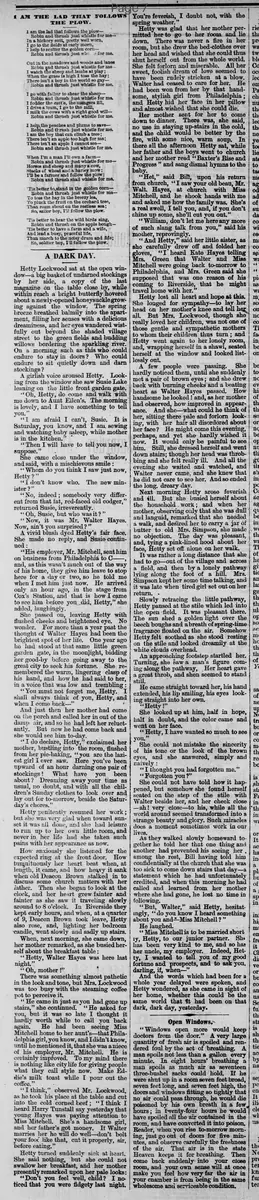
A Dark Day.
Hetty Lockwood sat at the open window—a big basket of undarned stockings by her side, a copy of the last magazine on the table close by. While within reach a bright butterfly hovered about a newly-opened honeysuckle growing against the window. The spring breeze breathed balmily into the apartment, filling her senses with a delicious dreaminess, and her eyes wandered wistfully out beyond the shaded village street to the green fields and budding willows bordering the sparkling river.
On a morning such as this who could endure to stay indoors? Who could endure to sit quietly down and darn stockings?
A girlish voice aroused Hetty. Looking from the window she saw Susie Lake leaning on the little front garden gate.
"Oh, Hetty, do come and walk with me down to Aunt Ellen's. The morning is lovely, and I have something to tell you."
"I am afraid I can't, Susie. It is Saturday, you know, and I am sewing and watching baby asleep, while mother is in the kitchen."
"Then I will have to tell you now, I suppose."
She came close under the window and said, with a mischievous smile:
"Whom do you think I saw just now, Hetty?"
"I don't know who. The new minister?"
"No, indeed; somebody very different from that fat, red-faced old codger," returned Susie, irreverently.
"Oh, Susie, but who was it?"
"Now, it was Mr. Walter Hayes. Now, ain't you surprised?"
A vivid blush dyed Hetty's fair face. She made no reply, and Susie continued:
"His employer, Mr. Mitchell, sent him on business from Philadelphia to C—and, as this wasn't much out of the way of his home, they give him leave to stop here for a day or two, so he told me when I met him just now. He arrived only an hour ago, in the stage from Cox's Station, and that is how I came to see him before you did, Hetty," she added, laughingly.
She passed on, leaving Hetty with flushed cheeks and brightened eye. No wonder. For more than a year past the thought of Walter Hayes had been the brightest spot of her life. One year ago he had stood at that same little green garden gate, in the moonlight, bidding her good-by before going away to the great city to seek his fortune. She remembered the warm, lingering clasp of his hand, and how he had said to her, in a voice that was low and trembling:
"You must not forget me, Hetty. I shall always think of you, Hetty, and when I come back—"
And just then her mother had come on the porch and called her in out of the damp air, and so he had left her reluctantly. But now he had come back and she would see him to-day.
"I do declare, Hetty," exclaimed her mother, bustling into the room, flushed from her pie-baking, "you are the laziest girl I ever saw. Here you've been upward of an hour darning one pair of stockings! What have you been about? Dreaming away your time as usual, no doubt, and with all the children's Sunday clothes to look over and lay out for to-morrow, beside the Saturday's chores."
Hetty penitently resumed her work; but she was very glad when toward sunset it was all done, and she had leisure to run up to her own little room, and never in her life had she taken such pains with her appearance as now.
How anxiously she listened for the expected ring at the front door. How tumultuously her heart beat when, at length, it came, and how heavy it sank when old Deacon Brown stalked in to discuss some church matters with her father. Then she began to look at the clock, and her heart grew fainter and fainter as she saw it traveling slowly around to 8 o'clock. In Riverside they kept early hours, and when, at a quarter of 9, Deacon Brown took leave, Hetty also rose, and, lighting her bedroom candle, went slowly and sadly upstairs.
When, next morning, she came down, her mother remarked, as she busied herself about the breakfast table:
"Hetty, Walter Hayes was here last night."
"Oh, mother!"
There was something almost pathetic in the look and tone, but Mrs. Lockwood was too busy with the steaming coffee pot to perceive it.
"He came in just as you had gone upstairs," she continued. "He asked for you, but it was so late I thought it hardly worth while to call you back again. He had been seeing Miss Mitchell home to her aunt's—that Philadelphia girl, you know, and I didn't know, until he mentioned it, that she was a niece of his employer, Mr. Mitchell. He is certainly improved. To my mind there is nothing like city life for giving people what they call style now. Make Eddie's milk toast while I pour out the coffee."
"I think," observed Mr. Lockwood as he took his place at the table and cut into the cold corned beef; "I think I heard Harry Tunstall say yesterday that young Hayes was paying attention to Miss Mitchell. She's a handsome girl, and her father's got money. If Walter marries her he will do well. Don't bolt your food like that, cut it properly, sir, before eating."
Hetty turned suddenly sick at heart. She said nothing, but she could not swallow her breakfast, and her mother presently remarked upon her pale looks:
"Don't you feel well, child? I noticed that you were fidgety last night. You're feverish, I doubt not, with the spring weather."
Hetty was glad that her mother permitted her to go to her room and lie down. There was never a fire in her room, but she drew the bed-clothes over her head and wished that she could thus shut herself out from the whole world.
She felt forlorn and miserable. All her sweet, foolish dream of love seemed to have been rudely stricken at a blow. Walter had ceased to care for her. He had been won from her by that handsome, stylish girl from Philadelphia; and Hetty hid her face in her pillow and almost wished that she could die.
Her mother sent for her to come down to dinner. There was, she said, no use in staying upstairs in the cold, and the child would be better by the fire, with some nice, warm soup. In there all the afternoon Hetty sat, while her father and the boys went to church and her mother read "Baxter's Rise and Progress" and sang dismal hymns to the baby.
"Het," said Bill, upon his return from church, "I saw your old beau, Mr. Walt. Hayes, at church with Miss Mitchell, and he shook hands with me and asked me how the family was. She's a real swell, I tell you, and, if you don't shine up some, she'll cut you out."
"William, don't let me hear any more of such slang talk from you," said his mother, reprovingly.
"And Hetty," said her little sister, as she carefully drew off and folded her gloves, "I heard Kate Hayes telling Mrs. Green that Walter and Miss Mitchell were going back to-morrow to Philadelphia, and Mrs. Green said she supposed that was one reason of his coming to Riverside, that he might travel home with her."
Hetty lost all heart and hope at this. She longed for sympathy to lay her head on her mother's knee and tell her all. But Mrs. Lockwood, though she really loved her children, was not one of those gentle and sympathetic mothers to whom their children thus turn; and Hetty went again to her lonely room and, wrapping herself in a shawl, seated herself at the window and looked listlessly out.
A few people were passing. She hardly noticed them, until she suddenly met a pair of brown eyes; and she drew back with burning cheeks and a beating heart as Walter Hayes passed. How handsome he looked! and, as her mother had observed, how improved in appearance. And she—what could he think of her, sitting there pale and forlorn looking, with her hair all disordered about her face? He might come this evening, perhaps, and yet she hardly wished it now. It would only be painful to see him. Still, she dressed herself and went downstairs; though her head was throbbing and she felt really ill. And all the evening she waited and watched, and Walter never came, and she knew that he did not care to see her. And so ended the long, dreary day.
Next morning Hetty arose feverish and ill. But she busied herself about the household work; and when her mother, observing only that she was dull and languid, remarked that she needed a walk, and desired her to carry a jar of butter to old Mrs. Simpson, she made no objection. The day was pleasant, and, tying a pink-lined hood about her face, Hetty set off alone on her walk.
It was rather a long distance that she had to go—out of the village and across a field, and then by a lonely pathway lying along the foot of a hill. Mrs. Simpson kept her some time talking, and it was late when tired girl set out on her return.
Slowly retracing the little pathway, Hetty paused at the stile which led into the open field. It was pleasant there. The sun shed a golden light over the beech boughs and a breath of spring-time fragrance floated on the air. Somehow Hetty felt soothed as she stood resting on the stile and looked dreamily at the white clouds overhead.
An approaching footstep startled her. Turning, she saw a man's figure coming along the pathway. Her heart gave a great throb, and she seemed to stand still.
He came straight toward her, his hand extended, his lip smiling, his eyes looking straight into her own.
"Hetty!"
She looked up at him, half in hope, half in doubt, and the color came and went on her face.
"Hetty, I have wanted so much to see you."
She could not mistake the sincerity of his tone or the look of the brown eyes, and she answered, simply and naively:
"I thought you had forgotten me."
"Forgotten you?"
She could not have told how it happened, but somehow she found herself seated on the step of the stile with Walter beside her, and her cheek close—ah! very close—to his, while all the world around seemed transformed into a strange beauty and glory. Such miracles does a moment sometimes work in our lives.
As they walked slowly homeward together he told her that one thing and another had prevented his seeing her among the rest, Bill having told him confidentially at the church that she was too sick to come downstairs that day—a statement which he had unfortunately credited, and when this morning he had called and learned from her mother where she had gone, he lost no time in following.
"But, Walter," said Hetty, hesitatingly, "do you know I heard something about you and Miss Mitchell?"
He laughed.
"Miss Mitchell is to be married shortly, Hetty, to our junior partner. She has been very kind to me, and so has her uncle, my employer. Indeed, Hetty, I wanted to tell you of my good fortune and prospects, and to ask you, darling, if, when—"
And the words which had been for a whole year delayed were spoken, and Hetty wondered, as she came in sight of her home, whether this could be the same world that it had been on that dark, dark day, yesterday.
Hetty Lockwood sat at the open window—a big basket of undarned stockings by her side, a copy of the last magazine on the table close by. While within reach a bright butterfly hovered about a newly-opened honeysuckle growing against the window. The spring breeze breathed balmily into the apartment, filling her senses with a delicious dreaminess, and her eyes wandered wistfully out beyond the shaded village street to the green fields and budding willows bordering the sparkling river.
On a morning such as this who could endure to stay indoors? Who could endure to sit quietly down and darn stockings?
A girlish voice aroused Hetty. Looking from the window she saw Susie Lake leaning on the little front garden gate.
"Oh, Hetty, do come and walk with me down to Aunt Ellen's. The morning is lovely, and I have something to tell you."
"I am afraid I can't, Susie. It is Saturday, you know, and I am sewing and watching baby asleep, while mother is in the kitchen."
"Then I will have to tell you now, I suppose."
She came close under the window and said, with a mischievous smile:
"Whom do you think I saw just now, Hetty?"
"I don't know who. The new minister?"
"No, indeed; somebody very different from that fat, red-faced old codger," returned Susie, irreverently.
"Oh, Susie, but who was it?"
"Now, it was Mr. Walter Hayes. Now, ain't you surprised?"
A vivid blush dyed Hetty's fair face. She made no reply, and Susie continued:
"His employer, Mr. Mitchell, sent him on business from Philadelphia to C—and, as this wasn't much out of the way of his home, they give him leave to stop here for a day or two, so he told me when I met him just now. He arrived only an hour ago, in the stage from Cox's Station, and that is how I came to see him before you did, Hetty," she added, laughingly.
She passed on, leaving Hetty with flushed cheeks and brightened eye. No wonder. For more than a year past the thought of Walter Hayes had been the brightest spot of her life. One year ago he had stood at that same little green garden gate, in the moonlight, bidding her good-by before going away to the great city to seek his fortune. She remembered the warm, lingering clasp of his hand, and how he had said to her, in a voice that was low and trembling:
"You must not forget me, Hetty. I shall always think of you, Hetty, and when I come back—"
And just then her mother had come on the porch and called her in out of the damp air, and so he had left her reluctantly. But now he had come back and she would see him to-day.
"I do declare, Hetty," exclaimed her mother, bustling into the room, flushed from her pie-baking, "you are the laziest girl I ever saw. Here you've been upward of an hour darning one pair of stockings! What have you been about? Dreaming away your time as usual, no doubt, and with all the children's Sunday clothes to look over and lay out for to-morrow, beside the Saturday's chores."
Hetty penitently resumed her work; but she was very glad when toward sunset it was all done, and she had leisure to run up to her own little room, and never in her life had she taken such pains with her appearance as now.
How anxiously she listened for the expected ring at the front door. How tumultuously her heart beat when, at length, it came, and how heavy it sank when old Deacon Brown stalked in to discuss some church matters with her father. Then she began to look at the clock, and her heart grew fainter and fainter as she saw it traveling slowly around to 8 o'clock. In Riverside they kept early hours, and when, at a quarter of 9, Deacon Brown took leave, Hetty also rose, and, lighting her bedroom candle, went slowly and sadly upstairs.
When, next morning, she came down, her mother remarked, as she busied herself about the breakfast table:
"Hetty, Walter Hayes was here last night."
"Oh, mother!"
There was something almost pathetic in the look and tone, but Mrs. Lockwood was too busy with the steaming coffee pot to perceive it.
"He came in just as you had gone upstairs," she continued. "He asked for you, but it was so late I thought it hardly worth while to call you back again. He had been seeing Miss Mitchell home to her aunt's—that Philadelphia girl, you know, and I didn't know, until he mentioned it, that she was a niece of his employer, Mr. Mitchell. He is certainly improved. To my mind there is nothing like city life for giving people what they call style now. Make Eddie's milk toast while I pour out the coffee."
"I think," observed Mr. Lockwood as he took his place at the table and cut into the cold corned beef; "I think I heard Harry Tunstall say yesterday that young Hayes was paying attention to Miss Mitchell. She's a handsome girl, and her father's got money. If Walter marries her he will do well. Don't bolt your food like that, cut it properly, sir, before eating."
Hetty turned suddenly sick at heart. She said nothing, but she could not swallow her breakfast, and her mother presently remarked upon her pale looks:
"Don't you feel well, child? I noticed that you were fidgety last night. You're feverish, I doubt not, with the spring weather."
Hetty was glad that her mother permitted her to go to her room and lie down. There was never a fire in her room, but she drew the bed-clothes over her head and wished that she could thus shut herself out from the whole world.
She felt forlorn and miserable. All her sweet, foolish dream of love seemed to have been rudely stricken at a blow. Walter had ceased to care for her. He had been won from her by that handsome, stylish girl from Philadelphia; and Hetty hid her face in her pillow and almost wished that she could die.
Her mother sent for her to come down to dinner. There was, she said, no use in staying upstairs in the cold, and the child would be better by the fire, with some nice, warm soup. In there all the afternoon Hetty sat, while her father and the boys went to church and her mother read "Baxter's Rise and Progress" and sang dismal hymns to the baby.
"Het," said Bill, upon his return from church, "I saw your old beau, Mr. Walt. Hayes, at church with Miss Mitchell, and he shook hands with me and asked me how the family was. She's a real swell, I tell you, and, if you don't shine up some, she'll cut you out."
"William, don't let me hear any more of such slang talk from you," said his mother, reprovingly.
"And Hetty," said her little sister, as she carefully drew off and folded her gloves, "I heard Kate Hayes telling Mrs. Green that Walter and Miss Mitchell were going back to-morrow to Philadelphia, and Mrs. Green said she supposed that was one reason of his coming to Riverside, that he might travel home with her."
Hetty lost all heart and hope at this. She longed for sympathy to lay her head on her mother's knee and tell her all. But Mrs. Lockwood, though she really loved her children, was not one of those gentle and sympathetic mothers to whom their children thus turn; and Hetty went again to her lonely room and, wrapping herself in a shawl, seated herself at the window and looked listlessly out.
A few people were passing. She hardly noticed them, until she suddenly met a pair of brown eyes; and she drew back with burning cheeks and a beating heart as Walter Hayes passed. How handsome he looked! and, as her mother had observed, how improved in appearance. And she—what could he think of her, sitting there pale and forlorn looking, with her hair all disordered about her face? He might come this evening, perhaps, and yet she hardly wished it now. It would only be painful to see him. Still, she dressed herself and went downstairs; though her head was throbbing and she felt really ill. And all the evening she waited and watched, and Walter never came, and she knew that he did not care to see her. And so ended the long, dreary day.
Next morning Hetty arose feverish and ill. But she busied herself about the household work; and when her mother, observing only that she was dull and languid, remarked that she needed a walk, and desired her to carry a jar of butter to old Mrs. Simpson, she made no objection. The day was pleasant, and, tying a pink-lined hood about her face, Hetty set off alone on her walk.
It was rather a long distance that she had to go—out of the village and across a field, and then by a lonely pathway lying along the foot of a hill. Mrs. Simpson kept her some time talking, and it was late when tired girl set out on her return.
Slowly retracing the little pathway, Hetty paused at the stile which led into the open field. It was pleasant there. The sun shed a golden light over the beech boughs and a breath of spring-time fragrance floated on the air. Somehow Hetty felt soothed as she stood resting on the stile and looked dreamily at the white clouds overhead.
An approaching footstep startled her. Turning, she saw a man's figure coming along the pathway. Her heart gave a great throb, and she seemed to stand still.
He came straight toward her, his hand extended, his lip smiling, his eyes looking straight into her own.
"Hetty!"
She looked up at him, half in hope, half in doubt, and the color came and went on her face.
"Hetty, I have wanted so much to see you."
She could not mistake the sincerity of his tone or the look of the brown eyes, and she answered, simply and naively:
"I thought you had forgotten me."
"Forgotten you?"
She could not have told how it happened, but somehow she found herself seated on the step of the stile with Walter beside her, and her cheek close—ah! very close—to his, while all the world around seemed transformed into a strange beauty and glory. Such miracles does a moment sometimes work in our lives.
As they walked slowly homeward together he told her that one thing and another had prevented his seeing her among the rest, Bill having told him confidentially at the church that she was too sick to come downstairs that day—a statement which he had unfortunately credited, and when this morning he had called and learned from her mother where she had gone, he lost no time in following.
"But, Walter," said Hetty, hesitatingly, "do you know I heard something about you and Miss Mitchell?"
He laughed.
"Miss Mitchell is to be married shortly, Hetty, to our junior partner. She has been very kind to me, and so has her uncle, my employer. Indeed, Hetty, I wanted to tell you of my good fortune and prospects, and to ask you, darling, if, when—"
And the words which had been for a whole year delayed were spoken, and Hetty wondered, as she came in sight of her home, whether this could be the same world that it had been on that dark, dark day, yesterday.
What sub-type of article is it?
Prose Fiction
What themes does it cover?
Love Romance
Social Manners
What keywords are associated?
Romance
Misunderstanding
Reunion
Village Life
Proposal
Literary Details
Title
A Dark Day.
Key Lines
"You Must Not Forget Me, Hetty. I Shall Always Think Of You, Hetty, And When I Come Back—"
"Hetty, I Have Wanted So Much To See You."
"I Thought You Had Forgotten Me."
"Miss Mitchell Is To Be Married Shortly, Hetty, To Our Junior Partner."
And The Words Which Had Been For A Whole Year Delayed Were Spoken, And Hetty Wondered, As She Came In Sight Of Her Home, Whether This Could Be The Same World That It Had Been On That Dark, Dark Day, Yesterday.