Thank you for visiting SNEWPapers!
Sign up free
Brownlow's Knoxville Whig
Knoxville, Knox County, Tennessee
What is this article about?
Governor W.G. Brownlow of Tennessee publicly rebukes Thomas Barry and J.C. Guild for contesting William Lauck's election as Chancellor of the Seventh District on procedural grounds, blaming rebel threats for polling issues, and affirms he will commission Lauck and ensure his protection amid post-war tensions. (248 characters)
Clipping
OCR Quality
Full Text
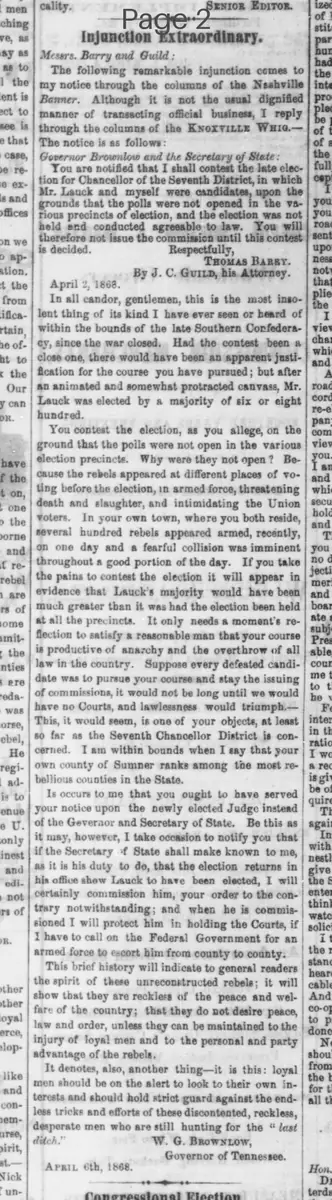
Messrs. Barry and Guild:
The following remarkable injunction comes to my notice through the columns of the Nashville Banner. Although it is not the usual dignified manner of transacting official business, I reply through the columns of the KNOXVILLE WHIG.
The notice is as follows:
Governor Brownlow and the Secretary of State:
You are notified that I shall contest the late election for Chancellor of the Seventh District, in which Mr. Lauck and myself were candidates, upon the grounds that the polls were not opened in the various precincts of election, and the election was not held and conducted agreeable to law. You will therefore not issue the commission until this contest is decided.
Respectfully,
Thomas Barry.
By J. C. Guild, his Attorney.
April 2, 1868.
In all candor, gentlemen, this is the most insolent thing of its kind I have ever seen or heard of within the bounds of the late Southern Confederacy, since the war closed. Had the contest been a close one, there would have been an apparent justification for the course you have pursued; but after an animated and somewhat protracted canvass, Mr. Lauck was elected by a majority of six or eight hundred.
You contest the election, as you allege, on the ground that the polls were not open in the various election precincts. Why were they not open? Because the rebels appeared at different places of voting before the election, in armed force, threatening death and slaughter, and intimidating the Union voters. In your own town, where you both reside, several hundred rebels appeared armed, recently, on one day and a fearful collision was imminent throughout a good portion of the day. If you take the pains to contest the election it will appear in evidence that Lauck's majority would have been much greater than it was had the election been held at all the precincts. It only needs a moment's reflection to satisfy a reasonable man that your course is productive of anarchy and the overthrow of all law in the country. Suppose every defeated candidate was to pursue your course and stay the issuing of commissions, it would not be long until we would have no Courts, and lawlessness would triumph.
This, it would seem, is one of your objects, at least so far as the Seventh Chancellor District is concerned. I am within bounds when I say that your own county of Sumner ranks among the most rebellious counties in the State.
It occurs to me that you ought to have served your notice upon the newly elected Judge instead of the Governor and Secretary of State. Be this as it may, however, I take occasion to notify you that if the Secretary of State shall make known to me, as it is his duty to do, that the election returns in his office show Lauck to have been elected, I will certainly commission him, your order to the contrary notwithstanding; and when he is commissioned I will protect him in holding the Courts, if I have to call on the Federal Government for an armed force to escort him from county to county.
This brief history will indicate to general readers the spirit of these unreconstructed rebels; it will show that they are reckless of the peace and welfare of the country; that they do not desire peace, law and order, unless they can be maintained to the injury of loyal men and to the personal and party advantage of the rebels.
It denotes, also, another thing—it is this: loyal men should be on the alert to look to their own interests and should hold strict guard against the endless tricks and efforts of these discontented, reckless, desperate men who are still hunting for the "last ditch."
W. G. Brownlow,
Governor of Tennessee.
APRIL 6th, 1868.
What sub-type of article is it?
What themes does it cover?
What keywords are associated?
What entities or persons were involved?
Letter to Editor Details
Author
W. G. Brownlow, Governor Of Tennessee
Recipient
Messrs. Barry And Guild
Main Argument
the election contest by barry and guild is unjustified due to rebel intimidation preventing polls from opening in some precincts, and lauck's large majority stands; the governor will commission lauck regardless and protect him with federal force if needed.
Notable Details