Thank you for visiting SNEWPapers!
Sign up free
Literary
February 11, 1852
Cooper's Clarksburg Register
Clarksburg, Harrison County, West Virginia
What is this article about?
In rural town C—, proud Eliva Nelby hosts a sugar party but panics when city cousin Lawrence arrives, fearing he'll scorn her country friends' manners. Lawrence enjoys the simple joys, befriends Helen Snow, and later marries her, humbling Eliva's pride.
Clipping
OCR Quality
98%
Excellent
Full Text
From Peterson's Magazine.
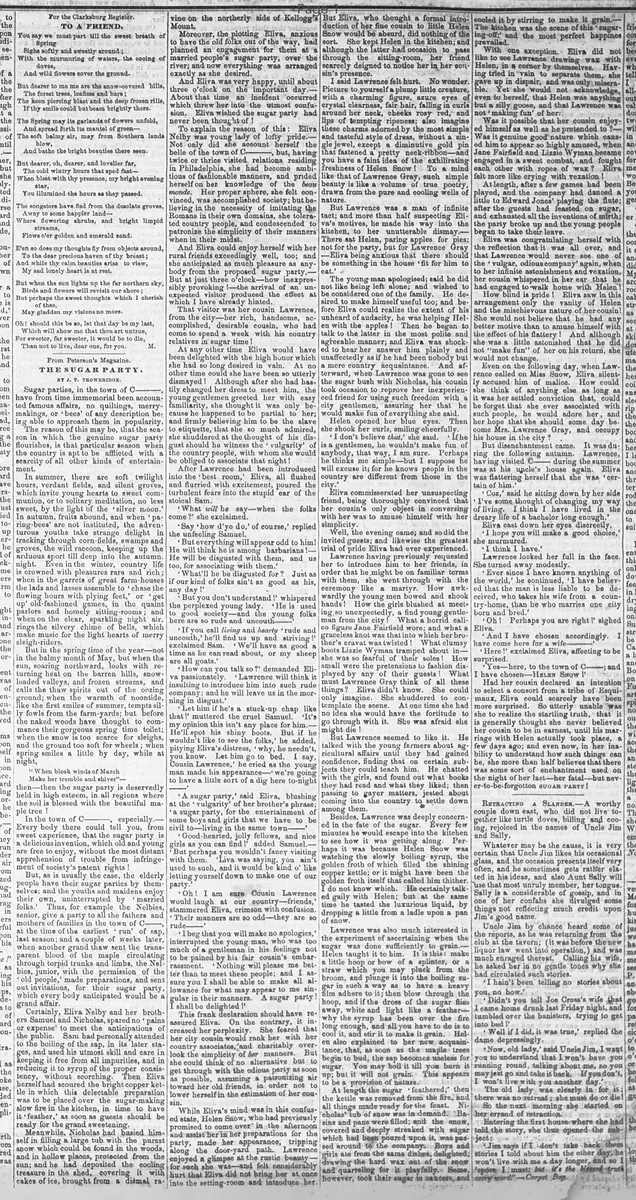
THE SUGAR PARTY.
BY J. T. TROWBRIDGE.
Sugar parties, in the town of C—, have from time immemorial been accounted famous affairs, no quiltings, merry-makings, or 'bees' of any description being able to approach them in popularity. The reason of this may be, that the season in which the genuine sugar party flourishes, is that particular season when the country is apt to be afflicted with a scarcity of all other kinds of entertainment.
In summer, there are soft twilight hours, verdant fields, and silent groves, which invite young hearts to sweet communion, or to solitary meditation, no less sweet, by the light of the silver moon. In autumn, fruits abound, and when 'paring-bees' are not instituted, the adventurous youths take strange delight in tracking through corn-fields, swamps and groves, the wild raccoon, keeping up the arduous sport till deep into the autumn night. Even in the winter, country life is crowned with pleasures rare and rich; when in the garrets of great farm-houses the lads and lasses assemble to 'chase the flowing hours with plying feet,' or 'get up' old-fashioned games, in the quaint parlors and homely sitting-rooms; and when on the clear, sparkling night air, rings the silvery chime of bells, which make music for the light hearts of merry sleigh-riders.
But in the spring time of the year—not in the balmy month of May, but when the sun, soaring northward, looks with returning heat on the barren hills, snow-loaded valleys, and frozen streams, and calls the thaw spirits out of the oozing ground: when the warmth of noontide, like the first smiles of summer, tempts silly fowls from the farm-yards: but before the naked woods have thought to commence their gorgeous spring time toilet; when the snow is too scarce for sleighs, and the ground too soft for wheels; when spring smiles a little by day, while at night,
"When bleak winds of March
Make her tremble and shiver"—
then—then the sugar party is deservedly held in high esteem, in all regions where the soil is blessed with the beautiful maple tree!
In the town of C—, especially.
Every body there could tell you, from sweet experience, that the sugar party is a delicious invention, which old and young are free to enjoy, without the most distant apprehension of trouble from infringement of society's patent rights!
But, as is usually the case, the elderly people have their sugar parties by themselves; and the youths and maidens enjoy their own, uninterrupted by married folks. Thus, for example the Nelbies, senior, give a party to all the fathers and mothers of families in the town of C—, at the time of the earliest 'run' of sap, last season; and a couple of weeks later, when another grand thaw sent the transparent blood of the maple circulating through torpid trunks and limbs, the Nelbies, junior, with the permission of the 'old people,' made preparations, and sent out invitations, for their sugar party, which every body anticipated would be a grand affair.
Certainly, Eliva Nelby and her brothers Samuel and Nicholas, spared no 'pains or expense' to meet the anticipations of the public. Sam had personally attended to the boiling of the sap, in its later stages, and used his utmost skill and care in keeping it free from all impurities, and in reducing it to syrup of the proper consistency, without scorching. Then Eliva herself had scoured the bright copper kettle in which this delectable preparation was to be placed over the sugar-making slow fire in the kitchen, in time to have it 'feather,' as soon as guests should be ready for the grand sweetening.
Meanwhile, Nicholas had busied himself in filling a large tub with the purest snow which could be found in the woods, and in hollow places, protected from the sun; and he had deposited the cooling treasure in the shed, covering it with cakes of ice, brought from a dismal ravine on the northerly side of Kellogg's Mount.
Moreover, the plotting Eliva, anxious to have the old folks out of the way, had planned an engagement for them at a married people's sugar party, over the river; and now 'everything was arranged exactly as she desired.
And Eliva was very happy, until about three o'clock on the important day. About that time an incident occurred which threw her into the utmost confusion. Eliva wished the sugar party had never been thought of!
To explain the reason of this: Eliva Nelby was a young lady of lofty pride. Not only did she account herself the belle of the town of C—, but, having twice or thrice visited relations residing in Philadelphia, she had become ambitious of fashionable manners, and prided herself on her knowledge of the beau monde. Her proper sphere, she felt convinced, was accomplished society: but believing in the necessity of imitating the Romans in their own domains, she tolerated country people, and condescended to patronize the simplicity of their manners when in their midst.
And Eliva could enjoy herself with her rural friends exceedingly well, too; and she anticipated as much pleasure as any body from the proposed sugar party. But at just three o'clock—how inexpressibly provoking! the arrival of an unexpected visitor produced the effect at which I have already hinted.
That visitor was her cousin Lawrence, from the city—her rich, handsome, accomplished, desirable cousin, who had come to spend a week with his country relatives in sugar time!
At any other time Eliva would have been delighted with the high honor which she had so long desired in vain. At no other time could she have been so utterly dismayed! Although after she had hastily changed her dress to meet him, the young gentleman greeted her with easy familiarity, she thought it was only because he happened to be partial to her; and firmly believing him to be the slave to etiquette, that she so much admired, she shuddered at the thought of his disgust should he witness the 'vulgarity' of the country people, with whom she would be obliged to associate that night!
After Lawrence had been introduced into the 'best room,' Eliva, all flushed and flurried with excitement, poured the turbulent fears into the stupid ear of the stoical Sam.
"What will he say—when the folks come?" she exclaimed.
"Say 'how d'ye do,' of course," replied the unfeeling Samuel.
"But everything will appear odd to him! He will think he is among barbarians! He will be disgusted with them, and us too, for associating with them."
"What'll he be disgusted for? Just as if our kind of folks ain't as good as his, any day!"
"But you don't understand!" whispered the perplexed young lady. "He is used to good society—and the young folks here are so rude and uncouth—"
"If you call living and hearty 'rude and uncouth,' he'll find us up and striving!" exclaimed Sam. "We'll have as good a time as he can read about, or my sheep are all goats."
"How can you talk so?" demanded Eliva passionately. "Lawrence will think it insulting to introduce him into such rude company; and he will leave us in the morning in disgust."
"Let him if he's a stuck-up chap like that!" muttered the cruel Samuel. "It's my opinion this isn't any place for him. He'll spot his shiny boots. But if he wouldn't like to see the folks," he added, pitying Eliva's distress, "why, he needn't, you know. Let him go to bed. I say, Cousin Lawrence," he cried as the young man made his appearance—"we're going to have a little sort of a dig here to-night."
"A sugar party," said Eliva, blushing at the 'vulgarity' of her brother's phrase; "a sugar party, for the entertainment of some boys and girls that we have to be civil to living in the same town."
"Good-hearted, jolly fellows, and nice girls as you can find!" added Samuel. "But perhaps you wouldn't fancy visiting with them. 'Liva was saying, you ain't used to such, and it would be kind o' like letting yourself down to make one of our party."
"Oh! I am sure Cousin Lawrence would laugh at our country—friends," stammered Eliva, crimson with confusion. "Their manners are so odd—they are so rude—"
"I beg that you will make no apologies," interrupted the young man, who was too much of a gentleman in his feelings not to be pained by his fair cousin's embarrassment. "Nothing will please me better than to meet these people; and I assure you I shall be able to make all allowance for what may appear to me singular in their manners. A sugar party! I shall be delighted!"
This frank declaration should have reassured Eliva. On the contrary, it increased her perplexity. She feared that her city cousin would rank her with her country associates, and charitably overlook the simplicity of her manners. But she could think of no alternative but to get through with the odious party as soon as possible, assuming a patronizing air toward her old friends, in order not to lower herself in the estimation of her cousin.
While Eliva's mind was in this confused state, Helen Snow, who had previously promised to come over in the afternoon and assist her in her preparations for the party, made her appearance, tripping along the door-yard path. Lawrence enjoyed a glimpse at the rustic beauty—for such she was—and felt considerably hurt that Eliva did not bring her at once into the sitting-room and introduce her.
But Eliva, who thought a formal introduction of her fine cousin to little Helen Snow would be absurd, did nothing of the sort. She kept Helen in the kitchen; and although the latter had occasion to pass through the sitting-room, her friend scarcely deigned to notice her in her cousin's presence.
I said Lawrence felt hurt. No wonder. Picture to yourself a plump little creature, with a charming figure, azure eyes of crystal clearness, fair hair, falling in curls around her neck, cheeks rosy red, and lips of tempting ripeness; also imagine these charms adorned by the most simple and tasteful style of dress, without a single jewel, except a diminutive gold pin that fastened a pretty neck-ribbon—and you have a faint idea of the exhilarating freshness of Helen Snow. To a mind like that of Lawrence Gray, such simple beauty is like a volume of true poetry, drawn from the pure and cooling wells of nature.
But Lawrence was a man of infinite tact; and more than half suspecting Eliva's motives, he made his way into the kitchen, to her unutterable dismay.
There sat Helen, paring apples for pies; not for the party, but for Lawrence Gray—Eliva being anxious that there should be something in the house 'fit for him to eat.'
The young man apologised; said he did not like being left alone; and wished to be considered one of the family. He desired to make himself useful too; and before Eliva could realize the extent of his unheard of audacity, he was helping Helen with the apples! Then he began to talk to the latter in the most polite and agreeable manner; and Eliva was shocked to hear her answer him plainly and unaffectedly as if he had been nobody but a mere country acquaintance. And afterward, when Lawrence was gone to see the sugar bush with Nicholas, his cousin took occasion to reprove her inexperienced friend for using such freedom with a city gentleman, assuring her that he would make fun of everything she said.
Helen opened her blue eyes. Then she shook her curls, smiling cheerfully.
"I don't believe that," she said. "If he is a gentleman, he wouldn't make fun of anybody, that way, I am sure. Perhaps he thinks me simple—but I suppose he will excuse it; for he knows people in the country are different from those in the city."
Eliva commiserated her unsuspecting friend, being thoroughly convinced that her cousin's only object in conversing with her was to amuse himself with her simplicity.
Well, the evening came; and so did the invited guests; and likewise the greatest trial of pride Eliva had ever experienced. Lawrence having previously requested her to introduce him to her friends, in order that he might be on familiar terms with them, she went through with the ceremony like a martyr. How awkwardly the young men bowed and shook hands! How the girls blushed at meeting, so unexpectedly, a fine young gentleman from the city! What a horrid calico figure Jane Fairfield wore; and what a graceless knot was that into which her brother's cravat was twisted! What clumsy boots Lizzie Wyman tramped about in—she was so fearful of their soles! How small were the pretensions to fashion displayed by any of their guests! What must Lawrence Gray think of all these things? Eliva didn't know. She could only imagine. She shuddered to contemplate the scene. At one time she had no idea she would have the fortitude to go through with it. She was afraid she might die!
But Lawrence seemed to like it. He talked with the young farmers about agricultural affairs until they had gained confidence, finding that on certain subjects they could teach him. He chatted with the girls, and found out what books they had read and what they liked; then passing to gayer matters, jested about coming into the country to settle down among them.
Besides, Lawrence was deeply concerned in the fate of the sugar. Every few minutes he would escape into the kitchen to see how it was getting along. Perhaps it was because Helen Snow was watching the slowly boiling syrup, the golden froth of which filled the shining copper kettle; or it might have been the golden froth itself that called him thither. I do not know which. He certainly talked gaily with Helen; but at the same time he tasted the luxurious liquid, by dropping a little from a ladle upon a pan of snow.
Lawrence was also much interested in the experiment of ascertaining when the sugar was done sufficiently to grain. Helen taught it to him. It is this: make a little hoop or bow of a splinter, or a straw which you may pluck from the broom, and plunge it into the boiling sugar in such a way as to have a heavy film adhere to it; then blow through the hoop, and if the dross of the sugar flies away, white and light like a feather—why the syrup has been over the fire long enough, and all you have to do is to cool it, and stir it to make it grain. Helen also explained to her new acquaintance, that, as soon as the maple trees begin to bud, the sap becomes useless for sugar. You may boil it till you burn it up; but it will not grain. This appears to be a provision of nature.
At length the sugar 'feathered;' then the kettle was removed from the fire, and all things made ready for the feast. Nicholas' tub of snow was in demand. Basins and pans were filled; and the snow, covered and deeply streaked with sugar which had been poured upon it, was passed around to the company. Boys and girls ate from the same dishes, delighted; drawing the hard wax out of the snow and quarreling for it playfully. Some, however, took their sugar in saucers, and cooled it by stirring to make it grain.
The kitchen was the scene of this 'sugaring-off;' and the most perfect happiness prevailed.
With one exception. Eliva did not like to see Lawrence drawing war with Helen, in a corner by themselves. Having tried in vain to separate them, she gave up in despair, and was only miserable. Yet she would not acknowledge, even to herself, that Helen was anything but a silly goose, and that Lawrence was not 'making fun' of her.
Was it possible that her cousin enjoyed himself as well as he pretended to?—Was it genuine good nature which caused him to appear so highly amused, when Jane Fairfield and Lizzie Wyman became engaged in a sweet combat, and fought each other with ropes of wax? Eliva felt more like crying with vexation!
At length, after a few games had been played, and the company had danced a little to Edward Jones' playing the flute: after the guests had feasted on sugar, and exhausted all the inventions of mirth; the party broke up and the young people began to take their leave.
Eliva was congratulating herself with the reflection that it was all over, and that Lawrence would never see one of the 'vulgar, odious company' again, when to her infinite astonishment and vexation, her cousin whispered in her ear that he had engaged to walk home with Helen!
How blind is pride! Eliva saw in this arrangement only the vanity of Helen and the mischievous nature of her cousin! She would not believe that he had any better motive than to amuse himself with the effect of his flattery! And although she was a little astonished that he did not "make fun" of her on his return, she would not change.
Even on the following day, when Lawrence called on Miss Snow, Eliva silently accused him of malice. How could she think of anything else as long as it was her settled conviction that, could he be brought to forget that she ever associated with such people, he would adore her, and her hope that she should some day become Mrs. Lawrence Gray, and occupy his house in the city?
But disenchantment came. It was during the following autumn. Lawrence, having visited C— during the summer was at his uncle's house again. Eliva was flattering herself that she was 'certain of him.'
"Coz," said he sitting down by her side "I've some thought of changing my way of living. I think I have lived in the dreary life of a bachelor long enough."
Eliva cast down her eyes discreetly.
"I hope you will make a good choice," she murmured.
"I think I have."
Lawrence looked her full in the face. She turned away modestly.
"Ever since I have known anything of the world," he continued, "I have believed that the man is less liable to be deceived, who takes his wife from a country-home, than he who marries one city born and bred."
"Oh! Perhaps you are right!" sighed Eliva.
"And I have chosen accordingly. I have come here for a wife—"
"Here!" exclaimed Eliva, affecting to be surprised.
"Yes—here, to the town of C—; and I have chosen—Helen Snow!"
Had her cousin declared an intention to select a consort from a tribe of Esquimaux, Eliva could scarcely have been more surprised. So utterly unable was she to realize the startling truth, that it is generally thought she never believed her cousin to be in earnest, until his marriage with Helen actually took place, a few days ago; and even now, in her inability to understand how such things can be, she more than half believes that there was some sort of enchantment used on the night of her last—her fatal but never-to-be-forgotten SUGAR PARTY!
THE SUGAR PARTY.
BY J. T. TROWBRIDGE.
Sugar parties, in the town of C—, have from time immemorial been accounted famous affairs, no quiltings, merry-makings, or 'bees' of any description being able to approach them in popularity. The reason of this may be, that the season in which the genuine sugar party flourishes, is that particular season when the country is apt to be afflicted with a scarcity of all other kinds of entertainment.
In summer, there are soft twilight hours, verdant fields, and silent groves, which invite young hearts to sweet communion, or to solitary meditation, no less sweet, by the light of the silver moon. In autumn, fruits abound, and when 'paring-bees' are not instituted, the adventurous youths take strange delight in tracking through corn-fields, swamps and groves, the wild raccoon, keeping up the arduous sport till deep into the autumn night. Even in the winter, country life is crowned with pleasures rare and rich; when in the garrets of great farm-houses the lads and lasses assemble to 'chase the flowing hours with plying feet,' or 'get up' old-fashioned games, in the quaint parlors and homely sitting-rooms; and when on the clear, sparkling night air, rings the silvery chime of bells, which make music for the light hearts of merry sleigh-riders.
But in the spring time of the year—not in the balmy month of May, but when the sun, soaring northward, looks with returning heat on the barren hills, snow-loaded valleys, and frozen streams, and calls the thaw spirits out of the oozing ground: when the warmth of noontide, like the first smiles of summer, tempts silly fowls from the farm-yards: but before the naked woods have thought to commence their gorgeous spring time toilet; when the snow is too scarce for sleighs, and the ground too soft for wheels; when spring smiles a little by day, while at night,
"When bleak winds of March
Make her tremble and shiver"—
then—then the sugar party is deservedly held in high esteem, in all regions where the soil is blessed with the beautiful maple tree!
In the town of C—, especially.
Every body there could tell you, from sweet experience, that the sugar party is a delicious invention, which old and young are free to enjoy, without the most distant apprehension of trouble from infringement of society's patent rights!
But, as is usually the case, the elderly people have their sugar parties by themselves; and the youths and maidens enjoy their own, uninterrupted by married folks. Thus, for example the Nelbies, senior, give a party to all the fathers and mothers of families in the town of C—, at the time of the earliest 'run' of sap, last season; and a couple of weeks later, when another grand thaw sent the transparent blood of the maple circulating through torpid trunks and limbs, the Nelbies, junior, with the permission of the 'old people,' made preparations, and sent out invitations, for their sugar party, which every body anticipated would be a grand affair.
Certainly, Eliva Nelby and her brothers Samuel and Nicholas, spared no 'pains or expense' to meet the anticipations of the public. Sam had personally attended to the boiling of the sap, in its later stages, and used his utmost skill and care in keeping it free from all impurities, and in reducing it to syrup of the proper consistency, without scorching. Then Eliva herself had scoured the bright copper kettle in which this delectable preparation was to be placed over the sugar-making slow fire in the kitchen, in time to have it 'feather,' as soon as guests should be ready for the grand sweetening.
Meanwhile, Nicholas had busied himself in filling a large tub with the purest snow which could be found in the woods, and in hollow places, protected from the sun; and he had deposited the cooling treasure in the shed, covering it with cakes of ice, brought from a dismal ravine on the northerly side of Kellogg's Mount.
Moreover, the plotting Eliva, anxious to have the old folks out of the way, had planned an engagement for them at a married people's sugar party, over the river; and now 'everything was arranged exactly as she desired.
And Eliva was very happy, until about three o'clock on the important day. About that time an incident occurred which threw her into the utmost confusion. Eliva wished the sugar party had never been thought of!
To explain the reason of this: Eliva Nelby was a young lady of lofty pride. Not only did she account herself the belle of the town of C—, but, having twice or thrice visited relations residing in Philadelphia, she had become ambitious of fashionable manners, and prided herself on her knowledge of the beau monde. Her proper sphere, she felt convinced, was accomplished society: but believing in the necessity of imitating the Romans in their own domains, she tolerated country people, and condescended to patronize the simplicity of their manners when in their midst.
And Eliva could enjoy herself with her rural friends exceedingly well, too; and she anticipated as much pleasure as any body from the proposed sugar party. But at just three o'clock—how inexpressibly provoking! the arrival of an unexpected visitor produced the effect at which I have already hinted.
That visitor was her cousin Lawrence, from the city—her rich, handsome, accomplished, desirable cousin, who had come to spend a week with his country relatives in sugar time!
At any other time Eliva would have been delighted with the high honor which she had so long desired in vain. At no other time could she have been so utterly dismayed! Although after she had hastily changed her dress to meet him, the young gentleman greeted her with easy familiarity, she thought it was only because he happened to be partial to her; and firmly believing him to be the slave to etiquette, that she so much admired, she shuddered at the thought of his disgust should he witness the 'vulgarity' of the country people, with whom she would be obliged to associate that night!
After Lawrence had been introduced into the 'best room,' Eliva, all flushed and flurried with excitement, poured the turbulent fears into the stupid ear of the stoical Sam.
"What will he say—when the folks come?" she exclaimed.
"Say 'how d'ye do,' of course," replied the unfeeling Samuel.
"But everything will appear odd to him! He will think he is among barbarians! He will be disgusted with them, and us too, for associating with them."
"What'll he be disgusted for? Just as if our kind of folks ain't as good as his, any day!"
"But you don't understand!" whispered the perplexed young lady. "He is used to good society—and the young folks here are so rude and uncouth—"
"If you call living and hearty 'rude and uncouth,' he'll find us up and striving!" exclaimed Sam. "We'll have as good a time as he can read about, or my sheep are all goats."
"How can you talk so?" demanded Eliva passionately. "Lawrence will think it insulting to introduce him into such rude company; and he will leave us in the morning in disgust."
"Let him if he's a stuck-up chap like that!" muttered the cruel Samuel. "It's my opinion this isn't any place for him. He'll spot his shiny boots. But if he wouldn't like to see the folks," he added, pitying Eliva's distress, "why, he needn't, you know. Let him go to bed. I say, Cousin Lawrence," he cried as the young man made his appearance—"we're going to have a little sort of a dig here to-night."
"A sugar party," said Eliva, blushing at the 'vulgarity' of her brother's phrase; "a sugar party, for the entertainment of some boys and girls that we have to be civil to living in the same town."
"Good-hearted, jolly fellows, and nice girls as you can find!" added Samuel. "But perhaps you wouldn't fancy visiting with them. 'Liva was saying, you ain't used to such, and it would be kind o' like letting yourself down to make one of our party."
"Oh! I am sure Cousin Lawrence would laugh at our country—friends," stammered Eliva, crimson with confusion. "Their manners are so odd—they are so rude—"
"I beg that you will make no apologies," interrupted the young man, who was too much of a gentleman in his feelings not to be pained by his fair cousin's embarrassment. "Nothing will please me better than to meet these people; and I assure you I shall be able to make all allowance for what may appear to me singular in their manners. A sugar party! I shall be delighted!"
This frank declaration should have reassured Eliva. On the contrary, it increased her perplexity. She feared that her city cousin would rank her with her country associates, and charitably overlook the simplicity of her manners. But she could think of no alternative but to get through with the odious party as soon as possible, assuming a patronizing air toward her old friends, in order not to lower herself in the estimation of her cousin.
While Eliva's mind was in this confused state, Helen Snow, who had previously promised to come over in the afternoon and assist her in her preparations for the party, made her appearance, tripping along the door-yard path. Lawrence enjoyed a glimpse at the rustic beauty—for such she was—and felt considerably hurt that Eliva did not bring her at once into the sitting-room and introduce her.
But Eliva, who thought a formal introduction of her fine cousin to little Helen Snow would be absurd, did nothing of the sort. She kept Helen in the kitchen; and although the latter had occasion to pass through the sitting-room, her friend scarcely deigned to notice her in her cousin's presence.
I said Lawrence felt hurt. No wonder. Picture to yourself a plump little creature, with a charming figure, azure eyes of crystal clearness, fair hair, falling in curls around her neck, cheeks rosy red, and lips of tempting ripeness; also imagine these charms adorned by the most simple and tasteful style of dress, without a single jewel, except a diminutive gold pin that fastened a pretty neck-ribbon—and you have a faint idea of the exhilarating freshness of Helen Snow. To a mind like that of Lawrence Gray, such simple beauty is like a volume of true poetry, drawn from the pure and cooling wells of nature.
But Lawrence was a man of infinite tact; and more than half suspecting Eliva's motives, he made his way into the kitchen, to her unutterable dismay.
There sat Helen, paring apples for pies; not for the party, but for Lawrence Gray—Eliva being anxious that there should be something in the house 'fit for him to eat.'
The young man apologised; said he did not like being left alone; and wished to be considered one of the family. He desired to make himself useful too; and before Eliva could realize the extent of his unheard of audacity, he was helping Helen with the apples! Then he began to talk to the latter in the most polite and agreeable manner; and Eliva was shocked to hear her answer him plainly and unaffectedly as if he had been nobody but a mere country acquaintance. And afterward, when Lawrence was gone to see the sugar bush with Nicholas, his cousin took occasion to reprove her inexperienced friend for using such freedom with a city gentleman, assuring her that he would make fun of everything she said.
Helen opened her blue eyes. Then she shook her curls, smiling cheerfully.
"I don't believe that," she said. "If he is a gentleman, he wouldn't make fun of anybody, that way, I am sure. Perhaps he thinks me simple—but I suppose he will excuse it; for he knows people in the country are different from those in the city."
Eliva commiserated her unsuspecting friend, being thoroughly convinced that her cousin's only object in conversing with her was to amuse himself with her simplicity.
Well, the evening came; and so did the invited guests; and likewise the greatest trial of pride Eliva had ever experienced. Lawrence having previously requested her to introduce him to her friends, in order that he might be on familiar terms with them, she went through with the ceremony like a martyr. How awkwardly the young men bowed and shook hands! How the girls blushed at meeting, so unexpectedly, a fine young gentleman from the city! What a horrid calico figure Jane Fairfield wore; and what a graceless knot was that into which her brother's cravat was twisted! What clumsy boots Lizzie Wyman tramped about in—she was so fearful of their soles! How small were the pretensions to fashion displayed by any of their guests! What must Lawrence Gray think of all these things? Eliva didn't know. She could only imagine. She shuddered to contemplate the scene. At one time she had no idea she would have the fortitude to go through with it. She was afraid she might die!
But Lawrence seemed to like it. He talked with the young farmers about agricultural affairs until they had gained confidence, finding that on certain subjects they could teach him. He chatted with the girls, and found out what books they had read and what they liked; then passing to gayer matters, jested about coming into the country to settle down among them.
Besides, Lawrence was deeply concerned in the fate of the sugar. Every few minutes he would escape into the kitchen to see how it was getting along. Perhaps it was because Helen Snow was watching the slowly boiling syrup, the golden froth of which filled the shining copper kettle; or it might have been the golden froth itself that called him thither. I do not know which. He certainly talked gaily with Helen; but at the same time he tasted the luxurious liquid, by dropping a little from a ladle upon a pan of snow.
Lawrence was also much interested in the experiment of ascertaining when the sugar was done sufficiently to grain. Helen taught it to him. It is this: make a little hoop or bow of a splinter, or a straw which you may pluck from the broom, and plunge it into the boiling sugar in such a way as to have a heavy film adhere to it; then blow through the hoop, and if the dross of the sugar flies away, white and light like a feather—why the syrup has been over the fire long enough, and all you have to do is to cool it, and stir it to make it grain. Helen also explained to her new acquaintance, that, as soon as the maple trees begin to bud, the sap becomes useless for sugar. You may boil it till you burn it up; but it will not grain. This appears to be a provision of nature.
At length the sugar 'feathered;' then the kettle was removed from the fire, and all things made ready for the feast. Nicholas' tub of snow was in demand. Basins and pans were filled; and the snow, covered and deeply streaked with sugar which had been poured upon it, was passed around to the company. Boys and girls ate from the same dishes, delighted; drawing the hard wax out of the snow and quarreling for it playfully. Some, however, took their sugar in saucers, and cooled it by stirring to make it grain.
The kitchen was the scene of this 'sugaring-off;' and the most perfect happiness prevailed.
With one exception. Eliva did not like to see Lawrence drawing war with Helen, in a corner by themselves. Having tried in vain to separate them, she gave up in despair, and was only miserable. Yet she would not acknowledge, even to herself, that Helen was anything but a silly goose, and that Lawrence was not 'making fun' of her.
Was it possible that her cousin enjoyed himself as well as he pretended to?—Was it genuine good nature which caused him to appear so highly amused, when Jane Fairfield and Lizzie Wyman became engaged in a sweet combat, and fought each other with ropes of wax? Eliva felt more like crying with vexation!
At length, after a few games had been played, and the company had danced a little to Edward Jones' playing the flute: after the guests had feasted on sugar, and exhausted all the inventions of mirth; the party broke up and the young people began to take their leave.
Eliva was congratulating herself with the reflection that it was all over, and that Lawrence would never see one of the 'vulgar, odious company' again, when to her infinite astonishment and vexation, her cousin whispered in her ear that he had engaged to walk home with Helen!
How blind is pride! Eliva saw in this arrangement only the vanity of Helen and the mischievous nature of her cousin! She would not believe that he had any better motive than to amuse himself with the effect of his flattery! And although she was a little astonished that he did not "make fun" of her on his return, she would not change.
Even on the following day, when Lawrence called on Miss Snow, Eliva silently accused him of malice. How could she think of anything else as long as it was her settled conviction that, could he be brought to forget that she ever associated with such people, he would adore her, and her hope that she should some day become Mrs. Lawrence Gray, and occupy his house in the city?
But disenchantment came. It was during the following autumn. Lawrence, having visited C— during the summer was at his uncle's house again. Eliva was flattering herself that she was 'certain of him.'
"Coz," said he sitting down by her side "I've some thought of changing my way of living. I think I have lived in the dreary life of a bachelor long enough."
Eliva cast down her eyes discreetly.
"I hope you will make a good choice," she murmured.
"I think I have."
Lawrence looked her full in the face. She turned away modestly.
"Ever since I have known anything of the world," he continued, "I have believed that the man is less liable to be deceived, who takes his wife from a country-home, than he who marries one city born and bred."
"Oh! Perhaps you are right!" sighed Eliva.
"And I have chosen accordingly. I have come here for a wife—"
"Here!" exclaimed Eliva, affecting to be surprised.
"Yes—here, to the town of C—; and I have chosen—Helen Snow!"
Had her cousin declared an intention to select a consort from a tribe of Esquimaux, Eliva could scarcely have been more surprised. So utterly unable was she to realize the startling truth, that it is generally thought she never believed her cousin to be in earnest, until his marriage with Helen actually took place, a few days ago; and even now, in her inability to understand how such things can be, she more than half believes that there was some sort of enchantment used on the night of her last—her fatal but never-to-be-forgotten SUGAR PARTY!
What sub-type of article is it?
Prose Fiction
What themes does it cover?
Social Manners
Love Romance
Moral Virtue
What keywords are associated?
Sugar Party
Rural Entertainment
Pride
Country Manners
City Cousin
Romance
Maple Sugar
What entities or persons were involved?
By J. T. Trowbridge.
Literary Details
Title
The Sugar Party.
Author
By J. T. Trowbridge.
Subject
A Rural Sugar Party Highlighting Pride And Social Contrasts.
Key Lines
"What Will He Say—When The Folks Come?" She Exclaimed.
"If You Call Living And Hearty 'Rude And Uncouth,' He'll Find Us Up And Striving!" Exclaimed Sam.
Picture To Yourself A Plump Little Creature, With A Charming Figure, Azure Eyes Of Crystal Clearness, Fair Hair, Falling In Curls Around Her Neck, Cheeks Rosy Red, And Lips Of Tempting Ripeness;
"Yes—Here, To The Town Of C—; And I Have Chosen—Helen Snow!"
She More Than Half Believes That There Was Some Sort Of Enchantment Used On The Night Of Her Last—Her Fatal But Never To Be Forgotten Sugar Party!