Thank you for visiting SNEWPapers!
Sign up free
Virginia Argus
Richmond, Virginia
What is this article about?
Court opinion on whether force is required for levying war in Aaron Burr's treason trial, delivered August 31, 1807. Latest proceedings from September 9-11 include jury selection, prosecutor's opening on misdemeanor charges under 1794 Neutrality Act, witness testimonies, and defense arguments on evidence admissibility in Richmond.
Merged-components note: These components form a continuous report on the Aaron Burr trial, spanning pages 1 and 2 in sequential reading order.
Clippings
1 of 2
OCR Quality
Full Text
The COMMONWEALTH.
1 1/2 Cents Single.
Virginia Argus.
RICHMOND:
SATURDAY, SEPTEMBER 12, 1807.
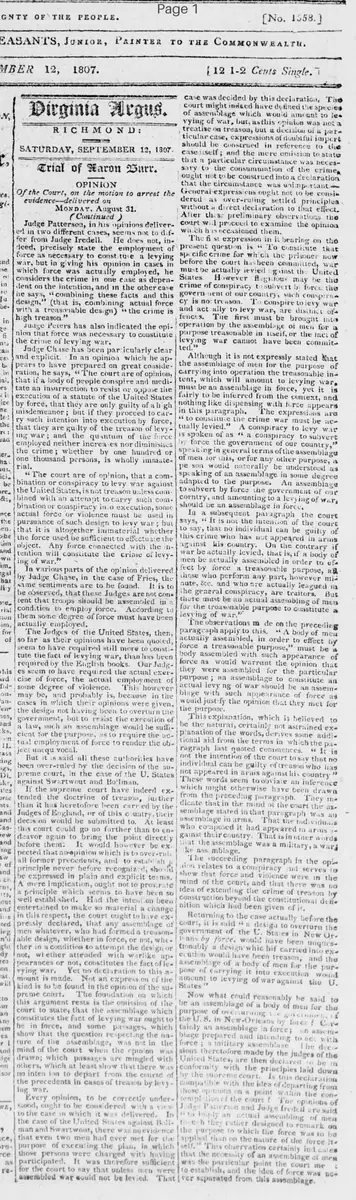
Trial of Aaron Burr.
OPINION
Of the Court, on the motion to arrest the evidence—delivered on
Monday, August 31.
(Continued)
Judge Patterson, in his opinions delivered in two different cases, seems not to differ from Judge Iredell. He does not, indeed, precisely state the employment of force as necessary to constitute a levying war, but in giving his opinion in cases in which force was actually employed, he considers the crime in one case as dependent on the intention, and in the other case he says, "combining these facts and this design," (that is, combining actual force with a treasonable design) "the crime is high treason."
Judge Peters has also indicated the opinion that force was necessary to constitute the crime of levying war.
Judge Chase has been particularly clear and explicit. In an opinion which he appears to have prepared on great consideration, he says, "The court are of opinion, that if a body of people conspire and meditate an insurrection to resist or oppose the execution of a statute of the United States by force, that they are only guilty of a high misdemeanor; but if they proceed to carry such intention into execution by force, that they are guilty of the treason of levying war; and the quantum of the force employed neither increases nor diminishes the crime; whether by one hundred or one thousand persons, is wholly immaterial."
"The court are of opinion, that a combination or conspiracy to levy war against the United States, is not treason unless combined with an attempt to carry such combination or conspiracy into execution, some actual force or violence must be used in pursuance of such design to levy war; but that it is altogether immaterial whether the force used be sufficient to effectuate the object. Any force connected with the intention will constitute the crime of levying of war."
In various parts of the opinion delivered by Judge Chase, in the case of Fries, the same sentiments are to be found. It is to be observed, that these Judges are not content that troops should be assembled in a condition to employ force. According to them some degree of force must have been actually employed.
The Judges of the United States, then, so far as their opinions have been quoted, seem to have required still more to constitute the fact of levying war, than has been required by the English books. Our Judges seem to have required the actual exercise of force, the actual employment of some degree of violence. This however may be, and probably is, because in the cases in which their opinions were given, the design not having been to overturn the government, but to resist the execution of a law, such an assemblage would be sufficient for the purpose, as to require the actual employment of force to render the object unequivocal.
But it is said all these authorities have been over-ruled by the decision of the supreme court, in the case of the U. States against Swartwout and Bollman.
If the supreme court have indeed extended the doctrine of treason, further than it has heretofore been carried by the Judges of England, or of this country, their decision would be submitted to. At least this court could go no further than to endeavor again to bring the point directly before them: It would however be expected that an opinion which is to over-rule all former precedents, and to establish principle never before recognized, should be expressed in plain and explicit terms.
A mere implication, ought not to prostrate a principle which seems to have been so well established. Had the intention been entertained to make so material a change in this respect, the court ought to have expressly declared, that any assemblage of men whatever, who had formed a treasonable design, whether in force, or not, whether in a condition to attempt the design or not, whether attended with warlike appearances or not, constitutes the fact of levying war. Yet no declaration to this amount is made. Not an expression of the kind is to be found in the opinion of the supreme court. The foundation on which this argument rests is the omission of the court to state, that the assemblage which constitutes the fact of levying war ought to be in force, and some passages, which show that the question respecting the nature of the assemblage, was not in the mind of the court when the opinion was drawn; which passages are mingled with others, which at least show that there was no intention to depart from the course of the precedents in cases of treason by levying war.
Every opinion, to be correctly understood, ought to be considered with a view to the case in which it was delivered. In the case of the United States against Bollman and Swartwout, there was no evidence that even two men had ever met for the purpose of executing the plan, in which those persons were charged with having participated. It was therefore sufficient for the court to say that unless men were assembled war could not be levied. That
case was decided by this declaration, The court might indeed have defined the species of assemblage which would amount to levying of war, but, as this opinion was not a treatise on treason, but a decision of a particular case, expressions of doubtful import should be construed in reference to the case itself; and the mere omission to state that a particular circumstance was necessary to the consummation of the crime, ought not to be construed into a declaration that the circumstance was unimportant.
General expressions ought not to be considered as over-ruling settled principles without a direct declaration to that effect.
After these preliminary observations the court will proceed to examine the opinion which has occasioned them.
The first expression in it bearing on the present question is "To constitute that specific crime for which the prisoner now before the court has been committed, war must be actually levied against the United States. However flagitious may be the crime of conspiracy to subvert by force the government of our country, such conspiracy is not treason. To conspire to levy war and actually to levy war, are distinct offences. The first must be brought into operation by the assemblage of men for a purpose treasonable in itself, or the fact of levying war cannot have been committed."
Although it is not expressly stated that the assemblage of men for the purpose of carrying into operation the treasonable intent, which will amount to levying war, must be an assemblage in force, yet it is fairly to be inferred from the context, and nothing like dispensing with force appears in this paragraph. The expressions are "to constitute the crime war must be actually levied." A conspiracy to levy war is spoken of as "a conspiracy to subvert by force the government of our country," speaking in general terms of the assemblage of men for this, or for any other purpose, a person would naturally be understood as speaking of an assemblage in some degree adapted to the purpose. An assemblage to subvert by force the government of our country, and amounting to a levying of war should be an assemblage in force.
In a subsequent paragraph the court says, "It is not the intention of the court to say, that no individual can be guilty of this crime who has not appeared in arms against his country. On the contrary if war be actually levied, that is, if a body of men be actually assembled in order to effect by force a treasonable purpose, all those who perform any part, however minute, &c. and who are actually leagued in the general conspiracy, are traitors. But there must be an actual assembling of men for the treasonable purpose to Constitute a levying of war."
The observations made on the preceding paragraph apply to this. "A body of men actually assembled, in order to effect by force a treasonable purpose," must be a body assembled with such appearance of force as would warrant the opinion that they were assembled for the particular purpose; an assemblage to constitute an actual levying of war should be an assemblage with such appearance of force as would justify the opinion that they met for the purpose.
This explanation, which is believed to be the natural, certainly not a strained explanation of the words, derives some additional aid from the terms in which the paragraph last quoted commences. "It is not the intention of the court to say that no individual can be guilty of treason who has not appeared in arms against his country"
These words seem to obviate an inference which might otherwise have been drawn from the preceding paragraph. They indicate that in the mind of the court the assemblage stated in that paragraph was an assemblage in arms. That the individuals who composed it had appeared in arms against their country. That is in other words that the assemblage was a military, a warlike assemblage.
The succeeding paragraph in the opinion relates to a conspiracy and serves to shew that force and violence were in the mind of the court, and that there was no idea of extending the crime of treason by construction beyond the constitutional definition which had been given of it.
Returning to the case actually before the court, it is said "a design to overturn the government of the U. States in New Orleans by force, would have been unquestionably a design which if carried into execution would have been treason, and the assemblage of a body of men for the purpose of carrying it into execution would amount to levying of war against the U. States"
Now what could reasonably be said to be an assemblage of a body of men for the purpose of overturning the government of the U. S. in New-Orleans by force? Certainly an assemblage in force; an assemblage prepared and intending to act with force; a military assemblage The decisions heretofore made by the judges of the United States, are then declared to be in conformity with the principles laid down by the supreme court." Is thus declaration Compatible with the idea of departing from those opinions on a point within the contemplation of the court? The opinions of Judge Patterson and Judge Iredell are said "to imply an actual assembling of men the object which they rather designed to remark on the purpose to which the force was to be applied than on the nature of the force itself." This observation certainly indicates that the necessity of an assemblage of men was the particular point the court meant to establish, and the idea of force was never separated from this assemblage,
The decisions of Judge Chase and Judge Peters are said to be "in perfect conformity with the doctrine which has been just stated."
In the case of the insurrection in Pennsylvania, the assemblage was in force, and the only doubt which could be entertained respected the object. In the case of Fries too, the assemblage was in force, and the only point made was, that the object was not treasonable.
The opinion of the supreme court then, instead of over-ruling, seems to coincide with, those principles which have been believed to be settled, and which are essential to the preservation of the liberty of the citizen.
The opinion of Judge Chase is next quoted with approbation. This opinion in terms requires the employment of force.
(To be Continued.)
Latest Proceedings in the Trial.
Wednesday, Sept. 9.
Mr. Hay informed the court that the Express he had sent to the President of the United States, had returned, and brought a copy of such parts of the letter of November 12th, from General Wilkinson as the President thought proper to be laid before the public; with a certificate written by the President annexed to the said copy. The certificate was in the following words:--
On re-examination of a letter of November 12th, 1806, from General Wilkinson to myself (which having been for a considerable time out of my possession is now returned to me) I find in it some passages entirely confidential, given for my information in the discharge of my executive functions, and which my duties and the public interest forbid me to make public. I have therefore given above a correct copy of all those parts which I ought to permit to be made public. Those not communicated are in no wise material for the purposes of justice on the charges of treason or misdemeanor depending against Aaron Burr: they are on subjects irrelevant to any issues which can arise out of those charges, and could contribute nothing towards his acquittal or conviction. The papers mentioned in the first and third paragraphs, as enclosed in the letter, being separated therefrom, and not in my possession, I am unable from memory to say what they were. I presume they are in the hands of the attorney for the United States. Given under my hand this 7th day of September, 1807.
THOMAS JEFFERSON.
A number of persons were called, who had been summoned for the purpose of completing the Jury.
Mr. Charles Spencer of this city said that, in a variety of companies, he had been compelled in conversation to express his impressions; and that he was always free to do so. The Chief Justice observed there is a difference between impressions and decisive opinions. Mr. Martin said the juror ought not to be under any impression against the accused. Mr. Spencer was set aside for the present.
Mr. Jacob Harrison was excused from serving, on the ground of private inconvenience; having no white person about his house to attend to his business in his absence.
Mr. Robert Gordon said that, like most other people, he had talked on the subject; whether he had expressed himself, chiefly, for, or against Col. Burr, he could not recollect; but he had formed no decisive opinion. He was accepted.
Messrs. James Taylor, John Glynn, John New and William Rowlett, severally declared that they had formed and expressed opinions of the guilt of Aaron Burr; and were therefore rejected.
Mr. James Penn declared that he had conversed a great deal on the subject, but had no decisive opinion. He was, of course, accepted.
Mr. Heath Jones Miller. I have been decidedly of one opinion, ever since the commencement; and that has been of his guilt.
Messrs. Jordan Harris, James Harris, Samuel Woodson and Benjamin Wolfe, declared that their opinions were fully made up. Mr. Wolfe said he had expressed his opinion a thousand times.
Maj. David Holloway and Mr. Richard Young were excused on account of ill health.
Mr. Thomas Lewis said that in conversation he had generally expressed himself unfavorably to Col. Burr, but had made up no decisive opinion. He was accepted.
Mr. Orris Paine (who had been called before on Monday last) was again called; when Mr. Hay asked him if he could say, with a safe conscience, that he had formed no opinion on this subject?--He answered that he had formed no decisive opinion.
The jury was then sworn; consisting of Messrs. Orris Paine, James Bootright, Obadiah Gathright, John Murphy, John M'Kim, William Bentley, Yeamans Smith, Carter Berkeley, Jesse Bowles, James Penn, Robert Gordon and Thomas Lewis.
Mr. Hay addressed them in a short and perspicuous speech, in which he explained the nature of the charges, exhibited in the indictment, and intended to be supported by the testimony.
He stated that the defendant stood charged with a misdemeanor committed in violation of an act of Congress passed in the year 1794, (L. U. S. 3 vol. p. 91. s.) by which it is enacted that if any person shall, within the territory or jurisdiction of the United States, begin, or set on foot, or provide or prepare the means for any military expedition or enterprise to be carried on, from thence, against the territory or dominions of any foreign prince or state with whom the United States are at peace, every such person, so offending, shall, upon conviction, be adjudged guilty of a high misdemeanor, and shall suffer fine and imprisonment at the discretion of the Court in which the conviction shall be had; so as that such fine shall not exceed three thousand dollars, nor the term of imprisonment be more than three years.
He mentioned that the indictment contained seven counts. The first charged the defendant with beginning a military expedition against the dominions of the king of Spain, (with whom the United States then were and still are at peace.) on the 13th day of December, 1806, from Blannerhasset's island in the county of Wood; the second with setting on foot a similar expedition at the same time and place. The third was to the same effect, except that it specified Mexico, as the particular territory of the king of Spain, against which the enterprise was directed. The fourth was similar in the first and second; but used the words "preparing the means for" a military expedition, instead of the word "beginning" or the words "setting on foot." The fifth was the same as the fourth; except that "Mexico" was specified, as in the third count. The sixth and seventh resembled the fifth, except that, in one of them "an unknown territory of the king
of Spain," and, in the other, "a foreign territory unknown," was mentioned instead of Mexico. Mr. Hay observed to the jury that, if any of the charges in those seven counts were proved, it would be incumbent upon them to find the defendant guilty.
He proceeded to state the general outlines of the facts which would be proved against the accused; that he with others had formed a design to divide the union, to seize New Orleans, and to attack the dominions of the king of Spain; that men, arms, and provisions were provided for that purpose at Blannerhasset's island; that the men were assembled at that place, under his direction; and left it, in consequence of a communication from him, warning them of danger; that they went down the river Ohio, and met him at the mouth of Cumberland, where other arms and military stores were collected, and other men were assembled; that the whole party put themselves under his command, and proceeded with him to the neighborhood of Natchez; where they understood that their preliminary point (the seizure of New Orleans) could not be accomplished: that this defeated their enterprise, and shortly afterwards, they dispersed; but the act of Congress was not intended against those only who should accomplish such an unlawful enterprise; it was sufficient if they began it or provided the means.
Mr. Graham (late Secretary of the Orleans Territory) was called as a witness.
Col. Burr wished Mr. Hay to state the substance of what he intended to prove by Mr. Graham. Mr. Hay. I expect to prove by Mr. Graham that the accused was the leader and preparer of the expedition.
Col. Burr. Such general declarations are not sufficient: they ought to be stated with more precision. Mr. Graham never saw me but once; at Natchez in the Mississippi Territory.
Mr. Hay. I hope we may be permitted to go on without interruption. I know not exactly what Mr. Graham will say. I have not had the advantages which other people have enjoyed of seeing the evidence laid before the Grand Jury. I can only say, therefore, in general terms, that Mr. Graham is to prove preparations in Virginia.
Col. Burr wished the gentleman in the first place to confine himself to proof of the fact laid in the Indictment.
Mr. Botts. The Court before suggested that the Counsel for the U. S. had better prove the fact first: but this recommendation of the Court was disregarded. I hope the Court will reconsider an opinion that permits the prosecutor to do wrong, when right and wrong are both set before him.
We were at first disposed, rather than disturb the proceedings, to let the gentlemen follow their own "lucid order."
But we hope they will be compelled to prove the military expedition from Blannerhasset's Island first. They may then search for stuff and nonsense to fill up vacuums.
Mr. Hay. I will take the gentleman at his word, and proceed to the Island at once; after which we shall produce not "stuff and nonsense" to the Court and Jury, but incontrovertible facts to prove the guilty designs of the accused, and his connexion with the expedition.
Peter Taylor (Blannerhasset's gardener) was then sworn.
Mr. Botts. I wish it to be understood that we reserve our objections to any part of the testimony which may be improper.
Peter Taylor was fully examined, as he had been in the trial for Treason. His evidence was exactly consistent in all its parts, and expressed with all the simplicity and force of truth.
Maurice P. Bellenot (who had also been examined heretofore) was called.
Col. Burr. I wish Mr. Bellenot to be confined to circumstances occurring on the Island.
Mr. Hay. I shall ask of Mr. Bellenot all that he knows.
Col. Burr objected to evidence of facts out of the District of Virginia: was willing that all the testimony taken before should be read to the Jury from the Judge's notes; but wished no evidence to be admitted of expressions of other people when he was absent.
Mr. Hay. We wish to prove that the accused, apprized of the proceedings of the Legislature of Ohio, sent Mr. Bellenot from Lexington with a letter which he delivered to Blannerhasset; that that letter warned the party assembled on the island, of their danger, and directed them to depart.
Col. Burr said that as he knew Mr. Bellenot would swear to no such thing, he might be examined fully.
The statement of Mr. Bellenot's evidence shall appear in the next Argus. It shewed very satisfactorily a connexion between Col. Burr and the party on the island; and that the boats had been built on his behalf; but did not pointedly prove that Col. Burr warned the party of their danger, and directed them to depart on that account. The witness said that Col. Burr in his letter to Blannerhasset expressed his wishes that they should make all possible speed down the river; that one expression probably was that the river would close up:--another was that from the Newspapers the public mind appeared to be much agitated; there might be difficulty in getting down the river; but "he hoped they would not oppose the constituted authorities."
Richard Neal was next sworn, and stated that Blannerhasset sent for him to his house, and, when he arrived, asked him if he could keep a secret.--He was proceeding to state what that secret was, when Col. Burr stopped him, and objected to evidence of any conversations with Blannerhasset when he was not present. He said it now appeared that he was not at the island. He should therefore now make his objections to any evidence of transactions out of the District, or where he was absent.
Mr. Hay insisted on going on with his evidence.
Mr. Botts then rose, and argued very much at length, against the admission of any farther evidence in this case. He made six points; 1st. that, under the Act of Congress, there can be no accessorial offender; i.e. none are within the pains of the statute but such as are acting at the
fact: 2d. that no act of Col. Burr out of the District could be given in evidence against him; 3d. that, if the first point should not be sustainable, no act of an accessorial agency could be given in evidence on this indictment, charging the offence of acting at the island, and not charging specially that the person indicted did the accessorial act; 4th. that, if the foregoing points should be not sustainable, still, no evidence of an accessorial agency could be given, until the record of the conviction of an actor in the expedition should have been produced; 5th. that the acts on Blannerhasset's island did not amount to a providing or preparing the means for, or beginning or setting on foot a military expedition there; 6th. that no evidence was admissible of conversations or acts of other persons out of the presence of Col. Burr.
On all these points Mr. Botts dilated very extensively, quoting and relying principally upon various parts of the opinion of the Chief Justice, pronounced on the motion for excluding the evidence in the Treason-case.
The 5th point he observed divided itself into two others; 1st. that there was not a military expedition in a state of maturity at Blannerhasset's Island: 2d. that if there was a military expedition in progress there, it was not begun or set on foot there, nor were the means provided or prepared there.
In support of these points, he went into a view of the English authorities to shew that penal laws must be construed strictly, and quoted 1 Hawk. 116, 68. 1 Bl. 88. Leach 48. 12s.--He contended that to provide or prepare the means of a military expedition required the providing of the entire means, and that the means must be adequate to the object in view; that the expedition must be a military one, and to establish this must have a military character and organization; that there was in fact no assembly of men engaged in this military expedition, because if Burr had such a design, the men assembled were not informed of it, and therefore did not meet for that purpose; and that no proof of intention could aid facts in making the means of a military expedition.
The discourse of Mr. Botts (of which this is a brief sketch) was not finished at the time of adjournment.
The Jury, by consent of parties, were permitted to go at large.
The Court adjourned until Thursday ten o'clock.
THURSDAY, September 10.
Mr. Botts concluded his speech; and was followed by a few remarks from Mr. Martin; in which he chiefly contended that the Court and not the Jury had a right to judge of the character of the alleged military expedition, and to determine whether the law had been violated.
Mr. Hay, in answer to the first point made by Mr. Botts, observed that this court had already decided in the case of treason, that a man may be found guilty of levying war without being present at the place where the war is levied; provided he be properly indicted.
The true ground (said he) of objection to the evidence, meant to be taken by Mr. Botts, is this; that, Aaron Burr not having been present at the time of the offence charged, the evidence offered must be irrelevant. This is, unquestionably, the only ground for excluding evidence. Mere variance between the case as charged, and as proved, will not justify such exclusion.
As in the case of murder, if a man be indicted for killing another with a hammer, and it appears that he killed him with a broad axe, the evidence is not to be excluded. But, where evidence offered does not bear upon the subject at all, the court may exclude it. For example, where A. is indicted for treason in Henrico, evidence that he had committed treason in Norfolk would be irrelevant until the offence in Henrico had been proved. Such was the decision of this court the other day. He here cited the opinion given on that subject; and contended that the court had gone on the ground of irrelevancy, not of mere variance.
He proceeded to argue that the evidence now offered was relevant to the charge in the indictment; because its object was to prove that Burr was the projector of the plan and provider of the means for the expedition.
In the treason case he observed that the indictment had been construed as charging the prisoner with being present at the place where the overt act was alleged: but this indictment contains no such charge, either expressly, or by implication; since Burr might begin, or set on foot, or provide the means of a military expedition at Blannerhasset's island without being present. Presence therefore not being expressly stated, nor alleged by inference, there is not even a variance between the case and the evidence.
If it be said, that the indictment is defective in not stating expressly whether the defendant was present or absent; it might be a ground for a motion in arrest of judgment, but not for objecting to the admissibility of evidence.
This objection, Mr. Hay said, was altogether new in a case of this kind. Prosecutions for keeping a gaming house, for retailing spirituous liquors at booths or arbors contrary to law, and for giving money or other things to voters, for the purpose of influencing their votes, had been frequent in the law; but the personal presence of the offender at the gaming, at the place where the liquors were sold or drank, or where the voters were bribed, was never considered as requisite to convict him of any of those offences.
In answer to Mr. Botts's 2d point, he said that this Court had already determined that evidence of facts out of the District is admissible, by way of explanation of the intention of facts within the District.
As to the 3d point, he observed an essential difference between the case of treason and that now before the Court. In treason, all who are leagued in the Conspiracy are in law Traitors; whereas in this Indictment the persons who were assembled at Blannerhasset's Island are not charged with guilt, but are only mentioned as the means provided by the defendant--Burr therefore can not be considered an accessory to any offence imputed to them.
The Chief Justice here interrupted Mr. Hay, and told him that he understood the argument on behalf of Col. Burr to be this; that, since the person who occasioned the means to be provided, employed other persons to enlist men and purchase provisions, those who enlisted the men and bought the provisions, and not the men assembled, were argued to be the principal offenders.
Mr. Hay. I should be sorry, upon principles of humanity, to see a doctrine of this kind prevail in a Government like ours; that a rule should be laid down so well calculated to protect from punishment able designing men, and to consign to destruction their poor weak deluded agents! This idea never occurred to the learned counsel who defended Smith and Ogden. Evidence of acts done by their agents was admitted without controversy.
See the trial of Smith and Ogden p. 102.
Mr. Botts. I never meant to concede that the persons enlisted were not guilty; if the expedition was criminal, and they were acquainted with the design.
Mr. Hay. This 3d position must have a limitation. If Burr is to be considered as an accessory, I wish Mr. Botts to say who was the principal. Burr applied to Dudley Woodbridge and engaged him to have a number of boats built for him on the Muskingum. Woodbridge, altho' he suspected his design to be unlawful, yet, not knowing it to be so, in the course of his trade makes the bargain, and has the boats built. Can Woodbridge be considered as guilty of any crime? Much less can he be regarded as a principal offender.
Mr. Hay observed, that Burr knew too well the leakiness of human nature to reveal his plans to all his subordinate agents. He made use of his great reputation, which was sufficient to induce multitudes to engage in any project proposed by him, under a persuasion that the man who had filled so vast a space in the affections of his fellow-citizens would not propose any criminal or chimerical scheme. He had trusted, indeed, to that reputation too much, and found himself deceived and disappointed in the end; but it had had its effect. His agents had got men to assemble at Blannerhasset's Island, under the expectation of meeting him on some great design which was not revealed. Were the agents guilty when the true design might not have been known to themselves?
Mr. Hay concluded his observations on the 3d point by observing, that this was a question which properly belonged to the jury whose province it is to judge both of fact and law; and asked why the gentlemen on the other side were so perpetually flying from the Jury to the Court, and so unwilling to trust the Jury with anything?
The 4th point, made by Mr. Botts, he observed was the same proposition with that laid down in the treason Case, mutatis mutandis: but, in that case, the court had expressly declared that, whether the acts on Blannerhasset's Island amounted to treason, or not, was a question of law and fact proper to be left to the jury; altho' the court had thought proper to go largely into a description of the nature of such acts as ought to be considered overt-acts of treason.
But Mr. Botts had said that the means provided at Blannerhasset's Island ought to have been adequate means, and that if a man had furnished only one brick to build a house, he could not be said to have provided the means for building it. Mr. Hay observed it was true that, if a man was to bring only one brick in a cart, it would not have the appearance of providing the means for building a house; but a single cart-load of bricks would certainly be beginning the preparations for the building. According to Mr. Botts's argument, a person could not be said to be providing materials for a building, so long as a single brick was wanting.
Mr. Botts here observed that his argument was not that a man could not be engaged in providing the means for a building until the whole were prepared, but that, until then, he could not be said to have provided the means.
Mr. Hay proceeded to observe it was impossible for a court or jury to say what were adequate means for such an expedition as that meditated by Col. Burr. The law speaks of means of a military expedition; whether adequate or not must depend upon the object in view. The intention of the accused was to keep the world in ignorance of the real object in view. It is immaterial whether that was conquest, plunder or revenge. The law does not require the object to be ascertained. According to this argument there could be no guilt unless the force should be so great as to defy opposition! If this construction is correct, what is to be done with the words "set on foot" and "begin" which are used in the act of Congress? It is evident that the law annexes a punishment by fine and imprisonment to the smallest degree of the crime.
Mr. Hay denied that there must be a military organization before the offence is complete. Suppose, said he, a man is preparing an expedition against one of the West India Islands. He puts every thing on board his vessels; implements of war, provisions, &c.--but reserves as his last act the enlisting of men and taking them on board; would he not be guilty of providing and preparing the means of the expedition, before his men should come on board, whereby they would be enabled to set sail, and get out of the reach of the law? Or, suppose a man enlists a thousand men for the purpose of a military expedition against the Spanish territories; pays them their bounty; and provides arms at Blannerhasset's Island to be delivered them when they should arrive at that place. But they do not get there: the scheme is discovered and suppressed before they assemble; shall the projector escape punishment on the ground that there was no military organization?
In answer to the 5th point, "that the expedition was not commenced at Blannerhasset's Island," Mr. Hay observed that this was a question of fact proper to be left to the jury: but another fact located it sufficiently on the island; viz: that means were provided there.
The proposition in the 6th point, he said was generally true; that the acts of A are not evidence against B; but there is a limitation of this proposition given by the law. Where two persons are engaged in
a common enterprise, the words and acts of one may be evidence against the other—2 Maule & Selw. 611--Smith and Ogden's trial, p. 102, &c. The words of all the agents of Smith were admitted as evidence against him, even tho' they were not leagued with him in the conspiracy. On this authority, whatever Blannerhasset did or said may with propriety be evidence against Burr; because; whether he was a conspirator or not, he was certainly one of Burr's agents.
Mr. Hay having concluded, Mr. Wirt observed that he was too unwell to proceed with the argument this evening.--The court therefore adjourned till Friday ten o'clock.
Friday, September 11.
Mr. Wirt did not commence the arguments of this day as had been expected. Mr. Martin cited several authorities to shew that the confession of a person concerned in a crime cannot be made use of as evidence against any of his coadjutors or associates.--He was answered by Mr. McRae, who also commented on the other points of law made in the case.--Mr. Wirt continued the debate, and Mr. Randolph closed it for the day.
Sketches of the substance of these able and eloquent discourses will be given to the readers of the Argus as soon as possible.
What sub-type of article is it?
What themes does it cover?
What keywords are associated?
What entities or persons were involved?
Where did it happen?
Story Details
Key Persons
Location
Richmond
Event Date
1807 08 31 To 1807 09 11
Story Details
Court opinion analyzes precedents requiring actual force for treason by levying war, rejecting overruling by Supreme Court in Bollman and Swartwout. Proceedings include Jefferson's certificate on Wilkinson's letter, jury selection, Hay's opening on misdemeanor charges for military expedition against Spain from Blennerhassett's Island, witness examinations, and defense objections to evidence admissibility.