Thank you for visiting SNEWPapers!
Sign up free
Story
June 11, 1893
Capital City Courier
Lincoln, Lancaster County, Nebraska
What is this article about?
Article details the transformation of wagon manufacturing from hand-fitted parts during the Civil War era to machine-driven production in Pittsburg, reducing costs and time while improving quality. Correspondent J. H. Baker reports on innovations like automated hub and spoke machines.
Clipping
OCR Quality
95%
Excellent
Full Text
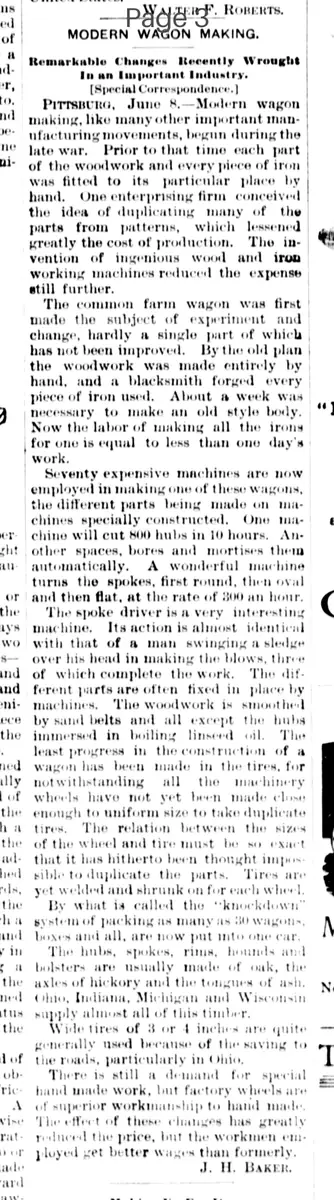
MODERN WAGON MAKING.
Remarkable Changes Recently Wrought
In an Important Industry.
[Special Correspondence.]
PITTSBURG, June 8. - Modern wagon
making, like many other important man-
ufacturing movements, begun during the
late war. Prior to that time each part
of the woodwork and every piece of iron
was fitted to its particular place by
hand. One enterprising firm conceived
the idea of duplicating many of the
parts from patterns, which lessened
greatly the cost of production. The in-
vention of ingenious wood and iron
working machines reduced the expense
still further.
The common farm wagon was first
made the subject of experiment and
change, hardly a single part of which
has not been improved. By the old plan
the woodwork was made entirely by
hand, and a blacksmith forged every
piece of iron used. About a week was
necessary to make an old style body.
Now the labor of making all the irons
for one is equal to less than one day's
work.
Seventy expensive machines are now
employed in making one of these wagons,
the different parts being made on ma-
chines specially constructed. One ma-
chine will cut 500 hubs in 10 hours. An-
other spaces, bores and mortises them
automatically. A wonderful machine
turns the spokes, first round, then oval
and then flat, at the rate of 500 an hour.
The spoke driver is a very interesting
machine. Its action is almost identical
with that of a man swinging a sledge
over his head in making the blows, three
of which complete the work. The dif-
ferent parts are often fixed in place by
machines. The woodwork is smoothed
by sand belts and all except the hubs
immersed in boiling linseed oil. The
least progress in the construction of a
wagon has been made in the tires, for
notwithstanding all the machinery
wheels have not yet been made close
enough to uniform size to take duplicate
tires. The relation between the sizes
of the wheel and tire must be so exact
that it has hitherto been thought imps
sible to duplicate the parts. Tires are
yet welded and shrunk on for each wheel.
By what is called the "knockdown"
system of packing as many as 50 wagons,
boxes and all, are now put into one car.
The hubs, spokes, rims, hounds and
bolsters are usually made of oak, the
axles of hickory and the tongues of ash.
Ohio, Indiana, Michigan and Wisconsin
supply almost all of this timber.
Wide tires of 3 or 4 inches are quite
generally used because of the saving to
the roads, particularly in Ohio.
There is still a demand for special
hand made work, but factory wheels are
of superior workmanship to hand made.
The effect of these changes has greatly
reduced the price, but the workmen em-
ployed get better wages than formerly.
J. H. BAKER.
Remarkable Changes Recently Wrought
In an Important Industry.
[Special Correspondence.]
PITTSBURG, June 8. - Modern wagon
making, like many other important man-
ufacturing movements, begun during the
late war. Prior to that time each part
of the woodwork and every piece of iron
was fitted to its particular place by
hand. One enterprising firm conceived
the idea of duplicating many of the
parts from patterns, which lessened
greatly the cost of production. The in-
vention of ingenious wood and iron
working machines reduced the expense
still further.
The common farm wagon was first
made the subject of experiment and
change, hardly a single part of which
has not been improved. By the old plan
the woodwork was made entirely by
hand, and a blacksmith forged every
piece of iron used. About a week was
necessary to make an old style body.
Now the labor of making all the irons
for one is equal to less than one day's
work.
Seventy expensive machines are now
employed in making one of these wagons,
the different parts being made on ma-
chines specially constructed. One ma-
chine will cut 500 hubs in 10 hours. An-
other spaces, bores and mortises them
automatically. A wonderful machine
turns the spokes, first round, then oval
and then flat, at the rate of 500 an hour.
The spoke driver is a very interesting
machine. Its action is almost identical
with that of a man swinging a sledge
over his head in making the blows, three
of which complete the work. The dif-
ferent parts are often fixed in place by
machines. The woodwork is smoothed
by sand belts and all except the hubs
immersed in boiling linseed oil. The
least progress in the construction of a
wagon has been made in the tires, for
notwithstanding all the machinery
wheels have not yet been made close
enough to uniform size to take duplicate
tires. The relation between the sizes
of the wheel and tire must be so exact
that it has hitherto been thought imps
sible to duplicate the parts. Tires are
yet welded and shrunk on for each wheel.
By what is called the "knockdown"
system of packing as many as 50 wagons,
boxes and all, are now put into one car.
The hubs, spokes, rims, hounds and
bolsters are usually made of oak, the
axles of hickory and the tongues of ash.
Ohio, Indiana, Michigan and Wisconsin
supply almost all of this timber.
Wide tires of 3 or 4 inches are quite
generally used because of the saving to
the roads, particularly in Ohio.
There is still a demand for special
hand made work, but factory wheels are
of superior workmanship to hand made.
The effect of these changes has greatly
reduced the price, but the workmen em-
ployed get better wages than formerly.
J. H. BAKER.
What sub-type of article is it?
Historical Event
Curiosity
What themes does it cover?
Triumph
Fortune Reversal
What keywords are associated?
Wagon Making
Industrial Changes
Machinery Innovation
Farm Wagons
Pittsburg Manufacturing
What entities or persons were involved?
J. H. Baker
Where did it happen?
Pittsburg
Story Details
Key Persons
J. H. Baker
Location
Pittsburg
Event Date
June 8
Story Details
Modern wagon making began during the late war with duplication of parts from patterns and invention of machines, transforming hand-crafted production to automated processes that greatly reduced costs and time for farm wagons, using specialized machinery for hubs, spokes, and other parts, while tires remain hand-fitted.