Thank you for visiting SNEWPapers!
Sign up free
Editorial
May 7, 1818
Daily National Intelligencer
Washington, District Of Columbia
What is this article about?
Editorial praises the simplicity and lack of ostentation in American government and leaders' habits, contrasting them favorably with ancient Roman and Greek examples like Augustus Caesar and Cato, highlighting virtues of US presidents and officials such as Washington, Hamilton, and Dallas.
Clipping
OCR Quality
98%
Excellent
Full Text
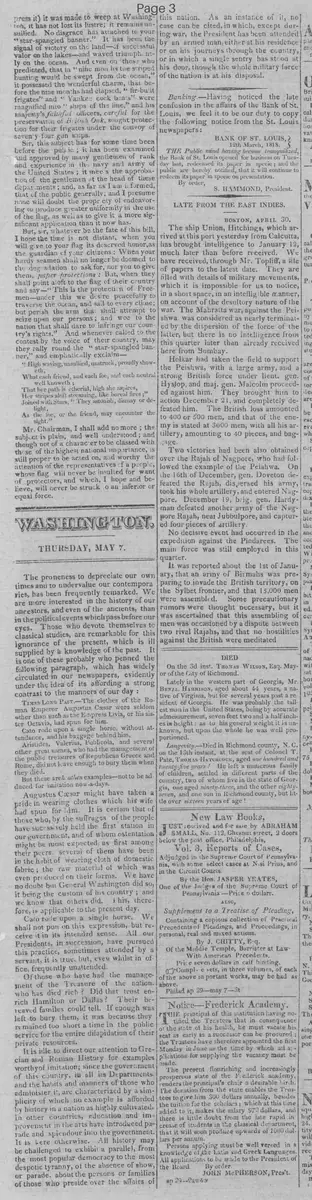
The proneness to depreciate our own times and to undervalue our contemporaries, has been frequently remarked. We are more interested in the history of our ancestors, and even of the ancients, than in the political events which pass before our eyes. Those who devote themselves to classical studies, are remarkable for this ignorance of the present, which is ill supplied by a knowledge of the past. It is one of these probably who penned the following paragraph, which has widely circulated in our newspapers, evidently under the idea of its affording a strong contrast to the manners of our day:
TIMES LONG PAST.—The clothes of the Roman Emperor Augustus Caesar were seldom other than such as the Empress Livia, or his sister Octavia, had spun for him. Cato rode upon a single horse, without attendance, and his baggage behind him. Aristides, Valerius, Publicola, and several other great names, who had the management of the public treasures of Republican Greece and Rome, did not leave enough to bury them when they died.
But these are ancient examples—not to be adduced for imitation now-a-days. Augustus Caesar might have taken a pride in wearing clothes which his wife had spun for him. It is certain that of those who, by the suffrages of the people have successively held the first station in our government, and of whom ostentation might be most expected as first among their peers, several of them have been in the habit of wearing cloth of domestic fabric; the raw material of which was even produced on their farms. We have no doubt but General Washington did so, it being the custom of his country; and we know that others did. This, therefore, is applicable to the present day.
Cato rode upon a single horse. We shall not pun on this expression, but receive it in its intended sense. All our Presidents, in succession, have pursued this practice, sometimes attended by a servant, it is true, but, even whilst in office, frequently unattended.
Of those who have had the management of the Treasury of the nation, who has died rich? Did that trust enrich Hamilton or Dallas? Their bereaved families could tell. If enough was left to bury them, it was because they remained too short a time in the public service for the entire dilapidation of their private resources.
It is idle to direct our attention to Grecian and Roman History for examples worthy of imitation; since the government of this country, in all its Departments, and the habits and manners of those who administer it, are characterized by a simplicity of which no example is afforded by history in a nation as highly cultivated. In other countries, education and improvement in the arts have introduced parade and splendour into the government. It is here otherwise. All history may be challenged to exhibit a parallel, from the most popular democracy to the most despotic tyranny, of the absence of show, or parade, about the persons or families of those who preside over the affairs of this nation. As an instance of it, no case can be cited, in which, except during war, the President has been attended by an armed man, either at his residence or on his journeys through the country, or in which a single sentry has stood at his door, though the whole military force of the nation is at his disposal.
TIMES LONG PAST.—The clothes of the Roman Emperor Augustus Caesar were seldom other than such as the Empress Livia, or his sister Octavia, had spun for him. Cato rode upon a single horse, without attendance, and his baggage behind him. Aristides, Valerius, Publicola, and several other great names, who had the management of the public treasures of Republican Greece and Rome, did not leave enough to bury them when they died.
But these are ancient examples—not to be adduced for imitation now-a-days. Augustus Caesar might have taken a pride in wearing clothes which his wife had spun for him. It is certain that of those who, by the suffrages of the people have successively held the first station in our government, and of whom ostentation might be most expected as first among their peers, several of them have been in the habit of wearing cloth of domestic fabric; the raw material of which was even produced on their farms. We have no doubt but General Washington did so, it being the custom of his country; and we know that others did. This, therefore, is applicable to the present day.
Cato rode upon a single horse. We shall not pun on this expression, but receive it in its intended sense. All our Presidents, in succession, have pursued this practice, sometimes attended by a servant, it is true, but, even whilst in office, frequently unattended.
Of those who have had the management of the Treasury of the nation, who has died rich? Did that trust enrich Hamilton or Dallas? Their bereaved families could tell. If enough was left to bury them, it was because they remained too short a time in the public service for the entire dilapidation of their private resources.
It is idle to direct our attention to Grecian and Roman History for examples worthy of imitation; since the government of this country, in all its Departments, and the habits and manners of those who administer it, are characterized by a simplicity of which no example is afforded by history in a nation as highly cultivated. In other countries, education and improvement in the arts have introduced parade and splendour into the government. It is here otherwise. All history may be challenged to exhibit a parallel, from the most popular democracy to the most despotic tyranny, of the absence of show, or parade, about the persons or families of those who preside over the affairs of this nation. As an instance of it, no case can be cited, in which, except during war, the President has been attended by an armed man, either at his residence or on his journeys through the country, or in which a single sentry has stood at his door, though the whole military force of the nation is at his disposal.
What sub-type of article is it?
Moral Or Religious
Constitutional
What keywords are associated?
Republican Simplicity
Government Manners
Ancient Rome
Us Presidents
Moral Virtue
Public Service
Lack Of Ostentation
What entities or persons were involved?
Augustus Caesar
Livia
Octavia
Cato
Aristides
Valerius
Publicola
General Washington
Hamilton
Dallas
Us Presidents
Editorial Details
Primary Topic
Simplicity In American Government And Leaders' Habits
Stance / Tone
Praise For Republican Simplicity And Virtue
Key Figures
Augustus Caesar
Livia
Octavia
Cato
Aristides
Valerius
Publicola
General Washington
Hamilton
Dallas
Us Presidents
Key Arguments
Ancient Leaders Exemplified Simplicity In Clothing, Travel, And Wealth Management.
Us Leaders Including Washington Wore Domestic Fabric From Their Farms.
Presidents Travel Simply, Often Unattended Even In Office.
Treasury Officials Like Hamilton And Dallas Did Not Enrich Themselves Through Public Service.
American Government Exhibits Unparalleled Simplicity Compared To Historical Examples From Democracies To Tyrannies.
No Armed Attendance For Presidents Except In War, Despite Military Availability.