Thank you for visiting SNEWPapers!
Sign up free
Story
October 23, 1887
The Indianapolis Journal
Indianapolis, Marion County, Indiana
What is this article about?
Gail Hamilton's 1887 essay critiques labor strikes over low wages (17 cents/hour), arguing from her Massachusetts community's experience that such pay allows comfortable living without starvation, promoting self-reliance and moral virtue over discontent.
Clipping
OCR Quality
95%
Excellent
Full Text
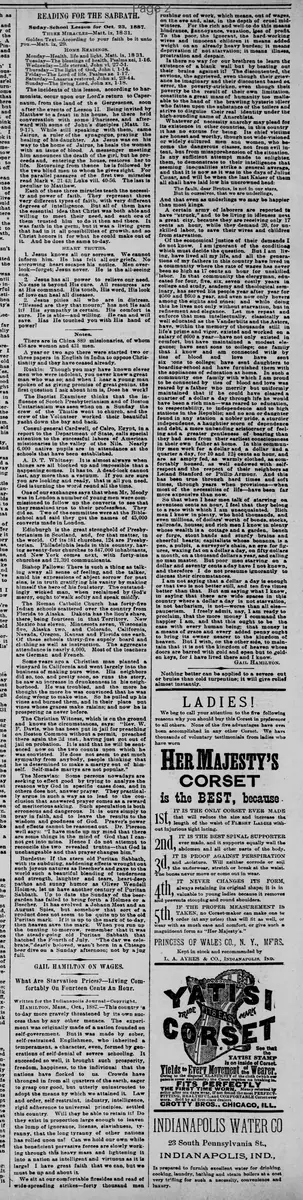
GAIL HAMILTON ON WAGES
What Are Starvation Prices?-Living Comfortably On Fourteen Cents An Hour.
Written for the Indianapolis Journal-Copyright.
HaMILTON, Mass., Oct., 1887.-This country is to-day more gravely threatened by its own success than by any other menace. The experiment was originally made of a nation founded on self-government. But it was made by sober, self-restrained Englishmen, who inherited a temperament, a character, even, formed by generations of self-denial of severe schooling. It succeeded so well, it brought such prosperity, freedom, happiness, to the individual that the nations have flocked to us. Crowds have thronged in from all quarters of the earth, eager to grasp our good, but utterly uninstructed to adopt the means by which we attained it. Law and order, self-restraint, industry, intelligence, rigid adherence to universal principles, settled this country. Will they be able to retain it? Do they exist in proportion large enough to leaven the lump of ignorance, license, slavishness, tyranny, that the long tyranny of other nations has rolled upon us? Can we hold our own while the beneficient pervasive forces are slowly working through this heavy mass and lightening it into a nation as intelligent and virtuous as it is large? I have great faith that we can, but we must be up and about it.
We sit at our comfortable firesides and read of wide-spreading strikes-forty thousand men rushing out of work, which means, out of wages on the eve and, alas, in the depth of cruel mid winters. For the rich and well-to-do this means hindrance, annoyance, vexation, loss of profit. To the poor, the ignorant, the hard-working wives and innocent children it means added weight on an already heavy burden; it means deprivation if not starvation; it means illness, prostration and despair.
Is there no way for our brethren to learn the existence of a blank wall but by beating out their brains against it? The discontented, the envious, the aggrieved, even though their grievance be imaginary and their discontent based on error, the poverty-stricken, even though their poverty be the result of their own limitation, constitute a great mass of humanity too malleable to the hand of the brawling hysteric idlers who fatten upon the substance of the toilers and strive to disguise their real identity under the high-sounding name of Anarchists.
Whatever of necessity anarchy may plead for its existence in other countries, in this country it has no excuse for being. Its chief victims are honest and worthy, though not wide-visioned or widely cultured men and women, who become the dangerous classes, not from evil intent, but from misapprehension of the situation.
Is any sufficient attempt made to enlighten them, to demonstrate to their intelligence that seeming inequalities strike a general average, and that it is now as it was in the days of Julius Caesar, and will be when the last Kaiser of them all shall have laid low his uncrowned head:
The fault, dear Brutus, is not in our stars,
But in ourselves, that we are underlings,
And that even as underlings we may be happier than most kings.
A certain army of laborers are reported to have "struck," and to be living in idleness near a great city, because they are receiving only 17 cents an hour, while they demand 20, for unskilled labor, to save their wives and children from starvation.
Of the economical justice of their demands I do not know. I am ignorant of the condition which must decide the question. But I am living, have lived all my life, and all the generations of my fathers in this country have lived in a community where the rate of wages has never been so high as 17 cents an hour for unskilled labor. In that community the clergyman, educated for four, five, six, seven costly years in college and study, academy and theological seminary, has served his people year after year for $500 and $600 a year, and even now only hovers among the eights and nines; and while doing this he lives not only without starvation, but in refinement and elegance. Let me repeat and enforce that men intellectually, classically as well educated as the Vanderbilts and the Astors, have, within the memory of thousands still in life's prime and vigor, existed and worked on a salary of $600 a year-have not only existed in comfort, but have maintained a modest elegance; have sent sons to college; one family that I know and am connected with by ties of blood and love have sent six sons to college; have sent daughters to boarding-school and have furnished them with the appliances of education at home. In such a community one family with which I am proud to be connected by ties of blood and love was reared by a father who merrily but uniformly maintained that if he could have cleared a quarter of a dollar a day through life he would have been a rich man-was reared to education, to respectability, to independence and to high stations in the Republic; and no son or daughter found in any station a nobler pride, a sturdier independence, a haughtier scorn of dependence and debt, a more unbending aristocracy of feeling and a greater gentleness of bearing than they had seen from their earliest consciousness in their own father at home. In this community men work for a dollar and a dollar and a quarter a day, for 10 and 12 cents an hour, and are as amply fed, as warmly clothed, as comfortably housed, as well endowed with self-respect and the respect of their neighbors as Leland Stanford or Philip Armour. And this has been true through hard times and soft times, through years when provisions-when most of the necessities of life-have been far more expensive than now.
So that when I hear men talk of starving on seventeen cents an hour, I feel that they belong to a race with which I am unacquainted. Rich men I know in plenty, who hold thousands, and even millions, of dollars' worth of bonds, stocks, railroads, houses; and rich men I know in plenty whose wealth is a cottage and a garden, bench or forge, stout hands and sturdy brains and cheerful hearts; capitalists whose bonanza is a pen, a pulpit, a surveyor's chain, an eye for figures, waxing fat on a dollar a day, on fifty dollars a month, on a thousand dollars a year, and calling no man master. But poor men starving on a dollar and seventy cents a day have I not known, and therefore I do not presume ignorantly to discuss their circumstances.
I am not saying that a dollar a day is enough or that two is not better still, and ten five times better than that. But am saying what I know in saying that there are wide spaces in this country where a dollar a day is not starvation, is not barbarism, is not--worse than all else-- pauperism. I freely admit, nay, I am ready to proclaim, that the more money I command the happier I am, and that this ought to be the case with every human being; that money is a means of grace and every added penny ought to bring its owner nearer to the kingdom of heaven. But I wish, on the other side, to maintain that it is not the kingdom of heaven whose doors are barred with gold and open but to golden keys, for I have lived there and I know.
GAIL HAMILTON.
Nothing better can be applied to a severe cut or bruise than cold turpentine; it will give relief almost instantly.
What Are Starvation Prices?-Living Comfortably On Fourteen Cents An Hour.
Written for the Indianapolis Journal-Copyright.
HaMILTON, Mass., Oct., 1887.-This country is to-day more gravely threatened by its own success than by any other menace. The experiment was originally made of a nation founded on self-government. But it was made by sober, self-restrained Englishmen, who inherited a temperament, a character, even, formed by generations of self-denial of severe schooling. It succeeded so well, it brought such prosperity, freedom, happiness, to the individual that the nations have flocked to us. Crowds have thronged in from all quarters of the earth, eager to grasp our good, but utterly uninstructed to adopt the means by which we attained it. Law and order, self-restraint, industry, intelligence, rigid adherence to universal principles, settled this country. Will they be able to retain it? Do they exist in proportion large enough to leaven the lump of ignorance, license, slavishness, tyranny, that the long tyranny of other nations has rolled upon us? Can we hold our own while the beneficient pervasive forces are slowly working through this heavy mass and lightening it into a nation as intelligent and virtuous as it is large? I have great faith that we can, but we must be up and about it.
We sit at our comfortable firesides and read of wide-spreading strikes-forty thousand men rushing out of work, which means, out of wages on the eve and, alas, in the depth of cruel mid winters. For the rich and well-to-do this means hindrance, annoyance, vexation, loss of profit. To the poor, the ignorant, the hard-working wives and innocent children it means added weight on an already heavy burden; it means deprivation if not starvation; it means illness, prostration and despair.
Is there no way for our brethren to learn the existence of a blank wall but by beating out their brains against it? The discontented, the envious, the aggrieved, even though their grievance be imaginary and their discontent based on error, the poverty-stricken, even though their poverty be the result of their own limitation, constitute a great mass of humanity too malleable to the hand of the brawling hysteric idlers who fatten upon the substance of the toilers and strive to disguise their real identity under the high-sounding name of Anarchists.
Whatever of necessity anarchy may plead for its existence in other countries, in this country it has no excuse for being. Its chief victims are honest and worthy, though not wide-visioned or widely cultured men and women, who become the dangerous classes, not from evil intent, but from misapprehension of the situation.
Is any sufficient attempt made to enlighten them, to demonstrate to their intelligence that seeming inequalities strike a general average, and that it is now as it was in the days of Julius Caesar, and will be when the last Kaiser of them all shall have laid low his uncrowned head:
The fault, dear Brutus, is not in our stars,
But in ourselves, that we are underlings,
And that even as underlings we may be happier than most kings.
A certain army of laborers are reported to have "struck," and to be living in idleness near a great city, because they are receiving only 17 cents an hour, while they demand 20, for unskilled labor, to save their wives and children from starvation.
Of the economical justice of their demands I do not know. I am ignorant of the condition which must decide the question. But I am living, have lived all my life, and all the generations of my fathers in this country have lived in a community where the rate of wages has never been so high as 17 cents an hour for unskilled labor. In that community the clergyman, educated for four, five, six, seven costly years in college and study, academy and theological seminary, has served his people year after year for $500 and $600 a year, and even now only hovers among the eights and nines; and while doing this he lives not only without starvation, but in refinement and elegance. Let me repeat and enforce that men intellectually, classically as well educated as the Vanderbilts and the Astors, have, within the memory of thousands still in life's prime and vigor, existed and worked on a salary of $600 a year-have not only existed in comfort, but have maintained a modest elegance; have sent sons to college; one family that I know and am connected with by ties of blood and love have sent six sons to college; have sent daughters to boarding-school and have furnished them with the appliances of education at home. In such a community one family with which I am proud to be connected by ties of blood and love was reared by a father who merrily but uniformly maintained that if he could have cleared a quarter of a dollar a day through life he would have been a rich man-was reared to education, to respectability, to independence and to high stations in the Republic; and no son or daughter found in any station a nobler pride, a sturdier independence, a haughtier scorn of dependence and debt, a more unbending aristocracy of feeling and a greater gentleness of bearing than they had seen from their earliest consciousness in their own father at home. In this community men work for a dollar and a dollar and a quarter a day, for 10 and 12 cents an hour, and are as amply fed, as warmly clothed, as comfortably housed, as well endowed with self-respect and the respect of their neighbors as Leland Stanford or Philip Armour. And this has been true through hard times and soft times, through years when provisions-when most of the necessities of life-have been far more expensive than now.
So that when I hear men talk of starving on seventeen cents an hour, I feel that they belong to a race with which I am unacquainted. Rich men I know in plenty, who hold thousands, and even millions, of dollars' worth of bonds, stocks, railroads, houses; and rich men I know in plenty whose wealth is a cottage and a garden, bench or forge, stout hands and sturdy brains and cheerful hearts; capitalists whose bonanza is a pen, a pulpit, a surveyor's chain, an eye for figures, waxing fat on a dollar a day, on fifty dollars a month, on a thousand dollars a year, and calling no man master. But poor men starving on a dollar and seventy cents a day have I not known, and therefore I do not presume ignorantly to discuss their circumstances.
I am not saying that a dollar a day is enough or that two is not better still, and ten five times better than that. But am saying what I know in saying that there are wide spaces in this country where a dollar a day is not starvation, is not barbarism, is not--worse than all else-- pauperism. I freely admit, nay, I am ready to proclaim, that the more money I command the happier I am, and that this ought to be the case with every human being; that money is a means of grace and every added penny ought to bring its owner nearer to the kingdom of heaven. But I wish, on the other side, to maintain that it is not the kingdom of heaven whose doors are barred with gold and open but to golden keys, for I have lived there and I know.
GAIL HAMILTON.
Nothing better can be applied to a severe cut or bruise than cold turpentine; it will give relief almost instantly.
What sub-type of article is it?
Biography
Curiosity
Personal Triumph
What themes does it cover?
Moral Virtue
Misfortune
Social Manners
What keywords are associated?
Low Wages
Living Comfortably
Strikes
Self Reliance
Economic Contentment
What entities or persons were involved?
Gail Hamilton
Vanderbilts
Astors
Leland Stanford
Philip Armour
Where did it happen?
Hamilton, Mass.
Story Details
Key Persons
Gail Hamilton
Vanderbilts
Astors
Leland Stanford
Philip Armour
Location
Hamilton, Mass.
Event Date
Oct., 1887
Story Details
Gail Hamilton argues that low wages like 17 cents an hour are not starvation in her community, where people live comfortably on even less, citing examples of educated men on $500-600 yearly salaries maintaining elegance and sending children to college, emphasizing self-restraint and contentment over demands for higher pay amid strikes.