Thank you for visiting SNEWPapers!
Sign up free
Virginia Argus
Richmond, Virginia
What is this article about?
U.S. House of Representatives session on Nov. 19-20, 1804: handled resignation of PA Rep. Horl, petitions for ports/land/duties, motion for educational import exemptions, commendation for Decatur's Tripoli exploit, chaplains/chairmen rules, treasury appropriations, Louisiana mines resolution, and bills on TN land/insurance.
Clipping
OCR Quality
Full Text
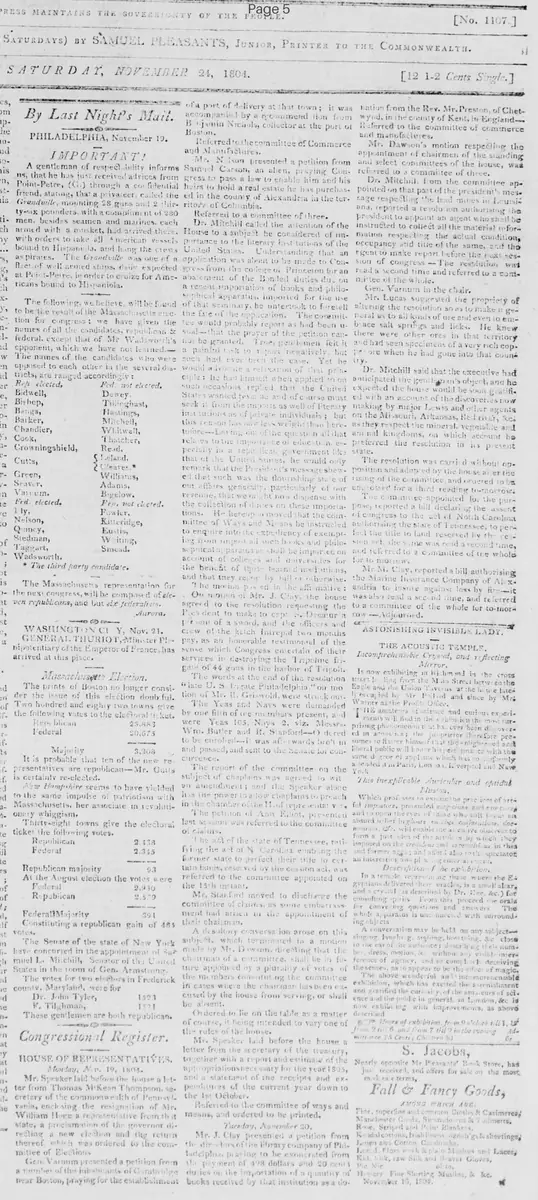
HOUSE OF REPRESENTATIVES.
Monday, Nov. 19, 1804.
Mr. Speaker laid before the house a letter from Thomas M'Kean Thompson, secretary of the commonwealth of Pennsylvania, enclosing the resignation of Mr. William Horl a representative from that state, a proclamation of the governor directing a new election and the return thereof which was ordered to the committee of Elections.
Gen. Varnum presented a petition from a number of the inhabitants of Cambridge near Boston, praying for the establishment of a port of delivery at that town; it was accompanied by a recommendation from Benjamin Nichols, collector at the port of Boston.
Referred to the committee of Commerce and Manufactures.
Mr. Nelson presented a petition from Samuel Carson, an alien, praying Congress to pass a law to enable him and his heirs to hold a real estate he has purchased in the county of Alexandria in the territory of Columbia.
Referred to a committee of three.
Dr. Mitchill called the attention of the House to a subject he considered of importance to the literary institutions of the United States. Understanding that an application was about to be made to Congress from the college at Princeton for abatement of the Bonded duties due on a recent importation of books and philosophical apparatus, imported for the use of that seminary, he undertook to foretell the fate of the application. The committee would probably report as had been usual—that the prayer of the petition cannot be granted. True, gentlemen felt it a painful task to report negatively, but usage had ever been the rule. Yet he would advocate a relaxation of the principle: he had himself when applied to on such occasions replied that the United States wanted revenue and of course must seek it from the imports as well of literary institutions as of private individuals: but this reason had now lost its weight—leaving out of the question all that relates to the importance of education— peculiarly in a republican government like that of the United States, he would only remark that the President's message shewed that such was the flourishing state of our affairs generally, particularly of our revenue, that we might now dispense with the collection of duties on these importations. He thereupon moved that the committee of ways and means be instructed to enquire into the expediency of exempting from duty such books and philosophical apparatus as shall be imported on account of colleges and universities for the benefit of those learned institutions, and that they report by bill or otherwise.
The motion passed in the affirmative.
On motion of Mr. J. Clay, the house agreed to the resolution requesting the President to make to capt. S. Decatur a token of a sword, and the officers and crew of the ketch Intrepid two months pay, as an honorable testimonial of the sense which Congress entertains of their services in destroying the Tripolitan frigate of 44 guns in the harbor of Tripoli.
The words at the end of the resolution "late U. S. frigate Philadelphia," on motion of Mr. R. Griswold, were struck out.
The Yeas and Nays were demanded by one fifth of the members present, and were—Yeas 105. Nays 2. viz. Messrs. Wm. Butler and R. Stanford—Ordered to be engrossed—was afterwards brought in and passed, and sent to the Senate for concurrence.
The report of the committee on the subject of chaplains was agreed to with an amendment: and the Speaker alone has the power to allow chaplains to preach in the chamber of the House at a convenient time.
The petition of Ann Elliot, presented last session was referred to the committee of claims.
The act of the state of Tennessee, ratifying the act of N. Carolina enabling the former state to perfect their title to certain lands, reserved by the Cession act, was referred to the committee appointed on the 15th instant.
Mr. Stanford moved to discharge the committee of claims, as some embarrassment had arisen in the appointment of their chairman.
A desultory conversation arose on this subject, which terminated in a motion made by Mr. Dawson, directing that the chairman of a committee, shall be in future appointed by a majority of votes of the members constituting the committee in cases where the chairman has been excused by the house from serving, or shall be absent.
Ordered to lie on the table as a matter of course, it being intended to vary one of the rules of the house.
Mr. Speaker laid before the house a letter from the secretary of the treasury, together with a report and estimate of the appropriations necessary to the year 1805, and a statement of the receipts and expenditures of the current year down to the 1st October.
Referred to the committee of ways and means, and ordered to be printed.
Tuesday, November 20,
Mr. J. Clay presented a petition from the directors of the library company of Philadelphia, praying to be exonerated from the payment of 408 dollars and 20 cents duties on the importation of a quantity of books received by that institution against duties.
[No. 1107.]
THE COMMONWEALTH.
[12 1-2 Cents Single.]
petition from the Rev. Mr. Preston, of Chetwynd, in the county of Kent, in England—
Referred to the committee of commerce and manufactures.
Mr. Dawson's motion respecting the appointment of chairmen of the standing and select committees of the house, was referred to a committee of three.
Dr. Mitchill, from the committee appointed on that part of the president's message respecting the lead mines in Louisiana, reported a resolution authorizing the president to appoint an agent who shall be instructed to collect all the material information respecting the actual condition, occupancy and title of the same, and to make report before the next session of congress—The resolution was read a second time and referred to a committee of the whole.
Gen. Varnum in the chair.
Mr. Lucas suggested the propriety of altering the resolution so as to make it general as to all kinds of ore and even to embrace salt springs and licks. He knew there were other ores in that territory and had seen specimens of a very rich copper ore when he had gone into that country.
Dr. Mitchill said that the executive had anticipated the gentleman's object, and he expected the house would be soon gratified with an account of the discoveries now making by major Lewis and other agents on the Missouri, Arkansas, Red river, &c. as they respect the mineral, vegetable and animal kingdoms, on which account he preferred the resolution in its present state.
The resolution was carried without opposition and adopted by the house after the rising of the committee and ordered to be engrossed for a third reading to-morrow.
The committee appointed to the purpose, reported a bill declaring the assent of congress to the act of North Carolina authorizing the state of Tennessee, to perfect the title to land reserved by the cession act—the same was read a second time, and referred to a committee of the whole for to-morrow.
Mr. M. Clay, reported a bill authorizing the Marine Insurance Company of Alexandria to insure against loss by fire—it was also read a second time, and referred to a committee of the whole for to-morrow—Adjourned.
What sub-type of article is it?
What keywords are associated?
What entities or persons were involved?
Domestic News Details
Event Date
Monday, Nov. 19, 1804 And Tuesday, November 20, 1804
Key Persons
Event Details
Proceedings in the U.S. House of Representatives included receiving a resignation from Pennsylvania representative William Horl and ordering a new election; petitions for a port of delivery at Cambridge near Boston, for alien Samuel Carson to hold real estate in Alexandria, from Philadelphia library company for duty exoneration, and from Rev. Mr. Preston of England; Dr. Mitchill's motion to inquire into exempting duties on books and apparatus for colleges, which passed; resolution commending Capt. S. Decatur and crew of Intrepid for destroying Tripolitan frigate, passed with amendments; agreement on chaplains report; referral of Ann Elliot's petition and Tennessee land ratification act; discussion and referral of motion on committee chairmen appointment; referral of treasury secretary's letter on appropriations; report and resolution on lead mines in Louisiana, adopted; bills on Tennessee land titles and Marine Insurance Company of Alexandria referred to committee of the whole.