Thank you for visiting SNEWPapers!
Sign up free
St. Johnsbury Caledonian
Saint Johnsbury, Caledonia County, Vermont
What is this article about?
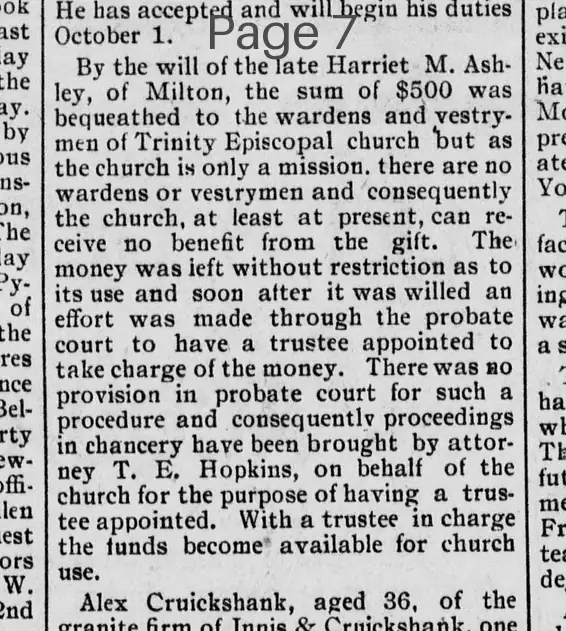
The late Harriet M. Ashley of Milton bequeathed $500 to Trinity Episcopal Church's wardens and vestrymen, but as a mission without them, the church cannot benefit. Attorney T. E. Hopkins filed chancery proceedings to appoint a trustee for the unrestricted funds.
Clipping
OCR Quality
Full Text
What sub-type of article is it?
What keywords are associated?
What entities or persons were involved?
Where did it happen?
Domestic News Details
Primary Location
Milton
Key Persons
Outcome
proceedings in chancery brought to appoint a trustee, making the funds available for church use.
Event Details
By the will of the late Harriet M. Ashley, of Milton, the sum of $500 was bequeathed to the wardens and vestrymen of Trinity Episcopal church but as the church is only a mission, there are no wardens or vestrymen and consequently the church, at least at present, can receive no benefit from the gift. The money was left without restriction as to its use and soon after it was willed an effort was made through the probate court to have a trustee appointed to take charge of the money. There was no provision in probate court for such a procedure and consequently proceedings in chancery have been brought by attorney T. E. Hopkins, on behalf of the church for the purpose of having a trustee appointed. With a trustee in charge the funds become available for church use.