Thank you for visiting SNEWPapers!
Sign up free
Editorial
May 31, 1813
Daily National Intelligencer
Washington, District Of Columbia
What is this article about?
An extract of a letter from an American in Europe discusses British blockade strategies, the core issue of impressment in the War of 1812, the moral superiority of the American cause for sailors' liberty, and British reactions to U.S. naval victories over the Guerriere and Macedonian.
Clipping
OCR Quality
98%
Excellent
Full Text
OUR NAVAL VICTORIES, &C.
Extract of a letter from a distinguished American in the North of Europe, to his friend in Boston.
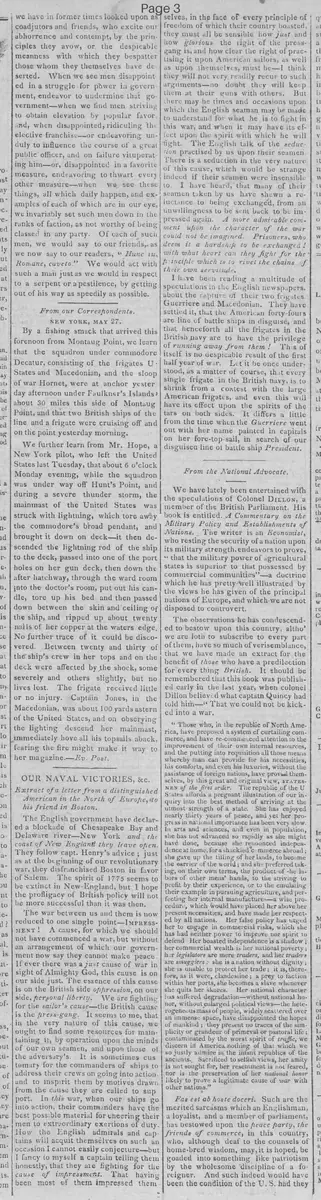
The English government have declared a blockade of Chesapeake Bay and Delaware river—New York and the coast of New England they leave open. They follow capt. Henry's advice; just as at the beginning of our revolutionary war, they disfranchised Boston in favor of Salem. The spirit of 1775 seems to be extinct in New-England, but I hope the profligacy of British policy will not be more successful than it was then. The war between us and them is now reduced to one single point—IMPRESSMENT! A cause, for which we should not have commenced a war, but without an arrangement of which our government now say they cannot make peace. If ever there was a just cause of war in sight of Almighty God, this cause is on our side just. The essence of this cause is on the British side oppression, on our side, personal liberty. We are fighting for the sailor's cause—the British cause is the press-gang. It seems to me, that in the very nature of this cause, we ought to find some resources for maintaining it, by operation upon the minds of our own seamen, and upon those of the adversary's. It is sometimes customary for the commanders of ships to address their crews on going into action, and to inspirit them by motives drawn from the cause they are called to support. In this war, when our ships go into action, their commanders have the best possible material for cheering their men to extraordinary exertions of duty. How the English admirals and captains will acquit themselves on such an occasion I cannot easily conjecture—but I fancy to myself a captain telling them honestly, that they are fighting for the cause of impressment. That having been most of them impressed themselves, in the face of every principle of freedom of which their country boasted, they must all be sensible how just and how glorious the right of the press-gang is, and how clear the right of practising it upon American Sailors, as well as upon themselves, must be—I think they will not very readily recur to such arguments—no doubt they will keep them at their guns with others. But there may be times and occasions upon which the English seaman may be made to understand for what he is to fight in this war, and when it may have its effect upon the spirit with which he will fight. The English talk of the seduction practised by us upon their seamen. There is a seduction in the very nature of this cause, which would be strange indeed if their seamen were insensible to. I have heard, that many of their seamen taken by us have shewn a reluctance to being exchanged, from an unwillingness to be sent back to be impressed again. A more admirable comment upon the character of the war could not be imagined. Prisoners, who deem it a hardship to be exchanged! with what heart can they fight for the principle which is to rivet the chains of their own servitude.
I have been reading a multitude of speculations in the English newspapers, about the capture of their two frigates Guerriere and Macedonian. They have settled it, that the American forty-fours are line of battle ships in disguise, and that henceforth all the frigates in the British navy are to have the privilege of running away from them! This of itself is no despicable result of the first half year of war. Let it be once understood, as a matter of course, that every single frigate in the British navy, is to shrink from a contest with the large American frigates, and even this will have its effect upon the spirits of the tars on both sides. It differs a little from the time when the Guerriere went out with her name painted in capitals on her fore-top-sail, in search of our disguised line of battle ship President.
Extract of a letter from a distinguished American in the North of Europe, to his friend in Boston.
The English government have declared a blockade of Chesapeake Bay and Delaware river—New York and the coast of New England they leave open. They follow capt. Henry's advice; just as at the beginning of our revolutionary war, they disfranchised Boston in favor of Salem. The spirit of 1775 seems to be extinct in New-England, but I hope the profligacy of British policy will not be more successful than it was then. The war between us and them is now reduced to one single point—IMPRESSMENT! A cause, for which we should not have commenced a war, but without an arrangement of which our government now say they cannot make peace. If ever there was a just cause of war in sight of Almighty God, this cause is on our side just. The essence of this cause is on the British side oppression, on our side, personal liberty. We are fighting for the sailor's cause—the British cause is the press-gang. It seems to me, that in the very nature of this cause, we ought to find some resources for maintaining it, by operation upon the minds of our own seamen, and upon those of the adversary's. It is sometimes customary for the commanders of ships to address their crews on going into action, and to inspirit them by motives drawn from the cause they are called to support. In this war, when our ships go into action, their commanders have the best possible material for cheering their men to extraordinary exertions of duty. How the English admirals and captains will acquit themselves on such an occasion I cannot easily conjecture—but I fancy to myself a captain telling them honestly, that they are fighting for the cause of impressment. That having been most of them impressed themselves, in the face of every principle of freedom of which their country boasted, they must all be sensible how just and how glorious the right of the press-gang is, and how clear the right of practising it upon American Sailors, as well as upon themselves, must be—I think they will not very readily recur to such arguments—no doubt they will keep them at their guns with others. But there may be times and occasions upon which the English seaman may be made to understand for what he is to fight in this war, and when it may have its effect upon the spirit with which he will fight. The English talk of the seduction practised by us upon their seamen. There is a seduction in the very nature of this cause, which would be strange indeed if their seamen were insensible to. I have heard, that many of their seamen taken by us have shewn a reluctance to being exchanged, from an unwillingness to be sent back to be impressed again. A more admirable comment upon the character of the war could not be imagined. Prisoners, who deem it a hardship to be exchanged! with what heart can they fight for the principle which is to rivet the chains of their own servitude.
I have been reading a multitude of speculations in the English newspapers, about the capture of their two frigates Guerriere and Macedonian. They have settled it, that the American forty-fours are line of battle ships in disguise, and that henceforth all the frigates in the British navy are to have the privilege of running away from them! This of itself is no despicable result of the first half year of war. Let it be once understood, as a matter of course, that every single frigate in the British navy, is to shrink from a contest with the large American frigates, and even this will have its effect upon the spirits of the tars on both sides. It differs a little from the time when the Guerriere went out with her name painted in capitals on her fore-top-sail, in search of our disguised line of battle ship President.
What sub-type of article is it?
War Or Peace
Foreign Affairs
Military Affairs
What keywords are associated?
Impressment
Naval Victories
War Of 1812
British Blockade
American Frigates
Sailors Liberty
Press Gang
What entities or persons were involved?
English Government
Capt. Henry
American Sailors
British Seamen
Guerriere
Macedonian
President
Editorial Details
Primary Topic
Justification Of War Over Impressment And American Naval Victories
Stance / Tone
Strongly Pro American, Anti British Impressment
Key Figures
English Government
Capt. Henry
American Sailors
British Seamen
Guerriere
Macedonian
President
Key Arguments
War Reduced To Impressment, A Just Cause For Personal Liberty Against British Oppression
American Commanders Can Inspire Crews With The Sailor's Cause
British Captains Unlikely To Motivate With Impressment Arguments
British Seamen Reluctant To Return After Capture Due To Fear Of Re Impressment
British Newspapers Speculate American Frigates Are Disguised Ships Of The Line
British Frigates Will Avoid Combat With Large American Frigates