Thank you for visiting SNEWPapers!
Sign up free
The Camden Journal
Camden, Kershaw County, South Carolina
What is this article about?
Correspondence from Washington reports on U.S. House and Senate proceedings June 11-14, including resolutions on Mexican claims, apportionment bill debates, tariff discussions, potential vetoes by President Tyler, and other legislative matters like Florida occupation and Navy appropriations.
Clipping
OCR Quality
Full Text
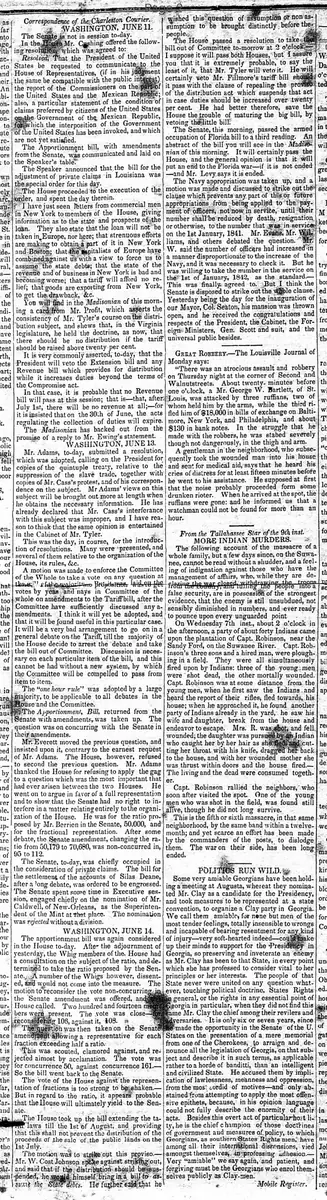
WASHINGTON, JUNE 11.
The Senate is not in session to-day. In the House Mr. Cushing offered the following resolution which was agreed to:
Resolved, That the President of the United States be requested to communicate to the House of Representatives, (if in his judgment the same be compatible with the public interest) the report of the Commissioners on the part of the United States and the Mexican Republic; also, a particular statement of the condition of claims preferred by citizens of the United States on the Government of the Mexican Republic, for which the interposition of the Government of the United States has been invoked, and which are not yet satisfied.
The Apportionment bill, with amendments from the Senate, was communicated and laid on the Speaker's table.
The Speaker announced that the bill for the adjustment of private claims in Louisiana was the special order for this day.
The House proceeded to the execution of the order, and spent the day therein.
I have just seen letters from commercial men in New York to members of the House, giving information as to the state and prospects of the loan. They also state that the loan will not be taken in Europe, nor here; that strenuous efforts are making to obtain a part of it in New York and Boston; that the capitalists of Europe have combined against us with a view to force us to assume the state debts; that the state of the revenue and of business in New York is bad and becoming worse; that a tariff will afford no relief; that goods are exporting from New York, to get the drawback, &c.
You will find in the Madisonian of this morning a card from Mr. Proffit, which asserts the consistency of Mr. Tyler's course on the distribution subject, and shews that, in the Virginia legislature, he held the doctrine, as now, that there should be no distribution if the tariff should be raised above twenty per cent.
It is very commonly asserted, to-day, that the President will veto the Extension bill and any Revenue bill which provides for distribution while it increases duties beyond the terms of the Compromise act.
In that case, it is probable that no Revenue bill will pass at this session; that is—that, after July 1st, there will be no revenue at all;—for it is insisted that on the 30th of June, the acts regulating the collection of duties will expire.
The Madisonian has backed out from the promise of a reply to Mr. Ewing's statement.
WASHINGTON, JUNE 13.
Mr. Adams, to-day, submitted a resolution, which was adopted, calling on the President for copies of the quintuple treaty, relative to the suppression of the slave trade, together with copies of Mr. Cass's protest, and of his correspondence on the subject. Mr Adams' views on this subject will be brought out more at length when he obtains the necessary information. He has already declared that Mr. Cass's interference with this subject was improper, and I have reason to think—that the same opinion is entertained in the Cabinet of Mr. Tyler.
This was the day, in course, for the introduction of resolutions. Many were presented, and several of them relative to the organization of the House, its rules, &c.
A motion was made to enforce the Committee of the Whole to take a vote on any question at the end of one hour, notwithstanding objections to the votes by yeas and nays in Committee of the whole on amendments to the Tariff bill, after the Committee have sufficiently discussed any amendments. I think it will yet be adopted, and that it will be found useful in this particular case.
It will be a very bad arrangement to go on in a general debate on the Tariff, till the majority of the House decide to arrest the debate and take the bill out of Committee. Discussion is necessary on each particular item of the bill, and this cannot be had without a new system, by which the Committee will be compelled to pass from item to item.
The "one hour rule" was adopted by a large majority, to be applicable to all debates in the House and the Committee.
The Apportionment Bill, returned from the Senate with amendments, was taken up. The question was on concurring with the Senate in their amendments.
Mr. Everett moved the previous question, and insisted upon it, contrary to the earnest request of Mr. Adams. The House, however, refused to second the previous question. Mr. Adams thanked the House for refusing to apply the gag to a question which was the most important that had ever arisen between the two Houses. He went on to argue in favor of a full representation and to show that the Senate had no right to interfere in a matter relating entirely to the organization of the House. He was for the ratio proposed by Mr. Berrien in the Senate, 50,000, and for the fractional representation. After some debate, the Senate amendment, changing the ratio from 50,179 to 70,680, was non-concurred in, 95 to 112.
The Senate, to-day, was chiefly occupied in the consideration of private claims. The bill for the settlement of the accounts of Silas Deane after a long debate, was ordered to be engrossed.
The Senate spent some time in Executive session, engaged chiefly on the nomination of Mr. Caldwell, of New-Orleans, as the Superintendent of the Mint at that place. The nomination was rejected without a division.
WASHINGTON, JUNE 14.
The apportionment bill was again considered in the House to-day. After the adjournment of yesterday, the Whig members of the House had a consultation on the subject of the ratio, and determined to take the ratio proposed by the Senate. A number of the Whigs however, dissented, and would not come into the measure. The motion to reconsider the vote non-concurring in the Senate amendment, was offered, and House called. Two hundred and fourteen members were present. The vote was close—reconsidering 105, against it, 108.
The question was then taken on the Senate amendment allowing a representative for each fraction exceeding half a ratio.
This was scouted, clamored against, and rejected almost by acclamation. The vote was for concurrence 50, against concurrence 161.
So the bill went back to the Senate.
The vote of the House against the representation of fractions is too strong to be shaken.— But in regard to the ratio, it appears probable that the House will ultimately yield to the Senate.
The House took up the bill extending the laws till the 1st of August, and providing that this shall not prevent the distribution of the proceeds of the sale of the public lands on the 1st July.
The motion is to strike out this proviso.—
Mr. W. Cost Johnson spoke against striking out, and said that if the distribution should be suspended, he would himself bring in a bill to assume the State debts. He further said that he wished this question of assumption or non-assumption to be brought distinctly before the people.
The House passed a resolution to take the bill out of Committee to-morrow at 2 o'clock, I suppose it will pass both Houses, but I assure you that it is extremely probable, to say the least of it, that Mr. Tyler will veto it. He will certainly veto Mr. Fillmore's tariff bill should it pass with the clause of repealing the proviso of the distribution act which suspends that act in case duties should be increased over twenty per cent. He had better therefore, save the House the trouble of maturing the big bill, by vetoing the little bill.
The Senate, this morning, passed the armed occupation of Florida bill to a third reading. An abstract of the bill you will see in the Madisonian of this morning. It will certainly pass the House; and the general opinion is that it will put an end to the Florida war—if it is not ended—and Mr. Levy says it is ended.
The Navy appropriation was taken up, and a motion was made and discussed to strike out the clause which prevents any part of this or future appropriations from being applied to the payment of officers, not now in service, until their number shall be reduced by death, resignation or otherwise, to the number that was in service on the 1st January, 1841. Mr. Evans, Mr. Williams, and others debated the question. Mr. W. said the number of officers had increased in a manner disproportionate to the increase of the Navy, and it was necessary to check it. But he was willing to take the number in the service on the 1st of January, 1842, as the standard.— This was finally agreed to.—But I think the Senate is disposed to strike out the whole clause.
Yesterday being the day for the inauguration of our Mayor, Col. Seaton, his mansion was thrown open, and he received the congratulations and respects of the President, the Cabinet, the Foreign Ministers, Gen. Scott and suite, and the universal public besides.
What sub-type of article is it?
What keywords are associated?
What entities or persons were involved?
Where did it happen?
Domestic News Details
Primary Location
Washington
Event Date
June 11, 13, 14
Key Persons
Outcome
apportionment bill non-concurred on senate amendments (95-112); reconsideration vote 105-108; fraction representation rejected 50-161; senate rejected mr. caldwell's nomination; 'one hour rule' adopted; florida armed occupation bill passed senate to third reading; navy appropriation clause modified; potential vetoes by president tyler on extension and revenue bills; mayor col. seaton inaugurated.
Event Details
Reports on U.S. congressional activities: House passes resolution for Mexican claims report; debates Apportionment bill amendments; adopts 'one hour rule' for debates; considers tariff amendments, revenue extension, and distribution; Senate handles private claims, Silas Deane bill, executive nominations, Florida occupation, and Navy appropriations; letters on loan prospects and economic conditions; assertions on President's veto intentions; resolution on slave trade treaty.