Thank you for visiting SNEWPapers!
Sign up free
The Augusta Courier
Augusta, Richmond County, Georgia
What is this article about?
The Georgia Baptist Convention in Atlanta on November 14, 1956, voted 3-1 to reject a report advocating acceptance of the Supreme Court's desegregation decision, led by opposition from Rev. John B. Burch and Dr. Louie D. Newton, reaffirming support for segregation.
Clipping
OCR Quality
Full Text
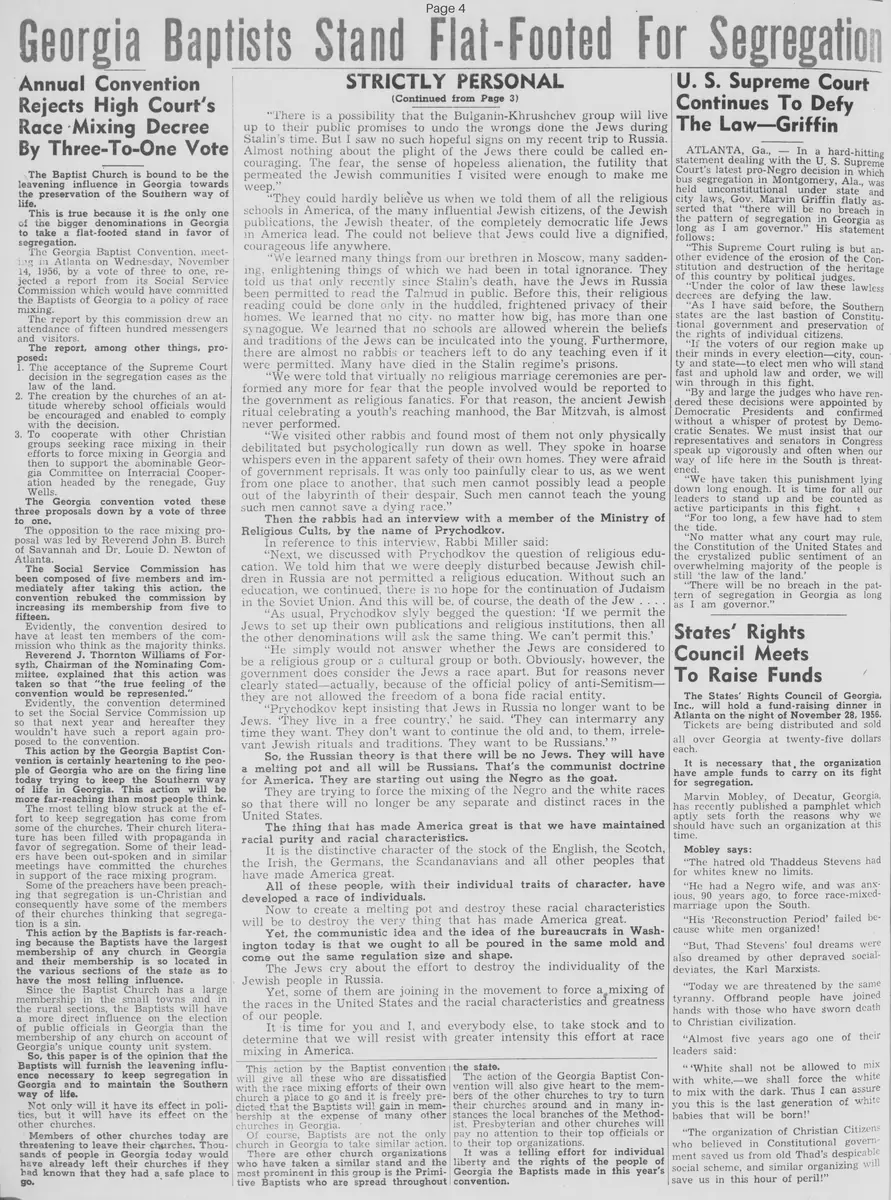
Annual Convention Rejects High Court's Race Mixing Decree By Three-To-One Vote
The Baptist Church is bound to be the leavening influence in Georgia towards the preservation of the Southern way of life.
This is true because it is the only one of the bigger denominations in Georgia to take a flat-footed stand in favor of segregation.
The Georgia Baptist Convention, meeting in Atlanta on Wednesday, November 14, 1956, by a vote of three to one, rejected a report from its Social Service Commission which would have committed the Baptists of Georgia to a policy of race mixing.
The report by this commission drew an attendance of fifteen hundred messengers and visitors.
The report, among other things, proposed:
1. The acceptance of the Supreme Court decision in the segregation cases as the law of the land.
2. The creation by the churches of an attitude whereby school officials would be encouraged and enabled to comply with the decision.
3. To cooperate with other Christian groups seeking race mixing in their efforts to force mixing in Georgia and then to support the abominable Georgia Committee on Interracial Cooperation headed by the renegade, Guy Wells.
The Georgia convention voted these three proposals down by a vote of three to one.
The opposition to the race mixing proposal was led by Reverend John B. Burch of Savannah and Dr. Louie D. Newton of Atlanta.
The Social Service Commission has been composed of five members and immediately after taking this action, the convention rebuked the commission by increasing its membership from five to fifteen.
Evidently, the convention desired to have at least ten members of the commission who think as the majority thinks.
Reverend J. Thornton Williams of Forsyth, Chairman of the Nominating Committee, explained that this action was taken so that "the true feeling of the convention would be represented."
Evidently, the convention determined to set the Social Service Commission up so that next year and hereafter they wouldn't have such a report again proposed to the convention.
This action by the Georgia Baptist Convention is certainly heartening to the people of Georgia who are on the firing line today trying to keep the Southern way of life in Georgia. This action will be more far-reaching than most people think.
The most telling blow struck at the effort to keep segregation has come from some of the churches. Their church literature has been filled with propaganda in favor of segregation. Some of their leaders have been out-spoken and in similar meetings have committed the churches in support of the race mixing program.
Some of the preachers have been preaching that segregation is un-Christian and consequently have some of the members of their churches thinking that segregation is a sin.
This action by the Baptists is far-reaching because the Baptists have the largest membership of any church in Georgia and their membership is so located in the various sections of the state as to have the most telling influence.
Since the Baptist Church has a large membership in the small towns and in the rural sections, the Baptists will have a more direct influence on the election of public officials in Georgia than the membership of any church on account of Georgia's unique county unit system.
So, this paper is of the opinion that the Baptists will furnish the leavening influence necessary to keep segregation in Georgia and to maintain the Southern way of life.
Not only will it have its effect in politics, but it will have its effect on the other churches.
Members of other churches today are threatening to leave their churches. Thousands of people in Georgia today would have already left their churches if they had known that they had a safe place to go.
This action by the Baptist convention will give all these who are dissatisfied with the race mixing efforts of their own church a place to go and it is freely predicted that the Baptists will gain in membership at the expense of many other churches in Georgia.
Of course, Baptists are not the only church in Georgia to take similar action.
There are other church organizations who have taken a similar stand and the most prominent in this group is the Primitive Baptists who are spread throughout the state.
The action of the Georgia Baptist Convention will also give heart to the members of the other churches to try to turn their churches around and in many instances the local branches of the Methodist, Presbyterian and other churches will pay no attention to their top officials or to their top organizations.
It was a telling effort for individual liberty and the rights of the people of Georgia the Baptists made in this year's convention.
What sub-type of article is it?
What themes does it cover?
What keywords are associated?
What entities or persons were involved?
Where did it happen?
Story Details
Key Persons
Location
Atlanta, Georgia
Event Date
Wednesday, November 14, 1956
Story Details
The Georgia Baptist Convention rejected a Social Service Commission report proposing acceptance of Supreme Court desegregation, cooperation with integration efforts, and support for interracial groups, voting 3-1 against it, led by opposition from key figures, and expanded the commission to align with majority views.