Thank you for visiting SNEWPapers!
Sign up free
Madison County Democrat
London, Madison County, Ohio
What is this article about?
Ohio tops sheep density at 28 per square mile and leads east of Missouri in numbers. 1952 value: $29M; annual income: $19M. Stomach worms cost thousands; Dr. Pope recommends phenothiazine drenches and trace minerals for 10-25% better lamb yields.
Clipping
OCR Quality
Full Text
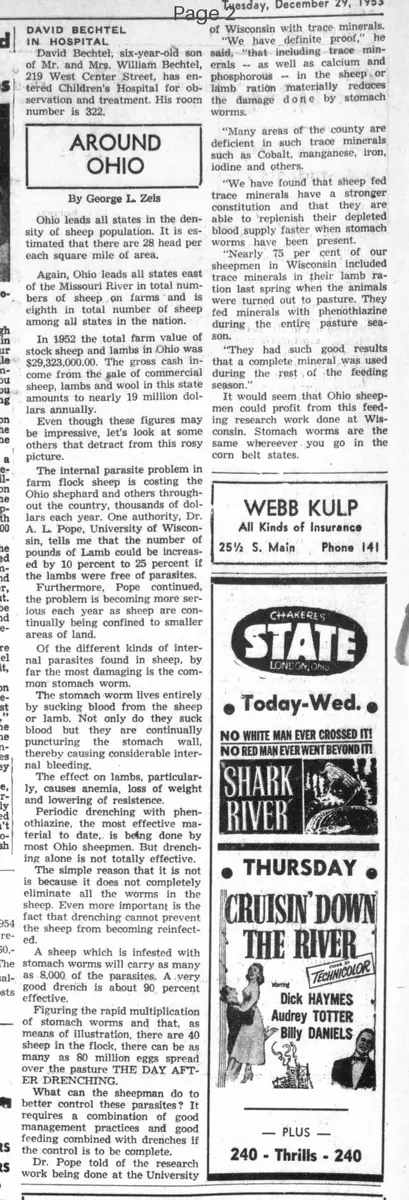
By George L. Zeis
Ohio leads all states in the density of sheep population. It is estimated that there are 28 head per each square mile of area.
Again, Ohio leads all states east of the Missouri River in total numbers of sheep on farms and is eighth in total number of sheep among all states in the nation.
In 1952 the total farm value of stock sheep and lambs in Ohio was $29,323,000.00. The gross cash income from the sale of commercial sheep, lambs and wool in this state amounts to nearly 19 million dollars annually.
Even though these figures may be impressive, let's look at some others that detract from this rosy picture.
The internal parasite problem in farm flock sheep is costing the Ohio shepherd and others throughout the country, thousands of dollars each year. One authority, Dr. A. L. Pope, University of Wisconsin, tells me that the number of pounds of lamb could be increased by 10 percent to 25 percent if the lambs were free of parasites. Furthermore, Pope continued, the problem is becoming more serious each year as sheep are continually being confined to smaller areas of land.
Of the different kinds of internal parasites found in sheep, by far the most damaging is the common stomach worm.
The stomach worm lives entirely by sucking blood from the sheep or lamb. Not only do they suck blood but they are continually puncturing the stomach wall, thereby causing considerable internal bleeding.
The effect on lambs, particularly, causes anemia, loss of weight and lowering of resistance.
Periodic drenching with phenothiazine, the most effective material to date, is being done by most Ohio sheepmen. But drenching alone is not totally effective. The simple reason that it is not is because it does not completely eliminate all the worms in the sheep. Even more important is the fact that drenching cannot prevent the sheep from becoming reinfected.
A sheep which is infested with stomach worms will carry as many as 8,000 of the parasites. A very good drench is about 90 percent effective.
Figuring the rapid multiplication of stomach worms and that, as means of illustration, there are 40 sheep in the flock, there can be as many as 80 million eggs spread over the pasture THE DAY AFTER DRENCHING.
What can the sheepman do to better control these parasites? It requires a combination of good management practices and good feeding combined with drenches if the control is to be complete.
Dr. Pope told of the research work being done at the University of Wisconsin with trace minerals.
"We have definite proof," he said, "that including trace minerals -- as well as calcium and phosphorous -- in the sheep or lamb ration materially reduces the damage done by stomach worms.
"Many areas of the county are deficient in such trace minerals such as Cobalt, manganese, iron, iodine and others.
"We have found that sheep fed trace minerals have a stronger constitution and that they are able to 'replenish their depleted blood supply faster when stomach worms have been present.
"Nearly 75 per cent of our sheepmen in Wisconsin included trace minerals in their lamb ration last spring when the animals were turned out to pasture. They fed minerals with phenothiazine during the entire pasture season.
"They had such good results that a complete mineral was used during the rest of the feeding season."
It would seem that Ohio sheepmen could profit from this feeding research work done at Wisconsin. Stomach worms are the same wherever you go in the corn belt states.
What sub-type of article is it?
What keywords are associated?
What entities or persons were involved?
Where did it happen?
Domestic News Details
Primary Location
Ohio
Key Persons
Outcome
internal parasites cost thousands of dollars annually; potential 10-25% increase in lamb production if controlled using drenches and trace minerals.
Event Details
Ohio leads states in sheep density with 28 per square mile and in total numbers east of Missouri River, eighth nationally. 1952 farm value $29,323,000; annual income from sheep, lambs, wool nearly $19 million. Stomach worms cause anemia, weight loss; phenothiazine drenching 90% effective but reinfection occurs. Research at University of Wisconsin shows trace minerals (cobalt, manganese, iron, iodine) with calcium, phosphorus reduce damage, strengthen sheep.