Thank you for visiting SNEWPapers!
Sign up free
The New Hampshire Gazette And General Advertiser
Portsmouth, Rockingham County, New Hampshire
What is this article about?
Reports from Philadelphia indicate that rumors of Fort Jefferson's capture are unfounded, with Gen. Scott likely to withdraw the garrison. Details emerge on the estimated 3,000 Native American warriors who defeated Gen. St. Clair's army, including alliances from various tribes. Lt. Denny arrives with updates: wounded recovering, Fort Jefferson secure with reinforcements, Gen. Butler killed, and most of 50 women in camp slain.
Clipping
OCR Quality
Full Text
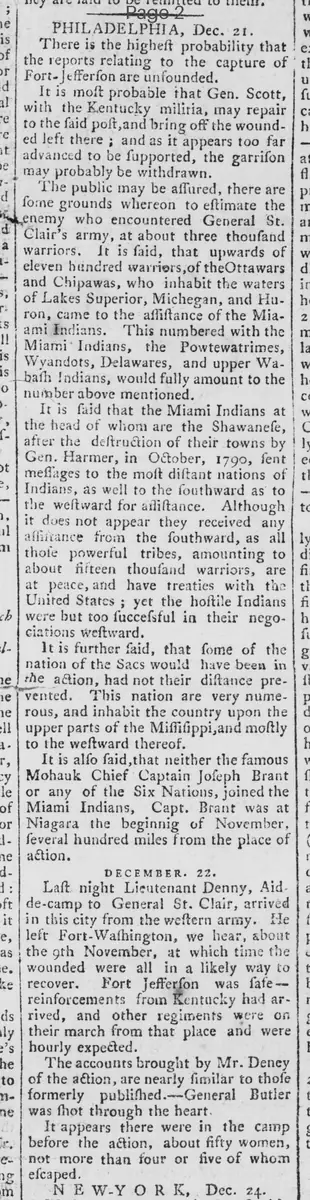
There is the highest probability that the reports relating to the capture of Fort-Jefferson are unfounded.
It is most probable that Gen. Scott, with the Kentucky militia, may repair to the said post, and bring off the wounded left there; and as it appears too far advanced to be supported, the garrison may probably be withdrawn.
The public may be assured, there are some grounds whereon to estimate the enemy who encountered General St. Clair's army, at about three thousand warriors. It is said, that upwards of eleven hundred warriors, of the Ottawas and Chipawas, who inhabit the waters of Lakes Superior, Michigan, and Huron, came to the assistance of the Miami Indians. This numbered with the Miami Indians, the Potewatimes, Wyandots, Delawares, and upper Wabash Indians, would fully amount to the number above mentioned.
It is said that the Miami Indians at the head of whom are the Shawanese, after the destruction of their towns by Gen. Harmer, in October, 1790, sent messages to the most distant nations of Indians, as well to the southward as to the westward for assistance. Although it does not appear they received any assistance from the southward, as all those powerful tribes, amounting to about fifteen thousand warriors, are at peace, and have treaties with the United States: yet the hostile Indians were but too successful in their negotiations westward.
It is further said, that some of the nation of the Sacs would have been in the action, had not their distance prevented. This nation are very numerous, and inhabit the country upon the upper parts of the Mississippi, and mostly to the westward thereof.
It is also said, that neither the famous Mohawk Chief Captain Joseph Brant or any of the Six Nations, joined the Miami Indians, Capt. Brant was at Niagara the beginning of November, several hundred miles from the place of action.
DECEMBER. 22.
Last night Lieutenant Denny, Aide-de-camp to General St. Clair, arrived in this city from the western army. He left Fort-Washington, we hear, about the 6th November, at which time the wounded were all in a likely way to recover.
Fort Jefferson was safe--
reinforcements from Kentucky had arrived, and other regiments were on their march from that place and were hourly expected.
The accounts brought by Mr. Denny of the action, are nearly similar to those formerly published.--General Butler was shot through the heart.
It appears there were in the camp before the action, about fifty women, not more than four or five of whom escaped.
What sub-type of article is it?
What keywords are associated?
What entities or persons were involved?
Where did it happen?
Domestic News Details
Primary Location
Fort Jefferson
Event Date
Dec. 21 22
Key Persons
Outcome
general butler shot through the heart; about fifty women in camp, not more than four or five escaped; wounded recovering; fort jefferson safe with reinforcements.
Event Details
Rumors of Fort Jefferson's capture deemed unfounded, with likely withdrawal of garrison by Gen. Scott. Enemy forces estimated at 3,000 warriors from tribes including Ottawas, Chipawas, Miamis, Potewatimes, Wyandots, Delawares, and upper Wabash Indians, allied after Harmer's 1790 campaign. No southern or Six Nations support; Sacs prevented by distance. Lt. Denny reports from Fort Washington: reinforcements arrived, action details confirm prior accounts.