Thank you for visiting SNEWPapers!
Sign up free
Editorial
August 27, 1812
Virginia Argus
Richmond, Virginia
What is this article about?
The Virginia Argus editorial analyzes the 1812 Baltimore riot, arguing that Alexander Contee Hanson and his armed supporters unlawfully defended a house against a mob attacking their Federal Republican newspaper office, killing two men. It stresses that rights must be pursued through legal channels, not force, to maintain civil order.
Clipping
OCR Quality
95%
Excellent
Full Text
VIRGINIA ARGUS.
RICHMOND:
THURSDAY, AUGUST 27, 1812.
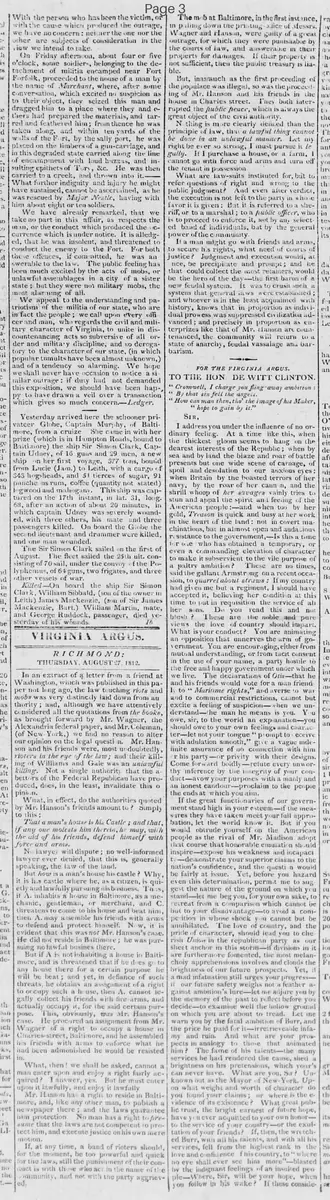
In an extract of a letter from a friend at Washington, which was published in this paper not long ago, the law touching riots and mobs was very distinctly laid down from authority; and, although we have attentively considered all the quotations from the books, as brought forward by Mr. Wagner, the Alexandria federal paper, and Mr. Coleman, (of New York,) we find no reason to alter our opinion on the legal question. Mr. Hanson and his friends were, most undoubtedly, rioters in the eye of the law; and their killing of Williams and Gale was an unlawful killing. Not a single authority that the advocates of the Federal Republican have produced, does, in the least, invalidate this opinion.
What, in effect, do the authorities quoted by Mr. Hanson's friends amount to? Simply to this:
That a man's house is his Castle; and that, if any one molests him therein, he may, with the aid of his friends, defend himself with force and arms.
No lawyer will dispute; no well-informed lawyer ever denied, that this is, generally speaking, the law of the land.
But how is a man's house his castle? Why, it is his castle where he, as a citizen, is quietly and lawfully pursuing his business. This, if A. inhabits a house in Baltimore, as a mechanic, gentleman, or merchant, and C. threatens to come to his house and beat him, then A. may assemble his friends with arms to defend and protect himself. Now, it is evident that this was not Mr. Hanson's case. He did not reside in Baltimore; he was pursuing no lawful business there.
But if A is not inhabiting a house in Baltimore, and is threatened that if he does go to any house there for a certain purpose he will be beat; and yet, in defiance of such threats, he obtains an assignment of a right to occupy such a house, then A. cannot legally collect his friends with fire-arms, and actually occupy it, for the said certain purpose. This, obviously, was Mr. Hanson's case. He procured an assignment from Mr. Wagner of a right to occupy a house in Charles-street, Baltimore, and he assembled his friends with arms to enforce what he had been admonished he would be resisted in.
What, then! we shall be asked, cannot a man enter upon and enjoy a right fairly acquired? I answer, yes. But he must enter upon it lawfully, and enjoy it lawfully.
Mr. Hanson has a right to reside in Baltimore, and, like any other man, to publish a newspaper there; and the laws guarantee him protection. No man has a right to presume that the laws are not competent to protect him, and execute justice on his own mere motion.
If, at any time, a band of rioters should, for the moment, be too powerful and quick for the laws, still the punishment of their conduct is with those who act in the name of the community, and not with the party aggrieved.
The mob at Baltimore, in the first instance, in pulling down the printing-office of messrs. Wagner and Hanson, were guilty of a great outrage, for which they were punishable by the courts of law, and answerable in their property for damages. If their property is not sufficient, then the public treasury is liable.
But, inasmuch as the first proceeding of the populace was illegal, so was the proceeding of Mr. Hanson and his friends in the house in Charles street. They both interrupted the public peace, which is always the great object of the civil authority.
Nothing is more clearly defined than the principle of law, that a lawful thing cannot be done in an unlawful manner. Let my right be ever so strong, I must pursue it legally. If I purchase a house, or a farm, I cannot go with force and arms and turn off the tenant in possession.
What are law-suits instituted for, but to refer questions of right and wrong to the public judgment? And even after verdict, the execution is not left to the party in whose favor it is given: But it is referred to a sheriff, or to a marshal; to a public officer, who is to proceed to enforce it, not by any selected band of individuals, but by the general power of the community.
If a man might go with friends and arms, to secure his rights, what need of courts of justice? Judgment and execution would, at once, be precipitate and prompt; and he that could collect the most retainers, would be the hero of the day—the first baron of a new feudal system. It was to crush such a system that general laws were established; and whoever is in the least acquainted with history, knows that in proportion as individual prowess was suppressed civilization advanced; and precisely in proportion as enterprises like that of Mr. Hanson are countenanced, the community will return to a state of anarchy, feudal vassalage and barbarism.
RICHMOND:
THURSDAY, AUGUST 27, 1812.
In an extract of a letter from a friend at Washington, which was published in this paper not long ago, the law touching riots and mobs was very distinctly laid down from authority; and, although we have attentively considered all the quotations from the books, as brought forward by Mr. Wagner, the Alexandria federal paper, and Mr. Coleman, (of New York,) we find no reason to alter our opinion on the legal question. Mr. Hanson and his friends were, most undoubtedly, rioters in the eye of the law; and their killing of Williams and Gale was an unlawful killing. Not a single authority that the advocates of the Federal Republican have produced, does, in the least, invalidate this opinion.
What, in effect, do the authorities quoted by Mr. Hanson's friends amount to? Simply to this:
That a man's house is his Castle; and that, if any one molests him therein, he may, with the aid of his friends, defend himself with force and arms.
No lawyer will dispute; no well-informed lawyer ever denied, that this is, generally speaking, the law of the land.
But how is a man's house his castle? Why, it is his castle where he, as a citizen, is quietly and lawfully pursuing his business. This, if A. inhabits a house in Baltimore, as a mechanic, gentleman, or merchant, and C. threatens to come to his house and beat him, then A. may assemble his friends with arms to defend and protect himself. Now, it is evident that this was not Mr. Hanson's case. He did not reside in Baltimore; he was pursuing no lawful business there.
But if A is not inhabiting a house in Baltimore, and is threatened that if he does go to any house there for a certain purpose he will be beat; and yet, in defiance of such threats, he obtains an assignment of a right to occupy such a house, then A. cannot legally collect his friends with fire-arms, and actually occupy it, for the said certain purpose. This, obviously, was Mr. Hanson's case. He procured an assignment from Mr. Wagner of a right to occupy a house in Charles-street, Baltimore, and he assembled his friends with arms to enforce what he had been admonished he would be resisted in.
What, then! we shall be asked, cannot a man enter upon and enjoy a right fairly acquired? I answer, yes. But he must enter upon it lawfully, and enjoy it lawfully.
Mr. Hanson has a right to reside in Baltimore, and, like any other man, to publish a newspaper there; and the laws guarantee him protection. No man has a right to presume that the laws are not competent to protect him, and execute justice on his own mere motion.
If, at any time, a band of rioters should, for the moment, be too powerful and quick for the laws, still the punishment of their conduct is with those who act in the name of the community, and not with the party aggrieved.
The mob at Baltimore, in the first instance, in pulling down the printing-office of messrs. Wagner and Hanson, were guilty of a great outrage, for which they were punishable by the courts of law, and answerable in their property for damages. If their property is not sufficient, then the public treasury is liable.
But, inasmuch as the first proceeding of the populace was illegal, so was the proceeding of Mr. Hanson and his friends in the house in Charles street. They both interrupted the public peace, which is always the great object of the civil authority.
Nothing is more clearly defined than the principle of law, that a lawful thing cannot be done in an unlawful manner. Let my right be ever so strong, I must pursue it legally. If I purchase a house, or a farm, I cannot go with force and arms and turn off the tenant in possession.
What are law-suits instituted for, but to refer questions of right and wrong to the public judgment? And even after verdict, the execution is not left to the party in whose favor it is given: But it is referred to a sheriff, or to a marshal; to a public officer, who is to proceed to enforce it, not by any selected band of individuals, but by the general power of the community.
If a man might go with friends and arms, to secure his rights, what need of courts of justice? Judgment and execution would, at once, be precipitate and prompt; and he that could collect the most retainers, would be the hero of the day—the first baron of a new feudal system. It was to crush such a system that general laws were established; and whoever is in the least acquainted with history, knows that in proportion as individual prowess was suppressed civilization advanced; and precisely in proportion as enterprises like that of Mr. Hanson are countenanced, the community will return to a state of anarchy, feudal vassalage and barbarism.
What sub-type of article is it?
Crime Or Punishment
Legal Reform
Press Freedom
What keywords are associated?
Baltimore Riot
Riots And Mobs
Legal Rights
Vigilantism
Press Protection
Unlawful Killing
Civil Authority
What entities or persons were involved?
Mr. Hanson
Mr. Wagner
Williams
Gale
Federal Republican
Mob At Baltimore
Editorial Details
Primary Topic
Legal Critique Of Armed Defense In The Baltimore Riot
Stance / Tone
Advocating Legal Recourse Over Vigilantism
Key Figures
Mr. Hanson
Mr. Wagner
Williams
Gale
Federal Republican
Mob At Baltimore
Key Arguments
Mr. Hanson And Friends Were Rioters And Their Killing Was Unlawful
A Man's House Is His Castle Only When Lawfully Pursuing Business There
Rights Must Be Entered And Enjoyed Lawfully, Not With Force
Laws Guarantee Protection; Individuals Should Not Presume To Execute Justice
Both The Initial Mob And Hanson's Group Interrupted Public Peace
Lawful Ends Cannot Justify Unlawful Means
Courts And Public Officers Enforce Rights, Not Private Armed Bands
Vigilantism Leads To Anarchy And Feudalism