Thank you for visiting SNEWPapers!
Sign up free
Gazette Of The United States
Philadelphia, Philadelphia County, Pennsylvania
What is this article about?
Camillus defends articles 14 and 15 of the Jay Treaty, explaining reciprocal commerce and navigation rights between the US and British European dominions, most favored nation treatment, duty equalizations, and countervailing measures, comparing to other US treaties and refuting objections.
Merged-components note: Continuation of the editorial essay 'THE DEFENCE--No. XXVII.' across pages 2 and 3; original story label corrected to editorial as it is an opinion piece on the treaty.
Clippings
1 of 2
OCR Quality
Full Text
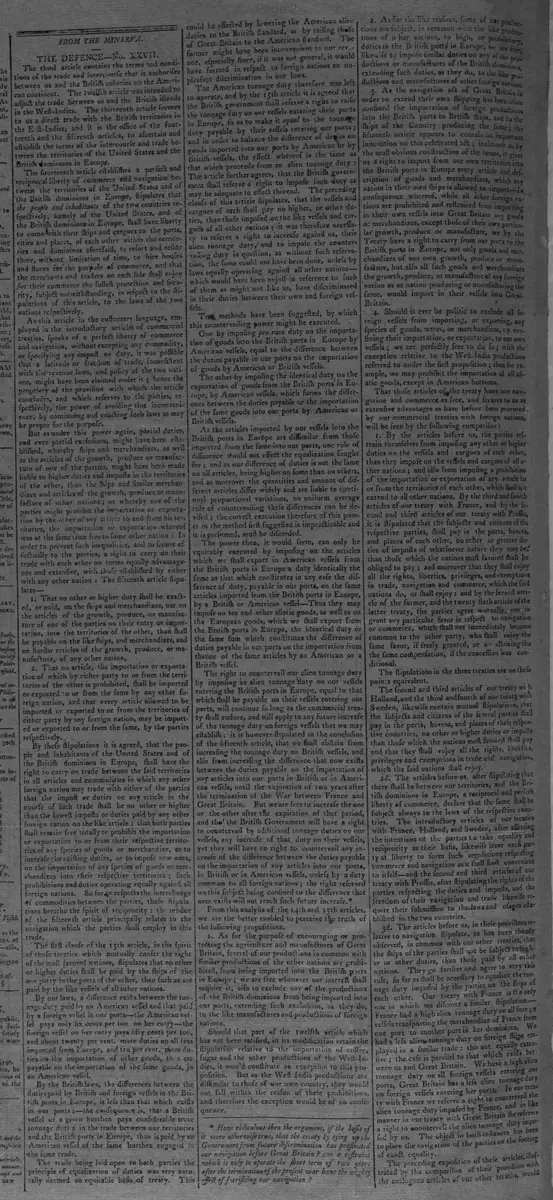
THE DEFENCE--No. XXVII.
The third article contains the terms and conditions of the trade and intercourse that it authorizes between us and the British colonies on the American continent. The twelfth article was intended to adjust the trade between us and the British islands in the West-Indies. The thirteenth article secures to us a direct trade with the British territories in the East-Indies: and it is the office of the fourteenth and the fifteenth articles, to ascertain and establish the terms of the intercourse and trade between the territories of the United States and the British dominions in Europe.
The fourteenth article establishes a perfect and reciprocal liberty of commerce and navigation between the territories of the United States and of the British dominions in Europe, stipulates that the people and inhabitants of the two countries respectively, namely of the United States, and of the British dominions in Europe, shall have liberty to come with their ships and cargoes to the ports, cities and places, of each other within the territories and dominions aforesaid, to resort and reside there, without limitation of time, to hire houses and stores for the purpose of commerce, and that the merchants and traders on each side shall enjoy for their commerce the fullest protection and security, subject notwithstanding, in respect to the stipulations of this article, to the laws of the two nations respectively.
As this article in the customary language, employed in the introductory articles of commercial treaties, speaks of a perfect liberty of commerce and navigation, without excepting any commodity, or specifying any impost or duty, it was possible that a latitude or freedom of trade, inconsistent with the revenue laws, and policy of the two nations, might have been claimed under it; hence the propriety of the provision with which the article concludes, and which reserves to the parties, respectively, the power of avoiding this inconvenience, by continuing and enacting such laws as may be proper for the purpose.
But as under this power again, partial duties, and even partial exclusions, might have been established, whereby ships and merchandizes, as well as the articles of the growth, produce or manufacture of one of the parties, might have been made liable to higher duties and imposts in the territories of the other, than the ships and similar merchandizes and articles of the growth, produce or manufacture of other nations; or whereby one of the parties might prohibit the importation or exportation by the other of any article to and from his territories, the importation or exportation whereof was at the same time free to some other nation: In order to prevent such inequalities, and to secure effectually to the parties, a right to carry on their trade with each other on terms equally advantageous and extensive, with those established by either with any other nation: The fifteenth article stipulates--
1. That no other or higher duty shall be exacted, or paid, on the ships and merchandizes, nor on the articles of the growth, produce, or manufacture of one of the parties on their entry or importation, into the territories of the other, than shall be payable on the like ships, and merchandizes, and on similar articles of the growth, produce, or manufacture, of any other nation,
2. That no article, the importation or exportation of which by either party to or from the territories of the other is prohibited, shall be imported or exported to or from the same by any other foreign nation, and that every article allowed to be imported or exported to or from the territories of either party by any foreign nation, may be imported or exported to or from the same, by the parties respectively.
By these stipulations it is agreed, that the people and inhabitants of the United States and of the British dominions in Europe, shall have the right to carry on trade between the said territories in all articles and commodities in which any other foreign nation may trade with either of the parties that the impost or duties on any article in the course of such trade shall be no other or higher than the lowest imposts or duties paid by any other foreign nation on the like article: that both parties shall remain free totally to prohibit the importation or exportation to or from their respective territories of any species of goods or merchandize, or to increase the existing duties, or to impose new ones, on the importation of any species of goods or merchandizes into their respective territories; such prohibitions and duties operating equally against all foreign nations. So far as respects the interchange of commodities between the parties, these stipulations breathe the spirit of reciprocity: the residue of the fifteenth article principally relates to the navigation which the parties shall employ in this trade.
The first clause of the 15th article, in the spirit of those treaties which mutually confer the right of the most favored nations, stipulates that no other or higher duties shall be paid by the ships of the one party in the ports of the other, than such as are paid by the like vessels of all other nations.
By our laws, a difference exists between the tonnage duty paid by an American vessel and that paid by a foreign vessel in our ports--the American vessel pays only six cents per ton on her entry--the foreign vessel on her entry pays fifty cents per ton, and about twenty per cent. more duties on all teas imported from Europe, and ten per cent. more duties on the importation of other goods, than are payable on the importation of the same goods, in an American vessel.
By the British laws, the differences between the duties paid by British and foreign vessels in the British ports in Europe, is less than that which exists in our ports:--the consequence is, that a British vessel of a given burthen pays considerably more tonnage duties in the trade between our territories and the British ports in Europe, than is paid by an American vessel of the same burthen engaged in the same trade.
The trade being laid open to both parties the principle of equalization of duties was very natural; and equalization could be effected by lowering the American alien duties to the British standard, or by raising those of Great-Britain to the American standard. The former might have been inconvenient to our revenue, especially since, if it was not general, it would have formed in respect to foreign nations an unpleasant discrimination in our laws.
The American tonnage duty therefore was left to operate, and by the 15th article it is agreed that the British government shall reserve a right to raise the tonnage duty on our vessels entering their ports in Europe, so as to make it equal to the tonnage duty payable by their vessels entering our ports; and in order to balance the difference of duties on goods imported into our ports by American or by British vessels, the effect whereof is the same as that which proceeds from an alien tonnage duty: The article further agrees, that the British government shall reserve a right to impose such duty as may be adequate to effect this end. The preceding clause of this article stipulates, that the vessels and cargoes of each shall pay no higher, or other duties, than those imposed on the like vessels and cargoes of all other nations; it was therefore necessary to reserve a right to increase against us, their prevailing duty in question, as without such reservation, the same could not have been done, unless by laws equally operating against all other nations--which would have been unjust in reference to such of them as might not like us, have discriminated in their duties between their own and foreign vessels.
Two methods have been suggested, by which this countervailing power might be executed.
One by imposing pro rata duty on the importation of goods into the British ports in Europe by American vessels, equal to the difference between the duties payable in our ports on the importation of goods by American or British vessels.
The other by imposing the identical duty on the exportation of goods from the British ports in Europe, by American vessels, which forms the difference between the duties payable on the importation of the same goods into our ports by American or British vessels.
As the articles imported by our vessels into the British ports in Europe are dissimilar from those imported from the same into our ports, one rule of difference would not effect the equalization sought for; and as our difference of duties is not the same on all articles, being higher on some than on others, and as moreover the quantities and amount of different articles differ widely and are liable to continual proportional variations, no uniform average rule of countervailing these differences can be devised; the correct execution therefore of this power in the method first suggested is impracticable and it is presumed, must be discarded.
The power then, it would seem, can only be equitably executed by imposing on the articles which we shall export in American vessels from the British ports in Europe a duty identically the same as that which constitutes in any case the difference of duty, payable in our ports, on the same articles imported from the British ports in Europe, by a British or American vessel--Thus they may impose on tea and other asiatic goods, as well as on the European goods, which we shall export from the British ports in Europe, the identical duty or the same sum which constitutes the difference of duties payable in our ports on the importation from thence of the same articles by an American or a British vessel.
The right to countervail our alien tonnage duty by imposing an alien tonnage duty on our vessels entering the British ports in Europe, equal to that which shall be payable on their vessels entering our ports, will continue so long as the commercial treaty shall endure, and will apply to any future increase of the tonnage duty on foreign vessels that we may establish; it is however stipulated in the conclusion of the fifteenth article, that we shall abstain from increasing the tonnage duty on British vessels, and also from increasing the difference that now exists between the duties payable on the importation of any articles into our ports in British or in American vessels, until the expiration of two years after the termination of the War between France and Great Britain. But we are free to increase the one or the other after the expiration of that period, and tho' the British Government will have a right to countervail by additional tonnage duties on our vessels, any increase of that duty on their vessels, yet they will have no right to countervail any increase of the difference between the duties payable on the importation of any articles into our ports, in British or in American vessels, unless by a duty common to all foreign nations; the right reserved on this subject being confined to the difference that now exists will not reach such future increase.*
From this analysis of the 14th and 15th articles, we are the better enabled to perceive the truth of the following propositions.
I. As for the purpose of encouraging or protecting the agriculture and manufactures of Great Britain, several of our productions in common with similar productions of the other nations are prohibited, from being imported into the British ports in Europe; we are free whenever our interest shall require it, also to exclude any of the productions of the British dominions from being imported into our ports, extending such exclusions, as they do, to the like manufactures and productions of foreign nations.
Should that part of the twelfth article which has not been ratified, in its modification retain the stipulation relative to the importation of coffee, sugar and the other productions of the West-Indies. it would constitute an exception to this proposition. But as the West India productions are dissimilar to those of our own country, they would not fall within the reason of these prohibitions, and therefore the exception would be of no consequence.
* How ridiculous then the argument, if the basis of it were otherwise true, that the treaty by tying up the Government from future discrimination has prostrated our navigation before Great Britain? can a restraint which is only to operate the short term of two years after the termination of the present war have the mighty effect of sacrificing our navigation?
2. As for the like reasons, some of our productions are subject, in common with the like productions of other nations, to high, or prohibitory, duties in the British ports in Europe, we are free, likewise to impose similar duties on any of the productions or manufactures of the British dominions extending such duties as they do to the like productions and manufactures of other foreign nations.
3. As the navigation act of Great Britain in order to extend their own shipping has heretofore confined the importation of foreign productions into the British ports to British ships, and to the Ships of the Country producing the same; the fifteenth article appears to contain an important innovation on this celebrated act; inasmuch as, by the most obvious construction of the terms, it gives us a right to import from our own territories into the British ports in Europe every article and description of goods and merchandizes, which any nation in their own ships is allowed to import in consequence whereof, while all other foreign nations are prohibited and restrained from importing in their own vessels into Great Britain any goods or merchandizes, except those of their own particular growth, produce or manufacture, we by the Treaty have a right to carry from our ports to the British ports in Europe, not only goods and merchandizes of our own growth, produce or manufacture, but also all such goods and merchandizes the growth, produce, or manufacture of any foreign nation as any nation producing or manufacturing the same, would import in their vessels into Great-Britain.
4. Should it ever be politic to exclude all foreign vessels from importing, or exporting, any species of goods, wares, or merchandizes, by confining their importation, or exportation, to our own vessels; we are perfectly free to do so; with the exception relative to the West-India productions referred to under the first proposition; thus for example, we may prohibit the importation of all asiatic goods, except in American bottoms.
That these articles of the treaty leave our navigation and commerce as free, and secures to us as extensive advantages as have before been procured by our commercial treaties with foreign nations, will be seen by the following comparison:
I. By the articles before us, the parties restrain themselves from imposing any other or higher duties on the vessels and cargoes of each other, than they impose on the vessels and cargoes of all other nations; and also from imposing a prohibition of the importation or exportation of any article to or from the territories of each other, which shall not extend to all other nations. By the third and fourth articles of our treaty with France, and by the second and third articles of our treaty with Prussia, it is stipulated that the subjects and citizens of the respective parties, shall pay in the ports, havens, and places of each other, no other or greater duties of imposts of whatsoever nature they may be, than those which the nations most favored shall be obliged to pay; and moreover that they shall enjoy all the rights, liberties, privileges, and exemptions, in trade, navigation and commerce, which the said nations do, or shall enjoy: and by the second article of the former, and the twenty sixth article of the latter treaty, the parties agree mutually not to grant any particular favor in respect to navigation or commerce, which shall not immediately become common to the other party, who shall enjoy the same favor, if freely granted, or on allowing the same compensation, if the concession was conditional.
The stipulations in the three treaties are on these points equivalent.
The second and third articles of our treaty with Holland, and the third and fourth of our treaty with Sweden, likewise contain mutual stipulations, that the subjects and citizens of the several parties shall pay in the ports, havens, and places of their respective countries, no other or higher duties or imposts than those which the nations most favored shall pay and that they shall enjoy all the rights, liberties, privileges and exemptions in trade and navigation, which the said nations shall enjoy.
2d. The articles before us, after stipulating that there shall be between our territories, and the British dominions in Europe, a reciprocal and perfect liberty of commerce, declare that the same shall be subject always to the laws of the respective countries. The introductory articles of our treaties with France, Holland, and Sweden, after asserting the intentions of the parties to take equality and reciprocity as their basis, likewise leave each party at liberty to form such regulations respecting commerce and navigation as it shall find convenient to itself--and the second and third articles of our treaty with Prussia, after stipulating the rights of the parties respecting the duties and imposts, and the freedom of their navigation and trade likewise require their submission to the laws and usages established in the two countries.
3d. The articles before us, in their provisions relative to navigation stipulate, as has been already observed, in common with our other treaties, that the ships of the parties shall not be subject to higher or other duties, than those paid by all other nations. They go farther and agree to vary this rule, so far as shall be necessary to equalize the tonnage duty imposed by the parties on the ships of each other. Our treaty with France is the only one in which we discover a similar stipulation.--France had a high alien tonnage duty on all foreign vessels entering her ports, but had a less alien, tonnage duty on foreign ships employed in a similar trade: those vessels transporting the merchandise of France from one port to another port in her dominions, We vessels transporting the merchandise of France from one port to another in her dominions had a less alien tonnage duty. The case is parallel to that which exists between us and Great Britain. We have a high alien tonnage duty on all foreign vessels entering our ports, Great Britain has a less alien tonnage duty on foreign vessels entering her ports. In our treaty with France we reserve a right to countervail the alien tonnage duty imposed by France, and in like manner in our treaty with Great Britain she reserves a right to countervail the alien tonnage duty imposed by us. The object in both instances has been to place the navigation of the parties on the footing of exact equality.
The preceding exposition of these articles, illustrated by the comparison of their provisions with the analogous articles of our other treaties, would be sufficient to vindicate them against the objections to which they have been exposed. It is however thought advisable to take notice of such of the objections as are likely to have any influence on the public opinion. This will be done in a subsequent number.
CAMILLUS.
What sub-type of article is it?
What keywords are associated?
What entities or persons were involved?
Editorial Details
Primary Topic
Defense Of The 14th And 15th Articles Of The Jay Treaty On Commerce And Navigation Between The Us And British Dominions
Stance / Tone
Defensive Vindication Of Treaty Provisions Against Objections
Key Figures
Key Arguments