Thank you for visiting SNEWPapers!
Sign up free
Editorial
June 2, 1787
Fowle's New Hampshire Gazette And General Advertiser
Portsmouth, Rockingham County, New Hampshire
What is this article about?
An editorial from London on April 9 warns against the French Treaty, highlighting France's global military buildup in India, Africa, America, and Europe, and the risks to British possessions, including potential conquest of America and loss of Newfoundland, urging opposition to the treaty.
Clipping
OCR Quality
95%
Excellent
Full Text
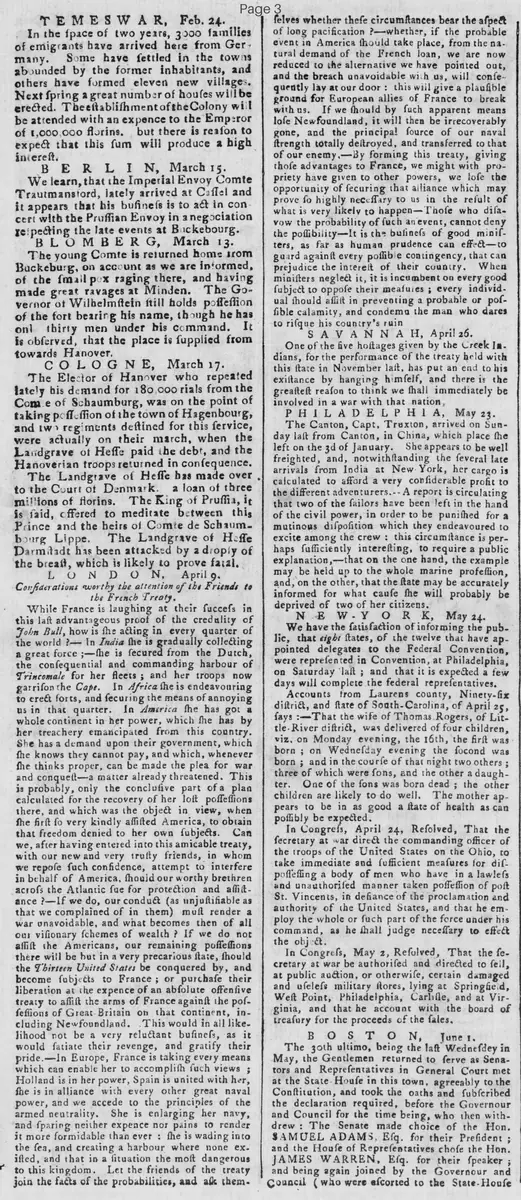
LONDON, April 9.
Considerations worthy the attention of the Friends to the French Treaty.
While France is laughing at their success in this last advantageous proof of the credulity of John Bull, how is she acting in every quarter of the world?-- In India she is gradually collecting a great force; she is secured from the Dutch, the consequential and commanding harbour of Trincomale for her fleets; and her troops now garrison the Cape. In Africa she is endeavouring to erect forts, and securing the means of annoying us in that quarter. In America she has got a whole continent in her power, which she has by her treachery emancipated from this country.
She has a demand upon their government, which she knows they cannot pay, and which, whenever she thinks proper, can be made the plea for war and conquest--a matter already threatened. This is probably, only the conclusive part of a plan calculated for the recovery of her lost possessions there, and which was the object in view, when she first so very kindly assisted America, to obtain that freedom denied to her own subjects. Can we, after having entered into this amicable treaty, with our new and very trusty friends, in whom we repose such confidence, attempt to interfere in behalf of America, should our worthy brethren across the Atlantic sue for protection and assistance?--If we do, our conduct (as unjustifiable as that we complained of in them) must render a war unavoidable, and what becomes then of all our visionary schemes of wealth? If we do not assist the Americans, our remaining possessions there will be but in a very precarious state, should the Thirteen United States be conquered by, and become subjects to France; or purchase their liberation at the expense of an absolute offensive treaty to assist the arms of France against the possessions of Great-Britain on that continent, including Newfoundland. This would in all likelihood not be a very reluctant business, as it would satiate their revenge, and gratify their pride.--In Europe, France is taking every means which can enable her to accomplish such views; Holland is in her power, Spain is united with her, she is in alliance with every other great naval power, and we accede to the principles of the armed neutrality. She is enlarging her navy, and sparing neither expense nor pains to render it more formidable than ever: she is wading into the sea, and creating a harbour where none existed, and that in a situation the most dangerous to this kingdom. Let the friends of the treaty join the facts of the probabilities, and ask themselves whether these circumstances bear the aspect of long pacification?--whether, if the probable event in America should take place, from the natural demand of the French loan, we are now reduced to the alternative we have pointed out, and the breach unavoidable with us, will consequently lay at our door: this will give a plausible ground for European allies of France to break with us. If we should by such apparent means lose Newfoundland, it will then be irrecoverably gone, and the principal source of our naval strength totally destroyed, and transferred to that of our enemy.--By forming this treaty, giving those advantages to France, we might with propriety have given to other powers, we lose the opportunity of securing that alliance which may prove so highly necessary to us in the result of what is very likely to happen--Those who disavow the probability of such an event, cannot deny the possibility--It is the business of good ministers, as far as human prudence can effect--to guard against every possible contingency, that can prejudice the interest of their country. When ministers neglect it, it is incumbent on every good subject to oppose their measures; every individual should assist in preventing a probable or possible calamity, and condemn the man who dares to risque his country's ruin.
Considerations worthy the attention of the Friends to the French Treaty.
While France is laughing at their success in this last advantageous proof of the credulity of John Bull, how is she acting in every quarter of the world?-- In India she is gradually collecting a great force; she is secured from the Dutch, the consequential and commanding harbour of Trincomale for her fleets; and her troops now garrison the Cape. In Africa she is endeavouring to erect forts, and securing the means of annoying us in that quarter. In America she has got a whole continent in her power, which she has by her treachery emancipated from this country.
She has a demand upon their government, which she knows they cannot pay, and which, whenever she thinks proper, can be made the plea for war and conquest--a matter already threatened. This is probably, only the conclusive part of a plan calculated for the recovery of her lost possessions there, and which was the object in view, when she first so very kindly assisted America, to obtain that freedom denied to her own subjects. Can we, after having entered into this amicable treaty, with our new and very trusty friends, in whom we repose such confidence, attempt to interfere in behalf of America, should our worthy brethren across the Atlantic sue for protection and assistance?--If we do, our conduct (as unjustifiable as that we complained of in them) must render a war unavoidable, and what becomes then of all our visionary schemes of wealth? If we do not assist the Americans, our remaining possessions there will be but in a very precarious state, should the Thirteen United States be conquered by, and become subjects to France; or purchase their liberation at the expense of an absolute offensive treaty to assist the arms of France against the possessions of Great-Britain on that continent, including Newfoundland. This would in all likelihood not be a very reluctant business, as it would satiate their revenge, and gratify their pride.--In Europe, France is taking every means which can enable her to accomplish such views; Holland is in her power, Spain is united with her, she is in alliance with every other great naval power, and we accede to the principles of the armed neutrality. She is enlarging her navy, and sparing neither expense nor pains to render it more formidable than ever: she is wading into the sea, and creating a harbour where none existed, and that in a situation the most dangerous to this kingdom. Let the friends of the treaty join the facts of the probabilities, and ask themselves whether these circumstances bear the aspect of long pacification?--whether, if the probable event in America should take place, from the natural demand of the French loan, we are now reduced to the alternative we have pointed out, and the breach unavoidable with us, will consequently lay at our door: this will give a plausible ground for European allies of France to break with us. If we should by such apparent means lose Newfoundland, it will then be irrecoverably gone, and the principal source of our naval strength totally destroyed, and transferred to that of our enemy.--By forming this treaty, giving those advantages to France, we might with propriety have given to other powers, we lose the opportunity of securing that alliance which may prove so highly necessary to us in the result of what is very likely to happen--Those who disavow the probability of such an event, cannot deny the possibility--It is the business of good ministers, as far as human prudence can effect--to guard against every possible contingency, that can prejudice the interest of their country. When ministers neglect it, it is incumbent on every good subject to oppose their measures; every individual should assist in preventing a probable or possible calamity, and condemn the man who dares to risque his country's ruin.
What sub-type of article is it?
Foreign Affairs
War Or Peace
What keywords are associated?
French Treaty
British Possessions
American Independence
French Aggression
Naval Power
Armed Neutrality
Newfoundland
What entities or persons were involved?
France
America
Britain
Holland
Spain
Dutch
Editorial Details
Primary Topic
Criticism Of The French Treaty And French Global Aggression
Stance / Tone
Strongly Opposed To The French Treaty, Warning Of Inevitable Conflict
Key Figures
France
America
Britain
Holland
Spain
Dutch
Key Arguments
France Is Building Military Forces In India, Securing Harbors Like Trincomale, And Garrisoning The Cape
France Is Erecting Forts In Africa To Annoy Britain
France Has Emancipated America Through Treachery And Holds A Debt That Can Justify War And Conquest
The Treaty Prevents Britain From Aiding America Without Risking War
Failure To Aid America Risks British Possessions, Including Newfoundland, Falling To France
France Controls Holland, Allies With Spain And Naval Powers, And Britain Accedes To Armed Neutrality
France Is Expanding Its Navy And Creating Dangerous Harbors
The Treaty Sacrifices Potential Alliances With Other Powers
Ministers Must Guard Against Contingencies; Subjects Should Oppose Negligent Measures