Thank you for visiting SNEWPapers!
Sign up free
Bozeman Avant Courier
Bozeman, Gallatin County, Montana
What is this article about?
Comprehensive overview of Montana Territory's geography, population, accessibility, impending railroad connections, trade value, agricultural and mineral resources, water and timber supplies, climate, scenery, and societal aspects, highlighting its potential for development into prosperous states.
Clipping
OCR Quality
Full Text
[From the West, San Francisco.]
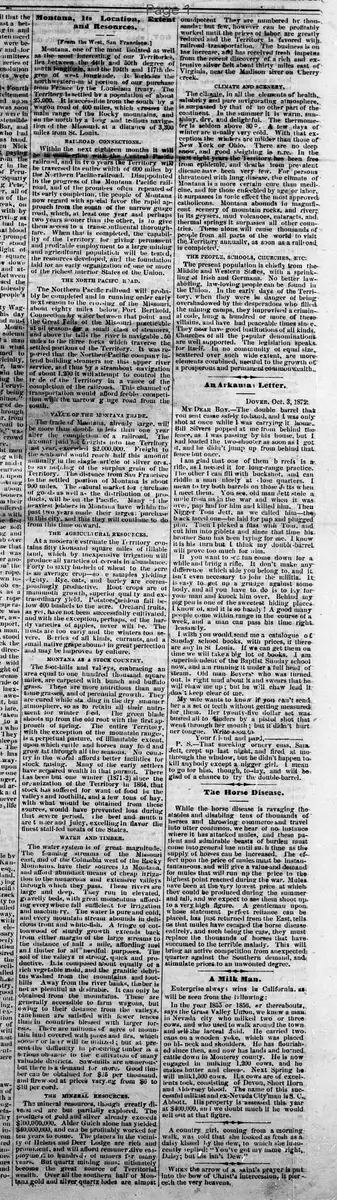
Montana, one of the most isolated as well as the most interesting of our Territories, lies between the 44th and 50th degree of north latitude and the 104th and 117th degrees of west longitude. It embraces the northwestern-most portion of our purchase from France by the Louisiana treaty. The Territory is settled by a population of about 25,000. It is accessible from the south by a wagon road of 400 miles, which crosses the main range of the Rocky mountains, and on the north by a long and tedious navigation of the Missouri, at a distance of 3,500 miles from St. Louis.
RAILROAD CONNECTIONS,
Within the next eighteen months it will be in connection with the Central Pacific railroad, and in two years the Territory will be traversed its entire width of 600 miles by the Northern Pacific railroad. Disappointed in the progress of the Montana-Pacific railroad, and of the promises often repeated of its early completion, the people of Montana now regard with special favor the rapid approach from the south of the narrow gauge road, which, at least one year and perhaps two years sooner than the other, is to give them access to a transcontinental thoroughfare. When that is completed, the capability of the Territory for giving permanent and profitable employment to a large mining and agricultural population will be tested, the resources developed, and the foundation laid for an early organization of one or more of the richest interior States of the Union.
THE NORTHERN PACIFIC ROAD.
The Northern Pacific railroad will probably be completed and in running order early next season to the crossing of the Missouri, about eighty miles below Fort Berthold. Connection by water between that point and the Great Falls of the Missouri practicable at all seasons by a small class of steamers, and above the falls the river is navigable 500 miles to the three forks which traverse the settled portions of the Territory. It was reported that the Northern Pacific company intend building steamers for this upper river service, and thus by a steamboat navigation of about 1,200 miles it will attempt to control the trade of the Territory in advance of the completion of the railroad. This channel of transportation would afford feeble competition with the narrow gauge road from the south.
VALUE OF THE MONTANA TRADE.
The trade of Montana, already large, will be more than double in less than one year after the completion of a railroad. The amount paid for freights into the Territory last year exceeded $2,000,000. Freight to the seaboard would reach half this amount annually in the single article of silver ores, to say nothing of the surplus grain of the Territory. The distance from San Francisco to the settled portion of Montana is about 1,000 miles. The natural market for purchase of goods as well as the distribution of products, will be on the Pacific. Many of the heaviest jobbers in Montana have within the past two years made their largest purchases in this city and this they will continue to do from this time onward.
THE AGRICULTURAL RESOURCES.
At a moderate estimate the Territory contains fifty thousand square miles of tillable land, which by inexpensive irrigation will produce all varieties of cereals in abundance. Forty to sixty bushels of wheat to the acre is an average crop - some samples yielding eighty. Rye, oats, and barley are correspondingly productive. Root crops are of mammoth growth, superior quality and extraordinary yield. Potatoes seldom fall below 400 bushels to the acre. Orchard fruits, as yet, have not been successfully cultivated, and with the exception, perhaps, of the hardy varieties of apples, never will be. The frosts are too early and the winters too severe. Berries of all kinds, currants, and a small native grape abound in great perfection and may be improved by culture.
The foot-hills and valleys, embracing an area equal to one hundred thousand square miles, are carpeted with bunch and buffalo grass. These are more nutritious than any tame grasses, and of perennial growth. They are cured while standing in the dry summer atmosphere, so as to retain all their nutriment for winter feed. The green blade shoots up from the old root with the first approach of spring. The entire Territory, with the exception of the mountain ranges, is a perpetual pasture, of illimitable extent, upon which cattle and horses may feed and grow fat through all the seasons. No country in the world affords better facilities for stock raising. Many of the early settlers have acquired wealth in that pursuit. There has been but one winter (1871-2) since the organization of the Territory in 1864, that stock has suffered for want of food in the valleys and foot-hills, and a few tons of hay, with what would be obtained from these sources, would have prevented loss during that severe period. The beef and mutton are tender and juicy, excelling in flavor the finest stall-fed meats of the States.
WATER AND TIMBER.
The water system is of great magnitude. The foaming streams of the Missouri east, and of the Columbia west of the Rocky Mountains, have their sources in Montana, and afford abundant means of cheap irrigation to the numerous and extensive valleys through which they pass. These rivers are large and deep. They run in elevated, gravelly beds, with great momentum affording everywhere fall sufficient for irrigation and machinery. The water is pure and cold, and every mountain stream abounds in delicious trout and white-fish. A fringe of cottonwood of sturdy growth extends back from either margin of the large streams to the distance of half a mile, affording fuel and timber for all needful purposes. The soil of the valleys is strong, quick and productive. It is composed about equally of a rich vegetable mold, and the granitic debris washed from the mountains and foot-hills. Away from the river banks, timber is not as plentiful as desirable. It can only be obtained from the mountains. These are generally accessible to farm wagons, but owing to their distance from the valleys, ranchmen are satisfied with fewer fences than in countries blessed with larger forests. There are millions of acres of mountain land covered with pines and firs, which sooner or later will be utilized; but at present the difficulty in procuring timber is a serious obstacle to the cultivation of many valuable districts. Saw-mills are numerous but there is a demand for more. Good timber can be obtained for $15 per thousand, and firewood at prices varying from $6 to $10 per cord.
THE MINERAL RESOURCES.
The mineral resources, though greatly diversified are but partially explored. The products of gold and silver already exceeds $100,000,000. Alder Gulch alone has yielded $60,000,000, and can be profitably worked for ten years to come. The placers in the vicinity of Helena and Deer Lodge are rich and prominent, and will afford remunerative employment to hundreds of miners for many years. But quartz mining must ultimately become the great source of Territorial wealth. Over all the southern half of Montana gold and silver quartz lodes are omnipotent. They are numbered by thousands: but few, however can be profitably worked until the prices of labor are greatly reduced and the Territory is favored with railroad transportation. The business is on the increase, and has received fresh impetus from the recent discovery of a rich and extensive silver belt about thirty miles east of Virginia, near the Madison River on Cherry creek.
CLIMATE AND SCENERY
The climate, in all the elements of health, salubrity and pure invigorating atmosphere, is surpassed by that of no other part of the continent. In the summer it is warm, sunny, dry, and delightful. The thermometer is seldom above 80°. A few days of winter are usually very cold. With that exception the winters are milder than those of New York or Ohio. There are no deep snows, and good sleighing is rare. In the past eight years the Territory has been free from epidemic, and deaths from prevalent disease have been very few. For persons threatened with lung disease, the climate of Montana is a more certain cure than medicine, and for those enfeebled by age or labor, it surpasses in tonic effect the most approved catholicon. Montana abounds in magnificent scenery of mountain, rocks, and river. In its geysers, mud volcanoes, cataracts, and thermal springs it surpasses all other countries. These alone will cause thousands of people from all parts of the world to visit the Territory annually, as soon as a railroad is completed.
THE PEOPLE, SCHOOLS, CHURCHES, ETC:
The present population is chiefly from the Middle and Western States, with a sprinkling of Irish and Germans. No better law-abiding, law-loving people can be found in the Union. In the early days of the Territory, when they were in danger of being overshadowed by the desperadoes who filled the mining camps, they improvised a criminal code, hung a hundred or more of these villains, and have had peaceable times since. They never have good institutions of all kinds. Churches of all the popular denominations are well supported. The legislation speaks for itself. In no community of equal size, scattered over such wide extent, are more elements combined, needful to the growth of a prosperous and permanent commonwealth.
What sub-type of article is it?
What themes does it cover?
What keywords are associated?
Where did it happen?
Story Details
Location
Montana Territory
Event Date
Since 1864
Story Details
Description of Montana's geographical position, population, transportation developments including railroads, trade potential, agricultural productivity, stock raising, water and timber resources, mineral wealth from gold and silver, healthful climate, scenic wonders, and law-abiding populace with institutions.