Thank you for visiting SNEWPapers!
Sign up free
The Union Times
New Haven, New Haven County, Connecticut
What is this article about?
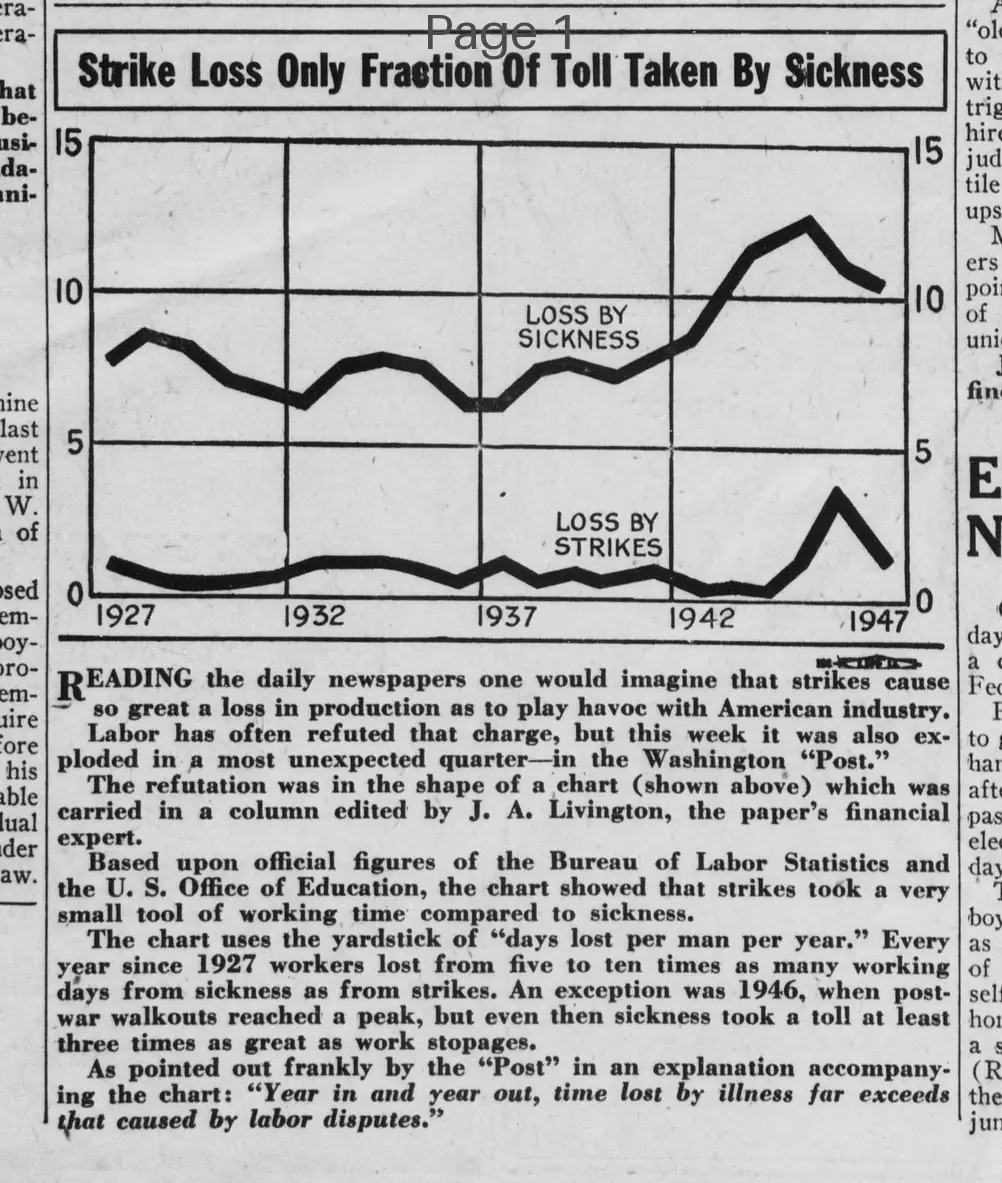
A Washington Post chart, based on Bureau of Labor Statistics and U.S. Office of Education data, shows that since 1927, workers lose 5-10 times more workdays to sickness than to strikes, refuting claims of strikes' severe impact on industry. Even in peak strike year 1946, sickness caused at least three times the loss.
Merged-components note: The image is the chart referenced in the story text, indicating spatial and contextual relation; merged into story as dominant content.
Clipping
OCR Quality
Full Text
READING the daily newspapers one would imagine that strikes cause so great a loss in production as to play havoc with American industry.
Labor has often refuted that charge, but this week it was also exploded in a most unexpected quarter-in the Washington "Post."
The refutation was in the shape of a chart (shown above) which was carried in a column edited by J. A. Livingston, the paper's financial expert.
Based upon official figures of the Bureau of Labor Statistics and the U. S. Office of Education, the chart showed that strikes took a very small toll of working time compared to sickness.
The chart uses the yardstick of "days lost per man per year." Every year since 1927 workers lost from five to ten times as many working days from sickness as from strikes. An exception was 1946, when post-war walkouts reached a peak, but even then sickness took a toll at least three times as great as work stoppages.
As pointed out frankly by the "Post" in an explanation accompanying the chart: "Year in and year out, time lost by illness far exceeds that caused by labor disputes."
What sub-type of article is it?
What themes does it cover?
What keywords are associated?
What entities or persons were involved?
Where did it happen?
Story Details
Key Persons
Location
Washington
Event Date
Since 1927
Story Details
A chart in the Washington Post demonstrates that lost workdays due to sickness far exceed those from strikes annually since 1927, with data from official sources refuting exaggerated impacts of labor disputes on industry.