Thank you for visiting SNEWPapers!
Sign up free
The Gary American
Gary, Lake County, Indiana
What is this article about?
William Pickens discusses 1930 U.S. Census data on Negro population age trends compared to 1910, highlighting declining proportions of young people due to lower birth rates and increasing longevity, especially in 35-54 age group, predicting potential racial absorption.
Clipping
OCR Quality
Full Text
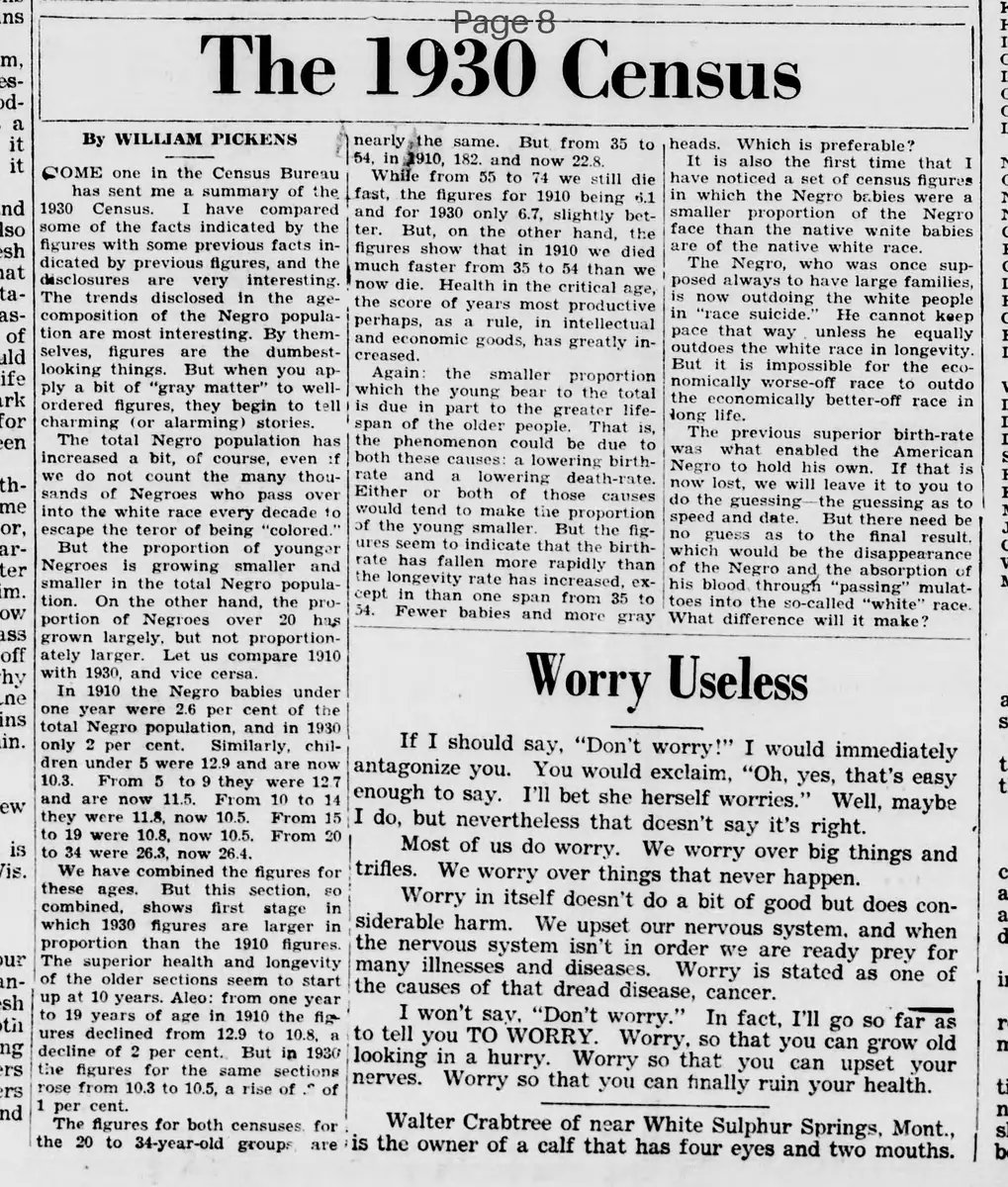
By WILLIAM PICKENS
Come one in the Census Bureau has sent me a summary of the 1930 Census. I have compared some of the facts indicated by the figures with some previous facts indicated by previous figures, and the disclosures are very interesting.
The trends disclosed in the age-composition of the Negro population are most interesting. By themselves, figures are the dumbest-looking things. But when you apply a bit of "gray matter" to well-ordered figures, they begin to tell charming (or alarming) stories.
The total Negro population has increased a bit, of course, even if we do not count the many thousands of Negroes who pass over into the white race every decade to escape the terror of being "colored."
But the proportion of younger Negroes is growing smaller and smaller in the total Negro population. On the other hand, the proportion of Negroes over 20 has grown largely, but not proportionately larger. Let us compare 1910 with 1930, and vice versa.
In 1910 the Negro babies under one year were 2.6 per cent of the total Negro population, and in 1930 only 2 per cent. Similarly, children under 5 were 12.9 and are now 10.3. From 5 to 9 they were 12.7 and are now 11.5. From 10 to 14 they were 11.8, now 10.5. From 15 to 19 were 10.8, now 10.5. From 20 to 34 were 26.3, now 26.4.
We have combined the figures for these ages. But this section, combined, shows first stage in which 1930 figures are larger in proportion than the 1910 figures. The superior health and longevity of the older sections seem to start up at 10 years. Also: from one year to 19 years of age in 1910 the figures declined from 12.9 to 10.8, a decline of 2 per cent. But in 1930 the figures for the same sections rose from 10.3 to 10.5, a rise of 0.2 per cent.
The figures for both censuses, for the 20 to 34-year-old groups are nearly the same. But from 35 to 54, in 1910, 18.2, and now 22.8. While from 55 to 74 we still die fast, the figures for 1910 being 5.1 and for 1930 only 6.7, slightly better. But, on the other hand, the figures show that in 1910 we died much faster from 35 to 54 than we now die. Health in the critical age, the score of years most productive perhaps, as a rule, in intellectual and economic goods, has greatly increased.
Again: the smaller proportion which the young bear to the total is due in part to the greater life-span of the older people. That is, the phenomenon could be due to both these causes: a lowering birth-rate and a lowering death-rate. Either or both of those causes would tend to make the proportion of the young smaller. But the figures seem to indicate that the birth-rate has fallen more rapidly than the longevity rate has increased, except in that one span from 35 to 54. Fewer babies and more gray heads. Which is preferable?
It is also the first time that I have noticed a set of census figures in which the Negro babies were a smaller proportion of the Negro race than the native white babies are of the native white race.
The Negro, who was once supposed always to have large families, is now outdoing the white people in "race suicide." He cannot keep pace that way, unless he equally outdoes the white race in longevity. But it is impossible for the economically worse-off race to outdo the economically better-off race in long life.
The previous superior birth-rate was what enabled the American Negro to hold his own. If that is now lost, we will leave it to you to do the guessing—the guessing as to speed and date.
But there need be no guess as to the final result, which would be the disappearance of the Negro and the absorption of his blood through "passing" mulattoes into the so-called "white" race.
What difference will it make?
What sub-type of article is it?
What keywords are associated?
What entities or persons were involved?
Domestic News Details
Event Date
1930
Key Persons
Outcome
declining birth rates leading to smaller proportion of young negroes; increased longevity especially in 35-54 age group; potential disappearance of negro race through passing into white race.
Event Details
Analysis of 1930 Census figures compared to 1910 showing trends in Negro population age composition: decreasing percentages under 20 (e.g., under 1 year: 2.6% to 2%; under 5: 12.9% to 10.3%), stable 20-34 (26.3% to 26.4%), increasing 35-54 (18.2% to 22.8%), and slight increase 55-74 (5.1% to 6.7%). Attributed to falling birth rates more than rising longevity, with Negro birth rate now below native white.