Thank you for visiting SNEWPapers!
Sign up free
Edwardsville Spectator
Edwardsville, Madison County, Illinois
What is this article about?
Report on the radical reform meeting in Smithfield, London, on July 21, 1819, led by Henry Hunt and others, demanding universal suffrage and annual elections; includes speeches, resolutions, arrest of Parson Harrison, and related news on Parliament prorogation and reform petitions.
Clipping
OCR Quality
Full Text
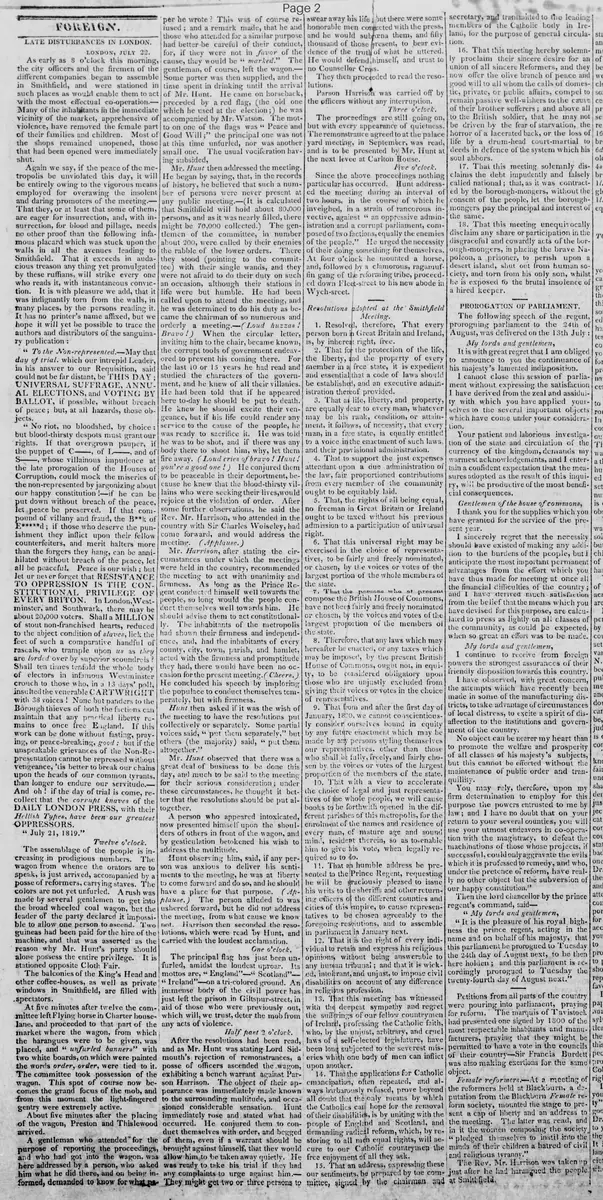
LATE DISTURBANCES IN LONDON.
LONDON, JULY 22.
As early as 8 o'clock this morning the city officers and the firemen of the different companies began to assemble in Smithfield, and were stationed in such places as would enable them to act with the most effectual co-operation. Many of the inhabitants in the immediate vicinity of the market, apprehensive of violence, have removed the female part of their families and children. Most of the shops remained unopened, those that had been opened were immediately shut.
Again we say, if the peace of the metropolis be unviolated this day, it will be entirely owing to the vigorous means employed for overawing the insolent and daring promoters of the meeting. That they, or at least that some of them, are eager for insurrection, and, with insurrection, for blood and pillage, needs no other proof than the following infamous placard which was stuck upon the walls in all the avenues leading to Smithfield. That it exceeds in audacious treason any thing yet promulgated by these ruffians, will strike every one who reads it, with instantaneous conviction. It is with pleasure we add, that it was indignantly torn from the walls, in many places, by the persons reading it. It has no printer's name affixed, but we hope it will yet be possible to trace the authors and distributors of the sanguinary publication:
"To the Non-represented.—May that day of trial, which our intrepid Leader, in his answer to our Requisition, said could not be far distant, be THIS DAY: UNIVERSAL SUFFRAGE, ANNUAL ELECTIONS, and VOTING BY BALLOT, if possible, without breach of peace; but, at all hazards, those objects.
"No riot, no bloodshed, by choice: but blood-thirsty despots must grant our rights. If that overgrown pauper, if the puppet of C—, of L—e—, and of S—, whose villainous impudence at the late prorogation of the Houses of Corruption, could mock the miseries of the non-represented by jargonizing about our happy constitution!—if he can be put down without breach of the peace, let peace be preserved. If that compound of villany and fraud, the B**k of E*****d; if those who deserve the punishment they inflict upon their fellow counterfeiters, and merit halters more than the forgers they hang, can be annihilated without breach of the peace, let all be peaceful. Peace is our wish; but let us never forget that RESISTANCE TO OPPRESSION IS THE CONSTITUTIONAL PRIVILEGE OF EVERY BRITON. In London, Westminster, and Southwark, there may be about 20,000 voters. Shall a MILLION of stout non-franchised hearts, reduced to the abject condition of slaves, lick the feet of such a comparative handful of rascals, who trample upon us as they are lorded over by superior scoundrels? Shall ten times tenfold the whole body of electors in infamous Westminster crouch to those who, in a 13 days' poll, insulted the venerable CARTWRIGHT with 38 voices! None but panders to the Borough thieves of both the factions can maintain that any practical liberty remains to once free England. If this work can be done without fasting, praying, or peace-breaking, good: but if the unspeakable grievances of the Non-Representation cannot be redressed without vengeance, 'tis better to break our chains upon the heads of our common tyrants, than longer to endure our servitude.—And oh! if the day of trial is come, recollect that the corrupt knaves of the DAILY LONDON PRESS, with their Hellish Types, have been our greatest OPPRESSORS."
July 21, 1819.
Twelve o'clock.
The assemblage of the people is increasing in prodigious numbers. The wagon from whence the orators are to speak, is just arrived, accompanied by a posse of reformers, carrying staves. The colors are not yet unfurled. A rush was made by several gentlemen to get into the broad wheeled coal wagon, but the leader of the party declared it impossible to allow one person to ascend. Two guineas had been paid for the hire of the machine, and that was asserted as the reason why Mr. Hunt's party should alone possess the entire privilege. It is stationed opposite Cloth Fair.
The balconies of the King's Head and other coffee-houses, as well as private windows in Smithfield, are filled with spectators.
At five minutes after twelve the committee left Flying Horse in Charter House-lane, and proceeded to that part of the market where the wagon, from which the harangues were to be given, was placed, and "unfurled banners" with two white boards, on which were painted the words order, order, were tied to it. The committee took possession of the wagon. This spot of course now becomes the grand focus of the mob, and from this moment the light-fingered gentry were extremely active.
About five minutes after the placing of the wagon, Preston and Thistlewood arrived.
A gentleman who attended for the purpose of reporting the proceedings, and who had got into the wagon, was here addressed by a person, who asked him what he did there, and on being informed, demanded to know for what paper he wrote? This was of course refused; and a remark made, that he and those who attended for a similar purpose had better be careful of their conduct, for, if they were not in favor of the cause, they would be "marked." The gentleman, of course, left the wagon.
Some porter was then supplied, and the time spent in drinking until the arrival of Mr. Hunt. He came on horseback, preceded by a red flag, (the old one which he used at the election;) he was accompanied by Mr. Watson. The motto on one of the flags was "Peace and Good Will;" the principal one was not at this time unfurled, nor was another small one. The usual vociferation having subsided,
Mr. Hunt then addressed the meeting. He began by saying, that, in the records of history, he believed that such a number of persons were never present at any public meeting. (It is calculated that Smithfield will hold about 80,000 persons, and as it was nearly filled, there might be 70,000 collected.) The gentlemen of the committee, in number about 200, were called by their enemies the rabble of the lower orders. There they stood (pointing to the committee) with their single wands, and they were not afraid to do their duty on such an occasion, although their stations in life were but humble. He had been called upon to attend the meeting, and he was determined to do his duty as became the chairman of so numerous and orderly a meeting. —(Loud huzzas! Bravo!) When the circular letter, inviting him to the chair, became known, the corrupt tools of government endeavored to prevent his coming there. For the last 10 or 15 years he had read and studied the characters of the government, and he knew of all their villanies. He had been told that if he appeared here to-day he should be put to death. He knew he should excite their vengeance, but if his life could render any service to the cause of the people, he was ready to sacrifice it. He was told he was to be shot, and if there was any body there to shoot him, why, let them fire away. (Loud cries of bravo! Hunt! you're a good one!) He conjured them to be peaceable in their deportment, because he knew that the blood-thirsty villains who were seeking their lives, would rejoice at the violation of order. After some further observations, he said the Rev. Mr. Harrison, who attended in the country with Sir Charles Wolseley, had come forward, and would address the meeting. (Applause.)
Mr. Harrison, after stating the circumstances under which the meetings were held in the country, recommended the meeting to act with unanimity and firmness. As long as the Prince Regent conducted himself well towards the people, so long would the people conduct themselves well towards him. He should advise them to act constitutionally. The inhabitants of the metropolis had shown their firmness and independence, and, had the inhabitants of every county, city, town, parish, and hamlet acted with the firmness and promptitude they had, there would have been no occasion for the present meeting. (Cheers.) He concluded his speech by imploring the populace to conduct themselves temperately, but with firmness.
Hunt then asked if it was the wish of the meeting to have the resolutions put collectively or separately. Some partial voices said, "put them separately," but others (the majority) said, "put them altogether."
Mr. Hunt observed that there was a great deal of business to be done this day, and much to be said to the meeting for their serious consideration; under these circumstances, he thought it better that the resolutions should be put altogether.
A person who appeared intoxicated, now presented himself upon the shoulders of others in front of the wagon, and by gesticulation betokened his wish to address the multitude.
Hunt observing him, said, if any person was anxious to deliver his sentiments to the meeting, he was at liberty to come forward and do so, and he should have a place for that purpose. (Applause.) The person alluded to was ushered forward, but he did not address the meeting, from what cause we know not. Harrison then seconded the resolutions, which were read by Hunt, and carried with the loudest acclamation.
One o'clock.
The principal flag has just been unfurled, amidst the loudest uproar. Its mottoes are, "England"—"Scotland"—"Ireland"—on a tri-colored ground. An immense body of the civil power has just left the prison in Giltspur-street, in aid of those who were previously out, which will, we trust, deter the mob from any acts of violence.
Half past 2 o'clock.
After the resolutions had been read, and as Mr. Hunt was stating Lord Sidmouth's rejection of remonstrances, a posse of officers ascended the wagon, exhibiting a bench warrant against Parson Harrison. The object of their appearance was immediately made known to the surrounding multitude, and occasioned considerable sensation. Hunt immediately rose and stated what had occurred. He conjured them to conduct themselves with order, and begged of them, even if a warrant should be brought against himself, that they would allow him to be taken away quietly. He was ready to take his trial if they had any complaints to urge against him. They might get two or three persons to swear away his life but there were some honorable men connected with the press, and he would subpoena them, and fifty thousand of those present, to bear evidence of the truth of what he uttered. He would defend himself, and trust to no Counsellor Cross.
They then proceeded to read the resolutions.
Parson Harrison was carried off by the officers without any interruption.
Three o'clock.
The proceedings are still going on, but with every appearance of quietness. The remonstrance agreed to at the palace yard meeting, in September, was read, and is to be presented by Mr. Hunt at the next levee at Carlton House.
Five o'clock.
Since the above proceedings nothing particular has occurred. Hunt addressed the meeting during an interval of two hours, in the course of which he inveighed, in a strain of rancorous invective, against "an oppressive administration and a corrupt parliament, composed of two factions, equally the enemies of the people." He urged the necessity of their doing something for themselves. At four o'clock he mounted a horse, and, followed by a clamorous, ragamuffin gang of the reforming tribe, proceeded down Fleet-street to his new abode in Wych-street.
Resolutions adopted at the Smithfield Meeting.
1. Resolved, therefore, That every person born in Great Britain and Ireland, is, by inherent right, free.
2. That for the protection of the life, the liberty, and the property of every member in a free state, it is expedient and essential that a code of laws should be established, and an executive administration thereof provided.
3. That as life, liberty, and property, are equally dear to every man, whatever may be his rank, condition, or attainment, it follows, of necessity, that every man, in a free state, is equally entitled to a voice in the enactment of such laws, and their provisional administration.
4. That to support the just expenses attendant upon a due administration of the law, fair proportioned contributions from every member of the community ought to be equitably laid.
5. That, the rights of all being equal, no freeman in Great Britain or Ireland ought to be taxed without his previous admission to a participation of universal right.
6. That this universal right may be exercised in the choice of representatives, to be fairly and freely nominated or chosen, by the voices or votes of the largest portion of the whole members of the state.
7. That the persons who at present compose the British House of Commons, have not been fairly and freely nominated or chosen, by the voices and votes of the largest proportion of the members of the state.
8. Therefore, that any laws which may hereafter be enacted, or any taxes which may be imposed, by the present British House of Commons, ought not, in equity, to be considered obligatory upon those who are unjustly excluded from giving their voices or votes in the choice of representatives.
9. That from and after the first day of January, 1820, we cannot conscientiously consider ourselves bound in equity by any future enactment which may be made by any persons styling themselves our representatives, other than those who shall be fully, freely, and fairly chosen by the voices or votes of the largest proportion of the members of the state.
10. That with a view to accelerate the choice of legal and just representatives of the whole people, we will cause books to be forthwith opened in the different parishes of this metropolis, for the enrolment of the names and residence of every man, of mature age and sound mind, resident therein, so as to enable him to give his vote, when legally required so to do.
11. That a humble address be presented to the Prince Regent, requesting he will be graciously pleased to issue his writs to the sheriffs and other returning officers of the different counties and cities of this empire, to cause representatives to be chosen agreeably to the foregoing resolutions, and to assemble in parliament in January next.
12. That it is the right of every individual to retain and express his religious opinions, without being answerable to any human tribunal; and that it is wicked, intolerant, and unjust, to impose civil disabilities on account of any difference in religious profession.
13. That this meeting has witnessed with the deepest sympathy and regret the sufferings of our fellow countrymen of Ireland, professing the Catholic faith, who, by the unjust, arbitrary, and cruel laws of a self-elected legislature, have been long subjected to the severest miseries which one body of men can inflict upon another.
14. That the applications for Catholic emancipation, often repeated, and always barbarously refused, prove beyond all doubt that the only means by which the Catholics can hope for the removal of their disabilities, is by uniting with the people of England and Scotland, and demanding radical reform, which, by restoring to all men equal rights, will secure to our Catholic countrymen the free enjoyment of all they ask.
15. That an address, expressing these our sentiments, be prepared by the committee, signed by the chairman and secretary, and transmitted to the leading members of the Catholic body in Ireland, for the purpose of general circulation.
16. That this meeting hereby solemnly proclaim their sincere desire for an union of all sincere Reformers, and they now offer the olive branch of peace and good will to all whom the calls of domestic, private, or public affairs, compel to remain passive well-wishers to the cause of their brother sufferers; and above all to the British soldier, that he may not be driven by the fear of starvation, the horror of a lacerated back, or the loss of life by a drum-head court-martial to deeds in defence of the system which his soul abhors.
17. That this meeting solemnly disclaims the debt impudently and falsely called national: that, as it was contracted by the borough-mongers, without the consent of the people, let the borough-mongers pay the principal and interest of the same.
18. That this meeting unequivocally disclaim any share or participation in the disgraceful and cowardly acts of the borough-mongers, in placing the brave Napoleon, a prisoner, to perish upon a desert island, shut out from human society, and torn from his only son, whilst he is exposed to the brutal insolence of a hired keeper.
PROROGATION OF PARLIAMENT.
The following speech of the regent, proroguing parliament to the 24th of August, was delivered on the 13th July:
My lords and gentlemen,
It is with great regret that I am obliged to announce to you the continuance of his majesty's lamented indisposition.
I cannot close this session of parliament without expressing the satisfaction I have derived from the zeal and assiduity with which you have applied yourselves to the several important objects which have come under your consideration.
Your patient and laborious investigation of the state and circulation of the currency of the kingdom, demands my warmest acknowledgements, and I entertain a confident expectation that the measures adopted as the result of this inquiry, will be productive of the most beneficial consequences.
Gentlemen of the house of commons,
I thank you for the supplies which you have granted for the service of the present year.
I sincerely regret that the necessity should have existed of making any addition to the burdens of the people, but I anticipate the most important permanent advantages from the effort which you have thus made for meeting at once all the financial difficulties of the country; and I have derived much satisfaction from the belief that the means which you have devised for this purpose, are calculated to press as lightly on all classes of the community, as could be expected, when so great an effort was to be made.
My lords and gentlemen,
I continue to receive from foreign powers the strongest assurances of their friendly disposition towards this country.
I have observed, with great concern, the attempts which have recently been made in some of the manufacturing districts, to take advantage of circumstances of local distress, to excite a spirit of disaffection to the institutions and government of the country.
No object can be nearer my heart than to promote the welfare and prosperity of all classes of his majesty's subjects, but this cannot be effected without the maintenance of public order and tranquillity.
You may rely, therefore, upon my firm determination to employ for this purpose the powers entrusted to me by law; and I have no doubt that on your return to your several counties, you will use your utmost endeavors in co-operation with the magistracy, to defeat the machinations of those whose projects, if successful, could only aggravate the evils which it is professed to remedy, and who, under the pretence of reform, have really no other object but the subversion of our happy constitution."
Then the lord chancellor by the prince regent's command, said—
"My lords and gentlemen,
"It is the pleasure of his royal highness the prince regent, acting in the name and on behalf of his majesty, that this parliament be prorogued to Tuesday the 24th day of August next, to be then here holden; and this parliament is accordingly prorogued to Tuesday the twenty-fourth day of August next."
Petitions from all parts of the country were pouring into parliament, praying for reform. The marquis of Tavistock had presented one signed by 1800 of the most respectable inhabitants and manufacturers, praying that they might be permitted to have a vote in the councils of their country—Sir Francis Burdett was also making exertions for the same object.
Female reformers.—At a meeting of the reformers held at Blackburn, a deputation from the Blackburn Female Reform Society, mounted the stage to present a cap of liberty and an address to the meeting. The latter was read, and in it the women composing the society "pledged themselves to instil into the minds of their children a hatred of civil and religious tyranny."
The Rev. Mr. Harrison was taken up just after he had harangued the people at Smithfield.
What sub-type of article is it?
What keywords are associated?
What entities or persons were involved?
Where did it happen?
Foreign News Details
Primary Location
London
Event Date
July 21, 1819
Key Persons
Outcome
parson harrison arrested on bench warrant without interruption; resolutions passed demanding universal suffrage, annual elections, voting by ballot, catholic emancipation, and radical reform; meeting dispersed peacefully; parliament prorogued to august 24, 1819.
Event Details
Large reform meeting in Smithfield with approximately 70,000 attendees; inflammatory placard circulated calling for universal suffrage; Mr. Hunt chaired and addressed the crowd urging peace; Rev. Mr. Harrison spoke on constitutional action; resolutions read and adopted collectively; principal flag unfurled; officers arrested Harrison during proceedings; Hunt continued speeches against government; meeting concluded with Hunt departing; related prorogation speech by Prince Regent on July 13 warning against disaffection; reform petitions presented including one by Marquis of Tavistock; Blackburn Female Reform Society presented address.