Thank you for visiting SNEWPapers!
Sign up free
Rogue River Courier
Grants Pass, Josephine County, Oregon
What is this article about?
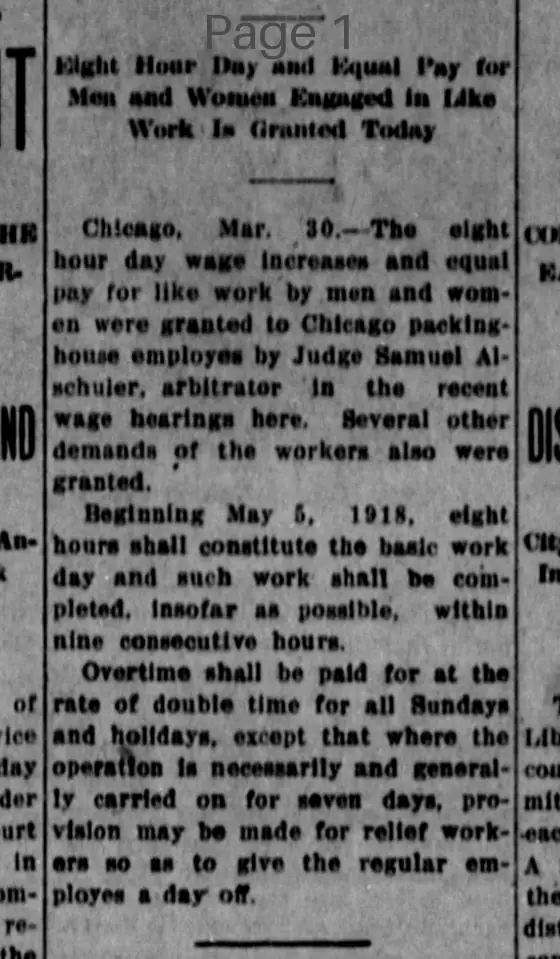
In Chicago on Mar. 30, 1918, Judge Samuel Alschuler granted Chicago packing house employees an eight-hour workday starting May 5, wage increases, equal pay for men and women, and other demands, including double time for overtime on Sundays and holidays.
Clipping
OCR Quality
Full Text
Men and Women Engaged In the
Work: Is Granted Today
Chicago, Mar. 30.--The eight hour day wage increases and equal
pay for like work by men and women were granted to Chicago packing
house employees by Judge Samuel Alschuler, arbitrator in the recent
wage hearings here. Several other demands of the workers also were
granted.
Beginning May 5, 1918, eight hours shall constitute the basic work
day and such work shall be completed, insofar as possible, within nine
consecutive hours.
Overtime shall be paid for at the rate of double time for all Sundays
and holidays, except that where the operation is necessarily and generally
carried on for seven days, provision may be made for relief workers so
as to give the regular employees a day off.
What sub-type of article is it?
What keywords are associated?
What entities or persons were involved?
Where did it happen?
Domestic News Details
Primary Location
Chicago
Event Date
Mar. 30, 1918
Key Persons
Outcome
eight-hour basic workday starting may 5, 1918, completed within nine consecutive hours; wage increases; equal pay for like work by men and women; double time for overtime on sundays and holidays; provisions for relief workers in seven-day operations; several other worker demands granted.
Event Details
Judge Samuel Alschuler, arbitrator in recent wage hearings, granted the eight-hour day, wage increases, equal pay for men and women doing like work, and several other demands to Chicago packing house employees.