Thank you for visiting SNEWPapers!
Sign up free
Literary
July 26, 1828
New Hampshire Statesman And Concord Register
Concord, Merrimack County, New Hampshire
What is this article about?
Descriptive essay on mountain Laplanders' wild appearance, bear-like clothing of reindeer fur, diminutive stature, hardy lifestyle, reliance on reindeer herds for food and survival, and cultural practices like consuming reindeer blood, from the London Magazine.
Clipping
OCR Quality
95%
Excellent
Full Text
From the London Magazine.
LAPLAND.
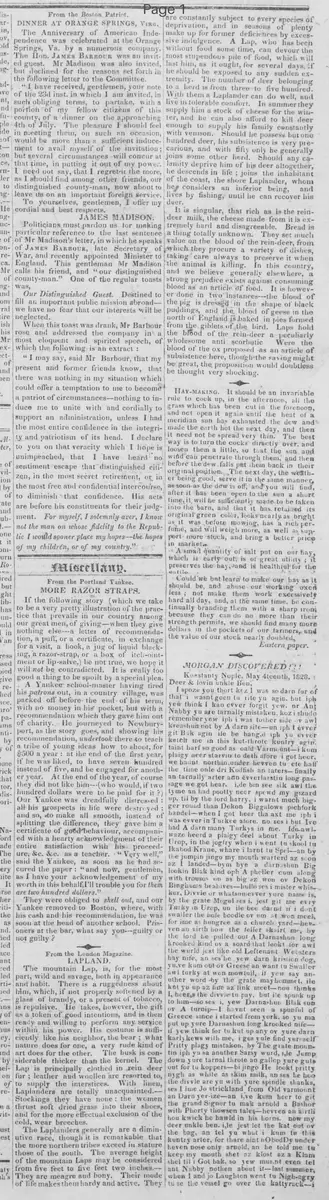
The mountain Laplander is, for the most part, wild and savage, both in appearance and habit. There is a ruggedness about him, which, if not properly softened by a glass of brandy, or a present of tobacco, is repulsive. He takes, however, the gift as a token of good intentions, and is then ready and willing to perform any service within his power. His costume is sufficiently like his neighbor, the bear; what nature does for one, a very rude kind of art does for the other. The husk is considerably thicker than the kernel. The Laplander is principally clothed in reindeer fur; leather and woollen are resorted to, to supply the interstices. With linen, Laplanders are totally unacquainted.—Stockings they have none: the women thrust soft dried grass into their shoes, and for the more effectual exclusion of the cold, wear breeches.
The Laplanders generally are a diminutive race, though it is remarkable that the more northern tribes exceed in stature those of the south. The average height of the mountain Laps may be considered from five feet to five feet two inches.—They are meagre and bony. Their mode of life makes them hardy and active. They are constantly subject to every species of deprivation, and in seasons of plenty make up for former deficiencies by excessive indulgence. A Laplander, who has been without food some time, can devour the most stupendous pile of food, which will last him, as it ought, for several days, if he should be exposed to any sudden extremity. The number of deer belonging to a herd is from three to five hundred. With them a Laplander can do well, and live in tolerable comfort. In summer they supply him a stock of cheese for the winter, and he can also afford to kill deer enough to supply his family constantly with venison. Should he possess but one hundred deer, his subsistence is very precarious, and with fifty only he generally joins some other herd. Should any calamity deprive him of his deer altogether, he descends in life; joins the inhabitant of the coast, the shore Laplander, whom he considers an inferior being, and lives by fishing, until he can recover his deer.
It is singular, that rich as is the reindeer milk, the cheese made from it is extremely hard and disagreeable. Bread is a thing totally unknown. They set much value on the blood of the rein-deer, from which they procure a variety of dishes, taking care always to preserve it when the animal is killing. In this country, and we believe generally elsewhere, a strong prejudice exists against consuming blood as an article of food. It is however done in two instances—the blood of the pig is dressed in the shape of black puddings, and the blood of geese in the north of England is baked in pies formed from the giblets of the bird. Laplanders hold the blood of the rein-deer a peculiarly wholesome anti-scorbutic. Were the blood of the ox proposed as an article of subsistence here, though the saving might be great, the proposition would doubtless be thought very shocking.
LAPLAND.
The mountain Laplander is, for the most part, wild and savage, both in appearance and habit. There is a ruggedness about him, which, if not properly softened by a glass of brandy, or a present of tobacco, is repulsive. He takes, however, the gift as a token of good intentions, and is then ready and willing to perform any service within his power. His costume is sufficiently like his neighbor, the bear; what nature does for one, a very rude kind of art does for the other. The husk is considerably thicker than the kernel. The Laplander is principally clothed in reindeer fur; leather and woollen are resorted to, to supply the interstices. With linen, Laplanders are totally unacquainted.—Stockings they have none: the women thrust soft dried grass into their shoes, and for the more effectual exclusion of the cold, wear breeches.
The Laplanders generally are a diminutive race, though it is remarkable that the more northern tribes exceed in stature those of the south. The average height of the mountain Laps may be considered from five feet to five feet two inches.—They are meagre and bony. Their mode of life makes them hardy and active. They are constantly subject to every species of deprivation, and in seasons of plenty make up for former deficiencies by excessive indulgence. A Laplander, who has been without food some time, can devour the most stupendous pile of food, which will last him, as it ought, for several days, if he should be exposed to any sudden extremity. The number of deer belonging to a herd is from three to five hundred. With them a Laplander can do well, and live in tolerable comfort. In summer they supply him a stock of cheese for the winter, and he can also afford to kill deer enough to supply his family constantly with venison. Should he possess but one hundred deer, his subsistence is very precarious, and with fifty only he generally joins some other herd. Should any calamity deprive him of his deer altogether, he descends in life; joins the inhabitant of the coast, the shore Laplander, whom he considers an inferior being, and lives by fishing, until he can recover his deer.
It is singular, that rich as is the reindeer milk, the cheese made from it is extremely hard and disagreeable. Bread is a thing totally unknown. They set much value on the blood of the rein-deer, from which they procure a variety of dishes, taking care always to preserve it when the animal is killing. In this country, and we believe generally elsewhere, a strong prejudice exists against consuming blood as an article of food. It is however done in two instances—the blood of the pig is dressed in the shape of black puddings, and the blood of geese in the north of England is baked in pies formed from the giblets of the bird. Laplanders hold the blood of the rein-deer a peculiarly wholesome anti-scorbutic. Were the blood of the ox proposed as an article of subsistence here, though the saving might be great, the proposition would doubtless be thought very shocking.
What sub-type of article is it?
Essay
What themes does it cover?
Agriculture Rural
Nature
What keywords are associated?
Lapland
Laplanders
Reindeer
Herding
Northern Life
Diet
Clothing
Stature
What entities or persons were involved?
From The London Magazine.
Literary Details
Title
Lapland.
Author
From The London Magazine.
Form / Style
Descriptive Prose Essay
Key Lines
The Mountain Laplander Is, For The Most Part, Wild And Savage, Both In Appearance And Habit.
The Laplander Is Principally Clothed In Reindeer Fur; Leather And Woollen Are Resorted To, To Supply The Interstices.
The Average Height Of The Mountain Laps May Be Considered From Five Feet To Five Feet Two Inches.
A Laplander, Who Has Been Without Food Some Time, Can Devour The Most Stupendous Pile Of Food, Which Will Last Him, As It Ought, For Several Days.
Laplanders Hold The Blood Of The Rein Deer A Peculiarly Wholesome Anti Scorbutic.