Thank you for visiting SNEWPapers!
Sign up free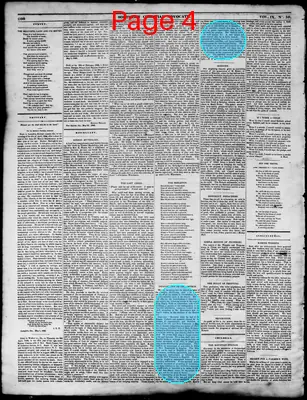
Editorial
May 22, 1846
Southern Christian Advocate
Charleston, Charleston County, South Carolina
What is this article about?
Satirical editorial critiques Roman Catholic claims to church infallibility, using an altered Henry VIII statute to depict suppression of dissenting religious texts, restrictions on Bible reading, and punishments like burning heretics as inevitable consequences.
Clipping
OCR Quality
98%
Excellent
Full Text
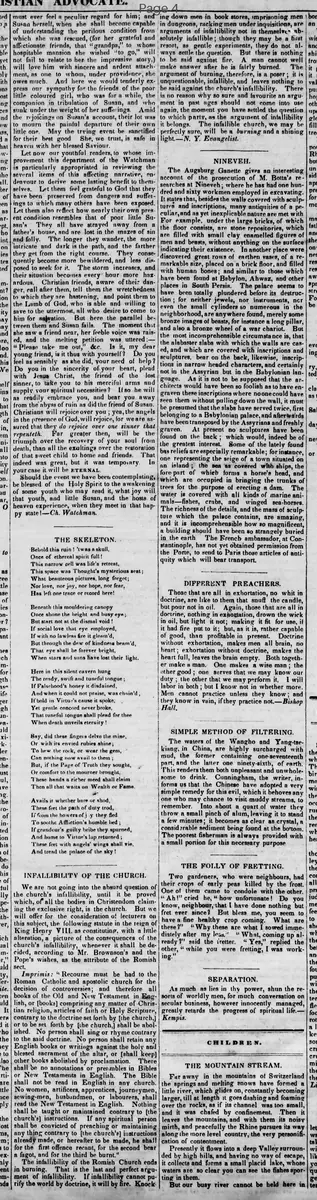
INFALLIBILITY OF THE CHURCH.
We are not going into the absurd question of the church's infallibility, until it be proved which, of all the bodies in Christendom claiming the exclusive right, is the church. But we will offer for the consideration of lecturers on this subject, the following statute in the reign of King Henry VIII. as constituting, with a little alteration, a picture of the consequences of the church's infallibility, whenever it shall be decided, according to Mr. Brownson's and the Pope's wishes, as the attribute of the Romish sect.
Imprimis: "Recourse must be had to the Roman Catholic and apostolic church for the decision of controversies; and therefore all books of the Old and New Testament in English, or [books] comprising any matter of Christian religion, articles of faith or Holy Scripture contrary to the doctrine set forth by [the church,] or to be set forth by [the church.] shall be abolished. No person shall sing or rhyme contrary to the said doctrine. No person shall retain any English books or writings against the holy and blessed sacrament of the altar, or [shall keep] other books abolished by proclamation. There shall be no annotations or preambles in Bibles or New Testaments in English. The Bible shall not be read in English in any church. No women, artificers, apprentices, journeymen, sewing-men, husbandmen, or labourers, shall read the New Testament in English. Nothing shall be taught or maintained contrary to [the church's] instructions. If any spiritual person shall be convicted of preaching or maintaining any thing contrary to [the church's] instructions already made, or hereafter to be made, he shall for the first offence recant, for the second bear a fagot. and for the third be burnt."
The infallibility of the Romish Church ends in burning. That is the last and perfect argument of infallibility. If infallibility cannot purify the world by doctrine, it will by fire. Knocking down men in book stores. imprisoning men in dungeons. racking men under inquisitions, are arguments of infallibility not in themselves absolutely infallible; though they may be a first resort, as gentle experiments, they do not always settle the question. But there is nothing to be said against fire. A man cannot well make answer after he is fairly burned. The argument of burning, therefore, is a poser : it is unquestionable, infallible, and leaves nothing to be said against the church's infallibility. There is no reason why so sure and favourite an argument in past ages should not come into use again, the moment you have settled the question to which party, as the argument of infallibility it belongs. The infallible church, we may be perfectly sure, will be a burning and a shining light.-N. Y. Evangelist.
We are not going into the absurd question of the church's infallibility, until it be proved which, of all the bodies in Christendom claiming the exclusive right, is the church. But we will offer for the consideration of lecturers on this subject, the following statute in the reign of King Henry VIII. as constituting, with a little alteration, a picture of the consequences of the church's infallibility, whenever it shall be decided, according to Mr. Brownson's and the Pope's wishes, as the attribute of the Romish sect.
Imprimis: "Recourse must be had to the Roman Catholic and apostolic church for the decision of controversies; and therefore all books of the Old and New Testament in English, or [books] comprising any matter of Christian religion, articles of faith or Holy Scripture contrary to the doctrine set forth by [the church,] or to be set forth by [the church.] shall be abolished. No person shall sing or rhyme contrary to the said doctrine. No person shall retain any English books or writings against the holy and blessed sacrament of the altar, or [shall keep] other books abolished by proclamation. There shall be no annotations or preambles in Bibles or New Testaments in English. The Bible shall not be read in English in any church. No women, artificers, apprentices, journeymen, sewing-men, husbandmen, or labourers, shall read the New Testament in English. Nothing shall be taught or maintained contrary to [the church's] instructions. If any spiritual person shall be convicted of preaching or maintaining any thing contrary to [the church's] instructions already made, or hereafter to be made, he shall for the first offence recant, for the second bear a fagot. and for the third be burnt."
The infallibility of the Romish Church ends in burning. That is the last and perfect argument of infallibility. If infallibility cannot purify the world by doctrine, it will by fire. Knocking down men in book stores. imprisoning men in dungeons. racking men under inquisitions, are arguments of infallibility not in themselves absolutely infallible; though they may be a first resort, as gentle experiments, they do not always settle the question. But there is nothing to be said against fire. A man cannot well make answer after he is fairly burned. The argument of burning, therefore, is a poser : it is unquestionable, infallible, and leaves nothing to be said against the church's infallibility. There is no reason why so sure and favourite an argument in past ages should not come into use again, the moment you have settled the question to which party, as the argument of infallibility it belongs. The infallible church, we may be perfectly sure, will be a burning and a shining light.-N. Y. Evangelist.
What sub-type of article is it?
Moral Or Religious
Satire
What keywords are associated?
Church Infallibility
Roman Catholic
Religious Doctrine
Henry Viii Statute
Burning Heretics
Religious Persecution
Infallible Argument
What entities or persons were involved?
Roman Catholic Church
Pope
Mr. Brownson
King Henry Viii
N. Y. Evangelist
Editorial Details
Primary Topic
Critique Of Roman Catholic Church Infallibility
Stance / Tone
Satirical Opposition To Church Infallibility
Key Figures
Roman Catholic Church
Pope
Mr. Brownson
King Henry Viii
N. Y. Evangelist
Key Arguments
Infallibility Requires Recourse To Roman Catholic Church For Controversies
All English Books On Religion Contrary To Church Doctrine Shall Be Abolished
No Annotations Or Preambles In English Bibles
Bible Not To Be Read In English In Churches
Certain Classes Prohibited From Reading New Testament In English
Punishments For Preaching Contrary Doctrine Include Recanting, Bearing Fagot, And Burning
Infallibility Ends In Burning As Ultimate Argument
Burning Settles Questions Irrefutably