Thank you for visiting SNEWPapers!
Sign up free
Mississippi Democrat
Carrollton, Carroll County, Mississippi
What is this article about?
1844 letter from US Secretary of State J.C. Calhoun to British Minister R. Pakenham rejecting a proposed Oregon Territory boundary along the 49th parallel and Columbia River, asserting US rights to the entire Columbia-drained region via discovery, exploration, settlement, and treaties with France and Spain.
Merged-components note: Continuation of Mr. Calhoun's letter on the Oregon boundary question across pages 1 and 2.
Clippings
1 of 2
OCR Quality
Full Text
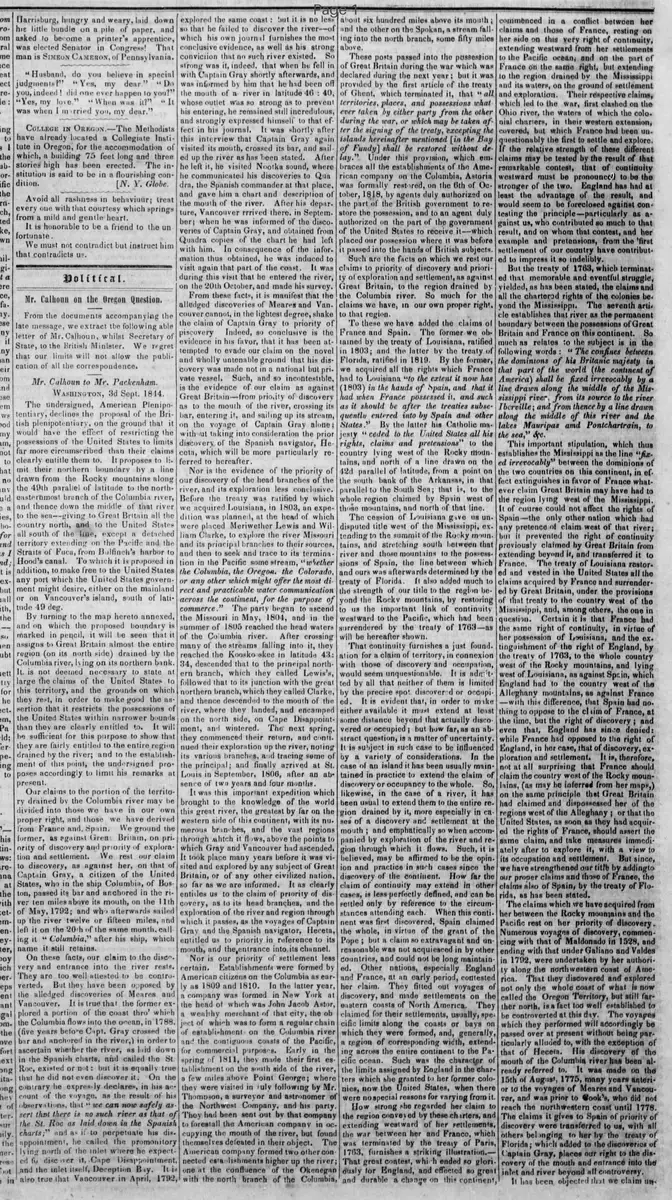
Mr. Calhoun on the Oregon Question.
From the documents accompanying the late message, we extract the following able letter of Mr. Calhoun, whilst Secretary of State, to the British Minister. We regret that our limits will not allow the publication of all the correspondence.
Mr. Calhoun to Mr. Packenham.
WASHINGTON, 3d Sept. 1844.
The undersigned, American Plenipotentiary, declines the proposal of the British plenipotentiary, on the ground that it would have the effect of restricting the possessions of the United States to limits far more circumscribed than their claims clearly entitle them to. It proposes to limit their northern boundary by a line drawn from the Rocky mountains along the 49th parallel of latitude to the northeasternmost branch of the Columbia river, and thence down the middle of that river to the sea—giving to Great Britain all the country north, and to the United States all south of the line, except a detached territory extending on the Pacific and the Straits of Fuca, from Bulfinch's harbor to Hood's canal. To which it is proposed in addition, to make free to the United States any port which the United States government might desire, either on the mainland or on Vancouver's island, south of latitude 49 deg.
By turning to the map hereto appended, and on which the proposed boundary is marked in pencil, it will be seen that it assigns to Great Britain almost the entire region (on its north side) drained by the Columbia river, lying on its northern bank. It is not deemed necessary to state at large the claims of the United States to this territory, and the grounds on which they rest, in order to make good the assertion that it restricts the possessions of the United States within narrower bounds than they are clearly entitled to. It will be sufficient for this purpose to show that they are fairly entitled to the entire region drained by the river; and to the establishment of this point, the undersigned proposes accordingly to limit his remarks at present.
Our claims to the portion of the territory drained by the Columbia river may be divided into those we have in our own proper right, and those we have derived from France and Spain. We ground the former, as against Great Britain, on priority of discovery and priority of exploration and settlement. We rest our claim to discovery, as against her, on that of Captain Gray, a citizen of the United States, who in the ship Columbia, of Boston, passed its bar and anchored in the river ten miles above its mouth, on the 11th of May, 1792; and who afterwards sailed up the river twelve or fifteen miles, and left it on the 20th of the same month, calling it "Columbia," after his ship, which name it still retains.
On these facts, our claim to the discovery and entrance into the river rests. They are too well attested to be controverted. But they have been opposed by the alledged discoveries of Meares and Vancouver. It is true that the former explored a portion of the coast thro' which the Columbia flows into the ocean, in 1788 (five years before Capt. Gray crossed the bar and anchored in the river,) in order to ascertain whether the river, as laid down in the Spanish charts, and called the St. Roc, existed or not: but it is equally true that he did not even discover it. On the contrary he expressly declares, in his account of the voyage, as the result of his observations, that "we can now safely assert that there is no such river as that of the St. Roc as laid down in the Spanish charts;" and as if to perpetuate his disappointment, he called the promontory lying north of the inlet where he expected to discover it, Cape Disappointment, and the inlet itself, Deception Bay. It is also true that Vancouver in April, 1792, explored the same coast: but it is no less so that he failed to discover the river—of which his own journal furnishes the most conclusive evidence, as well as his strong conviction that no such river existed. So strong was it, indeed, that when he fell in with Captain Gray shortly afterwards, and was informed by him that he had been off the mouth of a river in latitude 46:40, whose outlet was so strong as to prevent his entering, he remained still incredulous, and strongly expressed himself to that effect in his journal. It was shortly after this interview that Captain Gray again visited its mouth, crossed its bar, and sailed up the river as has been stated. After he left it, he visited Nootka sound, where he communicated his discoveries to Quadra, the Spanish commander at that place, and gave him a chart and description of the mouth of the river. After his departure, Vancouver arrived there in September; when he was informed of the discoveries of Captain Gray, and obtained from Quadra copies of the chart he had left with him. In consequence of the information thus obtained, he was induced to visit again that part of the coast. It was during this visit that he entered the river, on the 20th October, and made his survey.
From these facts, it is manifest that the alledged discoveries of Meares and Vancouver cannot, in the lightest degree, shake the claim of Captain Gray to priority of discovery. Indeed, so conclusive is the evidence in his favor, that it has been attempted to evade our claim on the novel and wholly untenable ground that his discovery was made not in a national but private vessel. Such, and so incontestible, is the evidence of our claim as against Great Britain—from priority of discovery as to the mouth of the river, crossing its bar, entering it, and sailing up its stream, on the voyage of Captain Gray alone—without taking into consideration the prior discovery of the Spanish navigator, Heceta, which will be more particularly referred to hereafter.
Nor is the evidence of the priority of our discovery of the head branches of the river, and its exploration less conclusive. Before the treaty was ratified by which we acquired Louisiana, in 1803, an expedition was planned, at the head of which were placed Meriwether Lewis and William Clarke, to explore the river Missouri and its principal branches to their sources, and then to seek and trace to its termination in the Pacific some stream, "whether the Columbia, the Oregon, the Colorado, or any other which might offer the most direct and practicable water communication across the continent, for the purpose of commerce." The party began to ascend the Missouri in May, 1804, and in the summer of 1805 reached the head waters of the Columbia river. After crossing many of the streams falling into it, they reached the Kooskooskee in latitude 43:34, descended that to the principal northern branch, which they called Lewis's, followed that to its junction with the great northern branch, which they called Clarke, and thence descended to the mouth of the river, where they landed, and encamped on the north side, on Cape Disappointment, and wintered. The next spring, they commenced their return, and continued their exploration up the river, noting its various branches, and tracing some of the principal; and finally arrived at St. Louis in September, 1806, after an absence of two years and four months.
It was this important expedition which brought to the knowledge of the world this great river, the greatest by far on the western side of this continent, with its numerous branches, and the vast regions through which it flows, above the points to which Gray and Vancouver had ascended. It took place many years before it was visited and explored by any subject of Great Britain, or of any other civilized nation, so far as we are informed. It as clearly entitles us to the claim of priority of discovery, as to its head branches, and the exploration of the river and region through which it passes, as the voyages of Captain Gray and the Spanish navigator, Heceta, entitled us to priority in reference to its mouth, and the entrance into its channel.
Nor is our priority of settlement less certain. Establishments were formed by American citizens on the Columbia as early as 1809 and 1810. In the latter year, a company was formed in New York at the head of which was John Jacob Astor, a wealthy merchant of that city, the object of which was to form a regular chain of establishments on the Columbia river and the contiguous coasts of the Pacific, for commercial purposes. Early in the spring of 1811, they made their first establishment on the south side of the river, a few miles above Point George; where they were visited in July following by Mr. Thompson, a surveyor and astronomer of the Northwest Company, and his party. They had been sent out by that company to forestall the American company in occupying the mouth of the river, but found themselves defeated in their object. The American company formed two other connected establishments higher up the river: one at the confluence of the Okenegan with the north branch of the Columbia, about six hundred miles above its mouth; and the other on the Spokan, a stream falling into the north branch, some fifty miles above.
These posts passed into the possession of Great Britain during the war which was declared during the next year; but it was provided by the first article of the treaty of Ghent, which terminated it, that "all territories, places, and possessions whatever taken by either party from the other during the war, or which may be taken after the signing of the treaty, excepting the islands hereinafter mentioned [in the Bay of Fundy] shall be restored without delay." Under this provision, which embraces all the establishments of the American company on the Columbia, Astoria was formally restored, on the 6th of October, 1818, by agents duly authorized on the part of the British government to restore the possession, and to an agent duly authorized on the part of the government of the United States to receive it—which placed our possession where it was before it passed into the hands of British subjects.
Such are the facts on which we rest our claims to priority of discovery and priority of exploration and settlement, as against Great Britain, to the region drained by the Columbia river. So much for the claims we have, in our own proper right, to that region.
To these we have added the claims of France and Spain. The former we obtained by the treaty of Louisiana, ratified in 1803; and the latter by the treaty of Florida, ratified in 1819. By the former, we acquired all the rights which France had to Louisiana "to the extent it now has (1803) in the hands of Spain, and that it had when France possessed it, and such as it should be after the treaties subsequently entered into by Spain and other States." By the latter his Catholic majesty "ceded to the United States all his rights, claims and pretensions" to the country lying west of the Rocky mountains, and north of a line drawn on the 42d parallel of latitude, from a point on the south bank of the Arkansas, in that parallel to the South Sea; that is, to the whole region claimed by Spain west of those mountains, and north of that line.
The cession of Louisiana gave us undisputed title west of the Mississippi, extending to the summit of the Rocky mountains, and stretching south between that river and those mountains to the possessions of Spain, the line between which and ours was afterwards determined by the treaty of Florida. It also added much to the strength of our title to the region beyond the Rocky mountains, by restoring to us the important link of continuity westward to the Pacific, which had been surrendered by the treaty of 1763—as will be hereafter shown.
That continuity furnishes a just foundation for a claim of territory, in connexion with those of discovery and occupation, would seem unquestionable. It is admitted by all that neither of them is limited by the precise spot discovered or occupied. It is evident that, in order to make either available it must extend at least some distance beyond that actually discovered or occupied; but how far, as an abstract question, is a matter of uncertainty. It is subject in such case to be influenced by a variety of considerations. In the case of an island it has been usually maintained in practice to extend the claim of discovery or occupancy to the whole. So, likewise, in the case of a river, it has been usual to extend them to the entire region drained by it, more especially in cases of a discovery and settlement at the mouth; and emphatically so when accompanied by exploration of the river and region through which it flows. Such, it is believed, may be affirmed to be the opinion and practice in such cases since the discovery of the Continent. How far the claim of continuity may extend in other cases, is less perfectly defined, and can be settled only by reference to the circumstances attending each. When this continent was first discovered, Spain claimed the whole, in virtue of the grant of the Pope; but a claim so extravagant and unreasonable was not acquiesced in by other Countries, and could not be long maintained. Other nations, especially England and France, at an early period, contested her claim. They fitted out voyages of discovery, and made settlements on the eastern coasts of North America. They claimed for their settlements, usually, specific limits along the coasts or bays on which they were formed, and, generally, a region of corresponding width, extending across the entire continent to the Pacific ocean. Such was the character of the limits assigned by England in the charters which she granted to her former colonies, now the United States, when there were no special reasons for varying from it. How strong she regarded her claim to the region conveyed by these charters, and extending westward of her settlements, the war between her and France, which was terminated by the treaty of Paris, 1763, furnishes a striking illustration. That great contest, which ended so gloriously for England, and effected so great and durable a change on this continent, commenced in a conflict between her claims and those of France, resting on her side on this very right of continuity, extending westward from her settlements to the Pacific ocean; and on the part of France on the same right, but extending to the region drained by the Mississippi and its waters, on the ground of settlement and exploration. Their respective claims, which led to the war, first clashed on the Ohio river, the waters of which the colonial charters, in their western extension, covered, but which France had been unquestionably the first to settle and explore. If the relative strength of these different claims may be tested by the result of that remarkable contest, that of continuity westward must be pronounced to be the stronger of the two. England has had at least the advantage of the result, and would seem to be foreclosed against contesting the principle—particularly as against us, who contributed so much to that result, and on whom that contest, and her example and pretensions, from the first settlement of our country have contributed to impress it so indelibly.
But the treaty of 1763, which terminated that memorable and eventful struggle, yielded, as has been stated, the claims and all the chartered rights of the colonies beyond the Mississippi. The seventh article establishes that river as the permanent boundary between the possessions of Great Britain and France on this continent. So much as relates to the subject is in the following words: "The confines between the dominions of his Britanic majesty in that part of the world (the continent of America) shall be fixed irrevocably by a line drawn along the middle of the Mississippi river, from its source to the river Iberville; and from thence by a line drawn along the middle of this river and the lakes Maurepas and Pontchartrain, to the sea," &c.
This important stipulation, which thus establishes the Mississippi as the line "fixed irrevocably" between the dominions of the two countries on this continent, in effect extinguishes in favor of France whatever claim Great Britain may have had to the region lying west of the Mississippi. It of course could not affect the rights of Spain—the only other nation which had any pretence of claim west of that river; but it prevented the right of continuity previously claimed by Great Britain from extending beyond it, and transferred it to France. The treaty of Louisiana restored and vested in The United States all the claims acquired by France and surrendered by Great Britain, under the provisions of that treaty to the country west of the Mississippi, and, among others, the one in question. Certain it is that France had the same right of continuity, in virtue of her possession of Louisiana, and the extinguishment of the right of England, by the treaty of 1763, to the whole country west of the Rocky mountains, and lying west of Louisiana, as against Spain, which England had to the country west of the Alleghany mountains, as against France—with this difference, that Spain had nothing to oppose to the claim of France, at the time, but the right of discovery; and even that, England has since denied: while France had opposed to the right of England, in her case, that of discovery, exploration and settlement. It is, therefore, not at all surprising that France should claim the country west of the Rocky mountains, (as may be inferred from her maps,) on the same principle that Great Britain had claimed and dispossessed her of the regions west of the Alleghany; or that the United States, as soon as they had acquired the rights of France, should assert the same claim, and take measures immediately after to explore it, with a view to its occupation and settlement. But since, we have strengthened our title by adding to our proper claims and those of France, the claims also of Spain, by the treaty of Florida, as has been stated.
The claims which we have acquired from her between the Rocky mountains and the Pacific rest on her priority of discovery. Numerous voyages of discovery, commencing with that of Maldonado in 1528, and ending with that under Galiano and Valdes in 1792, were undertaken by her authority along the northwestern coast of America. That they discovered and explored not only the whole coast of what is now called the Oregon Territory, but still farther north, is a fact too well established to be controverted at this day. The voyages which they performed will accordingly be passed over at present without being particularly alluded to, with the exception of that of Heceta. His discovery of the mouth of the Columbia river has been already referred to. It was made on the 15th of August, 1775, many years anterior to the voyages of Meares and Vancouver, and was prior to Cook's, who did not reach the northwestern coast until 1778. The claims it gives to Spain of priority of discovery were transferred to us, with all others belonging to her by the treaty of Florida: which added to the discoveries of Captain Gray, places our right to the discovery of the mouth and entrance into the inlet and river beyond all controversy.
It has been objected that we claim under various and conflicting titles, which mutually destroy each other. Such might indeed be the fact, while they were held by different parties; but since we have rightly acquired both those of Spain and France, and concentrated the whole in our hands, they mutually blend with each other and form one strong and connected chain of title, against the opposing claims of all others, including Great Britain.
In order to present more fully and perfectly the grounds on which our claims to the region in question rests, it will now be necessary to turn back to the time when Astoria was restored to us, under the provisions of the treaty of Ghent, and to trace what has since occurred between the two countries in reference to the territory, and inquire whether their respective claims have been affected by the settlements since made in the territory by Great Britain, or the occurrences which have since taken place.
The restoration of Astoria took place under the provisions of the treaty of Ghent, on the 6th day of October, 1818—the effect of which was to put Mr. Prevost, the agent authorized by our government to receive it, in possession of the establishment, with the right at all times to be reinstated and considered the party in possession, as was explicitly admitted by Lord Castlereagh in the first negotiation between the two governments in reference to the treaty. The words of Mr. Rush, our plenipotentiary on that occasion, in his letter to Mr. Adams, then Secretary of State, of the 14th of February, 1818, reporting what passed between him and his lordship, are, "that Lord Castlereagh admitted in the most ample extent our right to be reinstated, and to be the party in possession, while treating of the title."
That negotiation terminated in the convention of the 20th of October, 1818—the third article of which is in the following words:
"It is agreed that any country that may be claimed by either party on the north-west coast of America, westward of the Stony mountains, shall, together with its harbors, bays, creeks, and the navigation of all rivers within the same, be free and open, for the term of ten years from the date of the signature of the present convention, to the vessels, citizens and subjects of the two powers; it being well understood that this agreement is not to be construed to the prejudice of any claim which either of the two high contracting parties may have to any part of the said country; nor shall it be taken to affect the claims of any other power or State to take any part of the said country; the only object of the high contracting parties, in that respect, being to prevent disputes and differences amongst themselves."
The two acts, the restoration of our possession and the signature of the convention, were nearly contemporaneous—the latter taking place but fourteen days subsequently to the former. We were then, as admitted by Lord Castlereagh, entitled to be considered as the party in possession; and the convention which stipulated that the territory should be free and open, for the term of ten years from the date of its signature, to the vessels, citizens, and subjects of the two countries, without prejudice to any claim which either party may have to any part of the same, preserved and perpetuated all our claims to the territory, including the acknowledged right to be considered the party in possession, as perfectly during the period of its continuance as they were the day the convention was signed. Of this there can be no doubt.
After an abortive attempt to adjust the claims of the two parties to the territory, in 1824, another negotiation was commenced in 1826—which terminated in renewing, on the 6th of August, 1827, the third article of the convention of 1818, prior to its expiration. It provided for the indefinite extension of all the provisions of the third article of that convention: and also that either party might terminate it at any time it might think fit, by giving one year's notice, after the 20th of October, 1828.
It took, however, the precaution of providing expressly that "nothing contained in this convention, or in the third article of the convention of the 20th October, 1818, hereby continued in force, shall be construed to impair or in any manner affect the claims which either of the contracting parties may have to any part of the country westward of the Stony or Rocky mountains."
That convention is now in force, and has continued to be so since the expiration of that of 1818. By the joint operation of the two, our right to be considered the party in possession, and all the claims we had to the territory, while in possession, are preserved in as full vigor as they were at the date of its restoration in 1818, without being affected or impaired by the settlements since made by the subjects of Great Britain.
Time, indeed, so far from impairing our claims, has greatly strengthened them, since that period; for, since then, the treaty of Florida transferred to us all the rights, claims and pretensions of Spain, to the whole territory, as has been stated. In consequence of this, our claims to the portion drained by the Columbia river—the point now the subject of consideration—have been much strengthened by giving us the incontestable claim of the discovery of the mouth of the river by Heceta, as above stated. But it is not in this particular only that it has operated in our favor. Our well founded claim, grounded on continuity, has greatly strengthened, during the same period, by the rapid advance of our population towards the territory—its great increase, especially in the valley of the Mississippi—as well as the greatly increased facility of passing to the territory by more accessible routes, and the far stronger and rapidly-swelling tide of population that has recently commenced moving into it.
When the first convention was concluded in 1818, our whole population did not exceed nine millions of people. The portion of it inhabiting the States in the great valley of the Mississippi was probably under one million seven hundred thousand—of which not more than two hundred thousand were on the west side of the river.
Now, our population may be safely estimated at not less than nineteen millions—of which at least two millions inhabit the States and Territories west of that river. This portion of our population is now increasing far more rapidly than ever, and will in a short time fill the whole tier of States on its western bank.
To this great increase of population, especially in the valley of the Mississippi, may be added the increased facility of reaching the Oregon territory, in consequence of the discovery of the remarkable pass in the Rocky mountains at the head of the La Platte. The depression is so great, and the pass so smooth that loaded wagons now travel with facility from Missouri to the navigable waters of the Columbia river. These joint causes have had the effect of turning the current of our population towards the territory, and an emigration estimated at not less than one thousand during the last, and fifteen hundred during the present year, has flowed into it. The current thus commenced will no doubt continue to flow with increased volume hereafter. There can be no doubt now that the operation of the same causes which impelled our population westward from the shores of the Atlantic across the Alleghany to the valley of the Mississippi, will impel them onward with accumulated force across the Rocky mountains into the valley of the Columbia, and that the whole region drained by it is destined to be peopled by us.
Such are our claims to that portion of the territory, and the ground upon which they rest. The undersigned believes them to be well-founded, and trusts that the British plenipotentiary will see in them sufficient reasons why he should decline his proposal.
The undersigned plenipotentiary abstains for the present, from presenting the claims which the United States may have to other portions of the territory.
The undersigned avails himself of this occasion to renew to the British plenipotentiary assurances of his high consideration.
J. C. CALHOUN.
R. Pakenham, esq. &c. &c.
What sub-type of article is it?
What keywords are associated?
What entities or persons were involved?
Where did it happen?
Foreign News Details
Primary Location
Oregon Territory
Event Date
3 September 1844
Key Persons
Outcome
calhoun declines the british boundary proposal, asserting us entitlement to the entire columbia river region based on historical claims.
Event Details
US Secretary of State J.C. Calhoun writes to British Minister R. Pakenham rejecting a proposed boundary line along the 49th parallel to the Columbia River, arguing US priority in discovery (Captain Gray, Heceta), exploration (Lewis and Clark), settlement (Astor's company), and acquisitions from France (Louisiana Treaty 1803) and Spain (Florida Treaty 1819), including rights of continuity across the continent.