Thank you for visiting SNEWPapers!
Sign up free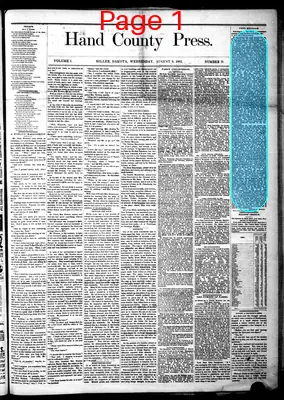
Hand County Press
Miller, Hand County, South Dakota
What is this article about?
President Chester A. Arthur vetoes the River and Harbor bill on August 1, 1882, objecting to appropriations for local improvements as unconstitutional and excessive, while supporting national welfare projects like Potomac harbor lines and Mississippi River improvements.
Clipping
OCR Quality
Full Text
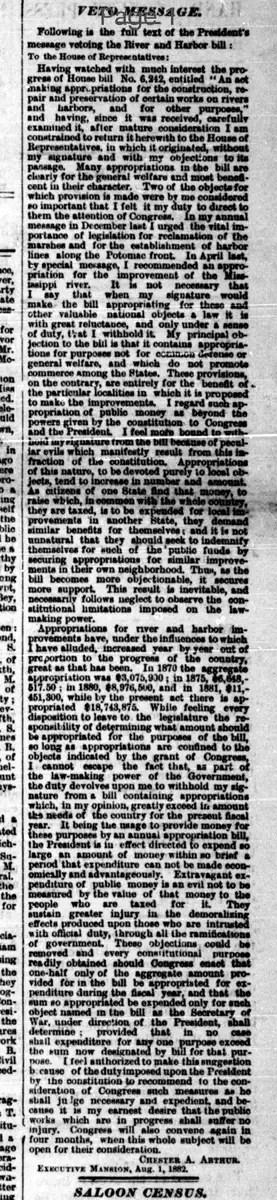
To the House of Representatives:
Having watched with much interest the progress of House bill No. 6,242, entitled "An act making appropriations for the construction, repair and preservation of certain works on rivers and harbors, and for other purposes," and having, since it was received, carefully examined it, after mature consideration I am constrained to return it herewith to the House of Representatives, in which it originated, without my signature and with my objections to its passage. Many appropriations in the bill are clearly for the general welfare and most beneficial in their character. Two of the objects for which provision is made were by me considered so important that I felt it my duty to direct to them the attention of Congress. In my annual message in December last I urged the vital importance of legislation for reclamation of the marshes and for the establishment of harbor lines along the Potomac front. In April last, by special message, I recommended an appropriation for the improvement of the Mississippi river. It is not necessary that I say that when my signature would make the bill appropriating for these and other valuable national objects a law it is with great reluctance, and only under a sense of duty, that I withhold it. My principal objection to the bill is that it contains appropriations for purposes not for national defense or general welfare, and which do not promote commerce among the States. These provisions, on the contrary, are entirely for the benefit of the particular localities in which it is proposed to make the improvements. I regard such appropriation of public money as beyond the powers given by the constitution to Congress and the President. I feel more bound to withhold my signature from the bill because of peculiar evils which manifestly result from this infraction of the constitution. Appropriations of this nature, to be devoted purely to local objects, tend to increase in number and amount. As citizens of one State find that money, to raise which, in common with the whole country, they are taxed, is to be expended for local improvements in another State, they demand similar benefits for themselves; and it is not unnatural that they should seek to indemnify themselves for such of the public funds by securing appropriations for similar improvements in their own neighborhood. Thus, as the bill becomes more objectionable, it secures more support. This result is inevitable, and necessarily follows neglect to observe the constitutional limitations imposed on the law-making power.
Appropriations for river and harbor improvements have, under the influences to which I have alluded, increased year by year out of proportion to the progress of the country, great as that has been. In 1870 the aggregate appropriation was $3,075,900; in 1875, $6,648,517.50; in 1880, $8,976,500, and in 1881, $11,451,300, while by the present act there is appropriated $18,743,875. While feeling every disposition to leave to the legislature the responsibility of determining what amount should be appropriated for the purposes of the bill, so long as appropriations are confined to the objects indicated by the grant of Congress, I cannot escape the fact that, as part of the law-making power of the Government, the duty devolves upon me to withhold my signature from a bill containing appropriations which, in my opinion, greatly exceed in amount the needs of the country for the present fiscal year. It being the usage to provide money for these purposes by an annual appropriation bill, the President is in effect directed to expend so large an amount of money within so brief a period that expenditure cannot be made economically and advantageously. Extravagant expenditure of public money is an evil not to be measured by the value of that money to the people who are taxed for it. They sustain greater injury in the demoralizing effects produced upon those who are intrusted with official duty, through all the ramifications of government. These objections could be removed and every constitutional purpose readily obtained should Congress enact that one-half only of the aggregate amount provided for in the bill be appropriated for expenditure during the fiscal year, and that the sum so appropriated be expended only for such object named in the bill as the Secretary of War, under direction of the President, shall determine; provided that in no case shall expenditure for any one purpose exceed the sum now designated by bill for that purpose. I feel authorized to make this suggestion because of the duty imposed upon the President by the constitution to recommend to the consideration of Congress such measures as he shall judge necessary and expedient, and because it is my earnest desire that the public works which are in progress shall suffer no injury. Congress will also convene again in four months, when this whole subject will be open for their consideration.
CHESTER A. ARTHUR.
Executive Mansion, Aug. 1, 1882.
What sub-type of article is it?
What keywords are associated?
What entities or persons were involved?
Where did it happen?
Domestic News Details
Primary Location
Washington, D.C.
Event Date
Aug. 1, 1882
Key Persons
Outcome
bill returned to house without signature; no immediate appropriations for local projects; suggestion for halved funding under executive discretion.
Event Details
President Arthur vetoes House bill No. 6,242 for river and harbor appropriations, citing constitutional limits on federal spending for local benefits, escalating costs from $3M in 1870 to $18M proposed, and potential for wasteful expenditure.