Thank you for visiting SNEWPapers!
Sign up free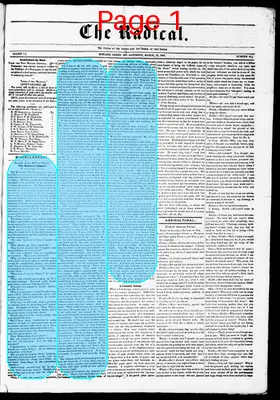
Literary
March 12, 1842
The Radical
Bowling Green, Pike County, Missouri
What is this article about?
A newlywed minister's wife pushes for an elegant dinner party to match social status, but her eccentric husband invites the poor, disabled, and forgotten Revolutionary War veterans instead, spending $1000 on charity and fulfilling a biblical call to aid the needy, transforming her perspective.
Clipping
OCR Quality
95%
Excellent
Full Text
MISCELLANEOUS.
From the 'Lady's World of Fashion.'
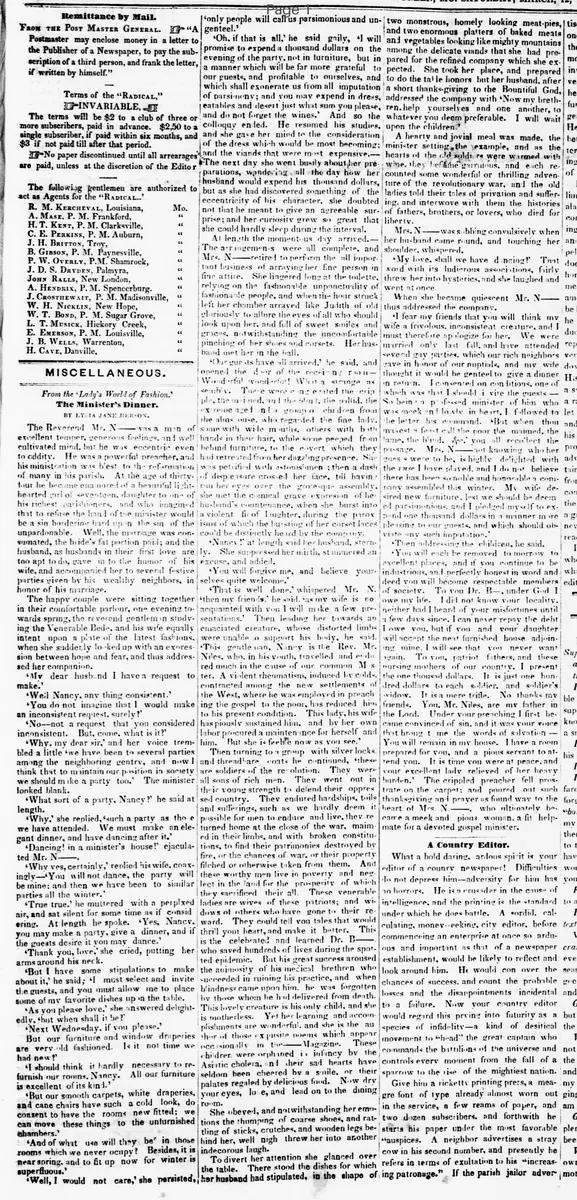
The Minister's Dinner.
BY LYDIA JANE PIERSON.
The Reverend Mr. N—was a man of excellent temper, generous feelings, and well cultivated mind; but he was eccentric even to oddity. He was a powerful preacher, and his ministration was blessed to the reformation of many in his parish. At the age of thirty-four he became enamored of a beautiful light-hearted girl of seventeen, daughter to one of his richest parishioners, and who imagined that to refuse the hand of the minister would be a sin bordering hard upon the sin of the unpardonable. Well, the marriage was consummated, the bride's fat portion paid; and the husband, as husbands in their first love are too apt to do, gave in to the humor of his wife, and accompanied her to several festive parties given by his wealthy neighbors, in honor of his marriage.
The happy couple were sitting together in their comfortable parlor, one evening towards spring, the reverend gentleman in studying the Venerable Bede, and his wife equally intent upon a plate of the latest fashions, when she suddenly looked up with an expression between hope and fear, and thus addressed her companion.
"My dear husband, I have a request to make."
"Well, Nancy, anything consistent."
"You do not imagine that I would make an inconsistent request, surely?"
"No—not a request that you considered inconsistent. But, come, what is it?"
"Why, my dear sir," and her voice trembled a little, "we have been to several parties among the neighboring gentry, and now I think that to maintain our position in society we should make a party too." The minister looked blank.
"What sort of a party, Nancy?" he said at length.
"Why," she replied, "such a party as those we have attended. We must make an elegant dinner, and have dancing after it."
"Dancing! in a minister's house!" ejaculated Mr. N—
"Why yes, certainly," replied his wife, coaxingly—“You will not dance, the party will be mine; and then we have been to similar parties all the winter."
"True, true," he muttered with a perplexed air, and sat silent for some time as if considering. At length he spoke. "Yes, Nancy, you may make a party, give a dinner, and if the guests desire it you may dance."
"Thank you, love," she cried, putting her arms around his neck.
"But I have some stipulations to make about it," he said; "I must select and invite the guests, and you must allow me to place some of my favorite dishes upon the table."
"As you please, love," she answered delightedly, "but when shall it be?"
"Next Wednesday, if you please."
"But our furniture and window draperies are very old fashioned. Is it not time we had new?"
"I should think it hardly necessary to refurnish our rooms, Nancy. All our furniture is excellent of its kind."
"But our smooth carpets, white draperies, and cane chairs have such a cold look, do consent to have the rooms new fitted; we can move these things to the unfurnished chambers."
"And of what use will they be in those rooms which we never occupy? Besides, it is near spring, and to fit up now for winter is superfluous."
"Well, I would not care," she persisted,
"only people will call us parsimonious and ungenteel."
"Oh, if that is all," he said gaily, "I will promise to expend a thousand dollars on the evening of the party, not in furniture, but in a manner which will be far more grateful to our guests, and profitable to ourselves, and which shall exonerate us from all imputation of parsimony; and you may expend in dress, eatables and dessert just what sum you please, and do not forget the wines." And so the colloquy ended. He resumed his studies, and she gave her mind to the consideration of the dress which would be most becoming, and the viands that were most expensive.
The next day she went busily about her preparations, wondering all the day how her husband would expend his thousand dollars, but as she had discovered something of the eccentricity of his character, she doubted not that he meant to give an agreeable surprise; and her curiosity grew so great that she could hardly sleep during the interval.
At length the momentous day arrived. The arrangements were all complete, and Mrs. N— retired to perform the all important business of arraying her fine person in fine attire. She lingered long at the toilette, relying on the fashionable unpunctuality of fashionable people, and when the hour struck left her chamber arrayed like Judith of old gloriously to allure the eyes of all who should look upon her, and full of sweet smiles and graces, notwithstanding the uncomfortable pinching of her shoes and corsets. Her husband met her in the hall.
"Our guests have all arrived?" he said, and opened the door of the reception room.
Wonderful! wonderful! What a strange assembly. There were the crippled, the maimed, the blind, the aged in a group of children from the alms house, who regarded the fine lady, some with wide mouths, others with both hands in their hair, while some peeped from behind furniture, to the covert which they had retreated from her dazzling presence. She was petrified with astonishment; then a dash of displeasure crossed her face, having run her eyes over the grotesque assembly, she met the comical grave expression of her husband's countenance, when she burst into a violent fit of laughter, during the paroxysms of which the bursting of her corset laces could be distinctly heard by the company.
"Nancy?" at length said her husband, sternly. She suppressed her mirth, stammered an excuse, and added,
"You will forgive me, and believe yourselves quite welcome."
"That is well done," whispered Mr. N— "then my friends," he said, as my wife is not acquainted with you I will make a few presentations." Then leading her towards an emaciated creature, whose distorted limbs were unable to support his body, he said,
"This gentleman, Nancy, is the Rev. Mr. Niles, who, in his youth, traveled and endured much in the cause of our common Master. A violent rheumatism, induced by colds, contracted among the new settlements of the West, where he was employed in preaching the gospel to the poor, has reduced him to his present condition. This lady, his wife, has piously sustained him, and by her own labor procured a maintenance for herself and him. But she is feeble now as you see."
Then turning to a group with silver locks, and threadbare coats he continued, "these are soldiers of the revolution. They were all sons of rich men. They went out in their young strength to defend their oppressed country. They endured hardships, toils and sufferings, such as we hardly deem it possible for men to endure and live, they returned home at the close of the war, maimed in their limbs, and with broken constitutions, to find their patrimonies destroyed by fire, or the chances of war, or their property filched or otherwise taken from them. And these worthy men live in poverty and neglect in the land for the prosperity of which they sacrificed their all. These venerable ladies are wives of these patriots; and widows of others who have gone to their reward. They could tell you tales that would thrill your heart, and make it better. This is the celebrated and learned Dr. B—, who saved hundreds of lives during the spotted epidemic. But his great success aroused the animosity of his medical brethren who succeeded in ruining his practice, and when blindness came upon him, he was forgotten by those whom he had delivered from death. This lovely creature is his only child, and she is motherless. Yet her learning and accomplishments are wonderful, and she is the author of those exquisite poems which appear occasionally in the ——— Magazine. These children were orphaned in infancy by the Asiatic cholera, and their sad hearts have seldom been cheered by a smile, or their palates regaled by delicious food. Now dry your eyes, love, and lead on to the dining room."
She obeyed, and notwithstanding her emotions the thumping of coarse shoes, and rattling of sticks, crutches, and wooden legs behind her, well nigh threw her into another indecorous laugh.
To divert her attention she glanced over the table. There stood the dishes for which her husband had stipulated, in the shape of two monstrous, homely looking meat-pies, and two enormous platters of baked meats and vegetables looking like mighty mountains among the delicate viands that she had prepared for the refined company which she expected. She took her place, and prepared to do the table honors but her husband, after a short thanks-giving to the Bountiful God, addressed the company with "Now my brethren, help yourselves and one another, to whatever you deem preferable. I will wait upon the children."
A hearty and jovial meal was made, the minister setting the example, and as the hearts of the old soldiers were warmed with wine, they became garrulous, and each recounted some wonderful or thrilling adventure of the revolutionary war, and the old ladies told their tales of privation and suffering, and interwove with them the histories of fathers, brothers, or lovers, who died for liberty.
Mrs. N— was sobbing convulsively when her husband came round, and touching her shoulder, whispered,
"My love, shall we have dancing?" That word with its ludicrous associations, fairly threw her into hysterics, and she laughed and wept at once.
When she became quiescent Mr. N—, thus addressed the company.
"I fear my friends that you will think my wife a frivolous, inconsistent creature, and I must therefore apologize for her. We were married only last fall, and have attended several gay parties, which our rich neighbors gave in honor of our nuptials, and my wife thought it would be genteel to give a dinner in return. I consented on conditions, one of which was that I should invite the guests—being a professed minister of him who was meek and lowly in heart. I followed his command. But when thou makest a feast call the poor, the maimed, the lame, the blind, &c.' you all recollect the passage. Mrs. N—not knowing who her guests were to be, is highly delighted with the ruse I have played, and I do not believe there has been so noble and honorable a company assembled this winter. My wife desired new furniture, lest we should be deemed parsimonious, and I pledged myself to expend one thousand dollars in a manner more pleasing to our guests, and which should obviate any such imputation."
Then addressing the children, he said,
"You will each be removed tomorrow to excellent places, and if you continue to be industrious, and perfectly honest in word and deed you will become respectable members of society. To you Dr. B—, under God I owe my life. I did not know your locality, neither had I heard of your misfortunes until a few days since. I can never repay the debt I owe you, but if you and your daughter will accept the neat furnished house adjoining mine, I will see that you never want again. To you, patriot fathers, and these nursing mothers of our country, I present the one thousand dollars. It is just one hundred dollars, to each soldier, and soldier's widow. It is a mere trifle. No thanks my friends. You, Mr. Niles, are my father in the Lord. Under your preaching I first became convinced of sin, and it was your voice that brought me the words of salvation—You will remain in my house. I have a room prepared for you, and a pious servant to attend you. It is time you were at peace, and your excellent lady relieved of her heavy burden." The crippled preacher fell prostrate on the carpet; and poured out such thanksgiving and prayer as found way to the heart of Mrs. N—, who ultimately became a meek and pious woman, a fit helpmate for a devoted gospel minister.
From the 'Lady's World of Fashion.'
The Minister's Dinner.
BY LYDIA JANE PIERSON.
The Reverend Mr. N—was a man of excellent temper, generous feelings, and well cultivated mind; but he was eccentric even to oddity. He was a powerful preacher, and his ministration was blessed to the reformation of many in his parish. At the age of thirty-four he became enamored of a beautiful light-hearted girl of seventeen, daughter to one of his richest parishioners, and who imagined that to refuse the hand of the minister would be a sin bordering hard upon the sin of the unpardonable. Well, the marriage was consummated, the bride's fat portion paid; and the husband, as husbands in their first love are too apt to do, gave in to the humor of his wife, and accompanied her to several festive parties given by his wealthy neighbors, in honor of his marriage.
The happy couple were sitting together in their comfortable parlor, one evening towards spring, the reverend gentleman in studying the Venerable Bede, and his wife equally intent upon a plate of the latest fashions, when she suddenly looked up with an expression between hope and fear, and thus addressed her companion.
"My dear husband, I have a request to make."
"Well, Nancy, anything consistent."
"You do not imagine that I would make an inconsistent request, surely?"
"No—not a request that you considered inconsistent. But, come, what is it?"
"Why, my dear sir," and her voice trembled a little, "we have been to several parties among the neighboring gentry, and now I think that to maintain our position in society we should make a party too." The minister looked blank.
"What sort of a party, Nancy?" he said at length.
"Why," she replied, "such a party as those we have attended. We must make an elegant dinner, and have dancing after it."
"Dancing! in a minister's house!" ejaculated Mr. N—
"Why yes, certainly," replied his wife, coaxingly—“You will not dance, the party will be mine; and then we have been to similar parties all the winter."
"True, true," he muttered with a perplexed air, and sat silent for some time as if considering. At length he spoke. "Yes, Nancy, you may make a party, give a dinner, and if the guests desire it you may dance."
"Thank you, love," she cried, putting her arms around his neck.
"But I have some stipulations to make about it," he said; "I must select and invite the guests, and you must allow me to place some of my favorite dishes upon the table."
"As you please, love," she answered delightedly, "but when shall it be?"
"Next Wednesday, if you please."
"But our furniture and window draperies are very old fashioned. Is it not time we had new?"
"I should think it hardly necessary to refurnish our rooms, Nancy. All our furniture is excellent of its kind."
"But our smooth carpets, white draperies, and cane chairs have such a cold look, do consent to have the rooms new fitted; we can move these things to the unfurnished chambers."
"And of what use will they be in those rooms which we never occupy? Besides, it is near spring, and to fit up now for winter is superfluous."
"Well, I would not care," she persisted,
"only people will call us parsimonious and ungenteel."
"Oh, if that is all," he said gaily, "I will promise to expend a thousand dollars on the evening of the party, not in furniture, but in a manner which will be far more grateful to our guests, and profitable to ourselves, and which shall exonerate us from all imputation of parsimony; and you may expend in dress, eatables and dessert just what sum you please, and do not forget the wines." And so the colloquy ended. He resumed his studies, and she gave her mind to the consideration of the dress which would be most becoming, and the viands that were most expensive.
The next day she went busily about her preparations, wondering all the day how her husband would expend his thousand dollars, but as she had discovered something of the eccentricity of his character, she doubted not that he meant to give an agreeable surprise; and her curiosity grew so great that she could hardly sleep during the interval.
At length the momentous day arrived. The arrangements were all complete, and Mrs. N— retired to perform the all important business of arraying her fine person in fine attire. She lingered long at the toilette, relying on the fashionable unpunctuality of fashionable people, and when the hour struck left her chamber arrayed like Judith of old gloriously to allure the eyes of all who should look upon her, and full of sweet smiles and graces, notwithstanding the uncomfortable pinching of her shoes and corsets. Her husband met her in the hall.
"Our guests have all arrived?" he said, and opened the door of the reception room.
Wonderful! wonderful! What a strange assembly. There were the crippled, the maimed, the blind, the aged in a group of children from the alms house, who regarded the fine lady, some with wide mouths, others with both hands in their hair, while some peeped from behind furniture, to the covert which they had retreated from her dazzling presence. She was petrified with astonishment; then a dash of displeasure crossed her face, having run her eyes over the grotesque assembly, she met the comical grave expression of her husband's countenance, when she burst into a violent fit of laughter, during the paroxysms of which the bursting of her corset laces could be distinctly heard by the company.
"Nancy?" at length said her husband, sternly. She suppressed her mirth, stammered an excuse, and added,
"You will forgive me, and believe yourselves quite welcome."
"That is well done," whispered Mr. N— "then my friends," he said, as my wife is not acquainted with you I will make a few presentations." Then leading her towards an emaciated creature, whose distorted limbs were unable to support his body, he said,
"This gentleman, Nancy, is the Rev. Mr. Niles, who, in his youth, traveled and endured much in the cause of our common Master. A violent rheumatism, induced by colds, contracted among the new settlements of the West, where he was employed in preaching the gospel to the poor, has reduced him to his present condition. This lady, his wife, has piously sustained him, and by her own labor procured a maintenance for herself and him. But she is feeble now as you see."
Then turning to a group with silver locks, and threadbare coats he continued, "these are soldiers of the revolution. They were all sons of rich men. They went out in their young strength to defend their oppressed country. They endured hardships, toils and sufferings, such as we hardly deem it possible for men to endure and live, they returned home at the close of the war, maimed in their limbs, and with broken constitutions, to find their patrimonies destroyed by fire, or the chances of war, or their property filched or otherwise taken from them. And these worthy men live in poverty and neglect in the land for the prosperity of which they sacrificed their all. These venerable ladies are wives of these patriots; and widows of others who have gone to their reward. They could tell you tales that would thrill your heart, and make it better. This is the celebrated and learned Dr. B—, who saved hundreds of lives during the spotted epidemic. But his great success aroused the animosity of his medical brethren who succeeded in ruining his practice, and when blindness came upon him, he was forgotten by those whom he had delivered from death. This lovely creature is his only child, and she is motherless. Yet her learning and accomplishments are wonderful, and she is the author of those exquisite poems which appear occasionally in the ——— Magazine. These children were orphaned in infancy by the Asiatic cholera, and their sad hearts have seldom been cheered by a smile, or their palates regaled by delicious food. Now dry your eyes, love, and lead on to the dining room."
She obeyed, and notwithstanding her emotions the thumping of coarse shoes, and rattling of sticks, crutches, and wooden legs behind her, well nigh threw her into another indecorous laugh.
To divert her attention she glanced over the table. There stood the dishes for which her husband had stipulated, in the shape of two monstrous, homely looking meat-pies, and two enormous platters of baked meats and vegetables looking like mighty mountains among the delicate viands that she had prepared for the refined company which she expected. She took her place, and prepared to do the table honors but her husband, after a short thanks-giving to the Bountiful God, addressed the company with "Now my brethren, help yourselves and one another, to whatever you deem preferable. I will wait upon the children."
A hearty and jovial meal was made, the minister setting the example, and as the hearts of the old soldiers were warmed with wine, they became garrulous, and each recounted some wonderful or thrilling adventure of the revolutionary war, and the old ladies told their tales of privation and suffering, and interwove with them the histories of fathers, brothers, or lovers, who died for liberty.
Mrs. N— was sobbing convulsively when her husband came round, and touching her shoulder, whispered,
"My love, shall we have dancing?" That word with its ludicrous associations, fairly threw her into hysterics, and she laughed and wept at once.
When she became quiescent Mr. N—, thus addressed the company.
"I fear my friends that you will think my wife a frivolous, inconsistent creature, and I must therefore apologize for her. We were married only last fall, and have attended several gay parties, which our rich neighbors gave in honor of our nuptials, and my wife thought it would be genteel to give a dinner in return. I consented on conditions, one of which was that I should invite the guests—being a professed minister of him who was meek and lowly in heart. I followed his command. But when thou makest a feast call the poor, the maimed, the lame, the blind, &c.' you all recollect the passage. Mrs. N—not knowing who her guests were to be, is highly delighted with the ruse I have played, and I do not believe there has been so noble and honorable a company assembled this winter. My wife desired new furniture, lest we should be deemed parsimonious, and I pledged myself to expend one thousand dollars in a manner more pleasing to our guests, and which should obviate any such imputation."
Then addressing the children, he said,
"You will each be removed tomorrow to excellent places, and if you continue to be industrious, and perfectly honest in word and deed you will become respectable members of society. To you Dr. B—, under God I owe my life. I did not know your locality, neither had I heard of your misfortunes until a few days since. I can never repay the debt I owe you, but if you and your daughter will accept the neat furnished house adjoining mine, I will see that you never want again. To you, patriot fathers, and these nursing mothers of our country, I present the one thousand dollars. It is just one hundred dollars, to each soldier, and soldier's widow. It is a mere trifle. No thanks my friends. You, Mr. Niles, are my father in the Lord. Under your preaching I first became convinced of sin, and it was your voice that brought me the words of salvation—You will remain in my house. I have a room prepared for you, and a pious servant to attend you. It is time you were at peace, and your excellent lady relieved of her heavy burden." The crippled preacher fell prostrate on the carpet; and poured out such thanksgiving and prayer as found way to the heart of Mrs. N—, who ultimately became a meek and pious woman, a fit helpmate for a devoted gospel minister.
What sub-type of article is it?
Prose Fiction
What themes does it cover?
Moral Virtue
Religious
Patriotism
What keywords are associated?
Minister Dinner
Charity
Revolutionary Veterans
Moral Lesson
Eccentric Clergy
Biblical Charity
What entities or persons were involved?
By Lydia Jane Pierson.
Literary Details
Title
The Minister's Dinner.
Author
By Lydia Jane Pierson.
Subject
Moral Tale On Charity And True Hospitality
Key Lines
"But When Thou Makest A Feast Call The Poor, The Maimed, The Lame, The Blind, &C.' You All Recollect The Passage.