Thank you for visiting SNEWPapers!
Sign up free
Southern Christian Advocate
Charleston, Charleston County, South Carolina
What is this article about?
J. Boring's letter defends his publication of Judge Shattuck's letter on a church debt claim and responds to Bishop Andrew's criticisms. He details his equitable claim for reimbursement on the Stockton, California church, payments made, and accumulated interest, seeking resolution without legal action. Dated Feb. 21, 1859, from San Antonio, Texas.
Clipping
OCR Quality
Full Text
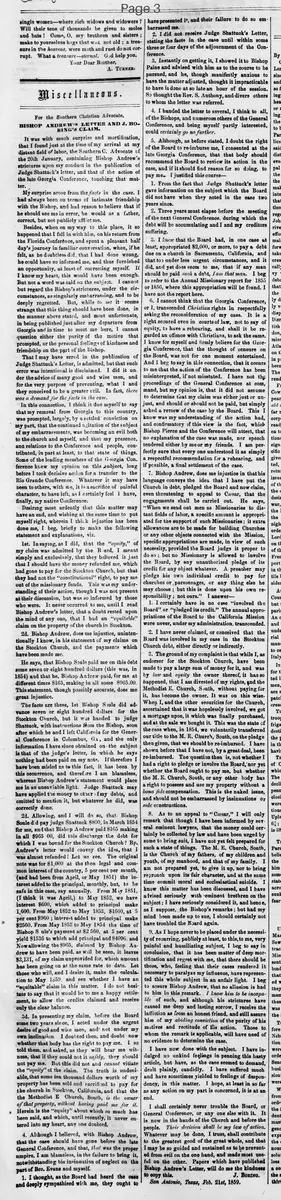
For the Southern Christian Advocate,
BISHOP ANDREW'S LETTER AND J. BORING'S CLAIM.
It was with much surprise and mortification, that I found just at the time of my arrival at my distant field of labor, the Southern C. Advocate of the 20th January, containing Bishop Andrew's strictures upon my conduct in the publication of Judge Shattuck's letter, and that of the action of the late Georgia Conference, touching that matter.
My surprise arose from the facts in the case. I had always been on terms of intimate friendship with the Bishop, and had reason to believe that if he should see me in error, he would as a father correct, but not publicly afflict me.
Besides, when on my way to this place, it so happened that I fell in with him, on his return from the Florida Conference, and spent a pleasant half day's journey in familiar conversation, when, if he felt, as he doubtless did, that I had done wrong, he could have so informed me, and thus furnished an opportunity, at least of correcting myself. If I know my heart, this would have been enough.
But not a word was said on the subject. I cannot but regard the Bishop's strictures, under the circumstances, as singularly embarrassing, and to be deeply regretted. But, while to me it seems strange that this thing should have been done, in the manner above stated, and most unfortunate, in being published just after my departure from Georgia and in time to meet me here, I cannot question either the purity of the motive that prompted, or the personal feelings of kindness and friendship on the part of the Bishop.
That I may have erred in the publication of Judge Shattuck's Letter, is admitted, but that such error was intentional is disclaimed. I did it under the advice of many good and wise men, and for the very purpose of preventing, what I and they conceived to be a greater evil. In fact, there was a demand for the facts in the case.
In this connection, I think it due myself to say that my removal from Georgia to this country, was prompted, largely, by a settled conviction on my part, that the continued agitation of the subject of my embarrassments, was becoming an evil both to the church and myself, and that my presence, and relations to the Conference and people, contributed, in part at least, to that state of things.
Some of the leading members of the Georgia Conference knew my opinion on this subject, long before I took decisive action for a transfer to the Rio Grande Conference. Whatever it may have been to others, with me, it is a sacrifice of painful character, to have left, as I certainly feel I have, finally, my native Conference.
Desiring most ardently that this matter may have an end, and wishing at the same time to put myself right, wherein I think injustice has been done me. I beg, briefly to make the following statement and explanations, viz.
1st. In saying, as I did, that the "equity," of my claim was admitted by the Board, I meant simply and exclusively, that they believed it just that I should have the money refunded me, which had gone to pay for the Stockton Church, but that they had not the "constitutional" right, to pay me out of the missionary funds. This was my understanding of their action, though I was not present at their discussion, but was so informed by those who were. It never occurred to me, until I read Bishop Andrew's letter, that a doubt rested upon the mind of any one, that I had an "equitable" claim on the property of the church in Stockton.
2d. Bishop Andrew, does me injustice, unintentionally I know, in his statement of my claims on the Stockton Church, and the payments which have been made me.
He says, that Bishop Soule paid me on this debt some seven or eight hundred dollars (this was, in 1854) and that he, Bishop Andrew paid, for me at different times $165, making in all some $965.00.
This statement, though possibly accurate, does me great injustice.
The facts are these, 1st Bishop Soule did advance seven or eight hundred dollars for the Stockton Church, but it was handed to Judge Shattuck, with instructions from the Bishop, soon after which he and I left California for the General Conference in Columbus, Ga, and the only information I have since obtained on the subject is that of the Judge's letter, in which he says nothing had been paid on my note. If therefore I have been misled as to this fact, it has been by this occurrence, and therefore I am blameless.
Whereas Bishop Andrew's statement would place me in an unenviable light. Judge Shattuck may have applied the money to other of my debts, and omitted to mention it, but whatever he did, was correctly done.
2d. Allowing, and I will do so, that Bishop Soule did pay Judge Shattuck $800, in March 1854 for me, and that Bishop Andrew paid $165 making in all $965.00, did this discharge the debt for which I was bound for the Stockton Church? Bp. Andrew's letter would convey the idea, that I was almost refunded! Let us see. The original note was for $1,000 at the then legal and common interest of the country, 5 per cent per month, (and had been from April, or May 1851) the interest added to the principal, monthly, but, to be safe in this case, say annually. From May 1851, (I think it was April,) to May 1852, we have interest $600, which added to principal make 1,600. From May 1852 to May 1853, $1600, at 5 per cent $80; interest added to principal make $2,560. From May 1853 to May 1854 the time of Bishop Soule's payment at $2,560, at 5 per cent yield $128 to which add principal and $4,096. and Now allowing the $965, claimed by Bishop Andrew to have been paid, as will be seen, it leaves $3,131, of my claim unprovided for, which amount has been going on at the same rate to date. Let those who will, and I desire it, make the calculation to May 1859, and see whether I have an "equitable" claim in this matter. I do not hesitate to say that it would be to me a happy settlement, to allow the credits claimed and receive only the clear balance.
3d. In presenting my claim, before the Board some two years since, I acted under the urgent desire of good and wise men, and not under my own inclination I doubted then, and doubt now whether that body has the right to pay me. I so told them, and asked, as they will bear me witness, that if they could not it safely, they should not pay me. But this did not and cannot vitiate the "equity" of the claim. The truth is undeniable, that some ten thousand dollars worth of my property has been sold and sacrificed to pay for the church in Stockton, California, and that the Methodist E. Church, South, is the owner of that property, without having paid me for it.
Herein is the "equity" about which so much has been said, and which, until recently, it never entered into my heart, any one doubted.
4. Although I believed, with Bishop Andrew, that the case should have gone before the late General Conference, and that, that was the proper umpire, I am blameless, in the failure to bring it, notwithstanding his insinuation of neglect on the part of Bro. Evans and myself.
1. I thought, as the Board had heard the case and deeply sympathised with me, they ought to have presented it, and their failure to do so embarrassed me.
2. I did not receive Judge Shattuck's Letter, stating the facts in the case until within some three or four days of the adjournment of the Conference.
3. Instantly on getting it, I showed it to Bishop Paine and advised with him as to the course to be pursued, and he, though manifestly anxious to have the matter adjusted, thought it impracticable to have it done at so late an hour of the session.
So thought the Rev. S. Anthony, and divers others to whom the letter was referred.
4. I handed the letter to several, I think to all, of the Bishops, and numerous others of the General Conference, and being myself partly interested, could certainly go no further.
5. Although, as before stated, I doubt the right of the Board to re-imburse me, I consented at the late Georgia Conference, that that body should recommend the Board to review its action in the case, and if it should find reason for so doing, to pay me. I justified this course—
1. From the fact that Judge Shattuck's letter gave information on the subject which the Board did not have when they acted in the case two years since.
2. Three years must elapse before the meeting of the next General Conference, during which the debt will be accumulating and I and my creditors suffering.
3. I knew that the Board had, in one case at least, appropriated $2,000 or more, to pay a debt due on a church in Sacramento, California, and that too under less urgent circumstances, and if did, and yet does seem to me, that if any man should be paid such a debt, I am that man. I beg to refer to the Annual Missionary report for 1855 or 1856, where this appropriation will be found. I have not the report here.
6. I cannot think that the Georgia Conference, or I, transcended Christian rights in respectfully asking the reconsideration of my case. It is a right secured even in courts of law, not to say of equity, to have a rehearing, and shall it be regarded an offence with Christians, to ask the same.
I know for myself and firmly believe for the Georgia Conference, that the thought of censure on the Board, was not for one moment entertained.
And I beg to say in this connection, that it occurs to me that the action of the Conference has been misinterpreted, if not misstated. I have not the proceedings of the General Conference at command, but my opinion is, that it did not assume to determine that my claim was either just or unjust, and should or should not be paid, but simply asked a review of the case by the Board. This I know was my understanding of the action had, and confirmatory of this view is the fact, which Bishop Pierce and the Conference will attest, that no explanation of the case was made, nor speech tendered either by me or my friends. I am perfectly sure that every one understood it as simply a respectful recommendation for a rehearing, and if possible, a final settlement of the case.
7. Bishop Andrew, does me injustice in that his language conveys the idea that I have put the Church in debt, pledged the Board and now claim, even threatening to appeal to Caesar, that the engagements shall be carried out. He says,
"When we send out men as Missionaries to distant fields of labor, a specific amount is appropriated for the support of such Missionaries; if extra allowances are to be made for building Churches or any other objects connected with the Mission, specific appropriations are made, in view of such necessity, provided the Board judge it proper to do so; but no Missionary is allowed to involve the Board, by any unauthorised pledge of its credit for any object whatever. A preacher may pledge his own individual credit to pay for churches or parsonages, or any thing else he may choose; but this is done upon his own responsibility; not ours." I answer—
1. I certainly have in no case "involved the Board" or "pledged its credit." The annual appropriations of the Board to the California Mission were never, under my administration, transcended.
2. I have never claimed, or conceived that the Board was involved in my case in the Stockton Church debt, either directly or indirectly.
3. The ground of my complaint is that while I, as endorser for the Stockton Church, have been made to pay a large sum of money for it, and was by law and equity the owner thereof, it has so happened, that I am divested of my rights, and the Methodist E. Church, South, without paying for it, has become the owner. It was on this wise.
When I, and the other securities for the Church, ascertained that it was hopelessly involved, we got a mortgage upon it which was finally purchased, and at the sale we bought it. This was the state of the case when, in 1854, we voluntarily transferred our title to the M. E. Church, South, on the pledge then given, that we should be re-imbursed. I have shown before that I have not, by a great deal, been re-imbursed. The question then is, not whether I had a right to pledge or involve the Board, nor yet whether the Board ought to pay me, but whether the M. E. Church, South, or any other body has a right to possess and use my property without a bona fide compensation. This is the naked issue, and should not be embarrassed by insinuations or side constructions.
8. As to an appeal to "Caesar," I will only remark that though I have been informed by several eminent lawyers, that the money could certainly be collected by law and have been urged by some to bring suit, I have not yet felt prepared for such a state of things. The M. E. Church, South, is the Church of my fathers, of my children and youth, of my manhood, and that of my family. I am not prepared yet, to give it up, nor to bring reproach upon its fair character, and at the same time commit moral and ecclesiastical suicide. I know this matter has been discussed, and I have advised seriously with eminent brethren on the subject; I have seriously considered it, and hence, as I suppose, the Bishop's remarks; but had my mind been made up to sue, I should certainly not have troubled the Board again.
9. As I hope never to be placed under the necessity of recurring, publicly at least, to this, to me, very painful and humiliating subject, I beg to say in conclusion, that it has been matter of deep mortification and regret with me, that there should be those, who, feeling that their cases rendered it necessary to paralyze my influence, have represented this whole subject in an unfair light. I beg to assure Bishop Andrew, that no allusion is had to him in this remark. I know him to be incapable of such, and although his strictures have caused me deep and lasting sorrow, I receive the infliction as from an honest friend, and still assure him of my abiding conviction of the purity of his motives and rectitude of his action. Those to whom the remark is applicable, will have need of no evidence to determine the case.
I have now done with the subject. I have indulged no unkind feelings in penning this hasty article, but have, as the case seemed to demand, dealt plainly, candidly. I have suffered much and have sometimes yielded to feelings of despondency, in this matter. I hope, at least in so far as any action on my part is concerned, it is at an end.
I shall certainly never trouble the Board, or General Conference, or any one else with it. It is now in the hands of the Church and before the people. Their decision shall be my law of action.
Whatever may be done, I trust, shall contribute to the greatest good of the great whole, and that I may be so guided and sustained as to be prevented from evil on the one hand, and made most useful on the other. Papers which have published Bishop Andrew's Letter, will do me the kindness to copy this.
J. BORING.
San Antonio, Texas, Feb. 21st, 1859.
What sub-type of article is it?
What themes does it cover?
What keywords are associated?
What entities or persons were involved?
Where did it happen?
Story Details
Key Persons
Location
Stockton, California; San Antonio, Texas; Georgia
Event Date
1851 To 1859
Story Details
J. Boring defends his publication of Judge Shattuck's letter regarding a church debt and asserts his equitable claim for reimbursement from the Methodist E. Church, South, for property sacrificed to fund the Stockton Church, detailing payments, interest accumulation, and refuting Bishop Andrew's criticisms while seeking amicable resolution.