Thank you for visiting SNEWPapers!
Sign up free
Virginia Argus
Richmond, Virginia
What is this article about?
Oration by Isaac Read Jr. delivered on July 4th at Charlotte Court House, Virginia, celebrating American independence, reflecting on the Revolutionary War and George Washington's heroism, condemning Napoleon Bonaparte and British aggression, and calling for national unity amid the War of 1812.
Merged-components note: The text on page 2 directly continues the oration from page 1, forming a single narrative speech; label remains 'story' as it fits a full patriotic article.
Clippings
1 of 2
OCR Quality
Full Text
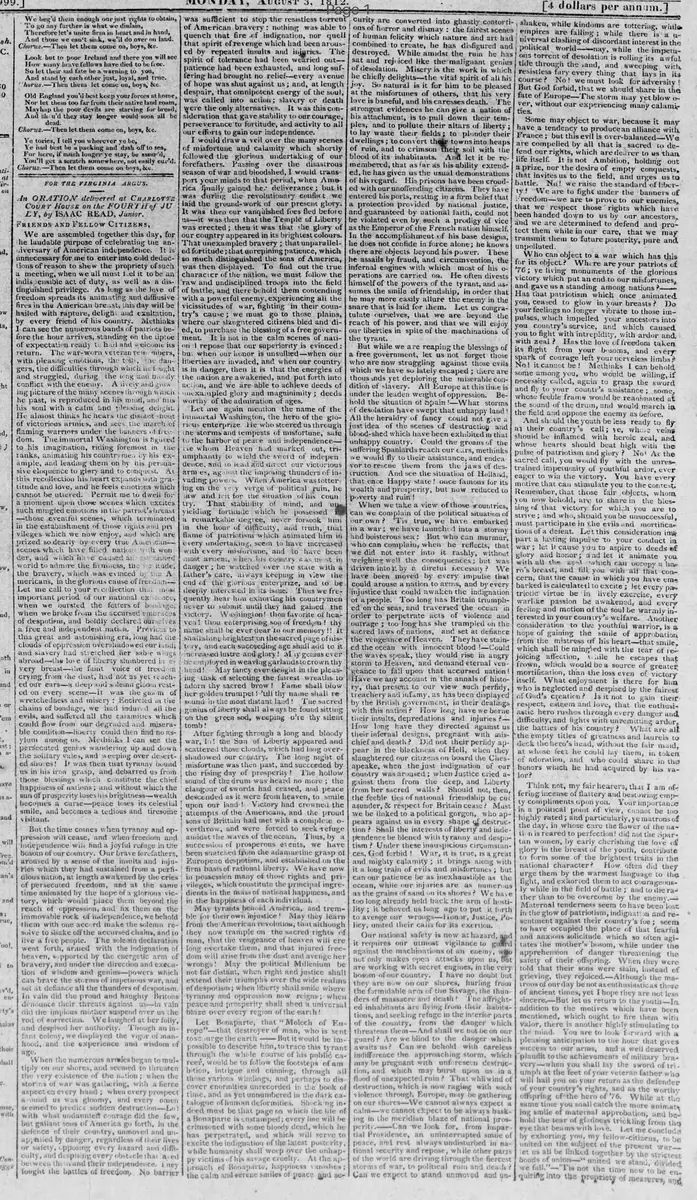
AN ORATION delivered at CHARLOTTE Court House on the FOURTH OF JULY, by ISAAC READ, Junior.
Friends and Fellow Citizens,
We are assembled together this day, for the laudable purpose of celebrating the anniversary of American independence. It is unnecessary for me to enter into cold deductions of reason to shew the propriety of such a meeting, when we all must feel it to be an indispensable act of duty, as well as a distinguished privilege. As long as the love of freedom spreads its animating and diffusive fires in the American breast, this day will be hailed with rapture, delight and exultation, by every friend of his Country. Methinks I can see the numerous bands of patriots before the hour arrives, standing on the tiptoe of expectation ready to hail and welcome its return. The war-worn veteran remembers, with pleasing emotions, the toils, the dangers, the difficulties through which he fought and struggled, during the long and bloody conflict with the enemy. A lively and glowing picture of the many scenes through which he passed, is reproduced in his mind, and fills his soul with a calm and pleasing delight. He almost thinks he hears the distant shout of victorious armies, and sees the march of flaming warriors under the banners of freedom. The immortal Washington is figured to his imagination, riding foremost in the ranks, animating his countrymen by his example, and leading them on by his persuasive eloquence to glory and to conquest. At this recollection his heart expands with gratitude and love, and he feels emotions which cannot be uttered. Permit me to dwell for a moment upon those scenes which excite such mingled emotions in the patriot's breast—those eventful scenes, which terminated in the establishment of those rights and privileges which we now enjoy, and which are prized so dearly by every true American—scenes which have filled nations with wonder, and which have caused an astonished world to admire the firmness, the fortitude, the bravery, which was evinced by the Americans, in the glorious cause of freedom—Let me call to your recollection that most important period of our national existence, when we burst the fetters of bondage, when we broke from the accursed embraces of despotism, and boldly declared ourselves a free and independent nation. Previous to this great and astonishing era, long had the clouds of oppression overshadowed our land, and slavery had stretched her sable wings abroad—the love of liberty slumbered in every breast—the faint voice of freedom crying from the dust, had not as yet reached our ears—a deep and solemn gloom rested on every scene—It was the gloom of wretchedness and misery: Encircled in the chains of bondage, we had endured all the evils, and suffered all the calamities which could flow from our degraded and miserable condition—liberty could then find no asylum among us. Methinks I can see the persecuted genius wandering up and down the solitary vales, and weeping over deserted shores! It was then that tyranny bound us in his iron grasp, and debarred us from those blessings which constitute the chief happiness of nations; and without which the sun of prosperity loses his brightness—wealth becomes a curse—peace loses its celestial smile, and becomes a tedious and tiresome visitant.
But the time comes when tyranny and oppression will cease, and when freedom and independence will find a joyful refuge in the bosom of our Country. Our brave forefathers, aroused by a sense of the insults and injuries which they had sustained from a perfidious nation, at length awakened by the cries of persecuted freedom, and at the same time animated by the hope of a glorious victory, which would place them beyond the reach of oppression, and fix them on the immovable rock of independence, we behold them with one accord make the solemn resolve to shake off the accursed chains, and to live a free people. The solemn declaration went forth, armed with the indignation of heaven, supported by the energetic arm of bravery, and under the direction and execution of wisdom and genius—powers which can brave the storms of impetuous war, and set at defiance all the thunders of despotism. In vain did the proud and haughty Britons denounce their threats against us—in vain did the impious mother suspend over us the rod of correction. We laughed at her folly, and despised her authority. Though an infant colony, we displayed the vigor of manhood, and the experience and wisdom of age.
When the numerous armies began to multiply on our shores, and seemed to threaten the very existence of the nation; when the storms of war was gathering, with a fierce aspect on every hand; when every prospect around us was gloomy, and every one seemed to predict sudden destruction—Lo! with what undaunted courage did the few, but gallant sons of America go forth, in the defence of their country, unmoved and unappalled by danger, regardless of their lives or safety, opposing every hazard and difficulty, and despising every obstacle that lay between them and their independence. They fought the battles of freedom. No barrier was sufficient to stop the resistless torrent of American bravery: nothing was able to quench that fire of indignation, nor quell that spirit of revenge which had been aroused by repeated insults and injuries. The spirit of tolerance had been wearied out—patience had been exhausted, and long suffering had brought no relief—every avenue of hope was shut against us; and, at length despair, that omnipotent energy of the soul, was called into action; slavery or death were the only alternatives. It was this consideration that gave stability to our courage, perseverance to fortitude, and activity to all our efforts to gain our independence.
I would draw a veil over the many scenes of misfortune and calamity which shortly followed the glorious undertaking of our forefathers. Passing over the disastrous season of war and bloodshed, I would transport your minds to that period, when America finally gained her deliverance; but it was during the revolutionary conflict we laid the ground-work of our present glory. It was then our vanquished foes fled before us—it was then that the Temple of Liberty was erected; then it was that the glory of our country appeared in its brightest colours. That unexampled bravery; that unparalleled fortitude; that unrepining patience, which so much distinguished the sons of America, was then displayed. To find out the true character of the nation, we must follow the raw and undisciplined troops into the field of battle, and there behold them contending with a powerful enemy, experiencing all the vicissitudes of war, fighting in their country's cause; we must go to those plains, where our slaughtered citizens bled and died, to purchase the blessing of a free government. It is not in the calm scenes of national repose that our superiority is evinced: but when our honor is unsullied—when our liberties are invaded, and when our country is in danger, then it is that the energies of the nation are awakened, and put forth into action, and we are able to achieve deeds of unexampled glory and magnanimity; deeds worthy of the admiration of ages.
Let me again mention the name of the immortal Washington, the hero of the glorious enterprize. He who steered us through the storms and tempests of misfortune, safe to the harbor of peace and independence—he whom Heaven had marked out, triumphantly to wield the sword of independence, and to lead and direct our victorious armies, against the imposing thunders of invading powers. When America was tottering on the very verge of political ruin, he saw and felt for the situation of his country. That stability of mind, and unyielding fortitude which he possessed in a remarkable degree, never forsook him in the hour of difficulty, and truth, that flame of patriotism which animated him in every undertaking, seem to have increased with every misfortune, and to have been most ardent, when his country was most in danger; he watched over the state with a father's care, always keeping in view the end of the glorious enterprize, and to be deeply interested in its issue. Thus we frequently hear him exhorting his countrymen never to submit until they had gained the victory. Washington! thou favorite of heaven! thou enterprising son of freedom! thy name shall be ever dear to our memory! it shall shine brightest on the sacred page of history, and each succeeding age shall add to it increased lustre and glory! May genius ever be employed in weaving garlands to crown thy head! May fancy ever delight in the pleasing task of selecting the fairest wreaths to adorn thy sacred brow! Fame shall blow her golden trumpet! till thy name shall resound in the most distant land! The sacred genius of liberty shall always be found sitting on the green sod, weeping o'er thy silent tomb!
After fighting through a long and bloody war, In the Sun of Liberty appeared and scattered those clouds, which had long overshadowed our country. The long night of misfortune was then past, and succeeded by the rising day of prosperity! The hollow sound of the drum was heard no more; the clangour of swords had ceased, and peace descended as it were from heaven, to smile upon our land! Victory had crowned the attempts of the Americans, and the proud sons of Britain had met with a complete overthrow, and were forced to seek refuge amidst the waves of the ocean. Thus, by a succession of prosperous events, we have been snatched from the adamantine grasp of European despotism, and established on the firm basis of rational liberty. We have now in possession many of those rights and privileges, which constitute the principal ingredients in the mass of national happiness, and in the happiness of each individual.
May tyrants behold America, and tremble for their own injustice! May they learn from the American revolution, that although they now trample on the sacred rights of man, that the vengeance of heaven will ere long overtake them, and that injured freedom will arise from the dust and avenge her wrongs! May the political Millennium be not far distant, when right and justice shall extend their triumphs over the wide realms of despotism; when liberty shall smile where tyranny and oppression now reigns; when peace and prosperity shall shed a universal blaze over every region of the earth!
Let Bonaparte, that "Moloch of Europe"—that destroyer of man, who is sent to scourge the earth—But it would be impossible to describe him, to trace this tyrant through the whole course of his public career, would be to follow the footsteps of ambition, intrigue and cunning, through all those various windings, and perhaps to discover enormities unrecorded in the book of time, and as yet unnumbered in the dark catalogue of human deformities. Shocking indeed must be that page on which the life of a Bonaparte is enstamped; every line will be crimsoned with some bloody deed, which he has perpetrated, and which will serve to excite the indignation of the latest posterity, while humanity shall weep over the unhappy victims of his savage cruelty. At the approach of Bonaparte, happiness vanishes; the calm and serene smiles of peace and security are converted into ghastly contortions of horror and dismay: the fairest scenes of human felicity which nature and art had combined to create, he has disfigured and destroyed. While amidst the ruin he has sat and rejoiced like the malignant genius of desolation. Misery is the work in which he chiefly delights—the vital spirit of all his joy. So natural is it for him to be pleased at the misfortunes of others, that his very love is baneful, and his caresses death. The strongest evidences he can give a nation of his attachment, is to pull down their temples, and to pollute their altars of liberty; to lay waste their fields; to plunder their dwellings; to convert their towns into heaps of ruin, and to crimson their soil with the blood of its inhabitants. And let it be remembered, that as far as his ability extended, he has given us the usual demonstrations of his regard. His prisons have been crowded with our unoffending citizens. They have entered his ports, resting in a firm belief that a protection provided by national justice, and guaranteed by national faith, could not be violated even by such a prodigy of vice as the Emperor of the French nation himself. In the accomplishment of his base designs, he does not confide in force alone; he knows there are objects beyond his power. These he assails by fraud, and circumvention, the infernal engines with which most of his operations are carried on. He often divests himself of the powers of the tyrant, and assumes the smile of friendship, in order that he may more easily allure the enemy in the snare that is laid for them. Let us congratulate ourselves, that we are beyond the reach of his power, and that we will enjoy our liberties in spite of the machinations of the tyrant.
But while we are reaping the blessings of a free government, let us not forget those who are now struggling against those evils which we have so lately escaped; there are thousands yet deploring the miserable condition of slavery. All Europe at this time is under the leaden weight of oppression. Behold the situation of Spain! What storms of desolation have swept that unhappy land! All the heraldry of fancy could not give a just idea of the scenes of destruction and blood-shed which have been exhibited in that unhappy country. Could the groans of the suffering Spaniards reach our ears, methinks we would fly to their assistance, and endeavor to rescue them from the jaws of destruction. And see the situation of Holland, that once happy state! once famous for its wealth and prosperity, but now reduced to poverty and ruin!
When we take a view of those countries, can we complain of the political situation of our own? Tis true, we have embarked in a war; we have launched into a stormy and boisterous sea: But who can murmur, who can complain, when he reflects, that we did not enter into it rashly, without weighing well the consequences; but was driven into it by a dreadful necessity? We have been moved by every impulse that could arouse a nation to arms, and by every injustice that could awaken the indignation of a people. Too long has Britain triumphed on the seas, and traversed the ocean in order to perpetrate acts of violence and outrage; too long has she trampled on the sacred laws of nations, and set at defiance the vengeance of Heaven. They have stained the ocean with innocent blood! Could the waves speak, they would rise in angry storm to Heaven, and demand eternal vengeance to fall upon that accursed nation! Have we any account in the annals of history, that present to our view such perfidy, treachery and infamy, as has been displayed by the British government, in their dealings with this nation? How long have we borne their insults, depredations and injuries? How long have they directed against us their infernal designs, pregnant with mischief and death? Did not their perfidy appear in the blackness of Hell, when they slaughtered our citizens on board the Chesapeake, when the just indignation of our country was aroused; when Justice cried against them from the deep, and Liberty from her sacred walls? Should not, then, the feeble ties of national friendship be cut asunder, & respect for Britain cease? Must we be linked to a political gorgon, who appears against us in every shape of destruction? Shall the interests of liberty and independence be blended with tyranny and despotism? Under these inauspicious circumstances, God forbid! War, it is true, is a great and mighty calamity; it brings along with it a long train of evils and misfortunes; but can our patience be as inexhaustible as the ocean, while our injuries are as numerous as the grains of sand on its shores? We have too long already held back the arm of hostility; it behoved us long ago to put it forth to avenge our wrongs—Honor, or, Justice, Policy, united their calls for its exertion.
Our national safety is now at hazard, and it requires our utmost vigilance to guard against the machinations of an enemy, who not only makes open attacks upon us, but are working with secret engines, in the very bosom of our country. I have no doubt but they are now on our shores, hurling from the formidable arm of the Savage, the thunders of massacre and death! The affrighted inhabitants are flying from their habitations, and seeking refuge in the interior parts of the country, from the danger which threatens them—And shall we not be on our guard? Are we blind to the danger which awaits us? Can we behold with careless indifference the approaching storm, which may be pregnant with unforeseen destruction, and which may burst upon us in a flood of unexpected ruin? That whirlwind of destruction, which is now raging with such violence through Europe, may be gathering on our shores—We cannot always expect a calm—we cannot expect to be always basking in the meridian blaze of national prosperity.—Can we look for, from impartial Providence, an uninterrupted smile of peace, and rest always undisturbed in national security and repose, while other parts of the world are driving through the fiercest storms of war, to political ruin and death? Can we expect to stand unmoved and unshaken, while kingdoms are tottering, while empires are falling; while there is a universal clashing of discordant interest in the political world—nay, while the impetuous torrent of desolation is rolling its awful tide through the land, and sweeping with resistless fury every thing that lays in its course? No! we must look for adversity! But God forbid, that we should share in the fate of Europe—The storm may yet blow over, without our experiencing many calamities.
Some may object to war, because it may have a tendency to produce an alliance with France; but this evil is over-balanced. We are compelled by all that is sacred to defend our rights, which are dearer to us than life itself. It is not Ambition, holding out a prize, nor the desire of empty conquests, that invites us to the field, and urges us to battle. No! we raise the standard of liberty! We are to fight under the banners of freedom—we are to prove to our enemies, that we respect those rights which have been handed down to us by our ancestors, and we are determined to defend and protect them while in our care, that we may transmit them to future posterity, pure and unpolluted.
Who can object to a war which has this for its object? Where are your patriots of 76; ye living monuments of the glorious victory which put an end to our misfortunes, and gave us a standing among nations?—Has that patriotism which once animated you, ceased to glow in your breasts? Do your feelings no longer vibrate to those impulses, which impelled your ancestors into your country's service, and which caused you to fight with intrepidity, with ardor and with zeal? Has the love of freedom taken its flight from your bosoms, and every spark of courage left your nerveless limbs? No! it cannot be! Methinks I can behold some among you, who would be willing, if necessity called, again to grasp the sword and fly to your country's assistance; some, whose feeble frame would be reanimated at the sound of the drum, and would march in the field and oppose the enemy as before. And should the youth be less ready to fly at their country's call; ye, whose veins should be inflamed with heroic zeal, and whose hearts should beat high with the pulse of patriotism and glory? No! At the sacred call, you would fly with the untrained impetuosity of youthful ardor, ever eager to win the victory. You have every motive that can stimulate you to the contest. Remember, that those fair objects, whom you now behold, are to share in the blessings of that victory for which you are to strive; and who, should you be unsuccessful, must participate in the evils and mortifications of a defeat. Let this consideration impart a lasting impulse to your conduct in war; let it cause you to aspire to deeds of glory and honor; and let it animate you with all the zeal which can occupy a hero's breast, and fill you with all that concern, that the cause in which you have embarked is calculated to excite; let every patriotic virtue be in lively exercise, every warlike passion be awakened, and every feeling and motion of the soul be warmly interested in your country's welfare. Another consideration to the youthful warrior, is a hope of gaining the smile of approbation from the mistress of his heart—that smile, which shall be mingled with the tear of rejoicing affection, while he escapes that frown, which would be a source of greater mortification, than the loss even of victory itself. What enjoyment is there for him who is neglected and despised by the fairest of God's creation? Is it not to gain their respect, esteem and love, that the enthusiastic hero rushes through every danger and difficulty, and fights with unremitting ardor, the battles of his country? What are all the empty titles of greatness and laurels to deck the hero's head, without the fair maid, at whose feet he could lay them, in token of adoration, and who could share in the honors which he had acquired by his valor?
Think not, my fair hearers, that I am offering incense of flattery and bestowing empty compliments upon you. Your importance in a political point of view, cannot be too highly rated; and particularly, ye matrons of the day, in whose care the flower of the nation is reared to perfection! did not the Spartan women, by early cherishing the love of glory in the breast of the youth, contribute to form some of the brightest traits in the national character? How often did they urge them by the warmest language to the fight, and exhorted them to act courageously while in the field of battle; and to die rather than to be overcome by the enemy.—Maternal tenderness seem to have been lost in the glow of patriotism, indignation and resentment against their country's foe; seem to have occupied the place of that fearful and anxious solicitude which so often agitates the mother's bosom, while under the apprehension of danger threatening the safety of their offspring. When they were told that their sons were slain, instead of grieving, they rejoiced.—Although the matrons of our day be not as enthusiastic as those of ancient times, yet I hope they are not less sincere.—But let us return to the youth—In addition to the motives which have been mentioned, which ought to fire them with valor, there is another highly stimulating to the mind. You are to look forward with a pleasing anticipation to the hour that gives success to our arms, and a well deserved plaudit to the achievements of military bravery—when you shall lay the sword of triumph at the feet of your veteran father who will hail you on your return as the defender of your country's rights, and as the worthy offspring of the hero of '76. While at the same time you shall catch the more animating smile of maternal approbation, and behold the tear of gladness trickling from the eye that beams with love. Let me Conclude by exhorting you, my fellow-citizens, to be united on the subject of the present war—let us all be linked together by the strictest bonds of union—"united we stand, divided we fall."—Tis not the time now to be enquiring into the propriety of measures, and
to be investigating points of minor importance. We have passed the Rubicon! war is declared! The solemn declaration has sounded from the walls of the Capitol! Let us, then, be united—May that strict union, that harmonising consent of political opinions, which shall bring us all under one common embrace of unanimity, prevail; may the same connection exist between the several members of the human body, and the sentiments of each individual, like the various functions of the animal oeconomy, accord in the most relative and connected harmony.—Let every man be willing to risk his life, his honor, his fortune, for the good of his country. "If we are wrong, let us all be wrong together"—If we are approximating to ruin, let us plunge hand in hand into that which opens before us—"Tis better to fall by the hand of an enemy, than like the enraged serpent, inflict the sting of death upon ourselves. Of all the calamities that can befal a nation, intestine commotions are most to be deprecated; most to be dreaded—it gives the death blow to the political existence of a country; it destroys the vital principle of a republic, and spreads corruption in all its parts. If our liberty is to be retained at the expense of civil divisions and civil wars, let our republic go to swift destruction; let slavery again raise its accursed head! Let me again exhort you, my fellow-citizens, to be united, that we may oppose our whole strength against the invading foe, and by a concentration of the omnipotent powers and energies of the nation, we shall be able to hurl the prosperous thunders of war and to pluck the ruin out of the hands of our enemies and to drive it against their own heads.
What sub-type of article is it?
What themes does it cover?
What keywords are associated?
What entities or persons were involved?
Where did it happen?
Story Details
Key Persons
Location
Charlotte Court House
Event Date
Fourth Of July
Story Details
Oration celebrates American independence by recounting Revolutionary War struggles, praising Washington's leadership and American bravery, condemning British tyranny and Bonaparte's despotism, justifying the current war with Britain over incidents like the Chesapeake, and exhorting unity, patriotism, and defense of liberty among citizens, veterans, youth, and women.