Thank you for visiting SNEWPapers!
Sign up free
Editorial
January 7, 1835
Republican Herald
Providence, Providence County, Rhode Island
What is this article about?
This editorial defends Rhode Island's administration under Governor Francis, praising its prosperity, financial stability, and reduced expenditures. It criticizes an unauthorized Whig convention called by Henry Y. Cranston to oppose the government, recalling past Whig deceptions involving the Bank of the United States and predicting their inevitable defeat amid national Democratic triumphs.
Clipping
OCR Quality
98%
Excellent
Full Text
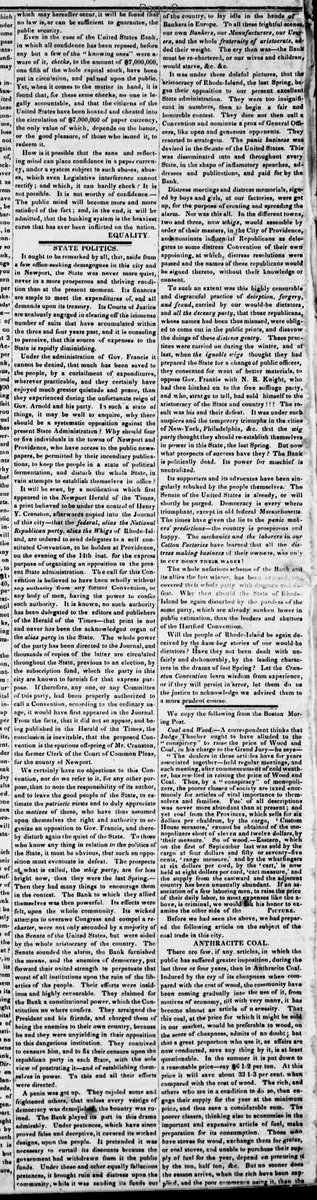
EQUALITY.
STATE POLITICS.
It ought to be remarked by all, that, aside from a few office-seeking demagogues in this city and in Newport, the State was never more quiet, never in a more prosperous and thriving condition than at the present moment. Its finances are ample to meet the expenditures of, and all demands upon its treasury. Its Courts of Justice are zealously engaged in clearing off the immense number of suits that have accumulated within the three and four years past, and it is consoling to perceive, that this source of expenses to the State is rapidly diminishing.
Under the administration of Gov. Francis it cannot be denied, that much has been saved to the people, by a curtailment of expenditures, wherever practicable, and they certainly have enjoyed much greater quietude and peace, than they experienced during the unfortunate reign of Gov. Arnold and his party. In such a state of things, it may be well to enquire, why there should be a systematic opposition against the present State Administration? Why should four or five individuals in the towns of Newport and Providence, who have access to the public newspapers, be permitted by their incendiary publications, to keep the people in a state of political fermentation, and disturb the whole State, in vain attempts to establish themselves in office?
It will be seen, by a notification which first appeared in the Newport Herald of the Times, a print believed to be under the control of Henry Y. Cranston, afterwards copied into the Journal of this city—that the federal, alias the National Republican party, alias the Whigs of Rhode-Island, are ordered to send delegates to a self constituted Convention, to be holden at Providence, on the evening of the 14th inst. for the express purpose of organizing an opposition to the present State administration. The call for this Convention is believed to have been wholly without any authority from any former Convention, or any body of men, having the power to confer such authority. It is known, no such authority has been delegated to the editors and publishers of the Herald of the Times—that print is not and never has been the acknowledged organ of the alias party in the State. The whole power of the party has been directed to the Journal, and thousands of copies of the latter are circulated throughout the State, previous to an election, by the subscription fund, which the party in this city are known to furnish for that express purpose. If therefore, any one, or any Committee of this party, had been properly authorized to call a Convention, according to the ordinary usage, it would have first appeared in the Journal. From the facts, that it did not so appear, and being published in the Herald of the Times, the conclusion is inevitable, that the proposed Convention is the spurious offspring of Mr. Cranston, the former Clerk of the Court of Common Pleas, for the county of Newport.
We certainly have no objections to this Convention, nor do we refer to it, for any other purpose, than to note the responsibility of its author. and to leave the good people of the State, to estimate the patriotic views and to duly appreciate the motives of those, who have thus assumed upon themselves the right and authority to organize an opposition to Gov. Francis, and thereby disturb again the quiet of the State. To those who know any thing in relation to the politics of the State, it must be obvious, that such an opposition must eventuate in defeat. The prospects of what is called, the whig party, are far less bright now, than they were the last Spring.— Then they had many things to encourage them in the contest. The Bank to which they allied themselves was then powerful. Its effects were felt, upon the whole community. Its wicked attempts to overawe Congress and compel a re-charter, were not only seconded by a majority of the Senate of the United States, but were aided by the whole aristocracy of the country, The Senate sounded the alarm, the Bank furnished the means, and the enemies of democracy, put forward their united strength to perpetuate that worst of all institutions upon the ruin of the liberties of the people. Their efforts were insidious and highly censurable. They claimed for the Bank a constitutional power, which the Constitution no where confers. They arraigned the President and his friends, and charged them of being the enemies to their own country, because he and they were unyielding in their opposition to this dangerous institution. They contrived to censure him, and to fix their censure upon the republican party in each State, with the sole view of prostrating it—and of establishing themselves in power. To this end all their efforts were directed.
A panic was got up. They cajoled some and frightened others, that unless every vestige of democracy was demolished, the country was ruined. The Bank played its part in this drama admirably. Under pretences, which have since proved false and deceptive, it covered its wicked designs, upon the people. It pretended it was necessary to curtail its discounts because the government had withdrawn from it the public funds. Under these and other equally fallacious pretences, it brought ruin and distress upon the community, while it was sending its funds out of the country, to lay idle in the hands of Bankers in Europe. To all these frightful scenes our own Bankers, our Manufacturers, our Usurers, and the whole fraternity of aristocrats, added their weight. The cry then was—the Bank must be re-chartered, or our wives and children, would starve, &c. &c.
It was under these doleful pictures, that the aristocracy of Rhode-Island, the last Spring, began their opposition to our present excellent State administration. They were too insignificant in numbers, then to begin a fair and honorable contest. They dare not then call a Convention and nominate a ticket of General Officers, like open and generous opponents. They resorted to stratagem. The panic business was devised in the Senate of the United States. This was disseminated into and throughout every State, in the shape of inflammatory speeches, addresses and publications, and paid for by the Bank.
Distress meetings and distress memorials, signed by boys and girls, at our factories, were got up, for the purpose of creating and spreading the alarm. Nor was this all. In the different towns, two and three, now whigs, would assemble by order of their masters, in the City of Providence, and—nominate influential Republicans as delegates to some distress Convention of their own appointing, at which, distress resolutions were passed and the names of these republicans would be signed thereto, without their knowledge or consent.
To such an extent was this highly censurable and disgraceful practice of deception, forgery, and fraud, carried by our would-be dictators, and all the decency party, that those republicans, whose names had been thus misused, were obliged to come out in the public prints, and disavow the doings of these distress gentry. These practices were carried on during the winter, and at last, when the ignoble whigs thought they had prepared the State for a change of public officers, they consented for want of better materials, to oppose Gov. Francis with N. R. Knight, who had then hitched on to the free suffrage party, and who, strange to tell, had sold himself to the aristocracy of the State and country!!! The result was his and their defeat. It was under such auspices and the temporary triumphs in the cities of New-York, Philadelphia, &c. that the whig party thought they should re-establish themselves in power in this State, the last Spring. But now what prospects of success have they? The Bank is politically dead. Its power for mischief is neutralized.
Its supporters and its advocates have been singularly rebuked by the people themselves. The Senate of the United States is already, or will shortly be purged. Democracy is everywhere triumphant, except in old federal Massachusetts. The times have given the lie to the panic makers' predictions—the country is prosperous and happy. The mechanics and the laborers in our Cotton Factories have learned that all the distress making business of their owners, was only TO CUT DOWN THEIR WAGES!
The whole nefarious scheme of the Bank and its allies the last winter. has been exposed, and covered their whole party with disgrace and defeat. Why then should the State of Rhode. Island be again disturbed by the panders of the same party, which are already sunken lower in public estimation, than the leaders and abettors of the Hartford Convention.
Will the people of Rhode-Island be again deceived by the hum-bug stories of our would-be dictators? Have they not been dealt with unfairly and dishonorably, by the leading characters in the drama of last Spring? Let the Cranston Convention learn wisdom from experience, or if they will persist in error, let them do us the justice to acknowledge we advised them to a more prudent course.
STATE POLITICS.
It ought to be remarked by all, that, aside from a few office-seeking demagogues in this city and in Newport, the State was never more quiet, never in a more prosperous and thriving condition than at the present moment. Its finances are ample to meet the expenditures of, and all demands upon its treasury. Its Courts of Justice are zealously engaged in clearing off the immense number of suits that have accumulated within the three and four years past, and it is consoling to perceive, that this source of expenses to the State is rapidly diminishing.
Under the administration of Gov. Francis it cannot be denied, that much has been saved to the people, by a curtailment of expenditures, wherever practicable, and they certainly have enjoyed much greater quietude and peace, than they experienced during the unfortunate reign of Gov. Arnold and his party. In such a state of things, it may be well to enquire, why there should be a systematic opposition against the present State Administration? Why should four or five individuals in the towns of Newport and Providence, who have access to the public newspapers, be permitted by their incendiary publications, to keep the people in a state of political fermentation, and disturb the whole State, in vain attempts to establish themselves in office?
It will be seen, by a notification which first appeared in the Newport Herald of the Times, a print believed to be under the control of Henry Y. Cranston, afterwards copied into the Journal of this city—that the federal, alias the National Republican party, alias the Whigs of Rhode-Island, are ordered to send delegates to a self constituted Convention, to be holden at Providence, on the evening of the 14th inst. for the express purpose of organizing an opposition to the present State administration. The call for this Convention is believed to have been wholly without any authority from any former Convention, or any body of men, having the power to confer such authority. It is known, no such authority has been delegated to the editors and publishers of the Herald of the Times—that print is not and never has been the acknowledged organ of the alias party in the State. The whole power of the party has been directed to the Journal, and thousands of copies of the latter are circulated throughout the State, previous to an election, by the subscription fund, which the party in this city are known to furnish for that express purpose. If therefore, any one, or any Committee of this party, had been properly authorized to call a Convention, according to the ordinary usage, it would have first appeared in the Journal. From the facts, that it did not so appear, and being published in the Herald of the Times, the conclusion is inevitable, that the proposed Convention is the spurious offspring of Mr. Cranston, the former Clerk of the Court of Common Pleas, for the county of Newport.
We certainly have no objections to this Convention, nor do we refer to it, for any other purpose, than to note the responsibility of its author. and to leave the good people of the State, to estimate the patriotic views and to duly appreciate the motives of those, who have thus assumed upon themselves the right and authority to organize an opposition to Gov. Francis, and thereby disturb again the quiet of the State. To those who know any thing in relation to the politics of the State, it must be obvious, that such an opposition must eventuate in defeat. The prospects of what is called, the whig party, are far less bright now, than they were the last Spring.— Then they had many things to encourage them in the contest. The Bank to which they allied themselves was then powerful. Its effects were felt, upon the whole community. Its wicked attempts to overawe Congress and compel a re-charter, were not only seconded by a majority of the Senate of the United States, but were aided by the whole aristocracy of the country, The Senate sounded the alarm, the Bank furnished the means, and the enemies of democracy, put forward their united strength to perpetuate that worst of all institutions upon the ruin of the liberties of the people. Their efforts were insidious and highly censurable. They claimed for the Bank a constitutional power, which the Constitution no where confers. They arraigned the President and his friends, and charged them of being the enemies to their own country, because he and they were unyielding in their opposition to this dangerous institution. They contrived to censure him, and to fix their censure upon the republican party in each State, with the sole view of prostrating it—and of establishing themselves in power. To this end all their efforts were directed.
A panic was got up. They cajoled some and frightened others, that unless every vestige of democracy was demolished, the country was ruined. The Bank played its part in this drama admirably. Under pretences, which have since proved false and deceptive, it covered its wicked designs, upon the people. It pretended it was necessary to curtail its discounts because the government had withdrawn from it the public funds. Under these and other equally fallacious pretences, it brought ruin and distress upon the community, while it was sending its funds out of the country, to lay idle in the hands of Bankers in Europe. To all these frightful scenes our own Bankers, our Manufacturers, our Usurers, and the whole fraternity of aristocrats, added their weight. The cry then was—the Bank must be re-chartered, or our wives and children, would starve, &c. &c.
It was under these doleful pictures, that the aristocracy of Rhode-Island, the last Spring, began their opposition to our present excellent State administration. They were too insignificant in numbers, then to begin a fair and honorable contest. They dare not then call a Convention and nominate a ticket of General Officers, like open and generous opponents. They resorted to stratagem. The panic business was devised in the Senate of the United States. This was disseminated into and throughout every State, in the shape of inflammatory speeches, addresses and publications, and paid for by the Bank.
Distress meetings and distress memorials, signed by boys and girls, at our factories, were got up, for the purpose of creating and spreading the alarm. Nor was this all. In the different towns, two and three, now whigs, would assemble by order of their masters, in the City of Providence, and—nominate influential Republicans as delegates to some distress Convention of their own appointing, at which, distress resolutions were passed and the names of these republicans would be signed thereto, without their knowledge or consent.
To such an extent was this highly censurable and disgraceful practice of deception, forgery, and fraud, carried by our would-be dictators, and all the decency party, that those republicans, whose names had been thus misused, were obliged to come out in the public prints, and disavow the doings of these distress gentry. These practices were carried on during the winter, and at last, when the ignoble whigs thought they had prepared the State for a change of public officers, they consented for want of better materials, to oppose Gov. Francis with N. R. Knight, who had then hitched on to the free suffrage party, and who, strange to tell, had sold himself to the aristocracy of the State and country!!! The result was his and their defeat. It was under such auspices and the temporary triumphs in the cities of New-York, Philadelphia, &c. that the whig party thought they should re-establish themselves in power in this State, the last Spring. But now what prospects of success have they? The Bank is politically dead. Its power for mischief is neutralized.
Its supporters and its advocates have been singularly rebuked by the people themselves. The Senate of the United States is already, or will shortly be purged. Democracy is everywhere triumphant, except in old federal Massachusetts. The times have given the lie to the panic makers' predictions—the country is prosperous and happy. The mechanics and the laborers in our Cotton Factories have learned that all the distress making business of their owners, was only TO CUT DOWN THEIR WAGES!
The whole nefarious scheme of the Bank and its allies the last winter. has been exposed, and covered their whole party with disgrace and defeat. Why then should the State of Rhode. Island be again disturbed by the panders of the same party, which are already sunken lower in public estimation, than the leaders and abettors of the Hartford Convention.
Will the people of Rhode-Island be again deceived by the hum-bug stories of our would-be dictators? Have they not been dealt with unfairly and dishonorably, by the leading characters in the drama of last Spring? Let the Cranston Convention learn wisdom from experience, or if they will persist in error, let them do us the justice to acknowledge we advised them to a more prudent course.
What sub-type of article is it?
Partisan Politics
Economic Policy
What keywords are associated?
Rhode Island Politics
Governor Francis
Whig Opposition
Bank Panic
Democratic Triumph
Cranston Convention
State Prosperity
What entities or persons were involved?
Gov. Francis
Henry Y. Cranston
Gov. Arnold
N. R. Knight
Whig Party
Bank Of The United States
Senate Of The United States
President (Implied Jackson)
Editorial Details
Primary Topic
Defense Of Governor Francis Against Whig Opposition And Bank Influenced Tactics
Stance / Tone
Strongly Pro Democratic Administration, Anti Whig And Anti Bank
Key Figures
Gov. Francis
Henry Y. Cranston
Gov. Arnold
N. R. Knight
Whig Party
Bank Of The United States
Senate Of The United States
President (Implied Jackson)
Key Arguments
State Under Gov. Francis Is Prosperous, Financially Stable, And Peaceful
Unauthorized Whig Convention By Cranston Aims To Disturb Quiet For Personal Gain
Past Whig Opposition Relied On Bank Induced Panic And Deceptive Tactics
Bank's Re Charter Efforts Were Unconstitutional And Aimed To Undermine Democracy
Whigs Used Fraud Like Fake Distress Meetings And Forged Signatures
National Democratic Triumphs And Bank's Defeat Doom Whig Prospects
People Should Reject Renewed Whig Agitation