Thank you for visiting SNEWPapers!
Sign up free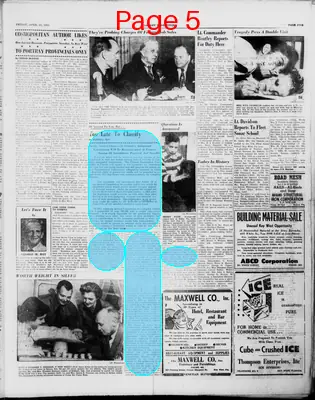
Editorial
April 13, 1951
The Key West Citizen
Key West, Monroe County, Florida
What is this article about?
Editorial by Russell Kay urges Florida Legislature to initiate revision of the 1885 Constitution via Citizens Committee proposals: annual sessions, judicial simplification under Article V, and a financed Commission for comprehensive study, preferring this over costly conventions for better public input and efficiency.
Clipping
OCR Quality
95%
Excellent
Full Text
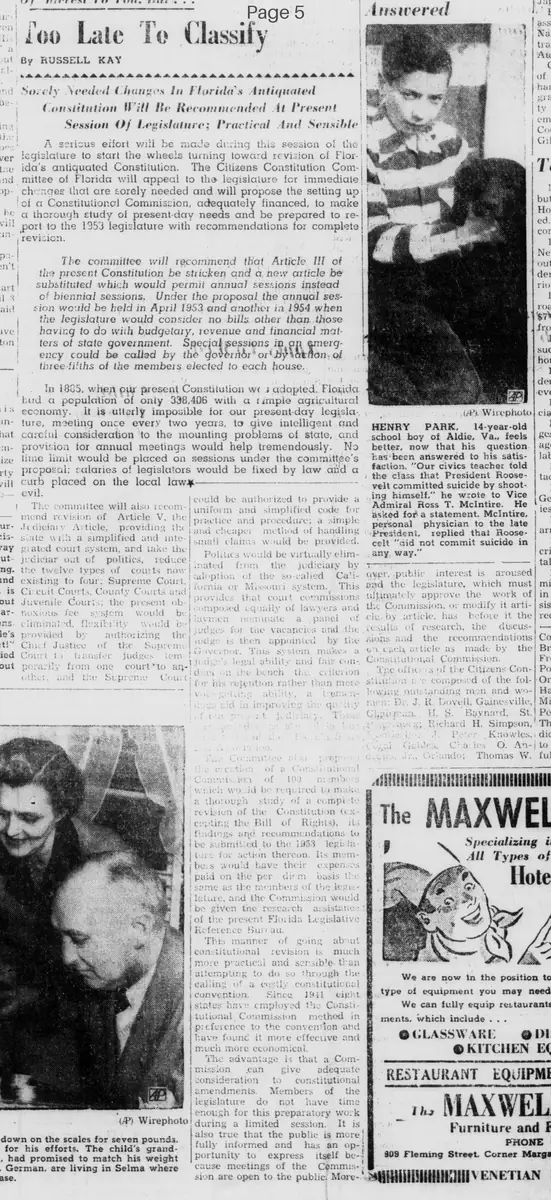
Too Late To Classify
By
RUSSELL KAY
Sorely Needed Changes In Florida's Antiquated Constitution Will Be Recommended At Present Session Of Legislature; Practical And Sensible
A serious effort will be made during this session of the legislature to start the wheels turning toward revision of Florida's antiquated Constitution. The Citizens Constitution Committee of Florida will appeal to the legislature for immediate changes that are sorely needed and will propose the setting up of a Constitutional Commission, adequately financed, to make a thorough study of present-day needs and be prepared to report to the 1953 legislature with recommendations for complete revision.
The committee will recommend that Article III of the present Constitution be stricken and a new article be substituted which would permit annual sessions instead of biennial sessions. Under the proposal the annual session would be held in April 1953 and another in 1954 when the legislature would consider no bills other than those having to do with budgetary, revenue and financial matters of state government.
Special sessions in an emergency could be called by the governor or by petition of three-fifths of the members elected to each house.
In 1885, when our present Constitution was adopted, Florida had a population of only 338,406 with a simple agricultural economy. It is utterly impossible for our present-day legislature, meeting once every two years, to give intelligent and careful consideration to the mounting problems of state, and provision for annual meetings would help tremendously. No time limit would be placed on sessions under the committee's proposal; salaries of legislators would be fixed by law and a curb placed on the local laws evil.
The committee will also recommend revision of Article V, the Judiciary Article, providing the state with a simplified and integrated court system, and take the judiciary out of politics, reduce the twelve types of courts now existing to four: Supreme Court, Circuit Courts, County Courts and Juvenile Courts; the present obnoxious fee system would be eliminated, flexibility would be provided by authorizing the Chief Justice of the Supreme Court to transfer judges temporarily from one court to another, and the Supreme Court could be authorized to provide a uniform and simplified code for practice and procedure; a simple and cheaper method of handling small claims would be provided. Politics would be virtually eliminated from the judiciary by adoption of the so-called California or Missouri system. This provides that court commissions composed equally of lawyers and laymen nominate a panel of judges for the vacancies and the judge is then appointed by the Governor. This system makes a judge's legal ability and fair conduct on the bench the criterion for his retention rather than mere availability, a tendency that aids in improving the quality of the judiciary.
The committee is also advocating the creation of a constitutional Commission of nine members which would be required to make a thorough study of a complete revision of the Constitution (excepting the Bill of Rights), its findings and recommendations to be submitted to the 1953 legislature for action thereon. Its members should have their expenses paid on the per diem basis the same as the members of the legislature, and the Commission would be given the research assistance of the present Florida Legislative Reference Bureau.
This manner of going about constitutional revision is much more practical and sensible than attempting to do so through the calling of a costly constitutional convention. Since 1941 eight states have employed the Constitutional Commission method in preference to the convention and have found it more effective and much more economical.
The advantage is that a Commission can give adequate consideration to constitutional amendments. Members of the legislature do not have time enough for this preparatory work during a limited session. It is also true that the public is more fully informed and has an opportunity to express itself because meetings of the Commission are open to the public. Moreover, public interest is aroused and the legislature, which must ultimately approve the work of the Commission, or modify it article by article, has before it the results of research, the discussions and the recommendations on each article as made by the Constitutional Commission.
By
RUSSELL KAY
Sorely Needed Changes In Florida's Antiquated Constitution Will Be Recommended At Present Session Of Legislature; Practical And Sensible
A serious effort will be made during this session of the legislature to start the wheels turning toward revision of Florida's antiquated Constitution. The Citizens Constitution Committee of Florida will appeal to the legislature for immediate changes that are sorely needed and will propose the setting up of a Constitutional Commission, adequately financed, to make a thorough study of present-day needs and be prepared to report to the 1953 legislature with recommendations for complete revision.
The committee will recommend that Article III of the present Constitution be stricken and a new article be substituted which would permit annual sessions instead of biennial sessions. Under the proposal the annual session would be held in April 1953 and another in 1954 when the legislature would consider no bills other than those having to do with budgetary, revenue and financial matters of state government.
Special sessions in an emergency could be called by the governor or by petition of three-fifths of the members elected to each house.
In 1885, when our present Constitution was adopted, Florida had a population of only 338,406 with a simple agricultural economy. It is utterly impossible for our present-day legislature, meeting once every two years, to give intelligent and careful consideration to the mounting problems of state, and provision for annual meetings would help tremendously. No time limit would be placed on sessions under the committee's proposal; salaries of legislators would be fixed by law and a curb placed on the local laws evil.
The committee will also recommend revision of Article V, the Judiciary Article, providing the state with a simplified and integrated court system, and take the judiciary out of politics, reduce the twelve types of courts now existing to four: Supreme Court, Circuit Courts, County Courts and Juvenile Courts; the present obnoxious fee system would be eliminated, flexibility would be provided by authorizing the Chief Justice of the Supreme Court to transfer judges temporarily from one court to another, and the Supreme Court could be authorized to provide a uniform and simplified code for practice and procedure; a simple and cheaper method of handling small claims would be provided. Politics would be virtually eliminated from the judiciary by adoption of the so-called California or Missouri system. This provides that court commissions composed equally of lawyers and laymen nominate a panel of judges for the vacancies and the judge is then appointed by the Governor. This system makes a judge's legal ability and fair conduct on the bench the criterion for his retention rather than mere availability, a tendency that aids in improving the quality of the judiciary.
The committee is also advocating the creation of a constitutional Commission of nine members which would be required to make a thorough study of a complete revision of the Constitution (excepting the Bill of Rights), its findings and recommendations to be submitted to the 1953 legislature for action thereon. Its members should have their expenses paid on the per diem basis the same as the members of the legislature, and the Commission would be given the research assistance of the present Florida Legislative Reference Bureau.
This manner of going about constitutional revision is much more practical and sensible than attempting to do so through the calling of a costly constitutional convention. Since 1941 eight states have employed the Constitutional Commission method in preference to the convention and have found it more effective and much more economical.
The advantage is that a Commission can give adequate consideration to constitutional amendments. Members of the legislature do not have time enough for this preparatory work during a limited session. It is also true that the public is more fully informed and has an opportunity to express itself because meetings of the Commission are open to the public. Moreover, public interest is aroused and the legislature, which must ultimately approve the work of the Commission, or modify it article by article, has before it the results of research, the discussions and the recommendations on each article as made by the Constitutional Commission.
What sub-type of article is it?
Constitutional
Legal Reform
What keywords are associated?
Florida Constitution
Constitutional Revision
Annual Sessions
Judiciary Reform
Constitutional Commission
What entities or persons were involved?
Citizens Constitution Committee Of Florida
Florida Legislature
Governor
Editorial Details
Primary Topic
Revision Of Florida's Antiquated Constitution
Stance / Tone
Supportive Of Practical Constitutional Changes
Key Figures
Citizens Constitution Committee Of Florida
Florida Legislature
Governor
Key Arguments
Propose Annual Legislative Sessions Starting In 1953, With 1954 Focused On Budget Matters
Allow Special Sessions By Governor Or Petition
Revise Article V For Simplified Court System With Four Court Types
Eliminate Fee System And Politics In Judiciary Via Nomination Commissions
Create Nine Member Constitutional Commission For Thorough Study And Recommendations To 1953 Legislature
Commission Method More Practical And Economical Than Constitutional Convention