Thank you for visiting SNEWPapers!
Sign up free
Letter to Editor
January 23, 1874
The Portland Daily Press
Portland, Cumberland County, Maine
What is this article about?
Critique of a legislative bill proposing selective capital punishment favoring educated, prominent murderers (e.g., Sickles, Stokes) over poor, ignorant ones (e.g., Harris), arguing for class-blind reform and highlighting societal biases in justice.
Clipping
OCR Quality
98%
Excellent
Full Text
Dress Coat and Kid Glove Murderers.
To the Editor of the Press:
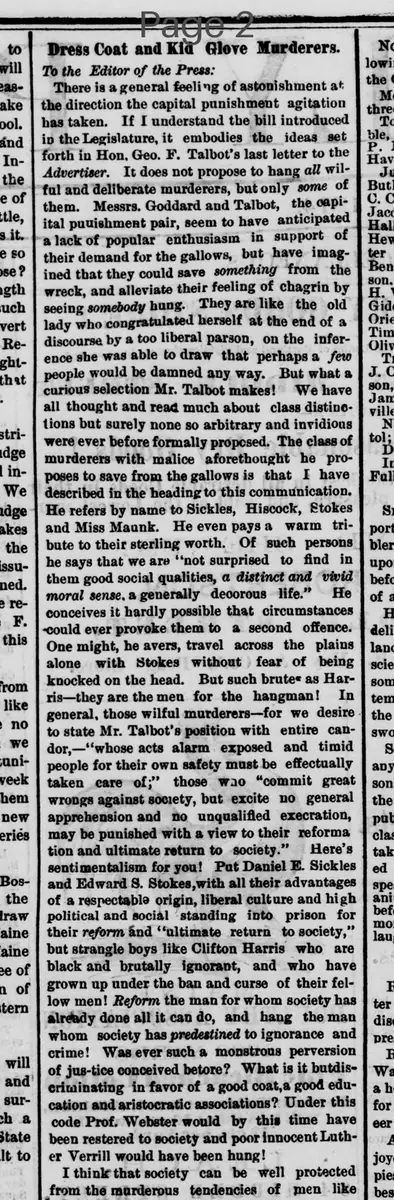
There is a general feeling of astonishment at the direction the capital punishment agitation has taken. If I understand the bill introduced in the Legislature, it embodies the ideas set forth in Hon, Geo. F. Talbot's last letter to the Advertiser. It does not propose to hang all wilful and deliberate murderers, but only some of them. Messrs. Goddard and Talbot, the capital punishment pair, seem to have anticipated a lack of popular enthusiasm in support of their demand for the gallows, but have imagined that they could save something from the wreck, and alleviate their feeling of chagrin by seeing somebody hung. They are like the old lady who congratulated herself at the end of a discourse by a too liberal parson, on the inference she was able to draw that perhaps a few people would be damned any way. But what a curious selection Mr. Talbot makes! We have all thought and read much about class distinctions but surely none so arbitrary and invidious were ever before formally proposed. The class of murderers with malice aforethought he proposes to save from the gallows is that I have described in the heading to this communication. He refers by name to Sickles, Hiscock, Stokes and Miss Mauk. He even pays a warm tribute to their sterling worth. Of such persons he says that we are 'not surprised to find in them good social qualities, a distinct and vivid moral sense, a generally decorous life.' He conceives it hardly possible that circumstances could ever provoke them to a second offence. One might, he avers, travel across the plains alone with Stokes without fear of being knocked on the head. But such brutes as Harris—they are the men for the hangman! In general, those wilful murderers—for we desire to state Mr. Talbot's position with entire candor,—'whose acts alarm exposed and timid people for their own safety must be effectually taken care of;' those who 'commit great wrongs against society, but excite no general apprehension and no unqualified execration, may be punished with a view to their reformation and ultimate return to society.' Here's sentimentalism for you! Put Daniel E. Sickles and Edward S. Stokes, with all their advantages of a respectable origin, liberal culture and high political and social standing into prison for their reform and 'ultimate return to society,' but strangle boys like Clifton Harris who are black and brutally ignorant, and who have grown up under the ban and curse of their fellow men! Reform the man for whom society has already done all it can do, and hang the man whom society has predestined to ignorance and crime! Was ever such a monstrous perversion of justice conceived before? What is it but discriminating in favor of a good coat, a good education and aristocratic associations? Under this code Prof. Webster would by this time have been restored to society and poor innocent Luther Verrill would have been hung!
I think that society can be well protected from the murderous tendencies of men like Sickles. Stokes. Walworth and Hiscock, without hanging them. They may be placed where they will have no opportunity to pursue 'murder as a fine art,' on future occasions, But they constitute exactly the class in respect to which the argument against capital punishment has the least force. Their characters are already formed—their intellects and their moral nature have received all the culture that is possible. They are, some of them, probably exceptions to the almost universal rule that moral diseases may be eradicated. On the contrary the very men whom Mr. Talbot would hang, are those who can almost certainly be restored to moral sanity. Whatever good qualities and instincts they may have, have been studiously repressed and stifled,—all their evil passions have been cultivated and encouraged by the circumstances in which society has placed them. Meanwhile they have been left in a state of complete intellectual darkness. If hanging is to be tried again, theirs is the very claim from immunity which society cannot with justice refuse. It is not their crimes that have rendered murder fashionable and contagious. No one is inspired to emulate their example. There is nothing fascinating about these vulgar animals who hack and hew their victims. It is the gilded murderer who performs his butchery with grand dramatic airs and posturing, who kills like the hero of a melo-drama and has his fine phrases ready for his audience like Booth, that has spread abroad the mania for bloodshed. It is not so much that these men have not been hung as that they have not been punished or restrained in any way that has done the mischief. The outrage has continued already too long, and now Messrs Talbot and Goddard propose to legalize it
To the Editor of the Press:
There is a general feeling of astonishment at the direction the capital punishment agitation has taken. If I understand the bill introduced in the Legislature, it embodies the ideas set forth in Hon, Geo. F. Talbot's last letter to the Advertiser. It does not propose to hang all wilful and deliberate murderers, but only some of them. Messrs. Goddard and Talbot, the capital punishment pair, seem to have anticipated a lack of popular enthusiasm in support of their demand for the gallows, but have imagined that they could save something from the wreck, and alleviate their feeling of chagrin by seeing somebody hung. They are like the old lady who congratulated herself at the end of a discourse by a too liberal parson, on the inference she was able to draw that perhaps a few people would be damned any way. But what a curious selection Mr. Talbot makes! We have all thought and read much about class distinctions but surely none so arbitrary and invidious were ever before formally proposed. The class of murderers with malice aforethought he proposes to save from the gallows is that I have described in the heading to this communication. He refers by name to Sickles, Hiscock, Stokes and Miss Mauk. He even pays a warm tribute to their sterling worth. Of such persons he says that we are 'not surprised to find in them good social qualities, a distinct and vivid moral sense, a generally decorous life.' He conceives it hardly possible that circumstances could ever provoke them to a second offence. One might, he avers, travel across the plains alone with Stokes without fear of being knocked on the head. But such brutes as Harris—they are the men for the hangman! In general, those wilful murderers—for we desire to state Mr. Talbot's position with entire candor,—'whose acts alarm exposed and timid people for their own safety must be effectually taken care of;' those who 'commit great wrongs against society, but excite no general apprehension and no unqualified execration, may be punished with a view to their reformation and ultimate return to society.' Here's sentimentalism for you! Put Daniel E. Sickles and Edward S. Stokes, with all their advantages of a respectable origin, liberal culture and high political and social standing into prison for their reform and 'ultimate return to society,' but strangle boys like Clifton Harris who are black and brutally ignorant, and who have grown up under the ban and curse of their fellow men! Reform the man for whom society has already done all it can do, and hang the man whom society has predestined to ignorance and crime! Was ever such a monstrous perversion of justice conceived before? What is it but discriminating in favor of a good coat, a good education and aristocratic associations? Under this code Prof. Webster would by this time have been restored to society and poor innocent Luther Verrill would have been hung!
I think that society can be well protected from the murderous tendencies of men like Sickles. Stokes. Walworth and Hiscock, without hanging them. They may be placed where they will have no opportunity to pursue 'murder as a fine art,' on future occasions, But they constitute exactly the class in respect to which the argument against capital punishment has the least force. Their characters are already formed—their intellects and their moral nature have received all the culture that is possible. They are, some of them, probably exceptions to the almost universal rule that moral diseases may be eradicated. On the contrary the very men whom Mr. Talbot would hang, are those who can almost certainly be restored to moral sanity. Whatever good qualities and instincts they may have, have been studiously repressed and stifled,—all their evil passions have been cultivated and encouraged by the circumstances in which society has placed them. Meanwhile they have been left in a state of complete intellectual darkness. If hanging is to be tried again, theirs is the very claim from immunity which society cannot with justice refuse. It is not their crimes that have rendered murder fashionable and contagious. No one is inspired to emulate their example. There is nothing fascinating about these vulgar animals who hack and hew their victims. It is the gilded murderer who performs his butchery with grand dramatic airs and posturing, who kills like the hero of a melo-drama and has his fine phrases ready for his audience like Booth, that has spread abroad the mania for bloodshed. It is not so much that these men have not been hung as that they have not been punished or restrained in any way that has done the mischief. The outrage has continued already too long, and now Messrs Talbot and Goddard propose to legalize it
What sub-type of article is it?
Persuasive
Social Critique
Provocative
What themes does it cover?
Crime Punishment
Social Issues
Morality
What keywords are associated?
Capital Punishment
Class Distinctions
Selective Hanging
Murder Reform
Social Justice
Discriminatory Justice
Gilded Murderers
What entities or persons were involved?
The Editor Of The Press
Letter to Editor Details
Recipient
The Editor Of The Press
Main Argument
the letter opposes a selective capital punishment bill that spares well-educated, socially prominent murderers like sickles and stokes while targeting poor, ignorant ones like harris, arguing this discriminates by class and that the latter should be reformed rather than hanged.
Notable Details
References Sickles, Hiscock, Stokes, Miss Mauk As Examples Of Spared Murderers
Contrasts With Harris As Example For Hanging
Mentions Prof. Webster And Luther Verrill Hypothetically
Critiques Lack Of Punishment For High Class Murderers As Source Of Societal Harm