Thank you for visiting SNEWPapers!
Sign up free
Literary
September 23, 1916
The West Virginian
Fairmont, Marion County, West Virginia
What is this article about?
Tom Wolcott falls in love with nurse Olive Hale while recovering from an injury. Jealousy over his assistant Minna Blair strains their relationship, leading Olive to spy and sabotage, culminating in her tragic suicide after Tom leaves in anger.
Clipping
OCR Quality
95%
Excellent
Full Text
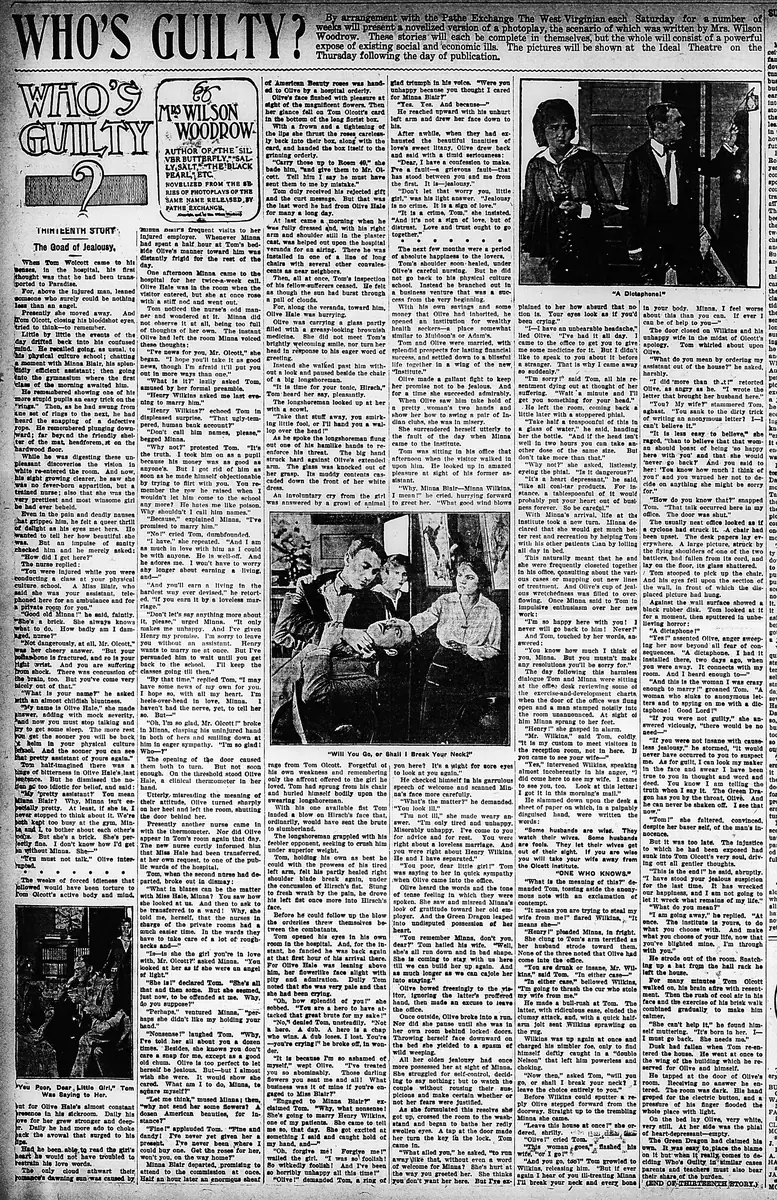
WHO'S GUILTY?
THE THIRTEENTH STORY
The Goad of Jealousy.
When Tom Wolcott came to his senses, in the hospital, his first thought was that he had been transported to Paradise.
For, above the injured man, leaned someone who surely could be nothing less than an angel.
Presently she moved away. And Tom Wolcott, closing his bloodshot eyes, tried to think—to remember.
Little by little the events of the day drifted back into his confused mind. He recalled going, as usual, to his physical culture school; chatting a moment with Minna Blair, his splendidly efficient assistant; then going to the gymnasium where the first class of the morning awaited him.
He remembered showing one of his more stupid pupils an easy trick on the "rings."
Then, as he had swung from one set of rings to the next, he had heard the snapping of a defective rope. He remembered plunging downward; far beyond the friendly shelter of the mat, head foremost on the hardwood floor.
While he was digesting these unpleasant discoveries the vision in white re-entered the room. And now, his sight growing clearer, he saw she was no fever-born apparition, but a trained nurse; also that she was the very prettiest and most winsome girl he had ever beheld.
Even in the pain and deadly nausea that gripped him, he felt a queer thrill of delight as his eyes met hers.
He wanted to tell her how beautiful she was.
But an impulse of sanity checked him and he merely asked:
"How did I get here?"
The nurse replied:
"You were injured while you were conducting a class at your physical culture school. A Miss Blair, who said she was your assistant, telephoned here for an ambulance and for a private room for you."
"Good old Minna!" he said, faintly. "She's a brick. She always knows what to do. How badly am I damaged, nurse?"
"Not dangerously, at all, Mr. Wolcott," was her cheery answer. "But your collar bone is fractured, and so is your right wrist. And you are suffering from shock. There was concussion of the brain, too. But you've come very nicely out of that."
"What is your name?" he asked with an almost childish bluntness.
"My name is Olive Hale," she made answer, adding with mock severity, "and now you must stop talking and try to get some sleep. The more rest you get the sooner you will be back at your physical culture school. And the sooner you can see that best pretty assistant of yours again."
Tom half-imagined there was a trace of bitterness in Olive Hale's last sentence.
But he dismissed the notion as too idiotic for belief, and said:
"My pretty assistant? You mean Minna Blair? Why, Minna isn't especially pretty. At least, if she is, I've never stopped to think about it. We're both kept too busy at the gym, Minna and I, to bother about each other's looks. But she's a brick. She's perfectly fine. I don't know how I'd get along without Minna."
"You must not talk," Olive interrupted.
The weeks of forced idleness that followed would have been torture to Tom Olcott's active body and mind, but for Olive Hale's almost constant presence in his sickroom. Daily his love for her grew stronger and deeper. Daily he had more ado to choke back the avowal that surged to his lips.
Had he been able to read the girl's heart he would not have troubled to restrain his love words.
The only cloud athwart their romance's dawning sun was caused by Minna Blair's frequent visits to her injured employer.
Whenever Minna had spent a half hour at Tom's bedside Olive's manner toward him was distantly frigid for the rest of the day.
One afternoon Minna came to the hospital for her twice-a-week call. Olive Hale was in the room when the visitor entered, but she at once rose with a stiff nod and went out.
Tom noticed the nurse's odd manner and wondered at it. Minna did not observe it at all, being too full of thoughts of her own. The instant Olive had left the room Minna voiced these thoughts:
"I've news for you, Mr. Olcott," she began. "I hope you'll take it as good news, though I'm afraid it'll put you out in more ways than one."
"What is it?" lazily asked Tom, amused by her formal preamble.
"Henry Wilkins asked me last evening to marry him."
"Henry Wilkins?" echoed Tom in displeased surprise.
"That ugly-tempered, human bank account?"
"Don't call him names, please," begged Minna.
"Why not?" protested Tom. "It's the truth. I took him on as a pupil because his money was as good as anyone's. But I got rid of him as soon as he made himself objectionable by trying to flirt with you. You remember the row he raised when I wouldn't let him come to the school any more? He hates me like poison. Why shouldn't I call him names?"
"Because," explained Minna, "I've promised to marry him."
"No!" cried Tom, dumbfounded.
"I have," she repeated. "And I am as much in love with him as I could be with anyone. He is well-off. And he adores me. I won't have to worry any longer about earning a living and—"
"And you'll earn a living in the hardest way ever devised," he retorted, "if you earn it by a loveless marriage."
"Don't let's say anything more about it, please," urged Minna. "It only makes me unhappy. And I've given Henry my promise. I'm sorry to leave you without an assistant. Henry wants to marry me at once. But I've persuaded him to wait until you get back to the school. I'll keep the classes going till then."
"By that time," replied Tom, "I may have some news of my own for you. I hope so, with all my heart. I'm heels-over-head in love, Minna. I haven't had the nerve, yet, to tell her. But—"
"Oh, I'm so glad, Mr. Olcott!" broke in Minna, clasping his uninjured hand in both of hers and smiling down at him in eager sympathy. "I'm so glad! Who—?"
The opening of the door caused them both to turn.
But not soon enough. On the threshold stood Olive Hale, a clinical thermometer in her hand.
Utterly misreading the meaning of their attitude, Olive turned sharply on her heel and left the room, shutting the door behind her.
Presently another nurse came in with the thermometer. Nor did Olive appear in Tom's room again that day.
The new nurse curtly informed him that Miss Hale had been transferred, at her own request, to one of the public wards of the hospital.
Tom, when the second nurse had departed, broke out in dismay:
"What in blazes can be the matter with Miss Hale, Minna? You saw how she looked at us. And then to ask to be transferred to a ward! Why, she told me, herself, that the nurses in charge of the private rooms had a much easier time. In the wards they have to take care of a lot of rough-necks and—"
"Is it she the girl you're in love with, Mr. Olcott?" asked Minna.
"You looked at her as if she were an angel of light."
"She is!" declared Tom. "She's all that and then some. But she seemed just now, to be offended at me. Why, do you suppose?"
"Perhaps," ventured Minna, "perhaps she didn't like my holding your hand."
"Nonsense!" laughed Tom. "I've told her all about you a dozen times. Besides, she knows you don't care a snap for me, except as a good old chum. Olive is too perfect to let herself be jealous. But—but I almost wish she were. It would show she cared. What am I to do, Minna, to square myself?"
"Let me think," mused Minna; then, "why not send her some flowers? A dozen American Beauties, for instance?"
"Fine!" applauded Tom. "Fine and dandy! I've never yet given her a present. I've never been where I could buy one. Get the roses for her, won't you, on the way home?"
Minna Blair departed, promising to attend to the commission at once.
Half an hour later an enormous sheaf of American Beauty roses was handed to Olive by a hospital orderly.
Olive's face flushed with pleasure at sight of the magnificent flowers. Then her glance fell on Tom Olcott's card in the bottom of the long florist box, with a frown and a tightening of the lips she thrust the roses carelessly back into their box, along with the card, and handed the box itself to the grinning orderly.
"Carry those up to Room 40," she bade him, "and give them to Mr. Olcott. Tell him I say he must have sent them to me by mistake."
Tom duly received his rejected gift and the curt message. But that was the last word he had from Olive Hale for many a long day.
At last came a morning when he was fully dressed and, with his right arm and shoulder still in the plaster cast, was helped out upon the hospital veranda for an airing.
There he was installed in one of a line of long chairs with several other convalescents as near neighbors.
Then, all at once, Tom's inspection of his fellow-sufferers ceased. He felt as though the sun had burst through a pall of clouds.
For, along the veranda, toward him, Olive Hale was hurrying.
Olive was carrying a glass partly filled with a greasy-looking brownish medicine.
She did not meet Tom's brightly welcoming smile, nor turn her head in response to his eager word of greeting.
Instead she walked past him without a look and paused beside the chair of a big longshoreman.
"It is time for your tonic, Hirsch," Tom heard her say, pleasantly.
The longshoreman looked up at her with a scowl.
"Take that stuff away, you smirking little fool, or I'll hand you a wallop over the head!"
As he spoke the longshoreman flung out one of his hamlike hands to re-enforce his threat.
The big hand struck hard against Olive's extended arm.
The glass was knocked out of her grasp.
Its muddy contents cascaded down the front of her white dress.
An involuntary cry from the girl was answered by a growl of animal glad triumph in his voice.
"Were you unhappy because you thought I cared for Minna Blair?"
"Yes. Yes. And because—"
He reached upward with his unhurt left arm and drew her face down to his.
After a while, when they had exhausted the beautiful inanities of love's sweet litany, Olive drew back and said with a timid seriousness:
"Dear, I have a confession to make. I've a fault—a grievous fault—that has stood between you and me from the first. It is—jealousy."
"Don't let that worry you, little girl," was his light answer. "Jealousy is no crime. It is a sign of love."
"It is a crime, Tom," she insisted. "And it's not a sign of love, but of distrust. Love and trust ought to go together."
The next few months were a period of absolute happiness to the lovers. Tom's shoulder soon healed, under Olive's careful nursing.
But he did not go back to his physical culture school.
Instead he branched out in a business venture that was successful from the very beginning.
With his own savings and some money that Olive had inherited, he opened an institution for wealthy health seekers—a place somewhat similar to Muldoon's or Adam's.
Tom and Olive were married, with splendid prospects for lasting financial success, and settled down to a blissful life together in a wing of the new "Institute."
Olive made a gallant fight to keep her promise not to be jealous.
And for a time she succeeded admirably.
When Olive saw him take hold of a pretty woman's two hands and show her how to swing a pair of Indian clubs, she was in misery.
She surrendered herself utterly to the fault of the day when Minna came to the institute.
Tom was sitting in his office that afternoon when the visitor walked in upon him.
He looked up in amazed pleasure at sight of his former assistant.
"Why, Minna Blair—Minna Wilkins, I mean!" he cried, hurrying forward to greet her.
"What good wind blows you here? It's a sight for sore eyes to look at you again."
He checked himself in his garrulous speech of welcome and scanned Minna's face more carefully.
"What's the matter?" he demanded. "You look ill."
"I'm not ill," she made weary answer. "I'm only tired and unhappy. Miserably unhappy. I've come to you for advice and for rest.
You were right about a loveless marriage. And you were right about Henry Wilkins. He and I have separated."
"You poor, dear little girl!" Tom was saying to her in quick sympathy when Olive came into the office.
Olive heard the words and the tone of tense feeling in which they were spoken. She saw and misread Minna's look of gratitude toward her old employer.
And the Green Dragon leaped into undisputed possession of her heart.
"You remember Minna, don't you, dear?" Tom hailed his wife. "Well, she's all run down and in bad shape. She is coming to stay with us here till we can build her up again. And as much longer as we can cajole her into staying."
Olive bowed freezingly to the visitor, ignoring the latter's proffered hand, then made an excuse to leave the office.
Once outside, Olive broke into a run. Nor did she pause until she was in her own room behind locked doors.
Throwing herself face downward on the bed she yielded to a spasm of wild weeping.
All her olden jealousy had once more possessed her at sight of Minna.
She struggled for self-control, deciding to say nothing; but to watch the couple without rousing their suspicions and make certain whether or not her fears were justified.
As she formulated this resolve she got up, crossed the room to the washstand and began to bathe her redly swollen eyes. A tap at the door made her turn the key in the lock.
Tom came in.
"What ailed you," he asked, "to run away like that, without even a word of welcome for Minna? She's hurt at the way you greeted her. She thinks you don't want her here. But I've er—"
"I-I have an unbearable headache." lied Olive. "I've had it all day. I came to the office to get you to give me some medicine for it. But I didn't like to speak to you about it before a stranger. That is why I came away so suddenly."
"I'm sorry!" said Tom, all his resentment dying out at thought of her suffering.
"Wait a minute and I'll get you something for your head."
He left the room, coming back a little later with a stoppered phial.
"Take half a teaspoonful of this in a glass of water," he said, handing her the bottle. "And if the head isn't well in two hours you can take another dose of the same size. But don't take more than that."
"Why not?" she asked, listlessly eyeing the phial. "Is it dangerous?"
"It's a heart depressant," he said "like all coal-tar products. For instance, a tablespoonful of it would probably put your heart out of business forever. So be careful."
With Minna's arrival, life at the institute took a new turn. Minna declared that she would get much better rest and recreation by helping Tom with his other patients than by lolling all day in bed.
This naturally meant that he and she were frequently closeted together in his office, consulting about the various cases or mapping out new lines of treatment. And Olive's cup of jealous wretchedness was filled to overflowing.
Once Minna said to Tom in impulsive enthusiasm over her new work:
"I'm so happy here with you! I never will go back to him! Never!"
And Tom, touched by her words, answered:
"You know how much I think of you, Minna. But you mustn't make any resolutions you'll be sorry for."
The day following this harmless dialogue Tom and Minna were sitting at the office desk reviewing some of the exercise-and-development charts, when the door of the office was flung open and a man stamped noisily into the room unannounced. At sight of him Minna sprang to her feet.
"Henry!" she gasped in alarm.
"Mr. Wilkins," said Tom, coldly "It is my custom to meet visitors in the reception room, not in here. If you came to see your wife—"
"Yes," intervened Wilkins, speaking almost incoherently in his anger, "I did come here to see my wife. I came to see you, too. Look at this letter! I got it in this morning's mail."
He slammed down upon the desk a sheet of paper on which, in a palpably disguised hand, were written the words:
"Some husbands are wise. They watch their wives. Some husbands are fools. They let their wives get out of their sight. If you are wise you will take your wife away from the Olcott institute.
"ONE WHO KNOWS."
"What is the meaning of this?" demanded Tom, tossing aside the anonymous note with an exclamation of contempt.
"It means you are trying to steal my wife from me!" flared Wilkins.
"It means she—"
"Henry!" pleaded Minna, in fright.
She clung to Tom's arm terrified as her husband strode toward them.
None of the three noted that Olive had come into the office.
"You are drunk or insane, Mr. Wilkins," said Tom.
"In either case—"
"In either case," bellowed Wilkins, "I'm going to thrash the cur who stole my wife from me."
He made a bull-rush at Tom. The latter, with ridiculous ease, eluded the clumsy attack, and, with a quick half-arm jolt sent Wilkins sprawling on the rug.
Wilkins was up again at once and charged his nimbler foe, only to find himself deftly caught in a "double Nelson" that left him powerless and choking.
"Now then," asked Tom, "will you go, or shall I break your neck? Leave the choice entirely to you."
Before Wilkins could sputter a reply Olive stepped forward from the doorway. Straight up to the trembling Minna she came.
"Leave this house at once!" she ordered, shrilly.
"Olive!" cried Tom.
"This woman goes," flashed his wife, "or I go!"
"And you go, too," Tom growled to Wilkins, releasing him. "But if ever again I hear of you ill-treating Minna I'll break your neck and every bone in your body."
The door closed on Wilkins and his unhappy wife in the midst of Olcott's apology.
Tom whirled about upon Olive.
"What do you mean by ordering my assistant out of the house?" he asked, harshly.
"I did more than that!" retorted Olive, as angry as he.
"I wrote the letter that brought her husband here."
"You? My wife?" stammered Tom, aghast.
"You sank to the dirty trick of writing an anonymous letter? I can't believe it."
"It is less easy to believe," she raged, "than to believe that that woman should boast of being 'so happy here with you' and that she would 'never go back?' And you said to her: 'You know how much I think of you!' and you warned her not to decide on anything she might be sorry for."
"How do you know that?" snapped Tom. "That talk occurred here in my office. The door was shut."
The usually neat office looked as if a cyclone had struck it. A chair had been upset. The desk papers lay everywhere. A large picture, struck by the flying shoulders of one of the two battlers, had fallen from its cord, and lay on the floor, its glass shattered.
Tom stooped to pick up the chair. And his eyes fell upon the section of the wall, in front of which the displaced picture had hung.
Against the wall surface showed a black rubber disk. Tom looked at it for a moment, then sputtered in unbelieving horror:
"A dictaphone!"
"Yes!" assented Olive, anger sweeping her now beyond all fear of consequences.
"A dictaphone. I had it installed there, two days ago, when you were away. It connects with my room. And I heard enough to—"
"And this is the woman I was crazy enough to marry!" groaned Tom.
"A woman who sinks to anonymous letters and to spying on me with a dictaphone! Good Lord!"
"If you were not guilty," she answered viciously, "there would be no need—"
"If you were not insane with causeless jealousy," he stormed, "it would never have occurred to you to suspect me. As for guilt, I can look my maker in the face and swear I have been true to you in thought and word and deed. You know I am telling the truth when I say it. The Green Dragon has you by the throat, Olive. And he can never be shaken off. I see that now."
"Tom!" she faltered, convinced, despite her baser self, of the man's innocence.
But it was too late. The injustice to which he had been exposed had sunk into Tom Olcott's very soul, driving out all gentler thoughts.
"This is the end!" he said, abruptly. "I have stood your jealous suspicion for the last time. It has wrecked our happiness, and I am not going to let it wreck what remains of my life."
"What do you mean?"
"I am going away," he replied. "At once. The institute is yours, to do what you choose with. And make what you choose of your life, now that you've blighted mine. I'm through with you."
He strode out of the room. Snatching up a hat from the hall rack he left the house.
For many minutes Tom Olcott walked on, his brain afire with resentment. Then the rush of cool air in his face and the exercise of his brisk walk combined gradually to make him calmer.
"She can't help it," he found himself muttering. "It's born in her. I must go back. She needs me."
Dusk had fallen when Tom re-entered the house. He went at once to the wing of the building which he reserved for Olive and himself.
He tapped at the door of Olive's room. Receiving no answer he entered. The room was dark. His hand groped for the electric button, and a pressure of his finger flooded the whole place with light.
On the bed lay Olive, very white, very still. At her side was the phial of heart-depressant empty.
The Green Dragon had claimed his own. It was easy to place the blame on it but when it really comes to deciding Who's Guilty in similar cases parents and teachers must also bear their share of the burden.
(END OF THIRTEENTH STORY.)
THE THIRTEENTH STORY
The Goad of Jealousy.
When Tom Wolcott came to his senses, in the hospital, his first thought was that he had been transported to Paradise.
For, above the injured man, leaned someone who surely could be nothing less than an angel.
Presently she moved away. And Tom Wolcott, closing his bloodshot eyes, tried to think—to remember.
Little by little the events of the day drifted back into his confused mind. He recalled going, as usual, to his physical culture school; chatting a moment with Minna Blair, his splendidly efficient assistant; then going to the gymnasium where the first class of the morning awaited him.
He remembered showing one of his more stupid pupils an easy trick on the "rings."
Then, as he had swung from one set of rings to the next, he had heard the snapping of a defective rope. He remembered plunging downward; far beyond the friendly shelter of the mat, head foremost on the hardwood floor.
While he was digesting these unpleasant discoveries the vision in white re-entered the room. And now, his sight growing clearer, he saw she was no fever-born apparition, but a trained nurse; also that she was the very prettiest and most winsome girl he had ever beheld.
Even in the pain and deadly nausea that gripped him, he felt a queer thrill of delight as his eyes met hers.
He wanted to tell her how beautiful she was.
But an impulse of sanity checked him and he merely asked:
"How did I get here?"
The nurse replied:
"You were injured while you were conducting a class at your physical culture school. A Miss Blair, who said she was your assistant, telephoned here for an ambulance and for a private room for you."
"Good old Minna!" he said, faintly. "She's a brick. She always knows what to do. How badly am I damaged, nurse?"
"Not dangerously, at all, Mr. Wolcott," was her cheery answer. "But your collar bone is fractured, and so is your right wrist. And you are suffering from shock. There was concussion of the brain, too. But you've come very nicely out of that."
"What is your name?" he asked with an almost childish bluntness.
"My name is Olive Hale," she made answer, adding with mock severity, "and now you must stop talking and try to get some sleep. The more rest you get the sooner you will be back at your physical culture school. And the sooner you can see that best pretty assistant of yours again."
Tom half-imagined there was a trace of bitterness in Olive Hale's last sentence.
But he dismissed the notion as too idiotic for belief, and said:
"My pretty assistant? You mean Minna Blair? Why, Minna isn't especially pretty. At least, if she is, I've never stopped to think about it. We're both kept too busy at the gym, Minna and I, to bother about each other's looks. But she's a brick. She's perfectly fine. I don't know how I'd get along without Minna."
"You must not talk," Olive interrupted.
The weeks of forced idleness that followed would have been torture to Tom Olcott's active body and mind, but for Olive Hale's almost constant presence in his sickroom. Daily his love for her grew stronger and deeper. Daily he had more ado to choke back the avowal that surged to his lips.
Had he been able to read the girl's heart he would not have troubled to restrain his love words.
The only cloud athwart their romance's dawning sun was caused by Minna Blair's frequent visits to her injured employer.
Whenever Minna had spent a half hour at Tom's bedside Olive's manner toward him was distantly frigid for the rest of the day.
One afternoon Minna came to the hospital for her twice-a-week call. Olive Hale was in the room when the visitor entered, but she at once rose with a stiff nod and went out.
Tom noticed the nurse's odd manner and wondered at it. Minna did not observe it at all, being too full of thoughts of her own. The instant Olive had left the room Minna voiced these thoughts:
"I've news for you, Mr. Olcott," she began. "I hope you'll take it as good news, though I'm afraid it'll put you out in more ways than one."
"What is it?" lazily asked Tom, amused by her formal preamble.
"Henry Wilkins asked me last evening to marry him."
"Henry Wilkins?" echoed Tom in displeased surprise.
"That ugly-tempered, human bank account?"
"Don't call him names, please," begged Minna.
"Why not?" protested Tom. "It's the truth. I took him on as a pupil because his money was as good as anyone's. But I got rid of him as soon as he made himself objectionable by trying to flirt with you. You remember the row he raised when I wouldn't let him come to the school any more? He hates me like poison. Why shouldn't I call him names?"
"Because," explained Minna, "I've promised to marry him."
"No!" cried Tom, dumbfounded.
"I have," she repeated. "And I am as much in love with him as I could be with anyone. He is well-off. And he adores me. I won't have to worry any longer about earning a living and—"
"And you'll earn a living in the hardest way ever devised," he retorted, "if you earn it by a loveless marriage."
"Don't let's say anything more about it, please," urged Minna. "It only makes me unhappy. And I've given Henry my promise. I'm sorry to leave you without an assistant. Henry wants to marry me at once. But I've persuaded him to wait until you get back to the school. I'll keep the classes going till then."
"By that time," replied Tom, "I may have some news of my own for you. I hope so, with all my heart. I'm heels-over-head in love, Minna. I haven't had the nerve, yet, to tell her. But—"
"Oh, I'm so glad, Mr. Olcott!" broke in Minna, clasping his uninjured hand in both of hers and smiling down at him in eager sympathy. "I'm so glad! Who—?"
The opening of the door caused them both to turn.
But not soon enough. On the threshold stood Olive Hale, a clinical thermometer in her hand.
Utterly misreading the meaning of their attitude, Olive turned sharply on her heel and left the room, shutting the door behind her.
Presently another nurse came in with the thermometer. Nor did Olive appear in Tom's room again that day.
The new nurse curtly informed him that Miss Hale had been transferred, at her own request, to one of the public wards of the hospital.
Tom, when the second nurse had departed, broke out in dismay:
"What in blazes can be the matter with Miss Hale, Minna? You saw how she looked at us. And then to ask to be transferred to a ward! Why, she told me, herself, that the nurses in charge of the private rooms had a much easier time. In the wards they have to take care of a lot of rough-necks and—"
"Is it she the girl you're in love with, Mr. Olcott?" asked Minna.
"You looked at her as if she were an angel of light."
"She is!" declared Tom. "She's all that and then some. But she seemed just now, to be offended at me. Why, do you suppose?"
"Perhaps," ventured Minna, "perhaps she didn't like my holding your hand."
"Nonsense!" laughed Tom. "I've told her all about you a dozen times. Besides, she knows you don't care a snap for me, except as a good old chum. Olive is too perfect to let herself be jealous. But—but I almost wish she were. It would show she cared. What am I to do, Minna, to square myself?"
"Let me think," mused Minna; then, "why not send her some flowers? A dozen American Beauties, for instance?"
"Fine!" applauded Tom. "Fine and dandy! I've never yet given her a present. I've never been where I could buy one. Get the roses for her, won't you, on the way home?"
Minna Blair departed, promising to attend to the commission at once.
Half an hour later an enormous sheaf of American Beauty roses was handed to Olive by a hospital orderly.
Olive's face flushed with pleasure at sight of the magnificent flowers. Then her glance fell on Tom Olcott's card in the bottom of the long florist box, with a frown and a tightening of the lips she thrust the roses carelessly back into their box, along with the card, and handed the box itself to the grinning orderly.
"Carry those up to Room 40," she bade him, "and give them to Mr. Olcott. Tell him I say he must have sent them to me by mistake."
Tom duly received his rejected gift and the curt message. But that was the last word he had from Olive Hale for many a long day.
At last came a morning when he was fully dressed and, with his right arm and shoulder still in the plaster cast, was helped out upon the hospital veranda for an airing.
There he was installed in one of a line of long chairs with several other convalescents as near neighbors.
Then, all at once, Tom's inspection of his fellow-sufferers ceased. He felt as though the sun had burst through a pall of clouds.
For, along the veranda, toward him, Olive Hale was hurrying.
Olive was carrying a glass partly filled with a greasy-looking brownish medicine.
She did not meet Tom's brightly welcoming smile, nor turn her head in response to his eager word of greeting.
Instead she walked past him without a look and paused beside the chair of a big longshoreman.
"It is time for your tonic, Hirsch," Tom heard her say, pleasantly.
The longshoreman looked up at her with a scowl.
"Take that stuff away, you smirking little fool, or I'll hand you a wallop over the head!"
As he spoke the longshoreman flung out one of his hamlike hands to re-enforce his threat.
The big hand struck hard against Olive's extended arm.
The glass was knocked out of her grasp.
Its muddy contents cascaded down the front of her white dress.
An involuntary cry from the girl was answered by a growl of animal glad triumph in his voice.
"Were you unhappy because you thought I cared for Minna Blair?"
"Yes. Yes. And because—"
He reached upward with his unhurt left arm and drew her face down to his.
After a while, when they had exhausted the beautiful inanities of love's sweet litany, Olive drew back and said with a timid seriousness:
"Dear, I have a confession to make. I've a fault—a grievous fault—that has stood between you and me from the first. It is—jealousy."
"Don't let that worry you, little girl," was his light answer. "Jealousy is no crime. It is a sign of love."
"It is a crime, Tom," she insisted. "And it's not a sign of love, but of distrust. Love and trust ought to go together."
The next few months were a period of absolute happiness to the lovers. Tom's shoulder soon healed, under Olive's careful nursing.
But he did not go back to his physical culture school.
Instead he branched out in a business venture that was successful from the very beginning.
With his own savings and some money that Olive had inherited, he opened an institution for wealthy health seekers—a place somewhat similar to Muldoon's or Adam's.
Tom and Olive were married, with splendid prospects for lasting financial success, and settled down to a blissful life together in a wing of the new "Institute."
Olive made a gallant fight to keep her promise not to be jealous.
And for a time she succeeded admirably.
When Olive saw him take hold of a pretty woman's two hands and show her how to swing a pair of Indian clubs, she was in misery.
She surrendered herself utterly to the fault of the day when Minna came to the institute.
Tom was sitting in his office that afternoon when the visitor walked in upon him.
He looked up in amazed pleasure at sight of his former assistant.
"Why, Minna Blair—Minna Wilkins, I mean!" he cried, hurrying forward to greet her.
"What good wind blows you here? It's a sight for sore eyes to look at you again."
He checked himself in his garrulous speech of welcome and scanned Minna's face more carefully.
"What's the matter?" he demanded. "You look ill."
"I'm not ill," she made weary answer. "I'm only tired and unhappy. Miserably unhappy. I've come to you for advice and for rest.
You were right about a loveless marriage. And you were right about Henry Wilkins. He and I have separated."
"You poor, dear little girl!" Tom was saying to her in quick sympathy when Olive came into the office.
Olive heard the words and the tone of tense feeling in which they were spoken. She saw and misread Minna's look of gratitude toward her old employer.
And the Green Dragon leaped into undisputed possession of her heart.
"You remember Minna, don't you, dear?" Tom hailed his wife. "Well, she's all run down and in bad shape. She is coming to stay with us here till we can build her up again. And as much longer as we can cajole her into staying."
Olive bowed freezingly to the visitor, ignoring the latter's proffered hand, then made an excuse to leave the office.
Once outside, Olive broke into a run. Nor did she pause until she was in her own room behind locked doors.
Throwing herself face downward on the bed she yielded to a spasm of wild weeping.
All her olden jealousy had once more possessed her at sight of Minna.
She struggled for self-control, deciding to say nothing; but to watch the couple without rousing their suspicions and make certain whether or not her fears were justified.
As she formulated this resolve she got up, crossed the room to the washstand and began to bathe her redly swollen eyes. A tap at the door made her turn the key in the lock.
Tom came in.
"What ailed you," he asked, "to run away like that, without even a word of welcome for Minna? She's hurt at the way you greeted her. She thinks you don't want her here. But I've er—"
"I-I have an unbearable headache." lied Olive. "I've had it all day. I came to the office to get you to give me some medicine for it. But I didn't like to speak to you about it before a stranger. That is why I came away so suddenly."
"I'm sorry!" said Tom, all his resentment dying out at thought of her suffering.
"Wait a minute and I'll get you something for your head."
He left the room, coming back a little later with a stoppered phial.
"Take half a teaspoonful of this in a glass of water," he said, handing her the bottle. "And if the head isn't well in two hours you can take another dose of the same size. But don't take more than that."
"Why not?" she asked, listlessly eyeing the phial. "Is it dangerous?"
"It's a heart depressant," he said "like all coal-tar products. For instance, a tablespoonful of it would probably put your heart out of business forever. So be careful."
With Minna's arrival, life at the institute took a new turn. Minna declared that she would get much better rest and recreation by helping Tom with his other patients than by lolling all day in bed.
This naturally meant that he and she were frequently closeted together in his office, consulting about the various cases or mapping out new lines of treatment. And Olive's cup of jealous wretchedness was filled to overflowing.
Once Minna said to Tom in impulsive enthusiasm over her new work:
"I'm so happy here with you! I never will go back to him! Never!"
And Tom, touched by her words, answered:
"You know how much I think of you, Minna. But you mustn't make any resolutions you'll be sorry for."
The day following this harmless dialogue Tom and Minna were sitting at the office desk reviewing some of the exercise-and-development charts, when the door of the office was flung open and a man stamped noisily into the room unannounced. At sight of him Minna sprang to her feet.
"Henry!" she gasped in alarm.
"Mr. Wilkins," said Tom, coldly "It is my custom to meet visitors in the reception room, not in here. If you came to see your wife—"
"Yes," intervened Wilkins, speaking almost incoherently in his anger, "I did come here to see my wife. I came to see you, too. Look at this letter! I got it in this morning's mail."
He slammed down upon the desk a sheet of paper on which, in a palpably disguised hand, were written the words:
"Some husbands are wise. They watch their wives. Some husbands are fools. They let their wives get out of their sight. If you are wise you will take your wife away from the Olcott institute.
"ONE WHO KNOWS."
"What is the meaning of this?" demanded Tom, tossing aside the anonymous note with an exclamation of contempt.
"It means you are trying to steal my wife from me!" flared Wilkins.
"It means she—"
"Henry!" pleaded Minna, in fright.
She clung to Tom's arm terrified as her husband strode toward them.
None of the three noted that Olive had come into the office.
"You are drunk or insane, Mr. Wilkins," said Tom.
"In either case—"
"In either case," bellowed Wilkins, "I'm going to thrash the cur who stole my wife from me."
He made a bull-rush at Tom. The latter, with ridiculous ease, eluded the clumsy attack, and, with a quick half-arm jolt sent Wilkins sprawling on the rug.
Wilkins was up again at once and charged his nimbler foe, only to find himself deftly caught in a "double Nelson" that left him powerless and choking.
"Now then," asked Tom, "will you go, or shall I break your neck? Leave the choice entirely to you."
Before Wilkins could sputter a reply Olive stepped forward from the doorway. Straight up to the trembling Minna she came.
"Leave this house at once!" she ordered, shrilly.
"Olive!" cried Tom.
"This woman goes," flashed his wife, "or I go!"
"And you go, too," Tom growled to Wilkins, releasing him. "But if ever again I hear of you ill-treating Minna I'll break your neck and every bone in your body."
The door closed on Wilkins and his unhappy wife in the midst of Olcott's apology.
Tom whirled about upon Olive.
"What do you mean by ordering my assistant out of the house?" he asked, harshly.
"I did more than that!" retorted Olive, as angry as he.
"I wrote the letter that brought her husband here."
"You? My wife?" stammered Tom, aghast.
"You sank to the dirty trick of writing an anonymous letter? I can't believe it."
"It is less easy to believe," she raged, "than to believe that that woman should boast of being 'so happy here with you' and that she would 'never go back?' And you said to her: 'You know how much I think of you!' and you warned her not to decide on anything she might be sorry for."
"How do you know that?" snapped Tom. "That talk occurred here in my office. The door was shut."
The usually neat office looked as if a cyclone had struck it. A chair had been upset. The desk papers lay everywhere. A large picture, struck by the flying shoulders of one of the two battlers, had fallen from its cord, and lay on the floor, its glass shattered.
Tom stooped to pick up the chair. And his eyes fell upon the section of the wall, in front of which the displaced picture had hung.
Against the wall surface showed a black rubber disk. Tom looked at it for a moment, then sputtered in unbelieving horror:
"A dictaphone!"
"Yes!" assented Olive, anger sweeping her now beyond all fear of consequences.
"A dictaphone. I had it installed there, two days ago, when you were away. It connects with my room. And I heard enough to—"
"And this is the woman I was crazy enough to marry!" groaned Tom.
"A woman who sinks to anonymous letters and to spying on me with a dictaphone! Good Lord!"
"If you were not guilty," she answered viciously, "there would be no need—"
"If you were not insane with causeless jealousy," he stormed, "it would never have occurred to you to suspect me. As for guilt, I can look my maker in the face and swear I have been true to you in thought and word and deed. You know I am telling the truth when I say it. The Green Dragon has you by the throat, Olive. And he can never be shaken off. I see that now."
"Tom!" she faltered, convinced, despite her baser self, of the man's innocence.
But it was too late. The injustice to which he had been exposed had sunk into Tom Olcott's very soul, driving out all gentler thoughts.
"This is the end!" he said, abruptly. "I have stood your jealous suspicion for the last time. It has wrecked our happiness, and I am not going to let it wreck what remains of my life."
"What do you mean?"
"I am going away," he replied. "At once. The institute is yours, to do what you choose with. And make what you choose of your life, now that you've blighted mine. I'm through with you."
He strode out of the room. Snatching up a hat from the hall rack he left the house.
For many minutes Tom Olcott walked on, his brain afire with resentment. Then the rush of cool air in his face and the exercise of his brisk walk combined gradually to make him calmer.
"She can't help it," he found himself muttering. "It's born in her. I must go back. She needs me."
Dusk had fallen when Tom re-entered the house. He went at once to the wing of the building which he reserved for Olive and himself.
He tapped at the door of Olive's room. Receiving no answer he entered. The room was dark. His hand groped for the electric button, and a pressure of his finger flooded the whole place with light.
On the bed lay Olive, very white, very still. At her side was the phial of heart-depressant empty.
The Green Dragon had claimed his own. It was easy to place the blame on it but when it really comes to deciding Who's Guilty in similar cases parents and teachers must also bear their share of the burden.
(END OF THIRTEENTH STORY.)
What sub-type of article is it?
Prose Fiction
What themes does it cover?
Moral Virtue
Love Romance
What keywords are associated?
Jealousy
Romance
Moral Tale
Tragedy
Short Story
Literary Details
Title
Who's Guilty? The Thirteenth Story The Goad Of Jealousy.
Key Lines
The Green Dragon Had Claimed His Own. It Was Easy To Place The Blame On It But When It Really Comes To Deciding Who's Guilty In Similar Cases Parents And Teachers Must Also Bear Their Share Of The Burden.