Thank you for visiting SNEWPapers!
Sign up free
Marshall County Republican
Plymouth, Marshall County, Indiana
What is this article about?
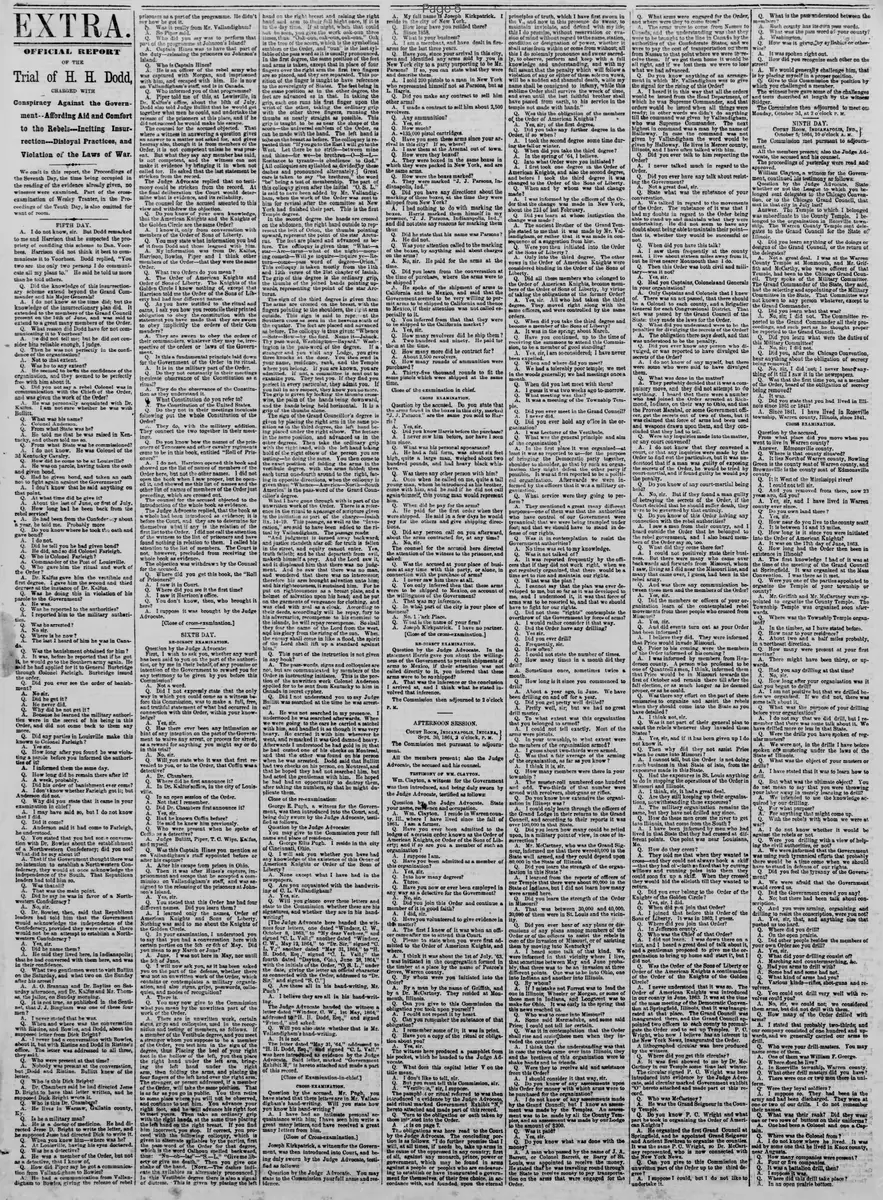
Official report of the trial of H.H. Dodd in Indianapolis, Indiana, in September-October 1864, for conspiracy against the U.S. government, aiding rebels, inciting insurrection, and violating laws of war. Testimonies detail secret societies like Order of American Knights/Sons of Liberty, planned uprisings, arms dealings, and rebel connections during the Civil War.
Clipping
OCR Quality
Full Text
OFFICIAL REPORT
OF THE
Trial of H. H. Dodd,
CHARGED WITH
Conspiracy Against the Government--Affording Aid and Comfort
to the Rebels---Inciting
Insurrection---Disloyal Practices, and
Violation of the Laws of War.
We omit in this report, the Proceedings of
the Seventh Day, the time being occupied in
the reading of the evidence already given, no
witnesses were examined. Part of the cross-
examination of Wesley Tranter, in the Pro-
ceedings of the Tenth Day, is also omitted for
want of room.
FIFTH DAY.
A. I do not know, sir. But Dodd remarked
to me and Harrison that he suspected the pro-
priety of confiding this scheme to Dan. Voor-
hees. Harrison did not think it best to com-
municate it to Voorhees. Dodd replied, "You
two are the only two persons I do communi-
cate all my plans to." He said he told us more
than he told others.
Q. Did the knowledge of this insurrection-
ary scheme extend beyond the Grand Com-
mander and his Major Generals?
A. I do not know as the time did; but the
knowledge of the insurrectionary plan did. It
extended to the members of the Grand Council
present on the 14th of June, and was said to
extend to a great many members of the Order.
Q. What reason did Dodd have for not com-
municating it to Voorhees?
A. He did not tell me; but he did not con-
sider him reliable enough, I judge.
Q. Then he was not perfectly in the confi-
dence of the organization?
A. Not to that extent.
Q. Was he to any extent?
A. He seemed to be in the confidence of the
organization, and they seemed to be perfectly
free with him about it.
Q. Did you not say a rebel Colonel was in
communication with the Chiefs of the Order,
and was given the work of the Order?
A. He was personally acquainted with Dr.
Kalfus.
I am
not sure whether he was with
Bullitt.
Q. From what State was he?
What was his name?
He told me that he was raised in Ken-
tucky, and others told me so.
Colonel Anderson.
tucky, and others told me so.
Q.
From what State was he commissioned?
A.
I do not know. He was Colonel of the
3d Kentucky Cavalry.
How did he come to be at Louisville?
A. He was on parole,
having taken the oath
and given bond.
Q. Had he given bond, and taken an oath
not to fight again against the Government?
A. I don't know
that he said anything on
that point.
Q. At what time did he give it?
A.
About the last of June, or first of July.
Q.
How long
had he been back from the
rebel service?
A. He had been from the Confederacy about
a year, he told me. Probably more.
Q. Do you know where he took the oath and
gave bond?
I do not.
Did he tell you he had given bond?
He did, and so did Colonel Farleigh.
Who is Colonel Farleigh?
Commander of the Post of Louisville.
Who gave him the ritual and work of
the Order?
A. Dr. Kalfus gave him the vestibule and
first degree. I gave him the second and third
degrees at the instance of Dr. Kalfus.
Q. Was he doing this in violation of his
parole to the Government?
He was.
Was he reported to the authorities?
Was he arrested?
Where is he now?
The last I heard of him he was in Cana-
I reported him to the military authori-
No sir.
da
Was the banishment obtained for him?
It was, before he reported that if he got
it he would go to the Southern army again. He
said he had applied for it to General Burbridge
through Colonel Farleigh. Burbridge issued
the order.
Q. Did
you
ever see the order of banish.
ment?
No sir.
Did he get it?
He never did.
Why did he not get it?
Because he learned the military authori-
ties were in the secret of his being in this
Order, and did not come back to them any
more.
Q. Did any parties in Louisville make this
known to Colonel Farleigh?
A.
Yes sir.
Q. How long after you found he was viola-
ting a parole before you informed the authori-
ties of it?
A.
I informed them the same day.
How long did he remain there after it?
A week, probably.
Did his order of banishment ever come?
A
I don't know whether Farleigh got it; but
Anderson did not.
Q. Why did you state that it came in your
examination in chief?
A. I may have said
so, but I do not know
that I did.
Q. Did it come?
A. Anderson said it had come to Farleigh,
he understood.
Q. You stated that you had some conversa-
tion with Dr. Bowles about the establishment
of a Northwestern Confederacy; did you not?
What did he say about it?
A. That if the Government thought there was
no intention to establish a Northwestern Con-
federacy, they would at once acknowledge the
independence of the South. That Republican
leaders had told him so.
Q.
Was that all?
A.
That was the main point.
Q.
Did he say he was in favor of a North-
western Confederacy?
A. No, sir.
Q. Dr. Bowles, then, said that Republican
leaders had told him that the Government
would acknowledge the independence of the
Confederacy, provided they were certain there
would not be an attempt to establish a North-
western Confederacy?
A.
Yes, sir.
Q.
Did he name them?
A
He said they lived here, in Indianapolis:
that he had conversed with them here, and was
in their confidence.
Q. What two gentlemen went to visit Bullitt
on the Saturday, and what two on the Sunday
after his arrest?
A. A. O. Brannan and Dr. Bayliss on Sat-
urday afternoon, and Dr. Kalfus and Mr. Thom-
as, the jailor, on Sunday morning.
Q. It is not true, as published in the Senti-
nel, that J. J. Bingham
one of these four
men?
A.
I never stated that he was.
Q.
When and where was the conversation
with Ristine, and Bowles, and Dodd, about the
supposed letter from Dick Bright?
A. I never had a conversation with Bowles
about it, but with Ristine and Dodd in Ristine's
office. The letter was addressed to all three,
they said.
Q.
Who were present at that time?
A.
Nobody was present at the conversation,
but Dodd and Ristine. Bullitt knew of the
letter.
Q.
Who is this Dick Bright?
A. Dr. Chambers said he had directed Jesse
D. Bright to have that letter written, and he
supposed Dick Bright wrote it.
Q.
Who is this Dr. Chambers?
A.
He lives in Warsaw,
Gallatin county,
Ky
Q. Is he a military man?
a.
He is a doctor of medicine. He had di-
rected Jesse D. Bright to write the letter, and
he supposed Jesse had directed Dick to write it.
When you knew him—where was he?
At Louisville, having his eyes
doctored
Q. Was he a detective?
A. He was a member of the Order, but not
as a detective, that I know of.
Q. How did Piper say he got a communica-
tion from Vallandigham to Bowles?
A. He had a communication from Vallan-
digham to Bowles giving the release of rebels
prisoners as a part of the programme. He didn't
say how he got it.
Q.
Was it really from Mr. Vallandigham?
A.
So Piper said.
Q.
Who did you say was to perform that
part of the programme at Johnson's Island?
A.
Captain Hines was to have that part of
the duty—releasing the prisoners on Johnson's
Island.
Q.
Who is Captain Hines?
A.
He is an officer of the rebel army who
was captured with Morgan, and imprisoned
with him, and escaped with him. He is now
on Vallandigham's staff, and is in Canada.
Q.
Who informed you of that programme?
A. Piper told me of this, at Louisville, in
Dr. Kalfus's office, about the 16th of July.
Dodd also told Judge Bullitt that he would get
together what men he could, and undertake the
release of the prisoners at this place, and if he
did not succeed he would make his escape.
The counsel for the accused objected. That
where a witness in answering a question gives
an answer to a matter not asked for, and gives
hearsay also, though it is from members of the
Order, it is not competent unless he was pres-
ent. But what they say any member has said,
is not competent, and the witness can not
make it evidence by bringing it in when not
called for. He asked that the last statement be
stricken from the record.
The Judge Advocate replied that no testi-
mony could be stricken from the record. At
the final deliberation the Court would deter-
mine what is evidence, and its reliability.
The counsel for the accused assented to this
view and withdrew the objection.
Q. Do you know of your own knowledge,
that the American Knights and the Knights of
the Golden Circle are the same Order?
A. I know it, only from conversation with
members of the Order of Sons of Liberty.
Q. You may state what information you had
of it from Dodd and those leagued with him.
A. My information was from Dr. Kalfus,
Harrison, Bowles, Piper and I think other
members of the Order—that they were the same
Order.
Q.
What two Orders do you mean?
A. The Order of American Knights and
Order of Sons of Liberty. The Knights of the
Golden Circle I know nothing of, except that
Harrison told me the Order of the Sons of Lib-
erty had had four different names.
Q.
As you have testified to the ritual and
oaths, I ask you how you reconcile their printed
obligation to obey the constitution with the
statement you have made that they are sworn
to obey implicitly the orders of their Com-
manders?
A. They are sworn to obey the orders of
their commanders, whatever they may be, irre-
spective of the orders or laws of the Govern-
ment.
Q.
Is this a fundamental principle laid down
for the Government of the Order in its ritual?
A.
It is in the military part of the Order.
Q. Do they not constantly in their meetings
inculcate observance of the Constitution as per
ritual?
A. They do the observance of the Constitu-
tion as they understand it.
What Constitution do you refer to?
The Constitution of the United States.
Q.
Do they not in their meetings inculcate
following out the whole Constitution of the
Order?
A.
They
do, with the military addition.
They connect the two together in their meet-
ings.
Q.
Do you know how the names of the pris-
oners of Tennessee and other cavalry regiments
came to be in this book, entitled "Roll of Pris-
oners?"
A. I do not. Harrison opened this book and
showed me the list of names of members of the
Order here, but not the other names. I did not
open the book when I saw proper, but he open-
ed it and showed me this list of names and the
other list of names of members of the Order just
preceding, which are crossed out.
The counsel for the accused objected to the
introduction of the whole book as evidence.
The Judge Advocate replied, that the book as
a whole had been introduced as evidence; it is
before the Court, and they are to determine for
themselves what if any is the relation of the
first list to the Order. I did not call the attention
of the witness to the list of prisoners and have
found nothing in relation to them. I called his
attention to the list of members. The Court is
not, however, precluded from receiving the
whole book as evidence.
The objection was withdrawn by the Counsel
for the accused.
Q.
Where did
you
get this book, the "Roll
of Prisoners?"
I saw it in Court.
Where did you see it the first time?
I saw it Harrison's office.
You don't know, then, who brought it
here?
A. I suppose it was brought by the Judge
Advocate.
[Close of cross-examination.]
SIXTH DAY.
RE-DIRECT EXAMINATION.
Question by the Judge Advocate:
First, I wish to ask you, whether any word
has been said to you on the part of the authori-
ties, or by me in their behalf, of any promise or
intention of the Government to reward you for
any testimony to be given by you before this
Commission?
A. Not a word.
Q. Did I not expressly state that the only
way in which you could come as a witness be-
fore this Commission, was to make a full, free,
and truthful statement of what had occurred in
connection with this Order, within your know-
ledge?
A.
Yes, sir.
Q.
Has there ever been any intimation or
hint of any intention on the part of the Govern-
ment to waive any arrest, or process for arrest,
as a reward for anything you might say or do
in this trial?
A.
No, sir.
Q.
Will you state who it was that first re-
vealed to you, or to the Order, that Coffin was a
detective?
A.
Dr. Chambers.
Where did he first announce it?
In Dr. Kalfus's office, in the city of Louis-
ville.
In an open session of the Order.
Not that I remember.
Did Dr. Chambers first announce it?
Yes, sir.
Had he known Coffin before?
He said he knew him previously.
Q.
Who were present when he spoke of
Coffin as a detective?
A. Judge Bullitt,
Piper, T. C. Wips, Kalfus,
and myself.
Q. Was this Captain Hines you mention as
on Vallandigham's staff appointed before or
after his capture?
A. After his escape from prison in Ohio.
Q. Then it was after Hines's capture, im-
prisonment and escape that he accepted a com-
mission on Vallandigham's staff, and was as-
signed to the releasing of the prisoners at John-
son's Island.
A. Yes, sir.
Q. You stated that this Order has had four
different names. Did you learn them?
A. I learned only the names, Order of
American Knights and Sons of Liberty.
Nothing was said to me about the Knights of
the Golden Circle.
Q. In your examination, I understood you
to say that you had a conversation here with
certain parties on the 5th or 6th of May. Did
you mean to say March or June?
A. June. I was not here in May, nor until
the 5th of June.
Q. I will now ask you, as it has been asked
you on the part of the defense, whether there
was not an unwritten work of the Order, which
contains or contemplates a military organiz-
ation, and also signs, grips, passwords, collo-
quies, and modes of recognition?
A. There is.
Q. You may now give to the Commission
what you mean by the unwritten part of the
work of the Order.
A. There are in unwritten work, certain
signs, grips and colloquies, used in the reco;
pitioa and testing of members as follows. If
A member of the Vestibule degree, and you meet
a stranger whom you suppose to be a member
of the Order, you test him in the sign of the
degree thus: Placing the toe of your right
foot in the hollow of the left, you then place
the right hand under the left arm, bring-
ing the left hand under the right
arm, then folding the arms and placing the
four fingers of the left hand over the right arm.
The stranger, or person addressed, if a member
of the Order, will take the same position. That
is as far as you go in public. You then retire
to some place where you will not be observed,
and continue to test him. You advance your
right foot, and he will advance his right foot
to meet yours.
Then take an ordinary grip
with the right hands, at the same time placing
the left hand on the right breast. If you find
him incorrect, you stop. If correct, you pro-
ceed with the following colloquy, which is
given in alternate syllables by the parties, first
the pass-word of the Order "for that degree,
which is the word Calhoun spelled backward
thus: "Nu-ob—lac"—"Si—I" "Give liberty
or give me death." Then you give one
shake of the hand. [Note.—The dashes indi-
cate the syllables as alternately pronounced.]
In this Vestibule degree there is also a signal
of distress. This is given by placing the left
hand on the right breast and raising the right
hand and arm to its full height once— if it is
in the daytime. If at night, when that could
not be seen, you give the word oak-oun three
times, thus "Oak-oun, oak-oun, oak-oun." Oak
is the tree of the acorn, which is the symbolical
emblem of the Order, and "oun" in the last syl-
lable of the pass word as it is usually pronounced.
In the first degree, the same position of the feet
and arms is taken, except that in place of four
fingers over the right arm the first two fingers
are so placed, and they are separated. This "po-
sition of the finger is taught to have reference
to the sovereignty of States. The foot being in
the same position as in the other degree, the
feet are advanced as in that. In taking the
grip, each one runs his first finger upon the
wrist of the other, taking the ordinary grip
with the other three fingers, running the
thumb as nearly straight as possible. This
grip is taught to be as near the shape of the
Acorn—the universal emblem of the Order, as
can be made with the hand. The left hand is
to be on the breast as before. The colloquy is re-
peated thus "If you go to the East I will go to the
West Let there be no strife between mine
and thine—for we be brethren—O—S—L
Resistance to tyrants—is obedience to God."
(All colloquies are syllabled as divided by these
dashes and pronounced alternately.) "Great
care is taken to say "be brethren," the word
"be" being a test of membership. The part of
this colloquy given after the initial "O. S. L."
is said to have been added by Mr. Vallandig-
ham, when the work of the Order was sent to
him for revision after the committee at New
York had finished their part. This is the first
Temple degree.
In the second degree the hands are crossed
on the abdomen, the right hand outside to rep-
resent the belt of Orion, the thumbs pointing
upward, represent the point of the star Arctu-
rus. The feet are placed and advanced as be-
fore. The colloquy is given thus: "What—a
star—Arc-turus—what of the night—morn-
ing cometh—Will ye inquire—inquire ye—Re-
turn—come—pass word of degree—Orion."
This colloquy is taken mostly from the 11th
and 12th verses of the 21st chapter of Isaiah.
The grip of this degree is the ordinary grip,
the thumbs of the joined hands pointing up-
wards, representing the point of the star Arc-
turus.
The sign of the third degree is given thus:
The arms are crossed on the breast, with the
fingers pointing to the shoulders, the right arm
outside. This sign is said to represent the
Southern cross as seen in the heavens south of
the equator. The feet are placed and advanced
as before. The colloquy is thus given: "Whence
—Seir—How—by the ford. Name it—Jabock
Thy pass-word, Washington—Bayard." Wash-
ington is the pass-word of the degree. If a
stranger and you visit any Lodge, you give
three knocks at the door. You then send in
your name, residence, rank, and the Temple
where you belong. If you are known, you are
admitted. If not, a committee is sent out to
examine you. They test you. If they find you
perfect in every particular, they admit you. If
you fail in any respect, they know you no more.
The grip is given by locking the thumbs cross-
wise, the palm of the hands being downward,
and the hands being held horizontal. It is a
grip of the thumbs alone.
The sign of the Grand Councillor’s degree is
given by placing the right arm in the same po-
sition as in the third degree, the left hand be-
ing placed under the right elbow. The feet are
in the same position, and advanced as in the
other degrees. Then take the ordinary grip
with the right hand, with the left hand taking
hold of the right elbow of the person you are
testing—he doing the same. You then come to
the exact position of folding the arms in the
vestibule degree, with the arms folded; then
each turns one-fourth around to the right, fac-
ing in opposite directions, when the colloquy is
given thus: "Whence—America—North—South
America" is the pass-word of the Grand Coun-
cilor’s degree.
What I have gone through with is part of the
unwritten work of the Order. There is a refer-
ence in the ritual to a passage of scripture given
in the initiation as part of the charge—Isaiah
lix. 14-19. This passage, as well as the "Invo-
cation," are said to have been added to the ri-
tual by Vallandigham. The passage reads:
"And judgment is turned away backward:
and justice standeth afar off: for truth is fallen
in the street, and equity cannot enter. Yea,
truth faileth; and he that departeth from evil,
maketh himself a prey. And the Lord saw it,
and it displeased him that there was no judg-
ment. And he saw that there was no man,
and wondered that there was no intercessor;
therefore his arm brought salvation unto him;
and his righteousness, it sustained him. For he
put on righteousness as a breast plate, and a
helmet of salvation upon his head; and he put
on the garments of vengeance for clothing, and
was clad with zeal as a cloak. According to
their deeds, accordingly will he repay, fury to
his adversaries, recompense to his enemies: to
the islands, he will repay recompense. So shall
they fear the name of the Lord from the west,
and his glory from the rising of the sun. When
the enemy shall come in like a flood, the spirit
of the Lord shall lift up a standard against
him."
Q.
This part of the instruction is not given
in any book?
A. The pass-words, signs and colloquies are
not, but are communicated by members of the
Order in instructing initiates. This is the por-
tion of the unwritten work Colonel Anderson
applied for to be sent from Kentucky to him in
Canada in secret cypher.
Q. Did I not understand you to say Judge
Bullitt was searched at the time he was arrest-
ed?
A. He was not searched in my presence. I
understood he was searched afterwards. When
we were going to the cars he carried a satchel
with him, and handled it as though it was very
heavy. He carried it with him wherever he
went, and remarked it was God damned heavy.
Afterwards I understood he had gold in it; that
he had cashed one of his checks on Montreal,
and that the other was found on his person
when he was arrested. Dodd said that Bullitt
had two checks on his person, on Montreal, and
that he hoped they had not searched him, but
had acted the gentleman with him. He hoped
he had had an opportunity to destroy them,
after taking the numbers, so that he might du-
plicate them.
Close of the re-examination:
George E. Pugh, a witness for the Govern-
ment, was then introduced into the Court, and,
being duly sworn by the Judge Advocate, testi-
fied as follows.
Question by the Judge Advocate:
You may give to the Commission your full
name and place of residence.
A. George Ellis Pugh. I reside in the city
of Cincinnati, Ohio.
Q. I will ask you whether you have had
any knowledge of the existence of this Order of
American Knights or Order of the Sons of
Liberty?
A. None except what I have had in the
newspapers.
Q. Are you acquainted with the handwrit-
ing of C. L. Vallandigham?
A. Yes, sir.
Q. Will you glance over these letters and
state to the Commission whether these are his
signatures, and whether they are in his hand-
writing?
[The Judge Advocate here handed the wit-
ness four letters, one dated "Windsor, C. W.,
October 8, 1863," to "My dear Voorhees," and
signed "C. L. Vall.;" another dated "Windsor,
C. W., May 12, 1864," to "Dear Sir," signed "C.
L. V." another dated "May 31, 1864," to "H.
H. Dodd, Esq.," signed "C. L. Vall." the
fourth dated "Dayton, Ohio, June 28, 1864,"
with the initials of the Order, "O S. L." under
the date, giving the letter an official character
as connected with the Order, addressed to "Dr.
Sir," and signed "S. C."
Q. Are these all in his hand-writing, Mr.
Pugh?
A. I believe they are all in his hand-writ-
ing.
The Judge Advocate handed the witness a
letter dated "Windsor, C. W., 1st May, 1864;"
addressed to "H. H. Dodd, Esq.," and signed
"Friend," and asked:
Q. Will you also state whether that is Mr.
Vallandigham's hand-writing.
A. It is not.
The letter dated "May 31, '64," addressed to
H. H. Dodd, Esq.," and signed "C. L. Vall.
was here introduced as evidence by the Judge
Advocate. Said letter, marked "Government
Exhibit M," is hereto attached and made a part
of this record.
[Close of Examination-in-chief.]
CROSS-EXAMINATION.
Question by the accused. Mr. Pugh, you
have stated that these letters are in Mr. Val-
landigham's hand-writing. Will you state how
you know his hand-writing?
A. I have had an intimate personal ac-
quaintance with him; I have seen him write a
great many letters, and have received a great
many letters from him.
[Close of Cross-examination.]
Joseph Kirkpatrick, a witness for the Govern-
ment, was then introduced into Court, and be-
ing duly sworn by the Judge Advocate, testi-
fied as follows:
Question by the Judge Advocate. You may
state to the Commission your full name and res-
idence.
A. My full name is Joseph Kirkpatrick. I
reside in the city of New York.
Q. How long have you resided there?
A. Since 1858.
Q. What is your business?
A. I am a merchant, and have
dealt in fire
arms for the last three years.
Q. Have you, since your arrival in this city,
seen and identified any arms sold by you in
New York city to a party purporting to be Mr.
Parsons? If so, you can state what they were
and describe them.
A. I sold 290 pistols to a man in New York
who represented himself not as Parsons, but as
L. Harris.
Q. Did you make any contract to sell him
other arms?
A. I made a contract to sell him about 2,500
revolvers.
Q. Any ammunition?
A. Yes, sir.
Q. How much?
A. 135,000 pistol cartridges.
Q. Have you seen these arms since your ar-
rival in this city? If so, where?
A. I saw them at the Arsenal out of town.
Q. How were they boxed?
A. They were boxed in the same boxes in
which they were packed in New York, and are
the same arms.
Q. How were the boxes marked?
A. They were marked
J. Parsons,
In
dianapolis, Ind."
Q. Did you have any directions about the
marking of these boxes, at the time they were
shipped from New York?
A. I had nothing to do with marking the
boxes. Harris marked them himself in my
presence, "J. J. Parsons, Indianapolis, Ind."
and did not state any reasons for marking them
thus.
Q. Did he state that his name was Parsons?
A. He did not.
Q. Was your attention called to the marking
of the boxes, by anything said about charges
on the arms?
A. No, sir. He paid for the arms at the
time.
Q. Did you learn from the conversation at
the time of purchase,
where the arms were to
be shipped?
A. He spoke of the shipment of arms to
California and to Mexico, and said that the
Government seemed to be very willing to per-
mit arms to be shipped to California and thence
to Mexico, if their attention was not called es-
pecially to it.
Q. You inferred from that that they were
to be shipped to the California market?
A.
Yes, sir.
Q. How many revolvers did he ship them?
Two hundred and ninety. He paid for
them at the time.
Q. How many more did he contract for?
A.
About 2,500 revolvers.
Q. How many rounds of ammunition were
purchased?
A. Thirty-five thousand rounds to fit the
same pistols which were shipped at
the same
time.
Close of the examination in chief.
CROSS EXAMINATION
Question by the accused. Do you state that
the arms found in the boxes in this city, marked
"J. J. Parsons," are the same you sold to Har-
ris?
A.
Yes, sir.
Q.
Did you know Harris before the purchase?
A. I never saw him before, nor have I seen
him since.
Q. What was his personal appearance?
A. He had a full form, was about six feet
high, quite a large man, weighed about two
hundred pounds, and had heavy black whis-
kers.
Q.
Was there any other person with him?
A. Once when he called on me, quite a tall
young man, whom he introduced as his brother,
came with him, and he said if he did not call
again himself, this young man would represent
him.
Q.
When did he pay for the arms?
A. He paid for the first order when they
were shipped. He said in a few days he would
pay for the others and give shipping direc-
tions.
Q. Did any person call on you afterward,
about the arms contracted for, at any time?
A. No, sir.
The counsel for the accused here directed
the attention of the witness to the prisoner, and
asked:
Q. Was the accused at your place of busi-
ness at any time with this party, or alone, in
connection with the purchase of arms?
A. I never saw him there at all.
Q. You only inferred then that these arms
were to be shipped to Mexico, on account of
the willingness of the Government?
A. That was my inference.
Q. In what part of the city is your place of
business?
A. No. 6 Park Place.
What is the name of your firm?
Joseph Kirkpatrick. I have no partner.
[Close of the cross-examination.]
RE-DIRECT EXAMINATION.
Question by the Judge Advocate. In the
statement Harris gave you about the willing-
ness of the Government to permit shipments of
arms to Mexico, if their attention was not
called directly to it, you inferred that these
arms were to be so shipped?
A. That was the inference or the conclusion
I arrived at, and I think what he stated in-
volved that inference.
The Commission then adjourned to 2 o'clock
P. M.
AFTERNOON SESSION.
Court Room, Indianapolis, Indiana,
Sept. 30, 1864, 2 o'clock, P. M.
The Commission met pursuant to adjourn-
ment.
All the members present; also the Judge
Advocate, the accused and his counsel.
TESTIMONY OF WM. CLAYTON.
Wm. Clayton, a witness for the Government
was then introduced, and being duly sworn by
the Judge Advocate, testified as follows:
Question by the Judge Advocate. State
your name, residence and occupation.
A. Wm. Clayton. I reside in Warren coun-
ty, Ill., where I have lived since the fall of
1861. I am a farmer.
Q. Have you ever
been admitted to the
lodges of a certain order known as the Order of
American Knights, or Order of the Sons of Lib-
erty; and if so are you a member of such an
organization?
A. I suppose I am.
Q. Have you been admitted as a member of
this organization?
A. Yes, sir.
Q.
Into how many degrees?
A.
Three.
Q. Have you now or ever been employed in
any way as a detective for the Government?
A. No, sir.
Q. Did you join this Order and continue a
member of it in good faith?
A. I did, sir.
Q. Have you volunteered to give evidence in
this matter?
A. The first I knew of it was when an offi-
cer came after me to attend this Court.
Q. Please to state when you were first ad-
mitted to the Order of American Knights, and
where.
A. I think it was about the 1st of July, '63.
I was initiated in the congregation formed in
the timber at a place by the name of Pearce's
Grove, Warren county.
Q. By whom
were
you
initiated into the
Order?
A. By a man by the name of Griffith, and
by a Dr. McCartney.
They resided at Mon-
mouth, Illinois.
Q. Can you give to this Commission the
obligation you took upon yourself?
A. I could not repeat it by heart.
Q.
Can you remember the substance of that
obligation?
A.
I remember some of it; it was in print.
Q.
Have you a copy of the ritual or obliga-
tion about you?
A. Yes, sir.
The witness here produced a pamphlet from
his pocket, which he handed to the Judge Ad-
vocate.
Q.
What does
this
capital letter V on the
title mean?
A.
I don't like to tell, sir.
Q.
But you must tell this Commission, sir.
A. "Vestibule," sir, I suppose.
The pamphlet or ritual referred to was then
introduced in evidence by the Judge Advocate,
said ritual marked Government Exhibit "N,"
hereto attached and made part of this record.
Q. Turn to the obligation or oath taken by
those initiated into the Order.
A. It is on page 7.
The obligation was here read to the Court
by the Judge Advocate. The concluding por-
tion is as follows: "I do further promise that I
will, at all times, if needs be, take up arms in
the cause of the oppressed in any country; first
of all, against any monarch, prince, power or
government, which may be found in arms
against a people or peoples who are endeavor-
ing to establish or have inaugurated a govern-
ment for themselves, of their free choice, in ac-
cordance with, and founded
upon the eternal
principles of truth, which I have first sworn in
the V. and now in this presence do swear, to
maintain inviolate, and defend with my life:
this I do promise, without reservation or eva-
sion of mind without regard to the name, station,
condition or designation of power, whether it
shall arise from within or come from without: all
this I do solemnly pronounce and swear sacred-
ly, to observe, perform and keep with full
knowledge and understanding, "and with my
full assent that the penalty which will follow a
violation of any or either of these solemn vows,
will be a sudden and shameful death, while my
name shall be consigned to infamy, while this
sublime Order shall survive the wreck of time
and even until the last faithful brother shall
have passed from earth, to his portion in the
temple not made with hands."
Q.
Was this the obligation of the members
of the Order of American Knights?
A.
Yes, sir; of the first degree.
Q.
Did you take any
further degree in the
Order, if so when?
A. I took the second degree some time dur-
ing the fall or winter.
Q. When did you take the third degree?
A. In the spring of '64, I believe.
Q. Into what Order were you initiated?
A. I first took one degree in the Order of
American Knights, and also the second degree
and before I took the third degree it was
changed to the Order of the Sons of Liberty.
Q. When and by whom was that change
made?
A. I was informed by the officers of the Or-
der that the change was made in New York,
about the 22d of last February.
Q. Did you learn
at
whose instigation the
change was made?
A. The Ancient Brother of the Grand Tem-
ple stated to me that it was made by Mr. Val-
landigham, or rather that it was made in con-
sequence of a suggestion from him.
Q. Were you then initiated into the Order
of the Sons of Liberty?
A. Only into the third degree. The other
vows in the Order of American Knights were
considered binding in the Order of the Sons of
Liberty.
Q. Did all these members who belonged to
the Order of American Knights, become mem-
bers of the Order of Sons of Liberty, by virtue
of taking the obligations of the former Order?
A. Yes, sir. All who had taken the third
degree. They moved right along with the
same officers, and were controlled by the same
orders.
Q. When did you take the third degree and
become a member of the Sons of Liberty?
A. It was in the spring; about March.
Q. Have you continued, up to the time of
receiving the summons to attend this Commis-
sion, to be a member of good standing?
A. Yes, sir, I am so considered; I have never
been expelled.
Q.
When and where did you meet?
A. We had a tolerably poor temple; we met
in the woods generally; we had meetings once a
month.
Q.
When did you last meet with them?
I guess it was two weeks ago to-morrow.
What meeting was that?
It was a meeting of the Township Tem-
ple.
Q.
Did you ever meet in the Grand Council?
A.
I never did.
Q. Did you ever hold any office in the or-
ganization?
A. I was Lecturer of the Vestibule.
Q.
What was the general principle and aim
of the organization?
A. In the first place it was organized—at
least it was so reported to us—for the purpose
of bringing the Democratic party together,
shoulder to shoulder, so that by such an organ-
ization they might defeat the other party if
possible. It was at first reported to be a politi-
cal organization. Afterwards we were in-
formed by the officers that it was a military or-
ganization.
Q.
What service
were they
going to per-
form?
A. They mentioned a great many different
purposes—one of them was that the authorities
who have control of our Government were
tyrannical; that we were being trampled under
foot; and that we should have to stand in de-
fense of our rights.
Q. Was it in contemplation to resist the
Government authorities?
A. No time was set to my knowledge.
Q. Was it not talked of?
A. It was reported frequently by the offi-
cers that if they did not work right, when we
got regularly organized, that there would be a
time set to rise and maintain our rights.
Q. What was the plan?
A. I cannot say that the plan was ever de-
veloped to me, but so far as it was developed to
me, and I understood it, it was that force of
arms was to be resorted to, and that we should
have to fight for our rights.
Q. Did not these "rights" contemplate the
overthrow of the Government by force of arms?
A. I would rather consider it that way.
Did the Order have any drilling?
Yes sir.
Did you ever drill?
Frequently, sir.
How often?
I could not state the number of times.
How many
times in a month did they
drill?
A.
Sometimes once, sometimes twice a
month.
How long is it since you commenced to
drill?
A. About a year ago, in June. We have
been drilling on and off for a year.
Q.
Did you get pretty well drilled?
A. Pretty well, sir; but we had no great
drill master.
Q. To what extent was this organization
that you belonged to armed?
A. I could not tell exactly. Most of the
arms were pistols.
Q. In your township, to what extent were
the members of the organization armed?
A. I guess about two-thirds were armed.
Q. Was that a fair average of the arming
of the organization, as far as you know?
A. I think it is, sir.
Q. How many members were there in your
township?
A. The muster-roll numbered one hundred
and odd. Two-thirds of that number were
armed with revolvers, shot-guns or rifles.
Q. Do you know how extensive the organi-
Zation in Illinois was?
A. I could only learn through the officers of
the Grand Lodge in their returns to the Grand
Council, and according to their reports it was
over 100,000 in that State.
Q. Did you learn how many could be relied
upon, in a military point of view, in case of in-
surrection?
A. Mr. McCartney, who was the Grand Sig-
neur, informed me that there were 40,000 in the
State well armed, and they could depend upon
80,000 in the State of Illinois.
Q. Did you learn the strength of
the organ-
ization in this State?
A. I learned from the reports of officers of
our Temple that there were about 80,000 in the
State of Indiana, but I did not learn how many
were armed here.
Q. Did you learn the strength of the Order
in Missouri?
A. That was
between 30,000 and 40,000.
20,000 of them were in St. Louis and the vicin-
ity.
Q.
Did you ever hear of any plans or dis-
cussions of any plans among members of the
Order or of the officers to assist the rebels in
case of the invasion of Missouri, or of assisting
them by moving into Kentucky?
A. I heard some talk of that kind. We
were informed in that vicinity where I live,
that sometime between May and June proba-
bly, that there was to be an invasion at three
different points. One was to be into Ohio, one
into Indiana and another into Illinois.
Q.
By whom?
A. If I mistake not Forrest was to lead the
one in Illinois; Wheeler or Morgan, or some of
those men in Indiana, and Longstreet was to
make for Ohio. It was early in the spring that
this news reached us.
Q.
Who was to come into Missouri?
A.
Some said Marmaduke, and some said
Price: I could not tell for certain.
Q. Was it in contemplation that the Order
shall rise and assist these men
when
they
invaded the country?
A. I think that the understanding was that
in case the rebels came over into Illinois, they
and the brethren of this organization were to
shake hands and be friends.
Q. Were they to receive aid and assistance
from this Order?
A. I should consider it that way, sir.
Q. Do you know of any assessments upon
this Order for money with which arms were to
be purchased for the organization?
A. I do not know of any assessments made
by the Grand Council; but I know an assess-
ment was made by the Temples. An assess-
ment was to be made by all the County Tem-
ples, and an assessment was made by our Lodge
to the amount of $200.
Q.
Was it paid?
A.
Yes, sir.
Q.
Do you know
what was done with the
money?
A. A man who passed by the name of J. A.
Barrett, or Colonel Barrett, or Barry of St.
Louis, was appointed to receive the money.
He stated that he was traveling round through
the State to receive money to pay transporta-
tion on the arms that were engaged for the
Order.
Q. What arms were engaged for the Order,
and where were they to come from?
A. The arms were to come from Nassau to
Canada, and the understanding was that they
were to be brought to the line in Canada by the
authorities of the Confederate States, and we
were to pay the cost of transportation of them
from Nassau to that point where we were to re-
ceive them. If we got them home it would be
all right, and if we lost them we were to lose
what we had advanced.
Q. Do you know anything of an arrange-
ment in which Mr. Vallandigham was to give
the signal for the rising of this Order?
A. I heard it in this way that all the orders
would be issued from the Head Department, of
which he was Supreme Commander, and that
orders would be issued when all things were
ready; in other words we didn't do anything
till the command was given by Vallandigham,
who was Supreme Commander. The next
highest in command was a man by the name of
Halloway. In case the command was not
given by Vallandigham the word would be
given by Halloway. He lives in Mercer county,
Illinois, and I have often talked with him.
Q. Did you ever talk to him respecting the
Order?
A. I never
talked much in regard to the
Order.
Q. Did you ever have any talk about resist-
ing the Government?
A. Not a great deal, sir.
Q. State what was the substance of your
conversation.
A. We talked in regard to the movements
of the Order. The substance of it was that I
had my doubts in regard to the Order being
able to stand up and maintain what they were
undertaking. He did not seem to have any
doubt about being able to maintain their point—
that is, whether they would be successful or
not.
Q.
When did you have this talk?
A. I saw them frequently at the county
seat. I live about sixteen miles away from it
but he lives nearer Monmouth than I do.
Q. Then this Order was both civil and mili-
tary—was it not?
A. Yes, sir.
Q. Had you Captains, Colonels and Generals
in your organization?
A. Only Captains and Colonels that I knew
of. There was an act passed, that there should
be a Colonel to each county, and a Brigadier
General for each Congressional District. That
act was passed by the Grand Council of the
State: they made the laws for the Order.
Q. What did you understand were to be the
penalties for divulging the secrets of the Order?
A. The obligation there says death, and that
was understood to be the penalty.
Q. Did you ever know any person who di-
vulged, or was reported to have divulged the
secrets of the Order?
A. I do not know of any myself, but there
were some who were said to have divulged
them.
Q.
What was done in the matter?
A.
They probably decided that it was a com-
pulsory move, and they did not attempt to do
anything. I heard that there were a number
who had joined the Order arrested at Rich-
mond, Indiana, on their way to Ohio, and that
the Provost Marshal, or some Government offi-
cer, got the secrets out of two of them, but it
was claimed that force of arms had been used
and weapons drawn upon them, and they con-
cluded that they had to tell.
Q. Were any inquiries made into the matter
or any court convened?
A. I do not know that they convened a
court, or that any inquiries were made by the
Order to find out the particulars, but it was un-
derstood that if a man was guilty of exposing
the secrets of the Order, he would be tried by
court-martial, and if found guilty he would pay
the penalty.
Q.
Do you know of any court-martial being
held?
A. No, sir. But if they found a man guilty
of betraying the secrets of the Order, if the
Court decided that he should suffer death, they
were to be governed by that entirely.
Q. Do you know of this Order having any
connection with the rebel authorities?
A. I saw a man from their country, and I
heard outside the Order that he belonged to
the rebel government, and I also heard mem-
bers of the Order say so, too.
Q. What did they come there for?
A. I could not positively state their busi-
ness. But there were many who came over
backwards and forwards from Missouri, whom
I saw, living as I did near the Missouri line, and
many that came over, I guess, had been in the
rebel army.
Q. And was there any communication be-
tween these men and the members of the Order?
A. Yes, sir.
Q. Did the members or officers of your or-
ganization learn of the contemplated rebel
movements from these people who crossed from
Missouri?
A. Yes, sir.
Q. And did events turn out as your Order
had been informed?
A. I believe they did. They were informed
that Price would invade Missouri.
Q. Prior to his coming were the members
of the Order informed of his coming?
A. I was informed by members from Hen-
derson county. A person who professed to be
one of Quantrell's men, I think, informed them
that Price would be in Missouri towards the
first of October and remain there till after the
fall election, or as much longer as he deemed
proper, or as he could.
Q. Was there any effort on the part of these
emissaries to organize and assist the rebels
when they should come into the State as you
have detailed?
A. I think not, sir.
Q. Was it not part of their general plan to
assist the rebels whenever they invaded these
States?
A. Yes, sir, and if it has been given up I do
not know it.
Q. Then why did they not assist Price
when he came into Missouri?
A. I cannot tell, but the Order is not doing
much business in that State of late, from the
exposures made in this State.
Q. Had the exposures in St. Louis anything
to do in stopping the operations of the Order in
Missouri and Illinois?
A. I think, sir, it had a great deal.
Q. Are they still keeping up their organiza-
tions, notwithstanding these exposures?
A. The military organization remains the
same, but they have not drilled any since.
Q. How do these men cross the river to get
into Illinois, that come from the South?
A. I have been informed by men who had
lived in that State that they had crossed at dif-
ferent points. One point was near Louisiana,
Mo.
Q.
How do they cross?
A.
They told me that when they wanted to
cross and they could not always hook a skiff
—that they had oil-cloth so fixed that by cutting
willows and running poles into them they
could soon fix up a skiff. When they crossed
they would hide the oilcloth till they wanted to
return.
Q. Did you ever belong to the Order of the
Knights of the Golden Circle?
A.
Yes, sir. I did.
Q. When did you join that Order?
A. I joined that before this Order of the
Sons of Liberty. It was in 1862, I guess.
Q. Where did you join that Order?
A. In Jefferson county.
Q. Who was the Chief of that Order?
A. I did not learn. I was down there on a
visit, and I heard a great deal of talk about it
and a gentleman proposed to give me the or-
ganization to bring up home and start it, but I
did not.
Q. Was the Order of the Sons of Liberty or
Order of the American Knights a continuation
of the Order of the Knights of the Golden
Circle?
A. I never understood that it was so. The
Order of American Knights was introduced
in our county in June, 1863. It was at the time
of the mass meeting of the Democratic Conven-
tion at Springfield, Illinois, that it was inau-
gurated at that place. The Grand Council was
inaugurated there, and the Grand Council ap-
pointed two officers to each county to promul-
gate the Order and to set up Temples. P. O.
Wright, who now I believe has an interest in
the New York News, inaugurated the Order.
A lithographed circular was here produced
by the witness.
Q.
Where did you get this circular?
A.
It was first showed to me by Dr. Mc-
Cartney in our Temple some time last winter.
The circular signed P. O. Wright was here
introduced into evidence by the Judge Advo-
cate, said circular marked Government exhibit
"O" hereto attached and made part of this re-
cord.
Q.
Who was McCartney?
A.
He was the Grand Seigneur in the Coun-
ty Temple.
Q. Do you know P. C. Wright and what
part he took in organizing the Order of Ameri-
can Knights?
A. He organized the first Grand Council at
Springfield, and he appointed Grand Seigneur
and Ancient Brethren to organize the counties.
It was the same P. C. Wright, so Dr. McCart-
ney represented, who is now connected with
the New York News.
Q. Can you give to this Commission the
unwritten part of the Order up to the third de-
gree?
A. I suppose I could, but I do not like to
undertake it.
Q. What is the pass understood between the
members?
A.
Each county has its own pass words.
What was the pass word of your county?
Washington.
How was it given, by syllables or other-
wise?
A. It was spoken right out.
Q. How did you recognize each other on the
street?
A. We would generally challenge him, that
is by placing myself in a proper position.
Give to this Commission the position by
which you challenged a member.
The witness here gave some of the challenges
and tests described at length by the witness
Stidger.
The Commission then adjourned to meet on
Monday, October 3d, at 2 o'clock P. M.
NINTH DAY.
COURT ROOM, INDIANAPOLIS, IND.,
October 5, 1864, 10 o'clock A. M.
The Commission met pursuant to adjourn-
ment.
All the members present; also the Judge Ad-
vocate, the accused and his counsel.
The proceedings of yesterday were read and
approved.
William Clayton, a witness for the Govern-
ment, continued his testimony as follows:
Question by the Judge Advocate. State
whether or not the League to which you be-
longed sent delegates to the Chicago Conven-
tion, or to the Chicago Grand Council, that
met in that city in July last?
Answer. The Temple to which I belonged
was subordinate to the County Temple. I be-
longed to the organization in Roseville town-
ship. The Warren County Temple sent dele-
gates to the Grand Council for the State of
Illinois.
Q. Did you learn anything of the doings or
designs of the Grand Council, or the return of
the delegates?
A. Not a great deal. I was at the Warren
County Temple at Monmouth, and Mr. Grif-
fith and McCarthy, who were officers of that
Temple, had been to the Chicago Grand Coun-
cil. They spoke of the Military Committee.
The Grand Commander of the State, they said,
had the selecting and appointing of the Military
Committee in the State. That Committee was
not known to any person whatever, except to
the Grand Commander.
Q.
Did you learn what that was?
A. No, sir; I did not. The Committee re-
ported to the Grand Commander all their pro-
ceedings, and such part as he thought proper
he reported to the Grand Council.
Q. Did you learn what were the duties of
this Military Committee?
A. No, sir; I did not.
Q. Did you, after the Chicago Convention,
hear anything about the obligation of secrecy
being removed?
Q. No, sir, I did not; I never heard any-
thing of it till I saw it in the newspapers.
Q. Was that the first time you, as a member
of the Order, heard of the obligation of secrecy
being removed?
A. It was.
Q.
Did you state that you had lived in Ill.
nois since 1861 or 1841?
A. Since 1841. I have lived in Roseville
township, Warren county, Illinois, since 1841.
CROSS EXAMINATION.
Question by the accused.
From what place did you move when you
went to live in Warren county?
Answer. Edmondsville county.
Q.
Where is that county situated?
A. It lies north of Warren county. Bowling
Green is the county seat of Warren county, and
Brownsville is the county seat of Edmondsville
county.
Q. Is it west of the Mississippi river?
A.
I could not tell sir.
Q. And you removed
from
here
now 23
years ago, did you?
A. Yes, sir, and I have lived in Warren
county ever since.
Q. Do you own land there?
A. Yes, sir.
Q. How near do you live to the county seat?
A. It is between 14 and 15 miles.
Q. How long is it since you were initiated
into the Order of American Knights?
A. It was on the 17th day of June, 1863.
Q. How long had the Order then been in
existence in Illinois?
A. The first knowledge I had of it was at
the time of the meeting of the Grand Council
at Springfield. It was organized at the Mass
Convention. I was there as it met.
Q. Were you one of the parties appointed to
organize the Temple of
your
township or
county?
A. Mr. Griffith and Mr. McCartney were ap-
pointed to organize the County Temple. The
Township
Temple was organized soon after-
wards.
Where was the Township Temple organ-
ized?
A.
In the timber, as I have stated before.
Q.
How near to your residence?
A.
About two and a half miles probably,
in a northeast direction.
Q. How
many
were
present
at
your first
meeting?
A.
There
might
have
been thirty, or up-
wards.
Q.
Had you any
drilling at that time?
A.
No, sir.
Q.
How long after your
organization was it
that you began to drill?
A. I am not positive but that we drilled be-
fore we organized.
If we
did
not,
there was
some talk about it.
Q. What was the purpose
of your drilling
before your organization?
A. I do not say that we did drill, but I re-
member that there was some talk about it. We
have drilled more or less in that State.
Q. Were the drills you have spoken of reg-
ular musters?
A. We were not, in the drills I have before
spoken of mustering under the laws of the
State of Illinois.
Q. What was the
object of
your musters or
drills?
A.
I have stated that it was to learn how to
drill.
Q.
But what was the ultimate object? You
do not mean to say that you were throwing
your labor away in merely learning to drill?
A. We intended to use the knowledge ac-
quired by our drilling.
For what purpose?
For anything that might come up.
With the rebels with whom we were at
A.
I do not know whether it would be
against the rebels or not.
Q. Were you drilling with a view of help-
ing the civil authorities, or not?
A. We were informed that the Government
was using such tyrannical efforts that probably
there would be a time come when we should
have to stand in defense of our rights.
Q. Did the Government crowd you any?
A. No; but there had been
talk about con-
scription.
Q. And you were arming, organizing and
drilling to resist the conscription, were you not?
A. Yes, sir, that, and
anything else that
pushed us too hard.
Q.
Where did you drill?
A.
On the open prairie.
Q.
Did other people besides the members of
your own Order see you drill?
Yes, sir.
What did your drilling consist of?
Marching and countermarching, &c.
Had you arms to drill with?
Some had and some had not.
What kind of arms had you?
Various kinds—rifles, shot-guns and re-
volvers.
Q. You could not drill very well with re-
volvers could you?
A. No, sir, we could not; we considered
them arms, but did not drill with them.
Q. How many of the Order drilled with
arms?
A. I stated that probably two-thirds; and
our company consisted of one hundred and up-
wards, and we generally carried our arms to
drill.
Q.
Who were your drill-masters.
You may
name some of them.
One of them was William F. George.
There were one or two men there in uni-
form.
What other drill masters did you have?
Where does he live?
In Roseville township, Warren county.
Were they loyal soldiers?
I suppose so. They had been in the
army and had been discharged. They were at
one or two of our drills. I do not remember
their names.
What was their rank? Did they wear
one or two rows of buttons on their uniforms?
One had been a Colonel and one a Cap-
in
I do not know
where
he lived. It
was a battalion drill, then?
A.
I suppose it was.
Q.
Where did this drill take place?
A.
In an open prairie bottom.
How many companies were present?
A.
Four or five companies.
What sub-type of article is it?
What themes does it cover?
What keywords are associated?
What entities or persons were involved?
Where did it happen?
Story Details
Key Persons
Location
Court Room, Indianapolis, Indiana
Event Date
Sept. 30, 1864 To October 5, 1864
Story Details
Testimonies in the trial reveal secret society's plans for insurrection, arms procurement, rebel collaborations, and rituals; witnesses describe oaths, drills, and connections to Confederate invasions.