Thank you for visiting SNEWPapers!
Sign up free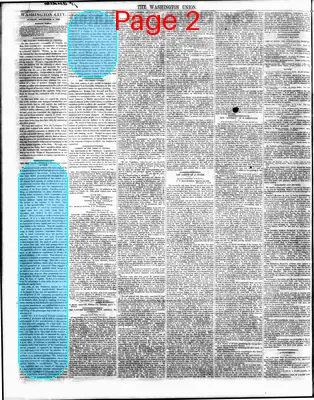
Story
December 5, 1858
The Washington Union
Washington, District Of Columbia
What is this article about?
An editorial critiquing the U.S. Protective System, arguing that high tariffs benefit manufacturers at the expense of agriculture and labor, leading to overinvestment, competition, and economic instability. It advocates for revenue-based tariffs over special protections.
Clipping
OCR Quality
95%
Excellent
Full Text
THE PROTECTIVE SYSTEM IN A FINANCIAL POINT OF VIEW.
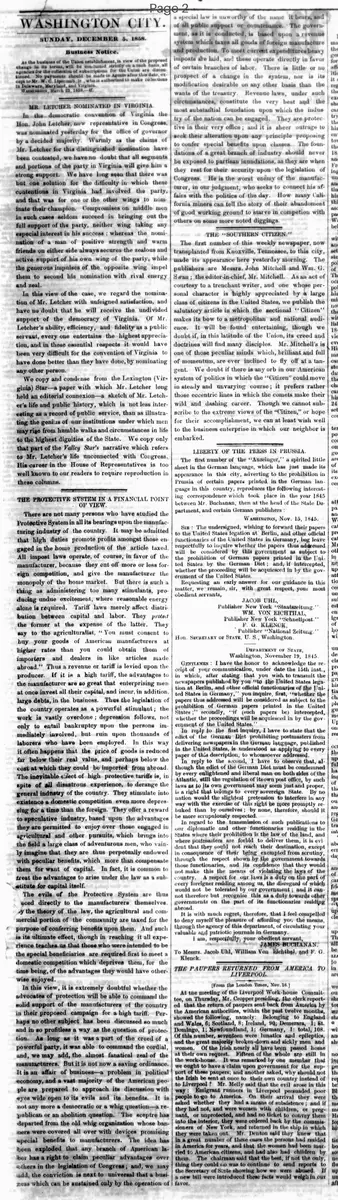
There are not many persons who have studied the Protective System in all its bearings upon the manufacturing industry of the country. It may be admitted that high duties promote profits amongst those engaged in the home production of the article taxed. All impost laws operate, of course, in favor of the manufacturer, because they cut off more or less foreign competition, and give the manufacturer the monopoly of the home market. But there is such a thing as administering too many stimulants, producing undue excitement, where reasonable energy alone is required. Tariff laws merely affect distribution between capital and labor. They protect the former at the expense of the latter. They say to the agriculturalist, 'You must consent to buy your goods of American manufacturers at higher rates than you could obtain them of importers and dealers in like articles made abroad.' Thus a revenue or tariff is levied upon the producer. If it is a high tariff, the advantages to the manufacturer are so great that enterprising men at once invest all their capital, and incur, in addition, large debts, in the business. Thus the legislation of the country operates as a powerful stimulant; the work is vastly overdone; depression follows, not only to entail bankruptcy upon the persons immediately involved, but ruin upon thousands of laborers who have been employed. In this way it often happens that the price of goods is reduced far below their real value, and perhaps below the cost at which they could be imported from abroad. The inevitable effect of high protective tariffs is, in spite of all disastrous experience, to derange the general industry of the country. They stimulate into existence a domestic competition even more depressing for a time than the foreign. They offer a reward to speculative industry, based upon the advantages they are permitted to enjoy over those engaged in agricultural and other pursuits, which brings into the field a large class of adventurous men, who vainly imagine that they are thus perpetually endowed with peculiar benefits, which more than compensate them for want of capital. In fact, it is common to treat the advantages to arise under the law as a substitute for capital itself.
The evils of the Protective System are thus reduced directly to the manufacturers themselves. By the theory of the law, the agricultural and commercial portion of the community are taxed for the purpose of conferring benefits upon them. And such is its ultimate effect, though in reaching it all experience teaches us that those who were intended to be the special beneficiaries are required first to meet a domestic competition which deprives them, for the time being, of the advantages they would have otherwise enjoyed.
In this view, it is extremely doubtful whether the advocates of protection will be able to command the solid support of the manufacturers of the country in their proposed campaign for a high tariff. Perhaps no other subject has been discussed so much and in so profitless a way as the question of protection. As long as it was a part of the creed of a powerful party, it was able to command the cordial, and, we may add, the almost fanatical zeal of the manufacturers. But it is not now a saving ordinance. It is an affair of business—a problem in political economy, and a vast majority of the American people are prepared to approach its discussion with eyes wide open to its evils and its benefits. It is not any more a democratic or a whig question—a republican or an abolition question. The sceptre has departed from the old whig organization whose banners were covered all over with devices promising special benefits to manufacturers. The idea has been exploded that any branch of American labor has a right to claim peculiar advantages over others in the legislation of Congress; and, we may add, the conviction is next to universal that a business which can be sustained only by the operation of a special law is unworthy of the name it bears, and of all public support or countenance. The government, as it is conducted, is based upon a revenue system which taxes all goods of foreign manufacture and production. To meet current expenditures heavy imposts are laid, and these operate directly in favor of certain branches of labor. There is little or no prospect of a change in the system, nor is its modification desirable on any other basis than the wants of the treasury. Revenue laws, under such circumstances, constitute the very best and the most substantial foundation upon which the industry of the nation can be engaged. They are protective in their very office; and it is sheer outrage to seek their alteration upon any principle proposing to confer special benefits upon classes. The foundations of a great branch of industry should never be exposed to partisan inundations, as they are when they rest for their security upon the legislation of Congress. He is the worst enemy of the manufacturer, in our judgment, who seeks to connect his affairs with the politics of the day. How many California miners can tell the story of their abandonment of good working ground to starve in competition with others on some more noted diggings.
There are not many persons who have studied the Protective System in all its bearings upon the manufacturing industry of the country. It may be admitted that high duties promote profits amongst those engaged in the home production of the article taxed. All impost laws operate, of course, in favor of the manufacturer, because they cut off more or less foreign competition, and give the manufacturer the monopoly of the home market. But there is such a thing as administering too many stimulants, producing undue excitement, where reasonable energy alone is required. Tariff laws merely affect distribution between capital and labor. They protect the former at the expense of the latter. They say to the agriculturalist, 'You must consent to buy your goods of American manufacturers at higher rates than you could obtain them of importers and dealers in like articles made abroad.' Thus a revenue or tariff is levied upon the producer. If it is a high tariff, the advantages to the manufacturer are so great that enterprising men at once invest all their capital, and incur, in addition, large debts, in the business. Thus the legislation of the country operates as a powerful stimulant; the work is vastly overdone; depression follows, not only to entail bankruptcy upon the persons immediately involved, but ruin upon thousands of laborers who have been employed. In this way it often happens that the price of goods is reduced far below their real value, and perhaps below the cost at which they could be imported from abroad. The inevitable effect of high protective tariffs is, in spite of all disastrous experience, to derange the general industry of the country. They stimulate into existence a domestic competition even more depressing for a time than the foreign. They offer a reward to speculative industry, based upon the advantages they are permitted to enjoy over those engaged in agricultural and other pursuits, which brings into the field a large class of adventurous men, who vainly imagine that they are thus perpetually endowed with peculiar benefits, which more than compensate them for want of capital. In fact, it is common to treat the advantages to arise under the law as a substitute for capital itself.
The evils of the Protective System are thus reduced directly to the manufacturers themselves. By the theory of the law, the agricultural and commercial portion of the community are taxed for the purpose of conferring benefits upon them. And such is its ultimate effect, though in reaching it all experience teaches us that those who were intended to be the special beneficiaries are required first to meet a domestic competition which deprives them, for the time being, of the advantages they would have otherwise enjoyed.
In this view, it is extremely doubtful whether the advocates of protection will be able to command the solid support of the manufacturers of the country in their proposed campaign for a high tariff. Perhaps no other subject has been discussed so much and in so profitless a way as the question of protection. As long as it was a part of the creed of a powerful party, it was able to command the cordial, and, we may add, the almost fanatical zeal of the manufacturers. But it is not now a saving ordinance. It is an affair of business—a problem in political economy, and a vast majority of the American people are prepared to approach its discussion with eyes wide open to its evils and its benefits. It is not any more a democratic or a whig question—a republican or an abolition question. The sceptre has departed from the old whig organization whose banners were covered all over with devices promising special benefits to manufacturers. The idea has been exploded that any branch of American labor has a right to claim peculiar advantages over others in the legislation of Congress; and, we may add, the conviction is next to universal that a business which can be sustained only by the operation of a special law is unworthy of the name it bears, and of all public support or countenance. The government, as it is conducted, is based upon a revenue system which taxes all goods of foreign manufacture and production. To meet current expenditures heavy imposts are laid, and these operate directly in favor of certain branches of labor. There is little or no prospect of a change in the system, nor is its modification desirable on any other basis than the wants of the treasury. Revenue laws, under such circumstances, constitute the very best and the most substantial foundation upon which the industry of the nation can be engaged. They are protective in their very office; and it is sheer outrage to seek their alteration upon any principle proposing to confer special benefits upon classes. The foundations of a great branch of industry should never be exposed to partisan inundations, as they are when they rest for their security upon the legislation of Congress. He is the worst enemy of the manufacturer, in our judgment, who seeks to connect his affairs with the politics of the day. How many California miners can tell the story of their abandonment of good working ground to starve in competition with others on some more noted diggings.
What sub-type of article is it?
Economic Commentary
Policy Analysis
What themes does it cover?
Justice
Misfortune
Moral Virtue
What keywords are associated?
Protective System
Tariffs
Manufacturers
Agriculture
Economic Policy
Domestic Competition
Revenue Laws
Where did it happen?
United States
Story Details
Location
United States
Story Details
Critique of the Protective System, explaining how high tariffs favor manufacturers over agriculture and labor, leading to overinvestment, domestic competition, economic depression, and ultimate harm to all parties; advocates for revenue tariffs without special protections.