Thank you for visiting SNEWPapers!
Sign up free
Editorial
January 14, 1897
The Bee
Earlington, Hopkins County, Kentucky
What is this article about?
The editorial critiques destructive business competition that harms workers, creditors, and capital, while benefiting consumers short-term, and advocates for producer agreements to maintain uniform fair prices as legitimate and wise.
Clipping
OCR Quality
95%
Excellent
Full Text
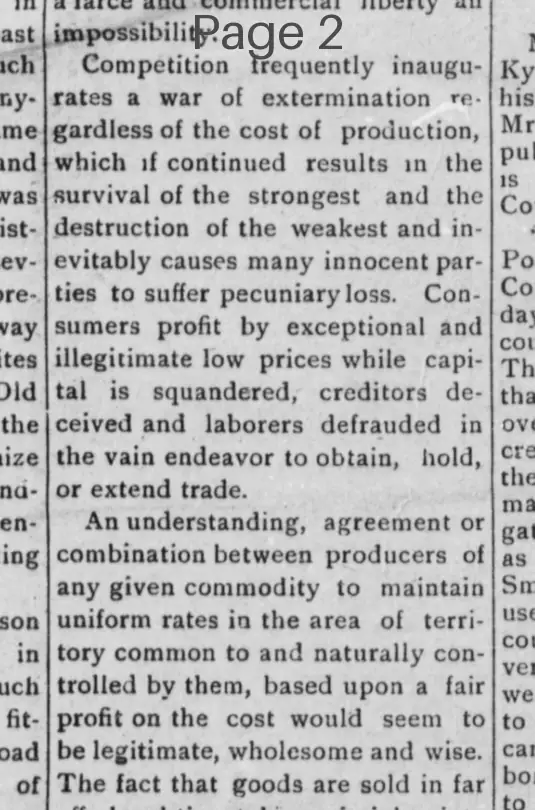
Competition frequently inaugurates a war of extermination regardless of the cost of production, which if continued results in the survival of the strongest and the destruction of the weakest and inevitable causes many innocent parties to suffer pecuniary loss. Consumers profit by exceptional and illegitimate low prices while capital is squandered, creditors deceived and laborers defrauded in the vain endeavor to obtain, hold, or extend trade.
An understanding, agreement or combination between producers of any given commodity to maintain uniform rates in the area of territory common to and naturally controlled by them, based upon a fair profit on the cost would seem to be legitimate, wholesome and wise.
An understanding, agreement or combination between producers of any given commodity to maintain uniform rates in the area of territory common to and naturally controlled by them, based upon a fair profit on the cost would seem to be legitimate, wholesome and wise.
What sub-type of article is it?
Economic Policy
Trade Or Commerce
What keywords are associated?
Business Competition
Price Fixing
Producer Agreements
Fair Profit
Trade Regulation
Economic Harm
Editorial Details
Primary Topic
Legitimacy Of Producer Agreements For Uniform Pricing
Stance / Tone
Supportive Of Price Maintenance Combinations
Key Arguments
Competition Leads To Destructive War Regardless Of Production Costs
Results In Survival Of Strongest And Destruction Of Weakest
Causes Innocent Parties Pecuniary Loss
Consumers Profit From Illegitimate Low Prices
Capital Squandered, Creditors Deceived, Laborers Defrauded To Gain Trade
Producer Agreements To Maintain Uniform Rates Based On Fair Profit Are Legitimate And Wise