Thank you for visiting SNEWPapers!
Sign up free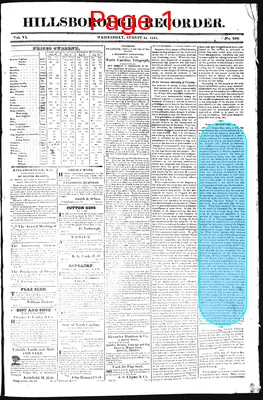
The Hillsborough Recorder
Hillsboro, Orange County, North Carolina
What is this article about?
A Baltimore American article reports on a proposal to form a mercantile company for importing African products like coffee, rice, and cotton to undermine the slave trade. British merchants have formed such a company, obtaining Fernando Po island near Benin for trade with African coasts, supplying West Indies, and monitoring slave trade via British navy.
Clipping
OCR Quality
Full Text
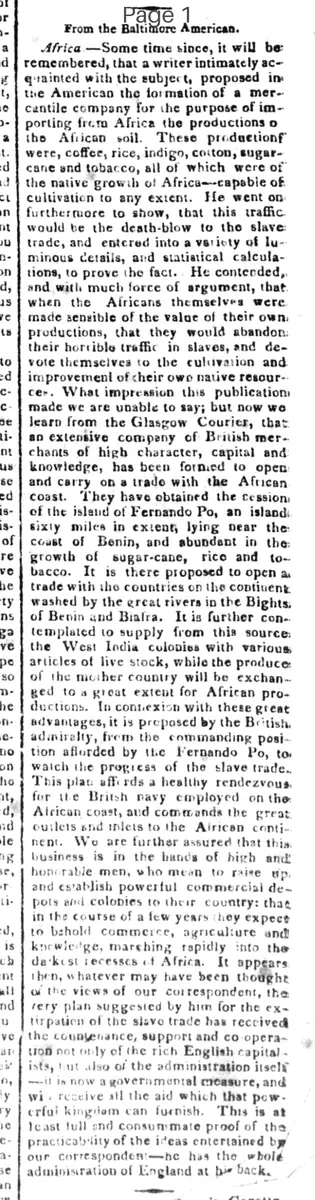
Africa.—Some time since, it will be remembered, that a writer intimately acquainted with the subject, proposed in the American the formation of a mercantile company for the purpose of importing from Africa the productions of the African soil. These productions were, coffee, rice, indigo, cotton, sugar-cane and tobacco, all of which were of the native growth of Africa—capable of cultivation to any extent. He went on furthermore to show, that this traffic would be the death-blow to the slave trade, and entered into a variety of luminous details, and statistical calculations, to prove the fact. He contended, and with much force of argument, that when the Africans themselves were made sensible of the value of their own productions, that they would abandon their horrible traffic in slaves, and devote themselves to the cultivation and improvement of their own native resources. What impression this publication made we are unable to say: but now we learn from the Glasgow Courier, that an extensive company of British merchants of high character, capital and knowledge, has been formed to open and carry on a trade with the African coast. They have obtained the Cession of the island of Fernando Po, an island sixty miles in extent, lying near the coast of Benin, and abundant in the growth of sugar-cane, rice and tobacco. It is there proposed to open a trade with the countries on the continent washed by the great rivers in the Bights of Benin and Biafra. It is further contemplated to supply from this source the West India colonies with various articles of live stock, while the produce of the mother country will be exchanged to a great extent for African productions. In connexion with these great advantages, it is proposed by the British admiralty, from the commanding position afforded by the Fernando Po, to watch the progress of the slave trade. This plan affords a healthy rendezvous, for the British navy employed on the African coast, and commands the great outlets and inlets to the African continent. We are further assured that this business is in the hands of high and honorable men, who mean to raise up and establish powerful commercial depots and colonies to their country: that in the course of a few years they expect to behold commerce, agriculture and knowledge, marching rapidly into the darkest recesses of Africa. It appears then, whatever may have been thought of the views of our correspondent, the very plan suggested by him for the extirpation of the slave trade has received the countenance, support and co-operation not only of the rich English capitalists, but also of the administration itself—it is now a governmental measure, and will receive all the aid which that powerful kingdom can furnish. This is at least full and consummate proof of the practicability of the ideas entertained by our Correspondent—he has the whole administration of England at his back.
What sub-type of article is it?
What keywords are associated?
Where did it happen?
Foreign News Details
Primary Location
Fernando Po
Outcome
formation of british mercantile company; cession of fernando po island; plan to establish trade depots and colonies; british naval monitoring of slave trade; expected promotion of commerce, agriculture, and knowledge in africa.
Event Details
A writer in the Baltimore American proposed a mercantile company to import African products (coffee, rice, indigo, cotton, sugar-cane, tobacco) to end the slave trade by encouraging Africans to cultivate their resources. British merchants formed such a company, obtaining Fernando Po near Benin for trade with Bights of Benin and Biafra coasts, supplying West Indies with livestock, exchanging British goods for African products, and using the island as a naval base to suppress slave trade. Supported by British administration.