Thank you for visiting SNEWPapers!
Sign up free
Morning Star
Limerick, York County, Maine
What is this article about?
Wm. Howitt's article details extreme poverty among rural poor in Britain, with families earning 3-6 shillings weekly, struggling to afford rent and bread, relying on charity amid denied relief; examples include starvation risks and meatless diets.
Merged-components note: The table is embedded within the article 'THE POOR IN ENGLAND' and provides supporting data on expenses; merge into the main story component.
Clipping
OCR Quality
Full Text
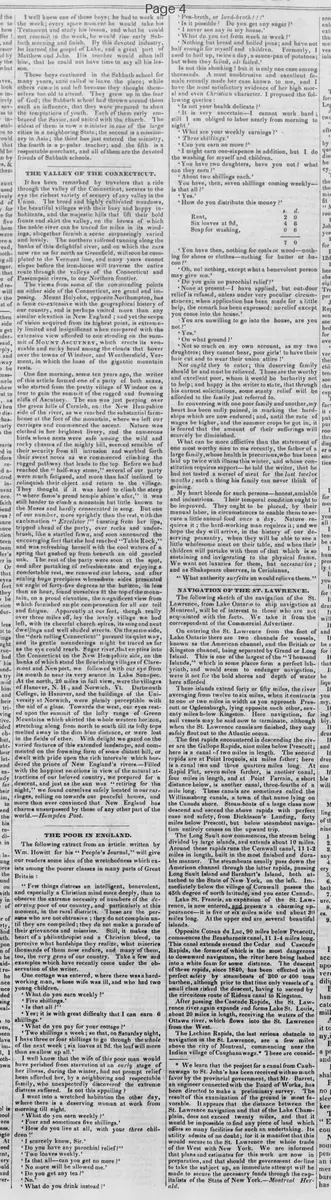
The following extract from an article written by Wm. Howitt for his 'People's Journal,' will give our readers some idea of the wretchedness which exists among the poorer classes in many parts of Great Britain:
'Few things distress an intelligent, benevolent, and especially a Christian mind more deeply, than to observe the extreme necessity of numbers of the deserving poor of our country, and particularly at this moment, in the rural districts. These are the persons who are not obtrusive; they do not complain until they are compelled; they do not make a parade of their grievances and miseries. Still, it makes the heart of a philanthropist and a Christian bleed, to perceive what hardships they realize, what miseries thousands of them now endure, and many of them, too, the very gems of our country. Take a few sad examples which have recently come under the observation of the writer.
One cottage was entered, where there was a hard-working man, whose wife was ill, and who had two young children.
'What do you earn weekly?'
'Five shillings.'
'Is that all?'
'Yes; it is with great difficulty that I can earn 6 shillings.'
'What do you pay for your cottage?'
'Two shillings a week; so that, on Saturday night, I have three or four shillings to go through the whole of the next week; six loaves at 9d. the loaf will more than swallow up all.'
I well know that the wife of this poor man would have perished from starvation at an early stage of her illness, during the winter, had not prompt relief been afforded her, by a neighboring and respectable family, who unexpectedly discovered the extreme distress suffered. Is not this appalling?
I went into a wretched habitation the other day, where there is a deserving woman at work from morning till night.
'What do you earn weekly?'
'Four and sometimes five shillings.'
'How do you live at all, with your three children!'
'I scarcely know, Sir.'
'Do you have any parochial relief?'
'Two loaves weekly.'
'Is that all—can you get no more?'
'No more will be allowed me.'
'Do you get any tea?'
'No.'
'What do you drink?'
'Pea-broth, or lard-broth!!!'
'Is it possible? Do you get any sugar?'
'I never see any in my house.'
'What do you eat from week to week?'
'Nothing but bread and boiled peas; and have not half enough for myself and children. Formerly, I used to boil up, twice a day, a sauce-pan of potatoes; but when they failed, all failed.'
Is not this shocking! but it is only one case among thousands. A most unobtrusive and excellent female recently made her case known to me, and I have the most satisfactory evidence of her high moral and even Christian character. I proposed the following queries:
'Is not your health delicate?'
'It is very uncertain—I cannot work hard; still I am obliged to labor nearly from morning to night.'
'What are your weekly earnings?'
'Three shillings.'
'Can you earn no more?'
'I might earn one sixpence in addition, but I do the washing for myself and children.'
'You have two daughters, have you not? what can they earn?'
'About two shillings each.'
'You have, then, seven shillings coming weekly—is that all?'
'Yes.'
'How do you distribute this money?'
[Omitted garbled: 70]
You have then, nothing for coals or wood—nothing for shoes or clothes—nothing for butter or bacon?'
'Oh, no! nothing, except what a benevolent person may give me.'
'Do you gain no parochial relief?'
'None at present—I have applied, but out-door relief is refused, unless under very peculiar circumstances; when application has been made for a little help, the remark has been expressed: no relief except you come into the house.'
'You are unwilling to go into the house, are you not?'
'Yes.'
'On what ground?'
'Not so much on my own account, as my two daughters; they cannot bear, poor girls! to have their hair cut and to wear their union attire!'
Nor ought they to enter; this deserving family should be and must be relieved. These are the worthy and excellent poor, whom it would be barbarity not to help; and happy is the writer to state, that through his earnest solicitations, some scanty relief will be afforded to the family just referred to.
In conversing with one poor family and another, my heart has been sadly pained, in marking the hardships which are now endured; and, until the rate of wages be higher, and the summer crops be got in, it is feared that the amount of their sufferings will scarcely be diminished.
What can be more afflictive than the statement of one most worthy man to me recently, the father of a large family, whose health is precarious, who has been laid up twice with illness this winter, and whose constitution requires support—he told the writer, that he had not tasted a morsel of meat for the last twelve months; such a thing his family can never think of gaining.
My heart bleeds for such persons—honest, amiable and industrious. Their temporal condition ought to be improved. They ought to be placed, by their manual labor, in circumstances to enable them to secure a little animal food once a day. Nature requires it; the hard-working man requires it; and we hope the day will arrive, in the history of our deserving peasantry, when they will be able to see a little wholesome meat on their table, and when their children will partake with them of that which is so sustaining and invigorating to the physical frame. We want not luxuries for them, but necessaries; and as Shakspeare observes, in Coriolanus,
'What authority surfeits on would relieve them.'
| Rent, | 2 | 0 |
| Six loaves at 9d, | 4 | 6 |
| Soap for washing, | 0 | 6 |
What sub-type of article is it?
What themes does it cover?
What keywords are associated?
What entities or persons were involved?
Where did it happen?
Story Details
Key Persons
Location
Rural Districts Of Great Britain
Story Details
Wm. Howitt recounts interviews with deserving poor families in rural England facing extreme hardship, earning 3-6 shillings weekly insufficient for rent, bread, and basics, surviving on peas and broth, denied adequate parochial relief, appealing for charitable aid.