Thank you for visiting SNEWPapers!
Sign up free
The North Carolina Standard
Raleigh, Wake County, North Carolina
What is this article about?
Newspaper reprints a letter from Democratic presidential candidate James K. Polk to a Cincinnati committee, strongly advocating immediate annexation of Texas to the U.S., citing historical claims from Louisiana Purchase and 1819 treaty, and warning against British influence. Contrasts with Henry Clay's opposition.
Clipping
OCR Quality
Full Text
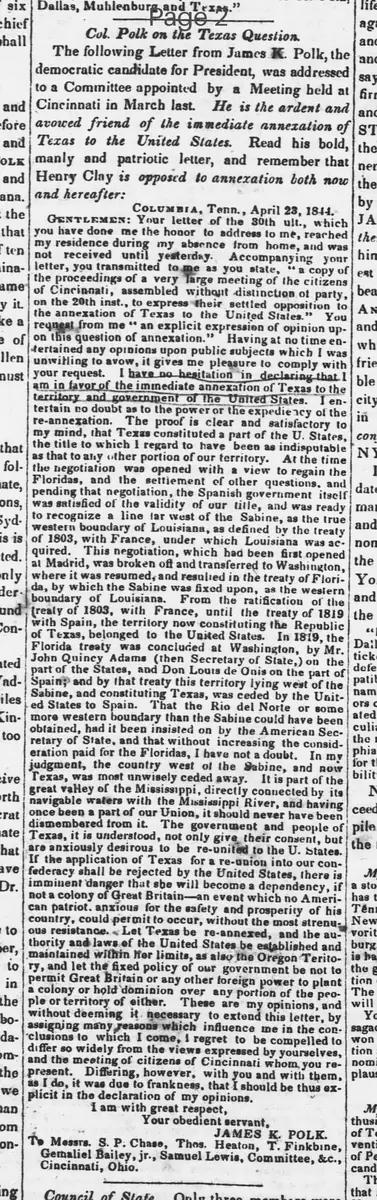
The following Letter from James K. Polk, the democratic candidate for President, was addressed to a Committee appointed by a Meeting held at Cincinnati in March last. He is the ardent and avowed friend of the immediate annexation of Texas to the United States. Read his bold, manly and patriotic letter, and remember that Henry Clay is opposed to annexation both now and hereafter:
COLUMBIA, Tenn., April 23, 1844.
GENTLEMEN: Your letter of the 20th ult., which you have done me the honor to address to me, reached my residence during my absence from home, and was not received until yesterday. Accompanying your letter, you transmitted to me as you state, "a copy of the proceedings of a very large meeting of the citizens of Cincinnati, assembled without distinction of party, on the 20th inst., to express their settled opposition to the annexation of Texas to the United States."
You request from me "an explicit expression of opinion upon this question of annexation." Having at no time entertained any opinions upon public subjects which I was unwilling to avow, it gives me pleasure to comply with your request. I have no hesitation in declaring that I am in favor of the immediate annexation of Texas to the territory and government of the United States. I entertain no doubt as to the power or the expediency of the re-annexation. The proof is clear and satisfactory to my mind, that Texas constituted a part of the U. States, the title to which I regard to have been as indisputable as that to any other portion of our territory. At the time the negotiation was opened with a view to regain the Floridas, and the settlement of other questions, and pending that negotiation, the Spanish government itself was satisfied of the validity of our title, and was ready to recognize a line far west of the Sabine, as the true western boundary of Louisiana, as defined by the treaty of 1803, with France, under which Louisiana was acquired. This negotiation, which had been first opened at Madrid, was broken off and transferred to Washington, where it was resumed, and resulted in the treaty of Florida, by which the Sabine was fixed upon, as the western boundary of Louisiana. From the ratification of the treaty of 1803, with France, until the treaty of 1819 with Spain, the territory now constituting the Republic of Texas, belonged to the United States. In 1819, the Florida treaty was concluded at Washington, by Mr. John Quincy Adams (then Secretary of State,) on the part of the States, and Don Louis de Onis on the part of Spain; and by that treaty this territory lying west of the Sabine, and constituting Texas, was ceded by the United States to Spain. That the Rio del Norte or some more western boundary than the Sabine could have been obtained, had it been insisted on by the American Secretary of State, and that without increasing the consideration paid for the Floridas, I have not a doubt. In my judgment, the country west of the Sabine, and now Texas, was most unwisely ceded away. It is part of the great valley of the Mississippi, directly connected by its navigable waters with the Mississippi River, and having once been a part of our Union, it should never have been dismembered from it. The government and people of Texas, it is understood, not only give their consent, but are anxiously desirous to be re-united to the U. States. If the application of Texas for a re-union into our confederacy shall be rejected by the United States, there is imminent danger that she will become a dependency, if not a colony of Great Britain—an event which no American patriot, anxious for the safety and prosperity of his country, could permit to occur, without the most strenuous resistance.—Let Texas be re-annexed, and the authority and laws of the United States be established and maintained within her limits, as also the Oregon Territory, and let the fixed policy of our government be not to permit Great Britain or any other foreign power to plant a colony or hold dominion over any portion of the people or territory of either. These are my opinions, and without deeming it necessary to extend this letter, by assigning many reasons which influence me in the conclusions to which I come, I regret to be compelled to differ so widely from the views expressed by yourselves, and the meeting of citizens of Cincinnati whom, you represent. Differing, however, with you and with them, as I do, it was due to frankness, that I should be thus explicit in the declaration of my opinions.
I am with great respect,
Your obedient servant,
JAMES K. POLK.
Messrs. S. P. Chase, Thos. Heaton, T. Finkbine, Gamaliel Bailey, jr., Samuel Lewis, Committee, &c.,
Cincinnati, Ohio.
What sub-type of article is it?
What themes does it cover?
What keywords are associated?
What entities or persons were involved?
Letter to Editor Details
Author
James K. Polk
Recipient
Messrs. S. P. Chase, Thos. Heaton, T. Finkbine, Gamaliel Bailey, Jr., Samuel Lewis, Committee, Cincinnati, Ohio
Main Argument
james k. polk declares his support for the immediate re-annexation of texas to the united states, based on historical u.s. claims from the louisiana purchase and criticizing the 1819 treaty with spain; he warns that rejection could lead to british control, endangering american interests.
Notable Details