Thank you for visiting SNEWPapers!
Sign up free
The New Hampshire Gazette And Historical Chronicle
Portsmouth, Greenland, Rockingham County, New Hampshire
What is this article about?
A letter to the Congress at Exeter warns against pursuing independence from Great Britain, arguing it stems from passion rather than prudence, will unite British opposition, and lead to economic and military ruin for the colonies. The author urges opposition to this 'horrid monster' before it's too late.
Clipping
OCR Quality
Full Text
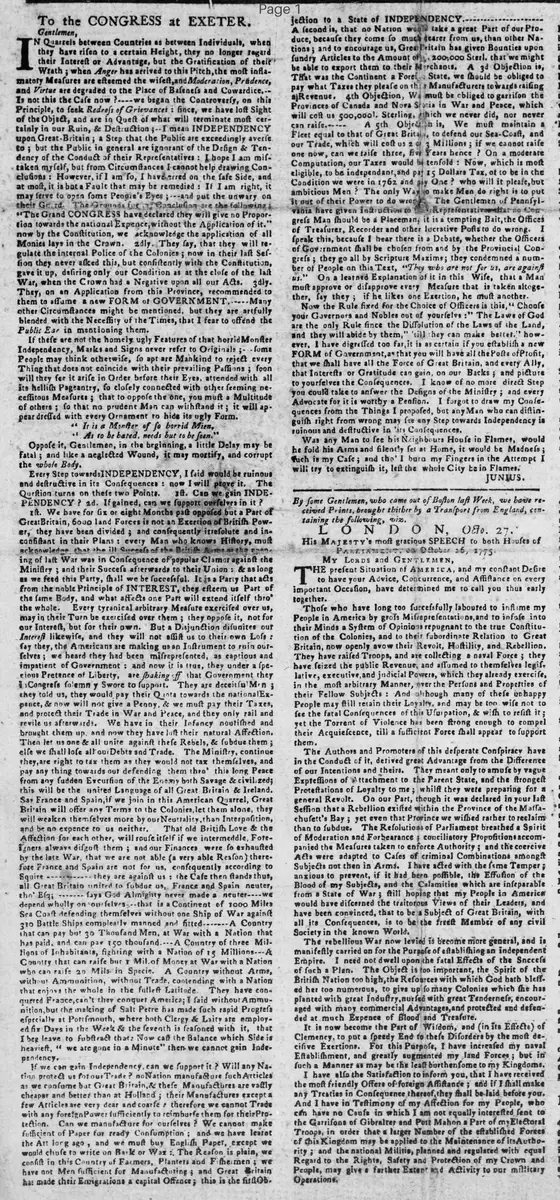
Gentlemen,
When men are heated with passion, and their resentments have risen to a certain height, they no longer regard their interest or advantage, but the gratification of their wrath; when anger has arrived to this pitch, the most inflammatory measures are esteemed the wisest, and moderation, prudence, and virtue are degraded to the place of baseness and cowardice.
Is not this the case now? We began the controversy on this principle, to seek redress of grievances; since, we have lost sight of the object, and are in quest of what will terminate most certainly in our ruin and destruction; I mean INDEPENDENCY upon Great-Britain; a step that the public are exceedingly averse to; but the public in general are ignorant of the design and tendency of the conduct of their representatives: I hope I am mistaken myself, but from circumstances I cannot help drawing conclusions: However, if I am so, I have erred on the safe side, and at most, it is but a fault that may be remedied: If I am right, it may serve to open some people's eyes; and put the unwary on their guard. The grounds for my conclusion are the following:
The Grand CONGRESS have declared they will give no proportion towards the national expense, without the application of it. Now by the constitution, we acknowledge the application of all monies lays in the Crown. 2dly. They say, that they will regulate the internal police of the colonies; now in their last session they never asked this, but consistently with the constitution, gave it up, desiring only our condition as at the close of the last war, when the Crown had a negative upon all our acts. 3dly. They, on an application from this province, recommended to them to assume a new form of government. Many other circumstances might be mentioned, but they are artfully blended with the necessity of the times, that I fear to offend the public ear in mentioning them.
If these are not the homely ugly features of that horrid monster Independency, marks and signs never refer to originals; some people may think otherwise, so apt are mankind to reject every thing that does not coincide with their prevailing passions; soon will they see it arise in order before their eyes, attended with all its hellish pageantry, so closely connected with other seeming necessary measures; that to oppose the one, you must a multitude of others; so that no prudent man can withstand it; it will appear dressed with every ornament to hide its ugly form.
"It is a monster of so horrid mien,
As to be hated, needs but to be seen."
Oppose it, gentlemen, in the beginning, a little delay may be fatal; and like a neglected wound, it may mortify, and corrupt the whole body.
Every step towards INDEPENDENCY, I said would be ruinous and destructive in its consequences: now I will prove it. The question turns on these two points. 1st. Can we gain INDEPENDENCY? 2d. If gained, can we support ourselves in it?
1st. We have for six or eight months past opposed but a part of Great Britain. 6000 land forces is not an exertion of British power, they have been divided; and consequently irresolute and inconsistent in their plans: every man who knows history, must acknowledge that the ill success of the British arms at the beginning of last war was in consequence of popular clamor against the ministry; and their success afterwards to their union: and as long as we fear this party, shall we be successful. It is a party that acts from the noble principle of INTEREST, they esteem us part of the same body, and what affects one part will extend itself thro' the whole. Every tyrannical arbitrary measure exercised over us, may in their turn be exercised over them; they oppose it, not for our interest, but for their own. But a disjunction disunites our interest likewise, and they will not aid us to their own loss: say they, the Americans are making us an instrument to ruin ourselves; we heard they had been misrepresented, as captious and impatient of government: and now it is thus, they under a specious pretense of liberty, are shaking off that government they in Congress solemnly swore to support. They are deceitful men; they told us, they would pay their quota towards the national expense, and now will not give a penny, and we must pay their taxes, and protect their trade in war and peace, and they only rail and revile us afterwards. We have in their infancy nourished and brought them up, and now they have lost their natural affection. Then let us one and all unite against these rebels, and subdue them; else we shall lose all our debts and trade. The ministry, continue they, are right to tax them as they would not tax themselves, and pay any thing towards our defending them thro' this long peace from any sudden excursion of the enemy both savage and civilized; this will be the united language of all Great Britain and Ireland. Sir France and Spain, if we join in this American quarrel, Great Britain will offer any terms to the colonies, let them alone, they will weaken themselves more by our neutrality than interposition, and be no expense to us neither. That old British love and affection for each other, will rouse itself if we intermeddle, foreigners always disgust them; and our finances were so exhausted by the late war, that we are not able (a very able reason) therefore France and Spain are not for us, consequently according to Squire --- or --- they are against us: the case then stands thus, all Great Britain united to subdue us, France and Spain neuter, tho' Esq; --- says God Almighty never made a neuter --- we depend wholly on ourselves --- that is a continent of 1000 miles sea coast defending themselves without one ship of war against 310 battle ships completely manned and fitted --- A country that can pay but 30 thousand men, at war with a nation that has paid, and can pay 150 thousand --- A country of three millions of inhabitants, fighting with a nation of 15 millions --- A country that can raise but 1 mil. of money at war with a nation who can raise 20 mils. in specie. A country without arms, without ammunition, without trade, contending with a nation that enjoys the whole in the fullest latitude. They have conquered France, can't they conquer America; I said without ammunition, but the making of salt petre has made such rapid progress especially at Portsmouth, where both clergy and laity are employed six days in the week and the seventh is seasoned with it, that I beg leave to subtract that: Now cast the balance which side is heaviest, we are gone in a minute then we cannot gain independency.
If we can gain independency, can we support it? Will any nation protect us for our trade? no nation manufacture such articles as we consume but Great Britain, and these manufactures are vastly cheaper and better than at Holland; their manufactures except a few articles are very dear and coarse: therefore we cannot trade with any foreign power sufficiently to reimburse them for their protection. Can we manufacture for ourselves? We cannot make sufficient of paper for ready consumption; and we have learnt the art long ago, and we must buy English paper, except we would choose to write on bark or wax: The reason is plain, we consist in this country of farmers, planters and fishermen; we have not men sufficient for manufacturing; and Great Britain has made their emigrations a capital offense; this is the first objection to a state of INDEPENDENCY.
A second is, that no nation would take a great part of our produce; because they come so much dearer from us, than other nations; and to encourage us, Great Britain has given bounties upon sundry articles to the amount of 200,000 sterling, that we might be able to export them to their merchants. A 3d objection is, That was the continent a foreign state, we should be obliged to pay what taxes they please on their manufacturers towards raising a revenue, 4th objection, We must be obliged to garrison the provinces of Canada and Nova Scotia in war and peace, which will cost us 200,000 l. sterling, which we never did, nor never can raise.
A 5th objection is, We must maintain a fleet equal to that of Great Britain, to defend our sea-coast, and our trade, which will cost us 2 or 3 millions; if we cannot raise one now, can we raise three, four years hence? On a moderate computation, our taxes would be tenfold: Now, which is most eligible, to be independent, and pay 15 dollars tax, or to be in the condition we were in 1762 and pay one? who will it please, but ambitious men? The only way to make men do right is to put it out of their power to do wrong.
The gentlemen of Pennsylvania have given instruction to representatives that no congress man should be a placeman; it is a tempting bait, the offices of treasurer, recorder and other lucrative posts to do wrong. I speak this, because I hear there is a debate, whether the officers of government shall be chosen from and by the provincial congress; they go all by scripture maxims; they condemned a number of people on this text, "They who are not for us, are against us." On a learned explanation of it in this wise, that a man must approve or disapprove every measure that is taken altogether. say they; if he likes one exertion, he must another.
Now the rule fixed for the choice of officers is this, "Choose your governors and nobles out of yourselves:" The laws of God are the only rule since the dissolution of the laws of the land, and they will abide by them, "till they can make better." however, I have digressed too far. it is as certain if you establish a new form of government, as that you will have all the posts of profit, that we shall have all the force of Great Britain, and every ally, that interest or gratitude can gain, on our backs; and picture to yourselves the consequences. I know of no more direct step you could take to answer the designs of the ministry; and every advocate for it is worthy a pension. I forgot to draw my consequences from the things I proposed, but any man who can distinguish right from wrong may see any step towards independency is ruinous and destructive in its consequences.
Was any man to see his neighbour's house in flames, would he fold his arms and silently sit at home, it would be madness; such is my case; and tho' I burn my fingers in the attempt I will try to extinguish it, lest the whole city be in flames.
JUNIUS.
What sub-type of article is it?
What themes does it cover?
What keywords are associated?
What entities or persons were involved?
Letter to Editor Details
Author
Junius.
Recipient
To The Congress At Exeter Gentlemen,
Main Argument
pursuit of independence from great britain is driven by passion, not prudence, and will lead to military defeat, economic ruin, and loss of british support; the public opposes it, but representatives are pushing it secretly through inflammatory measures.
Notable Details