Thank you for visiting SNEWPapers!
Sign up free
Atlanta Daily World
Atlanta, Fulton County, Georgia
What is this article about?
Lionel Hampton criticizes the music industry's practice of labeling records by Negro artists as 'race records,' highlighting inconsistencies and calling for its end to uphold dignity and democracy. He urges protests and references his past stand against discrimination in Kansas City.
Merged-components note: Continued story across pages
Clippings
1 of 2
OCR Quality
Full Text
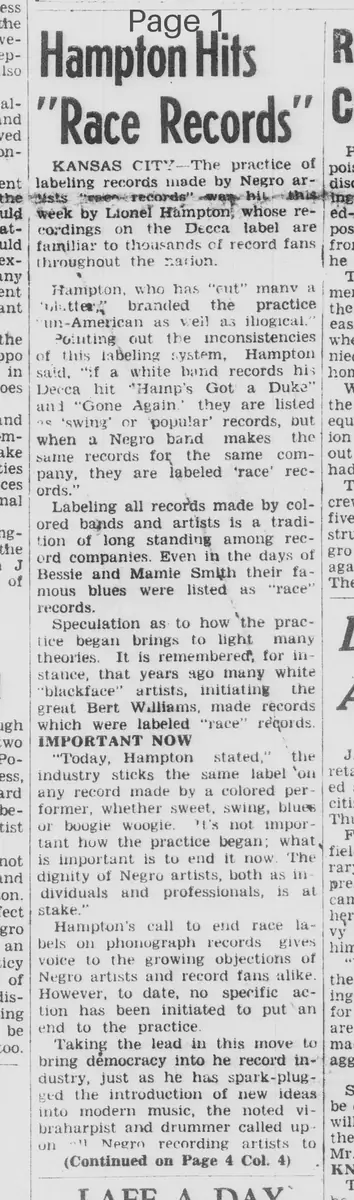
KANSAS CITY—The practice of labeling records made by Negro artists "race records" was hit this week by Lionel Hampton whose recordings on the Decca label are familiar to thousands of record fans throughout the nation.
Hampton, who has "cut" many a "vitter," branded the practice un-American as well as illogical.
Pointing out the inconsistencies of this labeling system, Hampton said: "If a white band records his Decca hit 'Hamp's Got a Duke' and 'Gone Again' they are listed as 'swing' or 'popular' records, but when a Negro band makes the same records for the same company, they are labeled 'race' records."
Labeling all records made by colored bands and artists is a tradition of long standing among record companies. Even in the days of Bessie and Mamie Smith their famous blues were listed as "race" records.
Speculation as to how the practice began brings to light many theories. It is remembered, for instance, that years ago many white "blackface" artists, initiating the great Bert Williams, made records which were labeled "race" records.
IMPORTANT NOW
"Today," Hampton stated, "the industry sticks the same label on any record made by a colored performer, whether sweet, swing, blues or boogie woogie. It's not important how the practice began; what is important is to end it now. The dignity of Negro artists, both as individuals and professionals, is at stake."
Hampton's call to end race labels on phonograph records gives voice to the growing objections of Negro artists and record fans alike. However, to date, no specific action has been initiated to put an end to the practice.
Taking the lead in this move to bring democracy into the record industry, just as he has spark-plugged the introduction of new ideas into modern music, the noted vibraharpist and drummer called upon Negro recording artists to
voice their protests to the various firms in the industry.
The "end-race-labels crusade is typical of Hampton's firm belief in democracy in all phases of American life. He once refused to permit his band to finish an engagement at a dance hall in Kansas City as a protest to discrimination.
In a statement to the press following the incident, the young band leader won the praise of Negro and white citizens alike for his straightforward condemnation of racial discrimination.
The Hamp's "Lionel Hampton Show" is heard over Mutual each Saturday night, 9:30 to 10:00 p.m. Eastern Standard Time.
What sub-type of article is it?
What themes does it cover?
What keywords are associated?
What entities or persons were involved?
Where did it happen?
Story Details
Key Persons
Location
Kansas City
Event Date
This Week
Story Details
Lionel Hampton denounces the 'race records' label for Negro artists' music as un-American and illogical, citing examples of inconsistent labeling by Decca. He calls for protests to end the practice, emphasizing artists' dignity, and references his past protest against discrimination.