Thank you for visiting SNEWPapers!
Sign up free
Editorial
April 30, 1913
Newport Daily Independent
Newport, Jackson County, Arkansas
What is this article about?
Editorial discusses Representative Gardner's admission of Republican faults in tariff policy, skepticism toward the Underwood bill, and defends the bill as a moderate downward revision promoting equality without radical change, reflecting a shift in Republican resistance.
Clipping
OCR Quality
98%
Excellent
Full Text
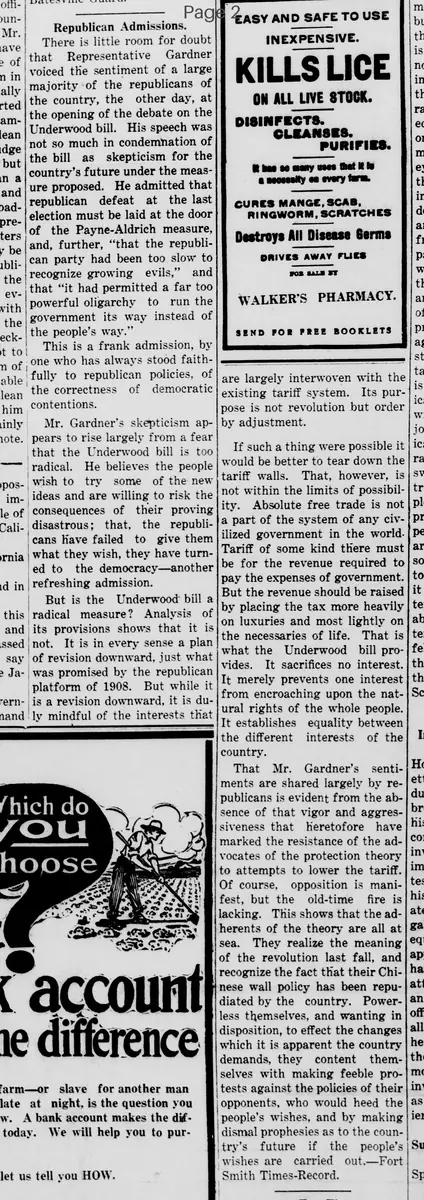
Republican Admissions.
There is little room for doubt that Representative Gardner voiced the sentiment of a large majority of the republicans of the country, the other day, at the opening of the debate on the Underwood bill. His speech was not so much in condemnation of the bill as skepticism for the country's future under the measure proposed. He admitted that republican defeat at the last election must be laid at the door of the Payne-Aldrich measure, and, further, "that the republican party had been too slow to recognize growing evils." and that "it had permitted a far too powerful oligarchy to run the government its way instead of the people's way."
This is a frank admission, by one who has always stood faithfully to republican policies, of the correctness of democratic contentions.
Mr. Gardner's skepticism appears to rise largely from a fear that the Underwood bill is too radical. He believes the people wish to try some of the new ideas and are willing to risk the consequences of their proving disastrous; that, the republicans have failed to give them what they wish, they have turned to the democracy—another refreshing admission.
But is the Underwood bill a radical measure? Analysis of its provisions shows that it is not. It is in every sense a plan of revision downward, just what was promised by the republican platform of 1908. But while it is a revision downward, it is duly mindful of the interests that are largely interwoven with the existing tariff system. Its purpose is not revolution but order by adjustment.
If such a thing were possible it would be better to tear down the tariff walls. That, however, is not within the limits of possibility. Absolute free trade is not a part of the system of any civilized government in the world. Tariff of some kind there must be for the revenue required to pay the expenses of government. But the revenue should be raised by placing the tax more heavily on luxuries and most lightly on the necessaries of life. That is what the Underwood bill provides. It sacrifices no interest. It merely prevents one interest from encroaching upon the natural rights of the whole people. It establishes equality between the different interests of the country.
That Mr. Gardner's sentiments are shared largely by republicans is evident from the absence of that vigor and aggressiveness that heretofore have marked the resistance of the advocates of the protection theory to attempts to lower the tariff. Of course, opposition is manifest, but the old-time fire is lacking. This shows that the adherents of the theory are all at sea. They realize the meaning of the revolution last fall, and recognize the fact that their Chinese wall policy has been repudiated by the country. Powerless themselves, and wanting in disposition, to effect the changes which it is apparent the country demands, they content themselves with making feeble protests against the policies of their opponents, who would heed the people's wishes, and by making dismal prophesies as to the country's future if the people's wishes are carried out.—Fort Smith Times-Record.
There is little room for doubt that Representative Gardner voiced the sentiment of a large majority of the republicans of the country, the other day, at the opening of the debate on the Underwood bill. His speech was not so much in condemnation of the bill as skepticism for the country's future under the measure proposed. He admitted that republican defeat at the last election must be laid at the door of the Payne-Aldrich measure, and, further, "that the republican party had been too slow to recognize growing evils." and that "it had permitted a far too powerful oligarchy to run the government its way instead of the people's way."
This is a frank admission, by one who has always stood faithfully to republican policies, of the correctness of democratic contentions.
Mr. Gardner's skepticism appears to rise largely from a fear that the Underwood bill is too radical. He believes the people wish to try some of the new ideas and are willing to risk the consequences of their proving disastrous; that, the republicans have failed to give them what they wish, they have turned to the democracy—another refreshing admission.
But is the Underwood bill a radical measure? Analysis of its provisions shows that it is not. It is in every sense a plan of revision downward, just what was promised by the republican platform of 1908. But while it is a revision downward, it is duly mindful of the interests that are largely interwoven with the existing tariff system. Its purpose is not revolution but order by adjustment.
If such a thing were possible it would be better to tear down the tariff walls. That, however, is not within the limits of possibility. Absolute free trade is not a part of the system of any civilized government in the world. Tariff of some kind there must be for the revenue required to pay the expenses of government. But the revenue should be raised by placing the tax more heavily on luxuries and most lightly on the necessaries of life. That is what the Underwood bill provides. It sacrifices no interest. It merely prevents one interest from encroaching upon the natural rights of the whole people. It establishes equality between the different interests of the country.
That Mr. Gardner's sentiments are shared largely by republicans is evident from the absence of that vigor and aggressiveness that heretofore have marked the resistance of the advocates of the protection theory to attempts to lower the tariff. Of course, opposition is manifest, but the old-time fire is lacking. This shows that the adherents of the theory are all at sea. They realize the meaning of the revolution last fall, and recognize the fact that their Chinese wall policy has been repudiated by the country. Powerless themselves, and wanting in disposition, to effect the changes which it is apparent the country demands, they content themselves with making feeble protests against the policies of their opponents, who would heed the people's wishes, and by making dismal prophesies as to the country's future if the people's wishes are carried out.—Fort Smith Times-Record.
What sub-type of article is it?
Economic Policy
Partisan Politics
What keywords are associated?
Underwood Bill
Tariff Revision
Republican Admissions
Payne Aldrich Tariff
Protectionism Critique
Economic Equality
What entities or persons were involved?
Representative Gardner
Underwood Bill
Payne Aldrich Measure
Republican Party
Democracy
Editorial Details
Primary Topic
Republican Admissions On Tariff Policy And Underwood Bill
Stance / Tone
Supportive Of Underwood Bill, Critical Of Republican Protectionism
Key Figures
Representative Gardner
Underwood Bill
Payne Aldrich Measure
Republican Party
Democracy
Key Arguments
Republican Defeat Due To Payne Aldrich Tariff
Republicans Slow To Recognize Evils And Allowed Oligarchy Influence
Underwood Bill Is Moderate Downward Revision, Not Radical
Tariff Needed For Revenue, Heavier On Luxuries Than Necessaries
Establishes Equality Among Interests Without Sacrificing Any
Republican Resistance To Tariff Reduction Lacks Former Vigor