Thank you for visiting SNEWPapers!
Sign up free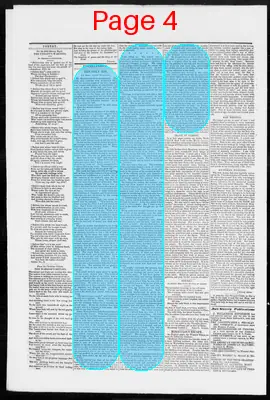
Literary
December 5, 1845
Anti Slavery Bugle
New Lisbon, Salem, Columbiana County, Ohio
What is this article about?
A stern lawyer disowns his dissolute teenage son after a drunken escapade. Years later, as a judge, he presides over the trial of a mail robber who turns out to be his son. The son's eloquent speech of his tragic fall from grace moves the judge to remorse, leading to a pardon and family reconciliation in Italy.
Clipping
OCR Quality
98%
Excellent
Full Text
MISCELLANEOUS.
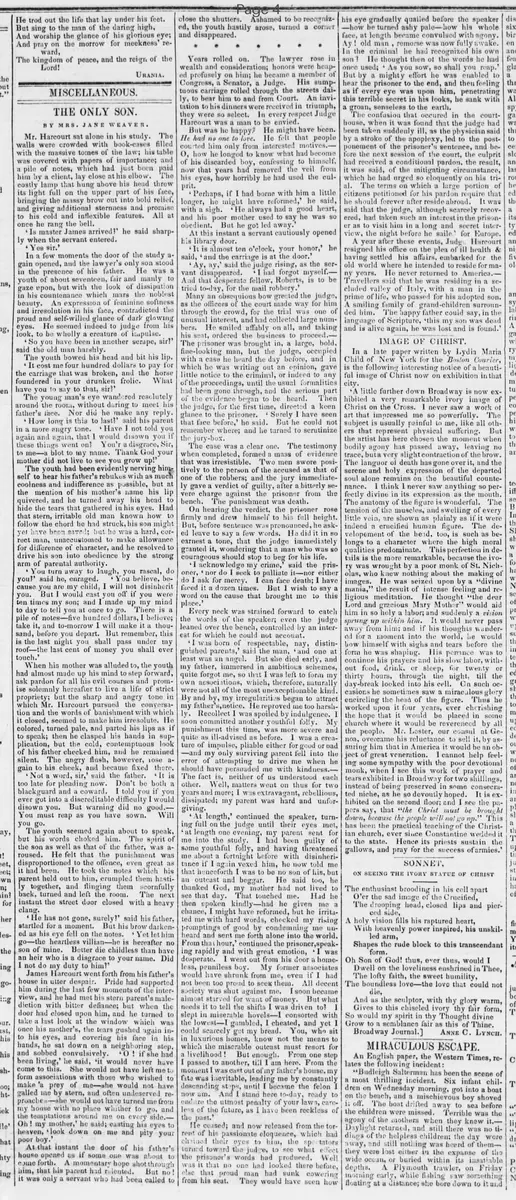
THE ONLY SON.
BY MRS. JANE WEAVER.
Mr. Harcourt sat alone in his study. The walls were crowded with book-cases filled with the massive tomes of the law; his table was covered with papers of importance; and a pile of notes, which had just been paid him by a client, lay close at his elbow. The costly lamp that hung above his head threw its light full on the upper part of his face, bringing the massy brow out into bold relief, and giving additional sternness and promise to his cold and inflexible features. All at once he rang the bell.
'Is master James arrived?' he said sharply when the servant entered.
'Yes sir.'
In a few moments the door of the study again opened, and the lawyer's only son stood in the presence of his father. He was a youth of about seventeen, fair and manly to gaze upon, but with the look of dissipation in his countenance which mars the noblest beauty. An expression of feminine softness and irresolution in his face, contradicted the proud and self-willed glance of dark glowing eyes. He seemed indeed to judge from his look, to be wholly a creature of impulse.
'So you have been in another scrape, sir?' said the old man harshly.
The youth bowed his head and bit his lip.
'It cost me four hundred dollars to pay for the carriage that was broken, and the horse foundered in your drunken frolic. What have you to say to that, sir?'
The young man's eye wandered resolutely around the room, without daring to meet his father's face. Nor did he make any reply.
'How long is this to last?' said his parent in a more angry tone. 'Have I not told you again and again, that I would disown you if these things went on? You're a disgrace, Sir, to me—a blot to my name. Thank God your mother did not live to see you grow up!'
The youth had been evidently nerving himself to hear his father's rebukes with as much coolness and indifference as possible, but at the mention of his mother's name his lip quivered, and he turned away his head to hide the tears that gathered in his eyes. Had that stern, irritable old man known how to follow the chord he had struck, his son might yet have been saved; but he was a hard, correct man, unaccustomed to make allowance for difference of character, and he resolved to drive his son into obedience by the strong arm of parental authority.
'You turn away to laugh, you rascal, do you?' said he, enraged. 'You believe, because you are my child, I will not disinherit you. But I would cast you off if you were ten times my son; and I made up my mind to day to tell you at once to go. There is a pile of notes—five hundred dollars, I believe; take it, and to-morrow I will make it a thousand, before you depart. But remember, this is the last night you shall pass under my roof—the last cent of money you shall ever touch.'
When his mother was alluded to, the youth had almost made up his mind to step forward, ask pardon for all his evil courses and promise solemnly hereafter to live a life of strict propriety; but the sharp and angry tone in which Mr. Harcourt pursued the conversation and the words of banishment with which it closed, seemed to make him irresolute. He colored, turned pale, and parted his lips as if to speak; then he clasped his hands in supplication, but the cold, contemptuous look of his father checked him, and he remained silent. The angry flush, however, rose again to his cheek, and became fixed there.
'Not a word, sir,' said the father. 'It is too late for pleading now. Don't be both a blackguard and a coward. I told you if you ever got into a discreditable difficulty I would disown you. But warning did no good.—You must reap as you have sown. Will you go.'
The youth seemed again about to speak. but his words choked him. The spirit of the son as well as that of the father, was aroused. He felt that the punishment was disproportioned to the offence, even great as it had been. He took the notes which his parent held out to him, crumpled them hastily together, and flinging them scornfully back, turned and left the room. The next instant the street door closed with a heavy clang.
'He has not gone, surely?' said his father, startled for a moment. But his brow darkened as his eye fell on the notes. 'Yet let him go—the heartless villain—he is hereafter no son of mine. Better die childless than have an heir who is a disgrace to your name. Did I not do my duty to him?'
James Harcourt went forth from his father's house in utter despair. Pride had supported him during the last few moments of the interview, and he had met his stern parent's malediction with bitter defiance; but when the door had closed upon him, and he turned to take a last look at the window which was once his mother's, the tears gushed again into his eyes, and covering his face in his hands, he sat down on a neighboring step, and sobbed convulsively. 'O! if she had been living,' he said, 'it would never have come to this. She would not have left me to form associations with those who wished to make a prey of me—she would not have galled me by stern, and often undeserved reproaches—she would not have turned me from my house with no place whither to go. and the temptations around me on every side.—Oh! my mother,' he said; casting his eyes to heaven, 'look down on me and pity your poor boy.'
At that instant the door of his father's house opened as if some one was about to come forth. A momentary hope shot through him, that his parent had relented. But no! it was only a servant who had been called to close the shutters. Ashamed to be recognized, the youth hastily arose, turned a corner and disappeared.
Years rolled on. The lawyer rose in wealth and consideration; honors were heaped profusely on him; he became a member of Congress, a Senator, a Judge. His sumptuous carriage rolled through the streets daily, to bear him to and from Court. An invitation to his dinners were received in triumph, they were so select. In every respect Judge Harcourt was a man to be envied.
But was he happy? He might have been. He had no one to love, He felt that people courted him only from interested motives.—O, how he longed to know what had become of his discarded boy, confessing to himself, now that years had removed the veil from his eyes, how horribly he had used the culprit.
'Perhaps, if I had borne with him a little longer, he might have reformed,' he said, with a sigh. 'He always had a good heart, and his poor mother used to say he was so obedient.' But he got led away
At this instant a servant cautiously opened his library door.
'It is almost ten o'clock, your honor,' he said, 'and the carriage is at the door.'
'Ay, ay,' said the judge rising, as the servant disappeared. 'I had forgot myself.—And that desperate fellow, Roberts, is to be tried to-day. for the mail robbery.'
Many an obsequious bow greeted the judge, as the officers of the court made way for him through the crowd, for the trial was one of unusual interest, and had collected large numbers. He smiled affably on all, and taking his seat, ordered the business to proceed.—The prisoner was brought in, a large, bold, fine-looking man, but the judge, occupied with a case he heard the day before. and in which he was writing out an opinion, gave little notice to the criminal, or indeed to any of the proceedings, until the usual formalities had been gone through, and the serious part of the evidence began to be heard. Then the judge, for the first time, directed a keen glance to the prisoner. 'Surely I have seen that face before,' he said. But he could not remember where; and he turned to scrutinize the jury-box.
The case was a clear one. The testimony when completed, formed a mass of evidence that was irresistible. Two men swore positively to the person of the accused as that of one of the robbers; and the jury immediately gave a verdict of guilty, after a bitterly severe charge against the prisoner from the bench. The punishment was death.
On hearing the verdict, the prisoner rose firmly and drew himself to his full height. But, before sentence was pronounced, he asked leave to say a few words. He did it in so earnest a tone, that the judge immediately granted it, wondering that a man who was so courageous should stop to beg for his life.
'I acknowledge my crime,' said the prisoner, 'nor do I seek to palliate it—nor either do I ask for mercy. I can face death; I have faced it a dozen times. But I wish to say a word on the cause that brought me to this place.'
Every neck was strained forward to catch the words of the speaker; even the judge leaned over the bench, controlled by an interest for which he could not account.
'I was born of respectable, nay, distinguished parents,' said the man, 'and one at least was an angel. But she died early, and my father, immersed in ambitious schemes, quite forgot me, so that I was left to form my own associations, which, therefore, naturally were not all of the most unexceptionable kind. By and by, my irregularities began to attract my father's notice. He reproved me too harshly. Recollect I was spoiled by indulgence. I soon committed another youthful folly. My punishment this time, was more severe and quite as ill-advised as before. I was a creature of impulse, pliable either for good or bad -and my only surviving parent fell into the error of attempting to drive me when he should have persuaded me with kindness.—The fact is. neither of us understood each other. Well, matters went on thus for two years and more; I was extravagant, rebellious, dissipated; my parent was hard and unforgiving.
At length,' continued the speaker, turning full on the judge until their eyes met, 'at length one evening, my parent sent for me into the study. I had been guilty of some youthful folly, and having threatened me about a fortnight before with disinheritance if I again vexed him, he now told me that henceforth I was to be no son of his, but an outcast and beggar. He said too, he thanked God, my mother had not lived to see that day. That touched me. Had he then spoken kindly—had he given me a chance, I might have reformed, but he irritated me with hard words, checked my rising promptings of good by condemning me unheard and sent me forth alone into the world.
From that hour,' continued the prisoner, speaking rapidly and with great emotion, 'I was desperate. I went out from his door a homeless, penniless boy. My former associates would have shrunk from me, even if I had not been too proud to seek them. All decent society was shut against me. I soon became almost starved for want of money. But what needs it to tell the shifts I was driven to? I slept in miserable hovels—I consorted with the lowest—I gambled, I cheated, and yet I could scarcely get my bread. You, who sit in luxurious homes, know not the means to which the miserable outcast must resort for a livelihood! But enough. From one step I passed to another, till I am here. From the moment I was cast out of my father's house, my fate was inevitable, leading me by constantly descending steps. until I became the felon I now am. And I stand here to-day, ready to endure the utmost penalty of your laws, careless of the future, as I have been reckless of the past.'
He ceased; and now released from the torrent of his passionate eloquence, which had chained their eyes to him, the spectators turned toward the judge, to see what effect the prisoner's words had produced. Well was it that no one had looked there before, else that proud man had sunk cowering from his seat. They would have seen how his eye gradually quailed before the speaker -how he turned ashy pale—how his whole face, at length became convulsed with agony. Ay! old man, remorse was now fully awake. In the criminal he had recognized his own son? He thought then of the words he had once used; 'As you sow, so shall you reap.' But by a mighty effort he was enabled to hear the prisoner to the end, and then feeling as if every eye was upon him, penetrating this terrible secret in his looks, he sank with a groan, senseless to the earth.
The confusion that occurred in the court-house, when it was found that the judge had been taken suddenly ill, as the physician said by a stroke of the apoplexy, led to the postponement of the prisoner's sentence, and before the next session of the court, the culprit had received a conditional pardon, the result, it was said, of the mitigating circumstance. which he had urged so eloquently on his trial. The terms on which a large portion of citizens petitioned for his pardon require that he should forever after reside abroad. It was said that the judge, although scarcely recovered, had taken such an interest in the prisoner as to visit him in a long and secret interview, the night before he sailed for Europe.
A year after these events, Judg. Harcourt resigned his office on the plea of ill health & having settled his affairs, embarked for the old world where he intended to reside for many years. He never returned to America.—Travellers said that he was residing in a secluded valley of Italy, with a man in the prime of life, who passed for his adopted son. A smiling family of grand-children surrounded him. The happy father could say, in the language of Scripture, 'this my son was dead and is alive again, he was lost and is found.'
THE ONLY SON.
BY MRS. JANE WEAVER.
Mr. Harcourt sat alone in his study. The walls were crowded with book-cases filled with the massive tomes of the law; his table was covered with papers of importance; and a pile of notes, which had just been paid him by a client, lay close at his elbow. The costly lamp that hung above his head threw its light full on the upper part of his face, bringing the massy brow out into bold relief, and giving additional sternness and promise to his cold and inflexible features. All at once he rang the bell.
'Is master James arrived?' he said sharply when the servant entered.
'Yes sir.'
In a few moments the door of the study again opened, and the lawyer's only son stood in the presence of his father. He was a youth of about seventeen, fair and manly to gaze upon, but with the look of dissipation in his countenance which mars the noblest beauty. An expression of feminine softness and irresolution in his face, contradicted the proud and self-willed glance of dark glowing eyes. He seemed indeed to judge from his look, to be wholly a creature of impulse.
'So you have been in another scrape, sir?' said the old man harshly.
The youth bowed his head and bit his lip.
'It cost me four hundred dollars to pay for the carriage that was broken, and the horse foundered in your drunken frolic. What have you to say to that, sir?'
The young man's eye wandered resolutely around the room, without daring to meet his father's face. Nor did he make any reply.
'How long is this to last?' said his parent in a more angry tone. 'Have I not told you again and again, that I would disown you if these things went on? You're a disgrace, Sir, to me—a blot to my name. Thank God your mother did not live to see you grow up!'
The youth had been evidently nerving himself to hear his father's rebukes with as much coolness and indifference as possible, but at the mention of his mother's name his lip quivered, and he turned away his head to hide the tears that gathered in his eyes. Had that stern, irritable old man known how to follow the chord he had struck, his son might yet have been saved; but he was a hard, correct man, unaccustomed to make allowance for difference of character, and he resolved to drive his son into obedience by the strong arm of parental authority.
'You turn away to laugh, you rascal, do you?' said he, enraged. 'You believe, because you are my child, I will not disinherit you. But I would cast you off if you were ten times my son; and I made up my mind to day to tell you at once to go. There is a pile of notes—five hundred dollars, I believe; take it, and to-morrow I will make it a thousand, before you depart. But remember, this is the last night you shall pass under my roof—the last cent of money you shall ever touch.'
When his mother was alluded to, the youth had almost made up his mind to step forward, ask pardon for all his evil courses and promise solemnly hereafter to live a life of strict propriety; but the sharp and angry tone in which Mr. Harcourt pursued the conversation and the words of banishment with which it closed, seemed to make him irresolute. He colored, turned pale, and parted his lips as if to speak; then he clasped his hands in supplication, but the cold, contemptuous look of his father checked him, and he remained silent. The angry flush, however, rose again to his cheek, and became fixed there.
'Not a word, sir,' said the father. 'It is too late for pleading now. Don't be both a blackguard and a coward. I told you if you ever got into a discreditable difficulty I would disown you. But warning did no good.—You must reap as you have sown. Will you go.'
The youth seemed again about to speak. but his words choked him. The spirit of the son as well as that of the father, was aroused. He felt that the punishment was disproportioned to the offence, even great as it had been. He took the notes which his parent held out to him, crumpled them hastily together, and flinging them scornfully back, turned and left the room. The next instant the street door closed with a heavy clang.
'He has not gone, surely?' said his father, startled for a moment. But his brow darkened as his eye fell on the notes. 'Yet let him go—the heartless villain—he is hereafter no son of mine. Better die childless than have an heir who is a disgrace to your name. Did I not do my duty to him?'
James Harcourt went forth from his father's house in utter despair. Pride had supported him during the last few moments of the interview, and he had met his stern parent's malediction with bitter defiance; but when the door had closed upon him, and he turned to take a last look at the window which was once his mother's, the tears gushed again into his eyes, and covering his face in his hands, he sat down on a neighboring step, and sobbed convulsively. 'O! if she had been living,' he said, 'it would never have come to this. She would not have left me to form associations with those who wished to make a prey of me—she would not have galled me by stern, and often undeserved reproaches—she would not have turned me from my house with no place whither to go. and the temptations around me on every side.—Oh! my mother,' he said; casting his eyes to heaven, 'look down on me and pity your poor boy.'
At that instant the door of his father's house opened as if some one was about to come forth. A momentary hope shot through him, that his parent had relented. But no! it was only a servant who had been called to close the shutters. Ashamed to be recognized, the youth hastily arose, turned a corner and disappeared.
Years rolled on. The lawyer rose in wealth and consideration; honors were heaped profusely on him; he became a member of Congress, a Senator, a Judge. His sumptuous carriage rolled through the streets daily, to bear him to and from Court. An invitation to his dinners were received in triumph, they were so select. In every respect Judge Harcourt was a man to be envied.
But was he happy? He might have been. He had no one to love, He felt that people courted him only from interested motives.—O, how he longed to know what had become of his discarded boy, confessing to himself, now that years had removed the veil from his eyes, how horribly he had used the culprit.
'Perhaps, if I had borne with him a little longer, he might have reformed,' he said, with a sigh. 'He always had a good heart, and his poor mother used to say he was so obedient.' But he got led away
At this instant a servant cautiously opened his library door.
'It is almost ten o'clock, your honor,' he said, 'and the carriage is at the door.'
'Ay, ay,' said the judge rising, as the servant disappeared. 'I had forgot myself.—And that desperate fellow, Roberts, is to be tried to-day. for the mail robbery.'
Many an obsequious bow greeted the judge, as the officers of the court made way for him through the crowd, for the trial was one of unusual interest, and had collected large numbers. He smiled affably on all, and taking his seat, ordered the business to proceed.—The prisoner was brought in, a large, bold, fine-looking man, but the judge, occupied with a case he heard the day before. and in which he was writing out an opinion, gave little notice to the criminal, or indeed to any of the proceedings, until the usual formalities had been gone through, and the serious part of the evidence began to be heard. Then the judge, for the first time, directed a keen glance to the prisoner. 'Surely I have seen that face before,' he said. But he could not remember where; and he turned to scrutinize the jury-box.
The case was a clear one. The testimony when completed, formed a mass of evidence that was irresistible. Two men swore positively to the person of the accused as that of one of the robbers; and the jury immediately gave a verdict of guilty, after a bitterly severe charge against the prisoner from the bench. The punishment was death.
On hearing the verdict, the prisoner rose firmly and drew himself to his full height. But, before sentence was pronounced, he asked leave to say a few words. He did it in so earnest a tone, that the judge immediately granted it, wondering that a man who was so courageous should stop to beg for his life.
'I acknowledge my crime,' said the prisoner, 'nor do I seek to palliate it—nor either do I ask for mercy. I can face death; I have faced it a dozen times. But I wish to say a word on the cause that brought me to this place.'
Every neck was strained forward to catch the words of the speaker; even the judge leaned over the bench, controlled by an interest for which he could not account.
'I was born of respectable, nay, distinguished parents,' said the man, 'and one at least was an angel. But she died early, and my father, immersed in ambitious schemes, quite forgot me, so that I was left to form my own associations, which, therefore, naturally were not all of the most unexceptionable kind. By and by, my irregularities began to attract my father's notice. He reproved me too harshly. Recollect I was spoiled by indulgence. I soon committed another youthful folly. My punishment this time, was more severe and quite as ill-advised as before. I was a creature of impulse, pliable either for good or bad -and my only surviving parent fell into the error of attempting to drive me when he should have persuaded me with kindness.—The fact is. neither of us understood each other. Well, matters went on thus for two years and more; I was extravagant, rebellious, dissipated; my parent was hard and unforgiving.
At length,' continued the speaker, turning full on the judge until their eyes met, 'at length one evening, my parent sent for me into the study. I had been guilty of some youthful folly, and having threatened me about a fortnight before with disinheritance if I again vexed him, he now told me that henceforth I was to be no son of his, but an outcast and beggar. He said too, he thanked God, my mother had not lived to see that day. That touched me. Had he then spoken kindly—had he given me a chance, I might have reformed, but he irritated me with hard words, checked my rising promptings of good by condemning me unheard and sent me forth alone into the world.
From that hour,' continued the prisoner, speaking rapidly and with great emotion, 'I was desperate. I went out from his door a homeless, penniless boy. My former associates would have shrunk from me, even if I had not been too proud to seek them. All decent society was shut against me. I soon became almost starved for want of money. But what needs it to tell the shifts I was driven to? I slept in miserable hovels—I consorted with the lowest—I gambled, I cheated, and yet I could scarcely get my bread. You, who sit in luxurious homes, know not the means to which the miserable outcast must resort for a livelihood! But enough. From one step I passed to another, till I am here. From the moment I was cast out of my father's house, my fate was inevitable, leading me by constantly descending steps. until I became the felon I now am. And I stand here to-day, ready to endure the utmost penalty of your laws, careless of the future, as I have been reckless of the past.'
He ceased; and now released from the torrent of his passionate eloquence, which had chained their eyes to him, the spectators turned toward the judge, to see what effect the prisoner's words had produced. Well was it that no one had looked there before, else that proud man had sunk cowering from his seat. They would have seen how his eye gradually quailed before the speaker -how he turned ashy pale—how his whole face, at length became convulsed with agony. Ay! old man, remorse was now fully awake. In the criminal he had recognized his own son? He thought then of the words he had once used; 'As you sow, so shall you reap.' But by a mighty effort he was enabled to hear the prisoner to the end, and then feeling as if every eye was upon him, penetrating this terrible secret in his looks, he sank with a groan, senseless to the earth.
The confusion that occurred in the court-house, when it was found that the judge had been taken suddenly ill, as the physician said by a stroke of the apoplexy, led to the postponement of the prisoner's sentence, and before the next session of the court, the culprit had received a conditional pardon, the result, it was said, of the mitigating circumstance. which he had urged so eloquently on his trial. The terms on which a large portion of citizens petitioned for his pardon require that he should forever after reside abroad. It was said that the judge, although scarcely recovered, had taken such an interest in the prisoner as to visit him in a long and secret interview, the night before he sailed for Europe.
A year after these events, Judg. Harcourt resigned his office on the plea of ill health & having settled his affairs, embarked for the old world where he intended to reside for many years. He never returned to America.—Travellers said that he was residing in a secluded valley of Italy, with a man in the prime of life, who passed for his adopted son. A smiling family of grand-children surrounded him. The happy father could say, in the language of Scripture, 'this my son was dead and is alive again, he was lost and is found.'
What sub-type of article is it?
Prose Fiction
What themes does it cover?
Moral Virtue
What keywords are associated?
Prodigal Son
Parental Remorse
Family Reconciliation
Moral Tale
Redemption
Disinheritance
What entities or persons were involved?
By Mrs. Jane Weaver.
Literary Details
Title
The Only Son.
Author
By Mrs. Jane Weaver.
Key Lines
'You Must Reap As You Have Sown.'
'I Was A Creature Of Impulse, Pliable Either For Good Or Bad And My Only Surviving Parent Fell Into The Error Of Attempting To Drive Me When He Should Have Persuaded Me With Kindness.'
'From The Moment I Was Cast Out Of My Father's House, My Fate Was Inevitable, Leading Me By Constantly Descending Steps. Until I Became The Felon I Now Am.'
'This My Son Was Dead And Is Alive Again, He Was Lost And Is Found.'