Thank you for visiting SNEWPapers!
Sign up free
Nashville Union And American
Nashville, Davidson County, Tennessee
What is this article about?
Opinion piece advocating the value of foreign immigration to the free States' economy, emphasizing its role in supplying labor for industries, agriculture, and infrastructure that native workers avoid, while noting recent immigrants bring capital but poorer ones drive growth.
Clipping
OCR Quality
Full Text
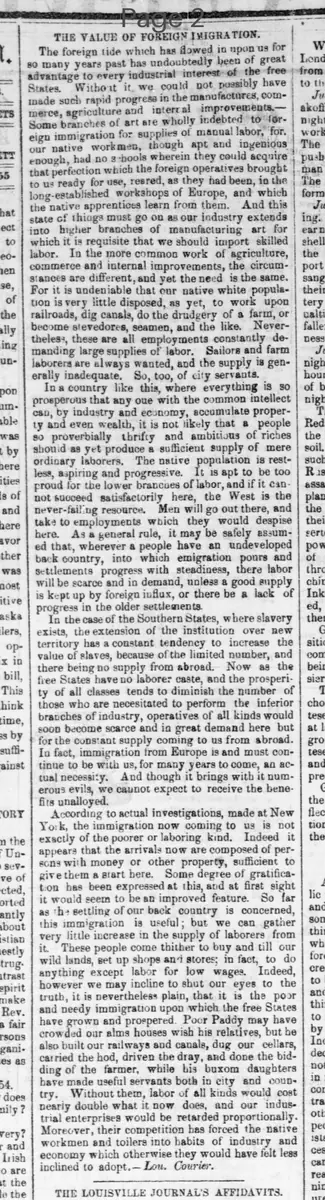
The foreign tide which has flowed in upon us for so many years past has undoubtedly been of great advantage to every industrial interest of the free States. Without it we could not possibly have made such rapid progress in the manufactures, commerce, agriculture and internal improvements. Some branches of art are wholly indebted to foreign immigration for supplies of manual labor, for our native workmen, though apt and ingenious enough, had no schools wherein they could acquire that perfection which the foreign operatives brought to us ready for use, reared, as they had been, in the long-established workshops of Europe, and which the native apprentices learn from them. And this state of things must go on as our industry extends into higher branches of manufacturing art for which it is requisite that we should import skilled labor. In the more common work of agriculture, commerce and internal improvements, the circumstances are different, and yet the need is the same. For it is undeniable that our native white population is very little disposed, as yet, to work upon railroads, dig canals, do the drudgery of a farm, or become stevedores, seamen, and the like. Nevertheless, these are all employments constantly demanding large supplies of labor. Sailors and farm laborers are always wanted, and the supply is generally inadequate. So, too, of city servants.
In a country like this, where everything is so prosperous that any one with the common intellect can, by industry and economy, accumulate property and even wealth, it is not likely that a people so proverbially thrifty and ambitious of riches should as yet produce a sufficient supply of mere ordinary laborers. The native population is restless, aspiring and progressive. It is apt to be too proud for the lower branches of labor, and if it cannot succeed satisfactorily here, the West is the never-failing resource. Men will go out there, and take to employments which they would despise here. As a general rule, it may be safely assumed that, wherever a people have an undeveloped back country, into which emigration pours and settlements progress with steadiness, there labor will be scarce and in demand, unless a good supply is kept up by foreign influx, or there be a lack of progress in the older settlements.
In the case of the Southern States, where slavery exists, the extension of the institution over new territory has a constant tendency to increase the value of slaves, because of the limited number, and there being no supply from abroad. Now as the free States have no laborer caste, and the prosperity of all classes tends to diminish the number of those who are necessitated to perform the inferior branches of industry, operatives of all kinds would soon become scarce and in great demand here but for the constant supply coming to us from abroad. In fact, immigration from Europe is and must continue to be with us, for many years to come, an actual necessity. And though it brings with it numerous evils, we cannot expect to receive the benefits unalloyed.
According to actual investigations, made at New York, the immigration now coming to us is not exactly of the poorer or laboring kind. Indeed it appears that the arrivals now are composed of persons with money or other property, sufficient to give them a start here. Some degree of gratification has been expressed at this, and at first sight it would seem to be an improved feature. So far as settling of our back country is concerned, this immigration is useful; but we can gather very little increase in the supply of laborers from it. These people come thither to buy and till our wild lands, set up shops and stores; in fact, to do anything except labor for low wages. Indeed, however we may incline to shut our eyes to the truth, it is nevertheless plain, that it is the poor and needy immigration upon which the free States have grown and prospered. Poor Paddy may have crowded our alms houses with his relatives, but he also built our railways and canals, dug our cellars, carried the hod, driven the dray, and done the bidding of the farmer, while his buxom daughters have made useful servants both in city and country. Without them, labor of all kinds would cost nearly double what it now does, and our industrial enterprises would be retarded proportionally. Moreover, their competition has forced the native workmen and toilers into habits of industry and economy which otherwise they would have felt less inclined to adopt.—Lou. Courier.
What sub-type of article is it?
What themes does it cover?
What keywords are associated?
What entities or persons were involved?
Where did it happen?
Story Details
Key Persons
Location
Free States, Southern States, New York, West, Europe
Story Details
Foreign immigration provides essential skilled and unskilled labor for the industrial, agricultural, and infrastructural growth of the free States, compensating for native reluctance to perform menial tasks; recent wealthier immigrants aid settlement but poorer ones drive prosperity through low-wage work.