Thank you for visiting SNEWPapers!
Sign up free
The Enquirer
Richmond, Henrico County, Virginia
What is this article about?
British House of Commons resolutions condemn Lord Melville for allowing misuse of naval public funds for private gain during his tenure as Treasurer (1782-1803), violating laws; includes his defensive letter and commissioners' refusal for further inquiry. (214 characters)
Clipping
OCR Quality
Full Text
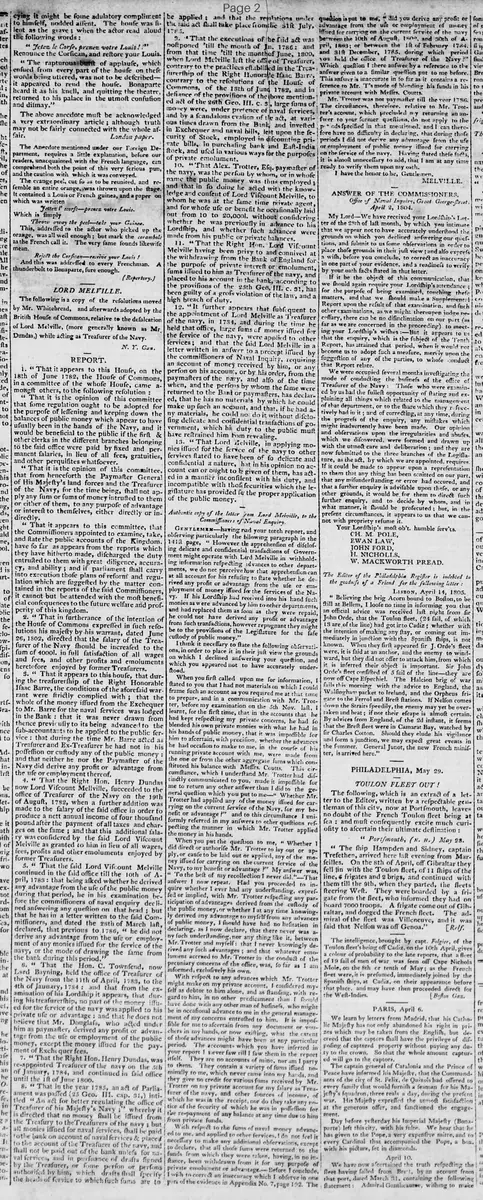
The following is a copy of the resolutions moved by Mr. Whitbread, and afterwards adopted by the British House of Commons, relative to the defalcation of Lord Melville, (more generally known as Mr. Dundas,) while acting as Treasurer of the Navy.
N. Y. Gaz.
REPORT.
1. "That it appears to this House, on the 18th of June 1782, the House of Commons, in a committee of the whole House, came amongst others, to the following resolution:
"That it is the opinion of this committee that some regulation ought to be adopted for the purpose of lessening and keeping down the balances of public money which appear to have usually been in the hands of the Navy, and it would be beneficial to the public if the first & other clerks in the different branches belonging to the said office were paid by fixed and permanent salaries, in lieu of all fees, gratuities, and other perquisites whatsoever.
"That it is the opinion of this committee, that from henceforth the Paymaster General of His Majesty's land forces and the Treasurer of the Navy, for the time being, shall not apply any sum or sums of money intrusted to them or either of them, to any purpose of advantage or interest to themselves, either directly or indirectly.
"That it appears to this committee, that the Commissioners appointed to examine, take, and state the public accounts of the Kingdom, have so far as appears from the reports which they have hitherto made, discharged the duty entrusted to them with great diligence, accuracy, and ability; and if parliament shall carry into execution those plans of reform and regulation which are suggested by the matter contained in the reports of the said Commissioners, it cannot but be attended with the most beneficial consequences to the future welfare and prosperity of this kingdom."
2. "That in furtherance of the intention of the House of Commons expressed in such resolutions his majesty by his warrant, dated June 26, 1802, directed that the salary of the Treasurer of the Navy should be increased to the sum of 4000l. in full satisfaction of all wages and fees, and other profits and emoluments heretofore enjoyed by former Treasurers.
3. "That it appears to this house, that during the treasurership of the Right Honorable Isaac Barre, the conditions of the aforesaid warrant were strictly complied with; that the whole of the money issued from the Exchequer to Mr. Barre for the naval services was lodged in the Bank: that it was never drawn from thence previously to its being advanced to the sub-accountants to be applied to the public service: that during the time Mr. Barre acted as Treasurer and Ex-Treasurer he had not in his possession or custody any of the public money: and that neither he nor the Paymaster of the Navy did derive any profit or advantage from the use or employment thereof.
4. "That the Right Hon. Henry Dundas now Lord Viscount Melville, succeeded to the office of Treasurer of the Navy on the 19th of August, 1782, when a further addition was made to the salary of the said office in order to produce a net annual income of four thousand pound after the payment of all taxes and charges on the same; and that this additional salary was considered by the said Lord Viscount Melville as granted to him in lieu of all wages, fees, profits and other emoluments enjoyed by former Treasurers.
5. "That the said Lord Viscount Melville continued in the said office till the 10th of April, 1783: that being asked whether he derived any advantage from the use of the public money during that period, he in his examination before the commissioners of naval enquiry declined answering any question on that head; but that he has in a letter written to the said Commissioners, and dated the 28th of March last, declared, that previous to 1786, "he did not derive any advantage from the use or employment of any monies issued for the service of the navy, or the mode of drawing the same from the bank during this period."
6. "That the Hon. C. Townshend, now Lord Bayning, held the office of Treasurer of the Navy from the 11th of April, 1783, to the 4th of January, 1784: and that from the examination of his Lordship it appears, that during his treasurership, no part of the money issued for the service of the navy was applied to his private use or advantage: and that he does not believe that Mr. Douglas, who acted under him as paymaster, derived any profit or advantage from the use or employment of the public money, except the money issued for the payment of Exchequer fees.
7. "That the Right Hon. Henry Dundas, was re-appointed Treasurer of the navy on the 5th of January, 1784, and continued in said office until the 1st of June 1800.
8. "That in the year 1785, an act of Parliament was passed (25 Geo. III. cap. 31,) intituled "An act for better regulating the office of Treasurer of his Majesty's Navy;" whereby it is directed that no money shall be issued from the Treasury to the Treasurers of the navy; but all monies issued for naval services, shall be paid to the bank on account of naval services & placed to the account of the Treasurer of the navy, and shall not be paid out of the bank unless for naval services, and in pursuance of drafts signed by the Treasurer, or some person or persons authorized by him, which drafts shall specify the heads of service to which such sums are to be applied: and that the regulations under the said act shall take place from the first July, 1785.
9. That the execution of the said act was postponed till the month of Jan. 1786: and from that time till the month of June, 1800, when Lord Melville left the office of Treasurer, contrary to the practice established in the Treasurership of the Right Honorable Isaac Barre, contrary to the resolutions of the House of Commons, of the 18th of June 1782, and in defiance of the provisions of the above mentioned act of the 25th Geo. III. c. 31, large sums of money were, under pretence of naval services, and by a scandalous evasion of the act, at various times drawn from the Bank and invested in Exchequer and naval bills, lent upon the security of Stock, employed in discounting private bills, in purchasing bank and East-India stock, and used in various ways for the purposes of private emolument.
10. "That Alex. Trotter, Esq. paymaster of the navy, was the person by whom, or in whose name the public money was thus employed; and that in so doing he acted with the knowledge and consent of Lord Viscount Melville, to whom he was at the same time private agent, and for whose use or benefit he occasionally laid out from 10 to 20,000l. without considering whether he was previously in advance to his Lordship, and whether such advances were made from his public or private balances.
11. "That the Right Hon. Lord Viscount Melville having been privy to and connived at the withdrawing from the Bank of England for the purpose of private interest or emolument, sums issued to him as Treasurer of the navy, and placed to his account in the bank, according to the provisions of the 25th Geo. III. c. 31, has been guilty of a gross violation of the law, and a high breach of duty.
12. "It further appears that subsequent to the appointment of Lord Melville as Treasurer of the navy, in 1784, and during the time he held that office, large sums of money issued for the service of the navy, were applied to other services: and that the said Lord Melville in a letter written in answer to a precept issued by the commissioners of Naval Inquiry, requiring an account of money received by him, or any person on his account, or by his order, from the paymasters of the navy, and also of the time when, and the persons by whom the same were returned to the Bank or paymasters, has declared, that he has no materials by which he could make up such an account, and that, if he had any materials, he could not do it without disclosing delicate and confidential transactions of government, which his duty to the public must have restrained him from revealing.
13. "That Lord Melville, in applying monies issued for the service of the navy to other services stated to have been of so delicate and confidential a nature, that in his opinion no account can or ought to be given of them, has acted in a manner inconsistent with his duty, and incompatible with those securities which the legislature has provided for the proper application of the public money.
Authentic copy of the letter from Lord Melville, to the Commissioners of Naval Enquiry.
Gentlemen—having read your tenth report, and observing particularly the following paragraph in the 141st page, "However the apprehension of disclosing delicate and confidential transactions of Government might operate with Lord Melville in withholding information respecting advances to other departments, we do not perceive how that apprehension can at all account for his refusing to state whether he derived any profit or advantage from the use or employment of money issued for the services of the Navy. If his Lordship had received into his hand such monies as were advanced by him to other departments, and had replaced them as soon as they were repaid, he could not have derived any profit or advantage from such transactions, however repugnant they might be to the provisions of the Legislature or the safe custody of public money."
I think it necessary to state the following observations, in order to place it in their just view the grounds on which I declined answering your question, and which you appeared not to have accurately understood.
When you first called upon me for information, I stated to you that I had not materials on which I could frame such an account as you required me at that time to prepare, and in a communication with Mr. Trotter, before my examination on the 5th Nov. last, I learnt, for the first time, that in the accounts that he had kept respecting my private concerns, he had so blended his own private monies with what he had in his hands of public money, that it was impossible for him to ascertain, with precision, whether the advances he had occasion to make to me, in the course of his running private account with me, were made from the one or from the other aggregate sums which constituted his balance with Messrs. Coutts. This circumstance, which I understand Mr. Trotter had distinctly communicated to you, made it impossible for me to return any other answer than I did to the general question which you put to me—“Whether Mr. Trotter had applied any of the money issued for carrying on the current service of the Navy, for my benefit or advantage?” and to this circumstance I uniformly referred in my answers to other questions respecting the manner in which Mr. Trotter applied the money in his hands.
When you put the question to me, "Whether I did direct or authorize Mr. Trotter to lay out or apply, or cause to be laid out or applied, any of the money issued for carrying on the current service of the Navy, to my benefit or advantage?" My answer was, "To the best of my recollection I never did."—That answer I now repeat. Had you proceeded to inquire whether I ever had any understanding, expressed or implied, with Mr. Trotter respecting any participation of advantages derived from the custody of the public money, or whether I at any time knowingly derived any advantage to myself from any advances of public money, I should have had no hesitation in declaring, as I now declare, that there never was any such understanding, nor any thing like it, between Mr. Trotter and myself: that I never knowingly derived any such advantages; and that whatever emolument accrued to Mr. Trotter in the conduct of the pecuniary concerns of the office, was, so far as I am informed, exclusively his own.
With respect to any advances which Mr. Trotter might make on my private account, I considered myself as debtor to him alone, and as standing, with respect to him, in no other predicament than I should have done with any other man of business, who might be in occasional advance to me in the general management of my concerns entrusted to him. It is impossible for me to ascertain from any document or vouchers in my hands, or now existing, what the extent of those advances might have been at any particular period. The accounts which you have inserted in your report I never saw till I saw them in the report itself. They are no accounts of mine, nor am I party to them. They contain a variety of sums issued nominally to me, which never came into my hands, and they give no credit for various sums received by Mr. Trotter on my private account for my salary as Treasurer of the navy, and other sources of income, of which he was in the receipt, nor do they take any notice of the security of which he was in possession for the re-payment of any balance at any time due to him from private funds.
With respect to the sums of naval money advanced to me, and applied to other services, I do not feel it necessary to make any additional observations, except to declare, that all those sums were returned to the funds from which they were taken, having, in no instance, been withdrawn from it for any purpose of private emolument or advantage.—Before I conclude, I wish to correct an inaccuracy which I observe in one part of the evidence in Appendix No. 7, page 192. The question is put to me, "did you derive any profit or advantage from the use or employment of money issued for carrying on the current service of the navy between the 10th of August, 1802, and 20th of April, 1803; or between the 1st of February 1784, and 31st December, 1785, during which period you held the office of Treasurer of the Navy?"
Which question I there answer by a reference to the answer given to a similar question put to me before. This answer is inaccurate in so far as it contains a reference to Mr. T's mode of blending his funds in his private account with Messrs. Coutts. Mr. Trotter was not paymaster till the year 1786. The circumstances, therefore, relative to Mr. Trotter's account, which precluded my returning an answer to your former questions, do not apply to the periods specified in that mentioned, and I can therefore have no difficulty in declaring, that during those periods I did not derive any advantage from the use or employment of public money issued for carrying on the service of the navy. Having stated these facts it is almost unnecessary to add, that I am at any time ready to verify them upon my oath.
I have the honor to be, Gentlemen,
MELVILLE.
ANSWER OF THE COMMISSIONERS.
Office of Naval Enquiry, Great George-street.
April 2, 1804.
My Lord—We have received your Lordship's Letter of the 28th of last month, by which you intimate that we appear not to have accurately understood the grounds on which you declined answering our questions, and submit to us some observations in order to place those grounds in their just view; and also express a wish, before you conclude, to correct an inaccuracy in one part of your evidence, and a readiness to verify by your oath facts stated in that letter.
If it be the object of this communication, that we should again require your Lordship's attendance; for the purpose of being examined, touching these matters, and that we should make a Supplemental Report upon the result of that examination, and such other examinations, as we might thereupon judge necessary, there can be no disinclination on our part (as far as we are concerned in the proceeding) to meeting your Lordship's wishes:—But it appears to us that the enquiry, which is the subject of the Tenth Report, has attained that period, when it would not become us to adopt such a measure, merely upon the suggestion of any of the parties, to whose conduct that Report relates.
We were occupied several months investigating the mode of conducting the business of the office of Treasurer of the Navy: Those who were examined by us had the fullest opportunity of stating and explaining all things which related to the management of that department, or to the share which they respectively had in it; and of correcting, at any time, during the progress of the enquiry, any mistakes which might inadvertently have been made. Our opinion and observations upon the irregularities and abuses, which we discovered, were formed and drawn up with the utmost care and deliberation; and they are now submitted to the three branches of the Legislature, as the act, by which we are appointed, requires.
If it could be made to appear upon a representation to them that any thing has been omitted on our part, that any misunderstanding or error had occurred, and that a further enquiry is advisable upon these, or any other grounds, it would be for them to direct such further enquiry, and to decide by whom, and in what manner, it should be prosecuted; but, in the present circumstances, it appears to us that we cannot with propriety resume it.
Your Lordship's most ob't. humble servants,
CH. M. POLE,
EWAN LAW,
JOHN FORD,
H. NICHOLLS.
W. MACKWORTH PRAED.
What sub-type of article is it?
What keywords are associated?
What entities or persons were involved?
Where did it happen?
Foreign News Details
Primary Location
Britain
Event Date
As Of April 1804
Key Persons
Outcome
lord melville found guilty of gross violation of the law and high breach of duty for conniving at withdrawal of public money for private emolument; resolutions adopted condemning misuse of naval funds.
Event Details
The British House of Commons adopted resolutions moved by Mr. Whitbread detailing the history of the Treasurer of the Navy office, highlighting Lord Melville's (Henry Dundas) tenure from 1782-1783 and 1784-1800, during which public money was improperly drawn from the Bank and used for private investments like Exchequer bills, stock, and discounting private bills, with the knowledge and consent of Melville, executed by paymaster Alexander Trotter. This violated 1782 resolutions and the 1785 Act (25 Geo. III. c. 31). Melville's letter to Naval Enquiry Commissioners defends that he derived no personal advantage, and funds for other services were returned without emolument. Commissioners' response declines further examination.